Umbrella papyrus
Cyperus involucratus. Family Cyperaceae. Perennial.
Also called Umbrella sedge, Umbrella plant, Umbrella grass.
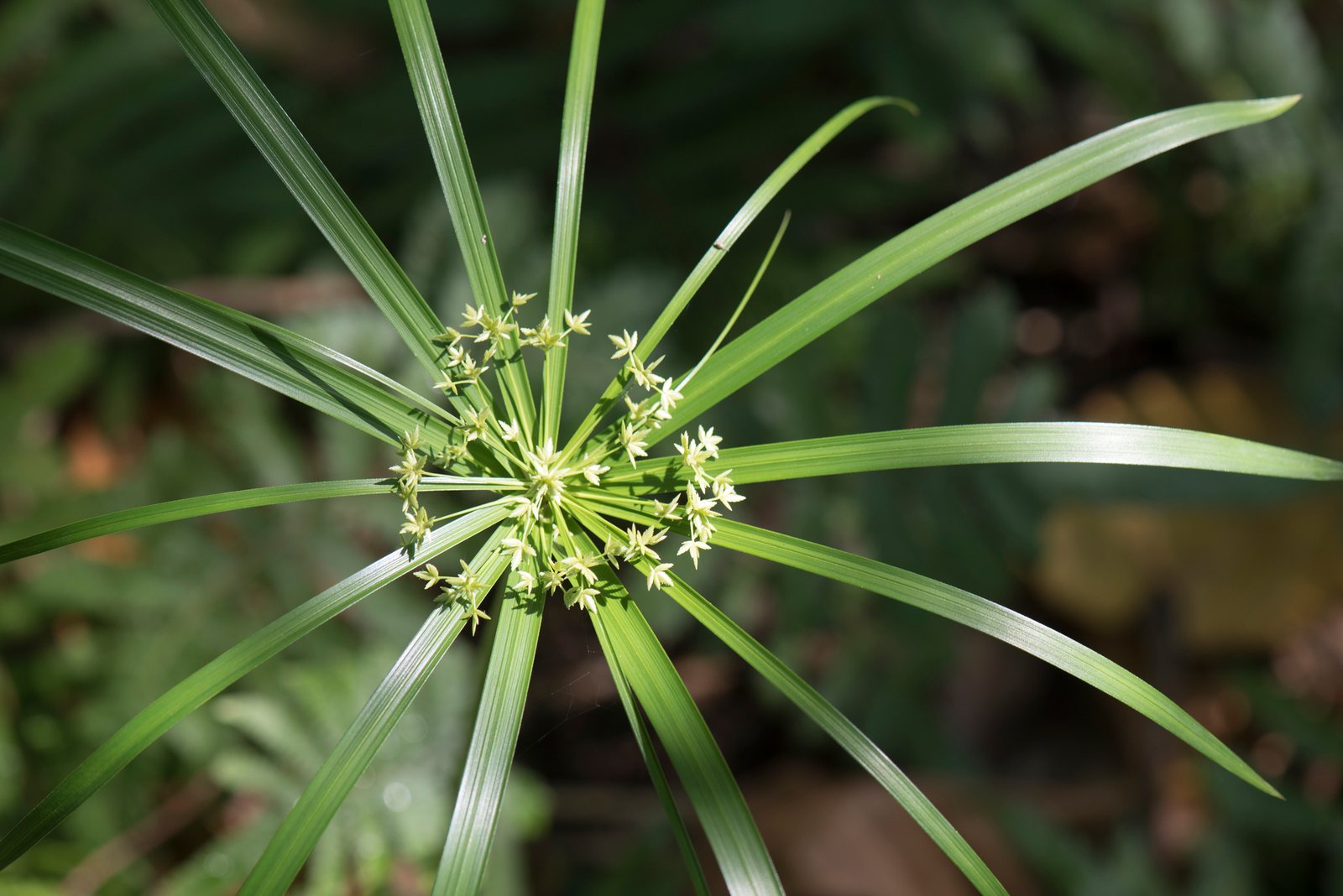
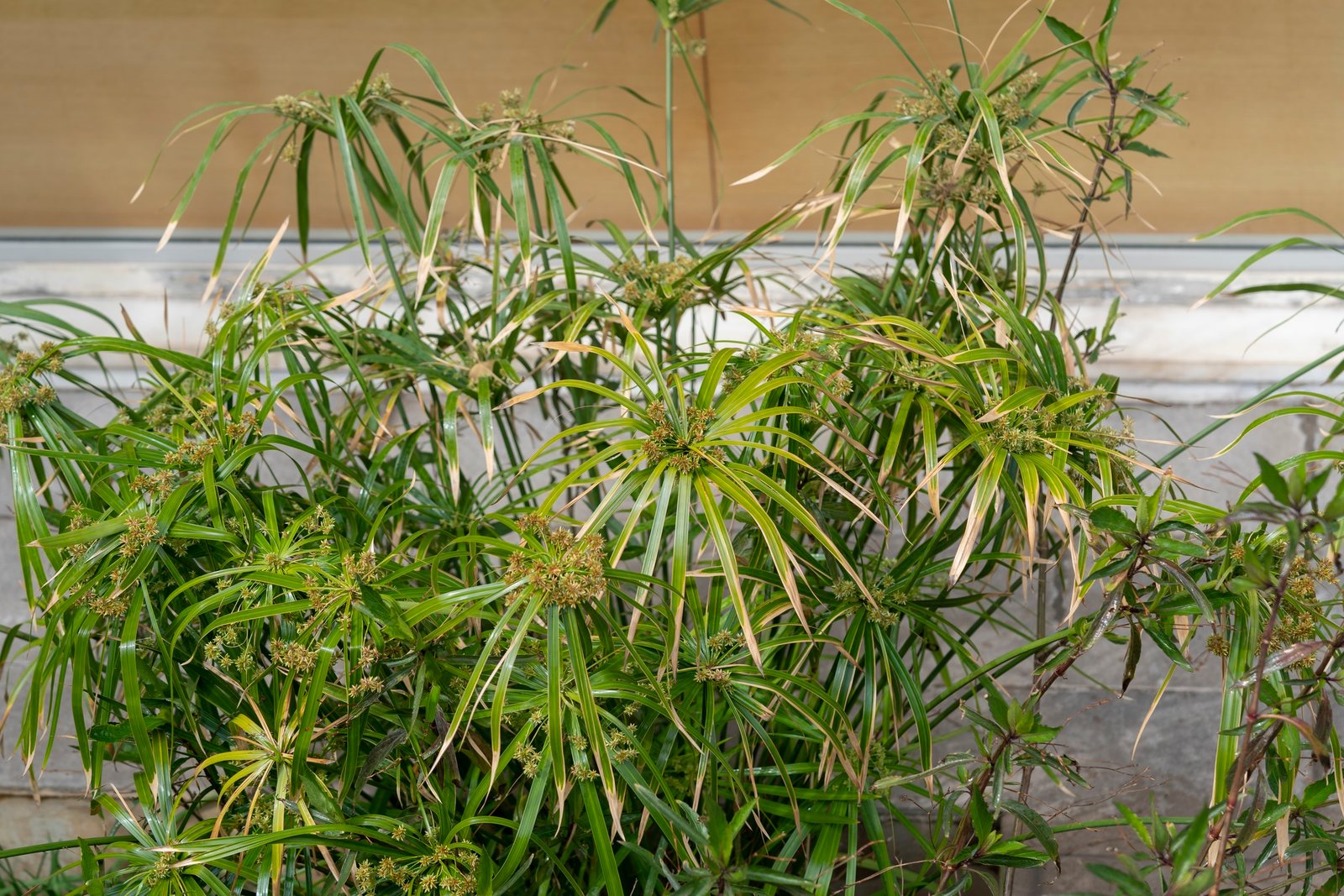
Umbrella papyrus is a clump-forming wetland sedge with upright stems topped by spoke-like whorls of green, leaf-like bracts. Gardeners grow it for its architectural shape beside ponds and in water-filled containers. It is evergreen in frost-free climates; elsewhere, grow it as a seasonal container plant and overwinter it indoors.
At a glance
- Sun
- Full sun to partial shade; light afternoon shade is useful in very hot climates.
- Water
- Keep constantly moist to wet. Established plants tolerate shallow standing water; never let container compost dry out.
- Soil
- Rich, moisture-retentive loam or aquatic planting soil; tolerates heavy soil and a broad range of pH.
- Height
- 3-6 ft (0.9-1.8 m)
- Spread
- 2-3 ft (0.6-0.9 m), widening through rhizomes
- Flowers
- Summer to autumn; small greenish flowers mature to brown in clusters above the umbrella-like bracts.
- Foliage
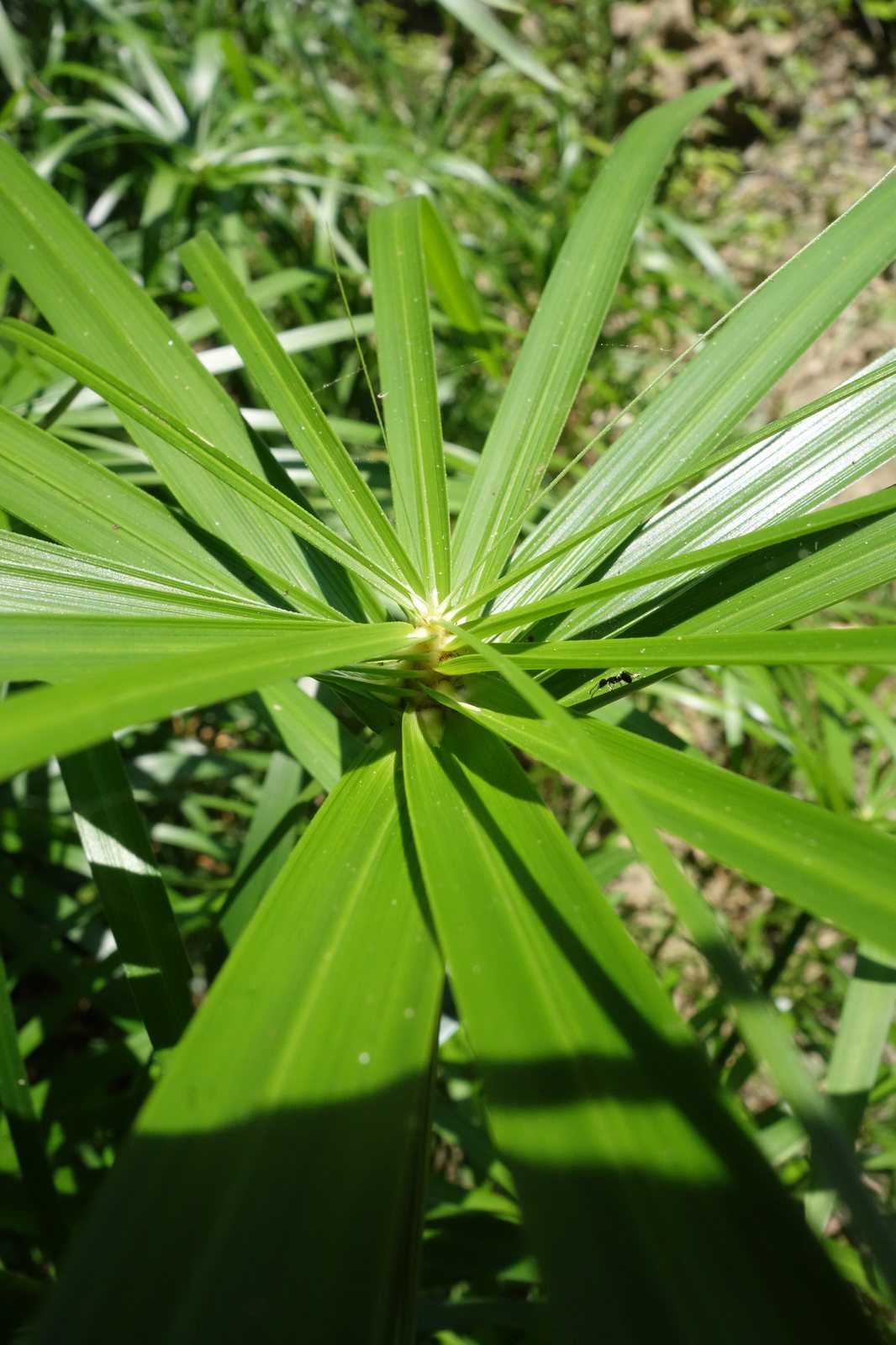
- Evergreen. Upright, mostly leafless green stems carry flattened, narrow green bracts arranged like umbrella spokes.
- Growth
- Fast in warm, wet conditions.
- Care needed
- Medium
The year at a glance
- Heat tolerant
- Wildlife
| J | F | M | A | M | J | J | A | S | O | N | D | |
|---|---|---|---|---|---|---|---|---|---|---|---|---|
| Plant |
Northern hemisphere months. In Australia, shift them by six.
- Difficulty
- Moderate
- Toughness
- Needs looking after
Will it suit your garden?
Pick your zone, country, light and whether you have pets.
Full sun is 6 or more hours of direct sun a day, part shade 3 to 6 hours, shade under 3.
How it grows
Planting day
1 ft (0.3 m)
After 1 year
2.8 ft (0.84 m)
After 2 years
4 ft (1.4 m)
full size
About 2 years to full size.
From a typical nursery size, at an average rate for this kind of plant. A rule of thumb, not a forecast.
Good to know
- Cats and dogs
- Mildly toxic: may upset a stomach
- Invasive in
- the US and Australia
- In the garden
- Spreads vigorously: plan to contain it.
- Growth rate
- Fast
Care
Jobs through the year
- WaterMay–Sep
- Keep established roots constantly wet in saturated soil or shallow water; check container reservoirs daily.
- WaterJan–Apr, Oct–Dec, every 3 days
- In frost-free winter shelter, check and replenish water so the root ball never dries.
- FeedMay–Sep, every 30 days
- Feed actively growing containers with balanced liquid fertiliser; use an aquatic product in ponds.
- DivideApr–May
- Divide congested clumps and replant immediately into wet soil.
- PruneJan–Dec, every 30 days
- Cut yellow, brown or broken stems at the base; do not shorten healthy umbrella stems.
- ProtectSep–Oct
- Move containers indoors before frost, providing bright light and preferably temperatures above 10°C.
- ProtectMay–Jun
- Return plants outdoors after frost danger, acclimatising gradually; use solid containers to contain spreading roots.
- Keep the root ball wet; stand containers in a deep saucer of water and replenish it frequently.
- For pond growing, position the crown at water level or under up to 4 in (10 cm) of water.
- Feed container plants monthly with a balanced liquid fertiliser during active growth; use aquatic fertiliser in ponds.
- Divide crowded clumps in spring and replant the divisions promptly into wet soil.
- Move containers indoors before frost and keep them in bright light, preferably above 50°F (10°C).
- Use a solid container where spreading roots could escape into drains or natural waterways.
Pruning. Cut yellow, brown or broken stems off at the base whenever they appear; shortened stems do not regain their umbrella tops. In spring, remove any winter-killed growth once new shoots emerge.
Through the year
- Spring
- Divide congested plants and repot into larger, watertight containers if needed.
- Late spring
- Move overwintered plants outside after frost danger has passed, gradually increasing their exposure to sun.
- Summer
- Check water levels frequently and feed actively growing container plants monthly.
- Late summer
- Remove flower clusters before seeds ripen where escape or self-seeding is a concern.
- Autumn
- Bring containers under cover before frost in cold climates.
- Winter
- Keep sheltered plants bright and wet, stop routine feeding, and remove dead stems.
In the garden
- Use a contained clump at a pond edge to add height without a dense screen.
- Place in a watertight courtyard container as a simple architectural focal point.
- Combine with cannas and elephant ears for contrasting leaf shapes in a wet tropical-style planting.
- Repeat containers beside a terrace or water feature for a rhythmic, upright accent.
Garden styles it suits: Architectural minimal, Modern tropical, Tropical, Bog garden, Modern courtyard and Green on green.
Plant it with: Canna, Elephant ears, Pickerelweed, Japanese iris, Water lilies and Soft rush.
Wildlife: Dense clumps provide cover and resting places for small pond animals and insects. The flowers are wind-pollinated and are not a significant nectar source.
Problems to watch for
- Brown tips and collapsing stems usually follow drying out: soak the root ball and maintain a steady water supply.
- Spider mites can cause pale, stippled growth indoors: rinse stems and bracts thoroughly and treat persistent infestations with insecticidal soap according to its label.
- Aphids may gather on tender shoots: wash them off with water or use insecticidal soap.
- Frost blackens stems and can kill the roots in containers: move plants into frost-free shelter before cold weather.
Safety
Safety information for umbrella sedges is inconsistent, partly because several unrelated plants share the common name. Treat stems, bracts and roots as potentially harmful to cats and dogs if eaten; vomiting or diarrhoea may occur. Toxicity to horses and people is not well established, so do not use it as food or animal forage.
Where it spreads. Spreads by rhizomes and seed and can form dense colonies in wet ground. It is invasive in Hawaii and parts of Florida, and is an environmental weed in parts of Australia, including Queensland and New South Wales. Keep it contained and never discard plants or seed heads into waterways.
Easily confused with
Papyrus (Cyperus papyrus)
Usually much taller, with large, airy heads of numerous fine, thread-like rays rather than a simple whorl of broad, flat bracts.
Dwarf umbrella sedge (Cyperus albostriatus)
Usually shorter and has conspicuous broad leaves near the base as well as broad bracts around its flower heads.
The name
The species name involucratus refers to the whorl of bracts surrounding the flower clusters, which also gives the plant its umbrella-like appearance.
Propagation. Divide rooted clumps in spring. Alternatively, cut a healthy stem with its umbrella intact, shorten the bracts, and place the umbrella upside down in water with the stem pointing upward; plant it once rooted shoots develop.
Checked against open data
- Accepted botanical name
- Cyperus involucratus
- In the US and Canada
- Introduced in Hawaii, the lower 48 states, Pacific Basin, Puerto Rico and US Virgin Islands.
Sources: GBIF (CC BY 4.0) and USDA PLANTS. The care and design notes are LandscapeGPT's own.
See it in your own yard.
Upload a photo of your yard and see it redesigned with plants that suit your climate, each checked against your zone.