Wedding cake tree
Cornus controversa 'Variegata'. Family Cornaceae. Tree.
Also called Variegated giant dogwood, Variegated table dogwood.
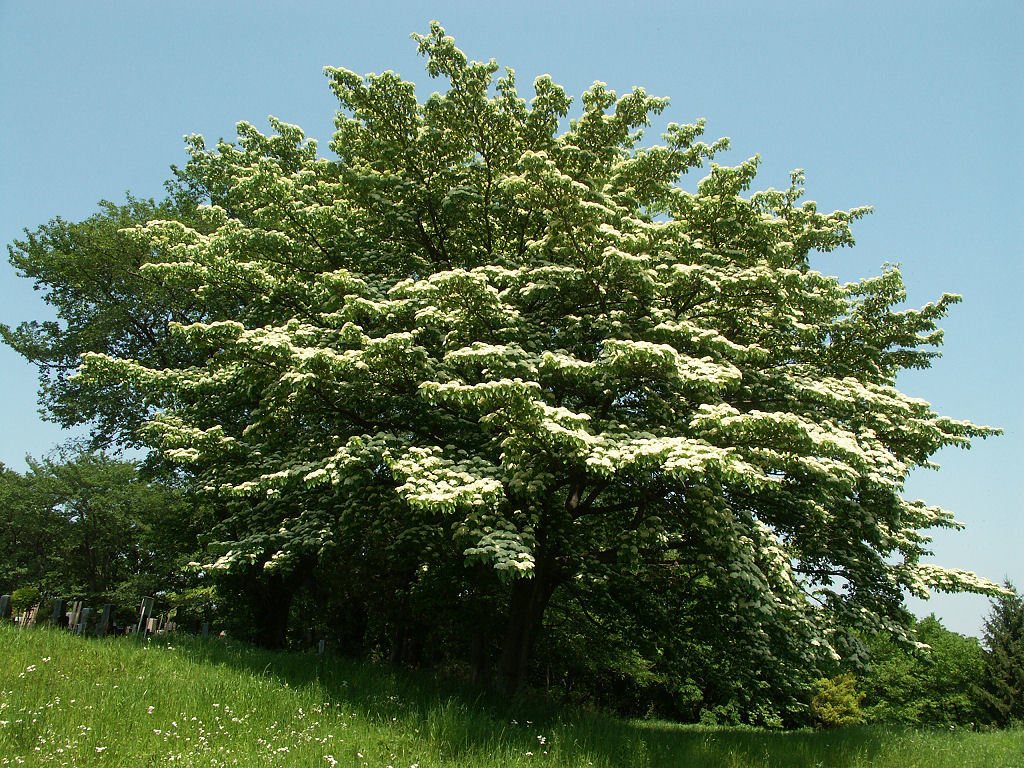
This deciduous dogwood forms distinct tiers of horizontal branches, with cream-edged leaves that give the canopy a light, layered appearance. Grow it as a specimen with room for its branches to spread naturally; it performs best in cool to moderate climates with dependable soil moisture.
At a glance
- Sun
- Full sun to partial shade; light afternoon shade helps prevent leaf scorch in warmer areas.
- Water
- Keep the root zone evenly moist but not waterlogged. Water deeply during dry spells, especially while establishing.
- Soil
- Fertile, humus-rich, well-drained soil, preferably slightly acidic to neutral. Avoid drought-prone sand, shallow chalk and persistently waterlogged ground.
- Height
- 20-30 ft (6-9 m), occasionally taller with age
- Spread
- 20-30 ft (6-9 m)
- Flowers
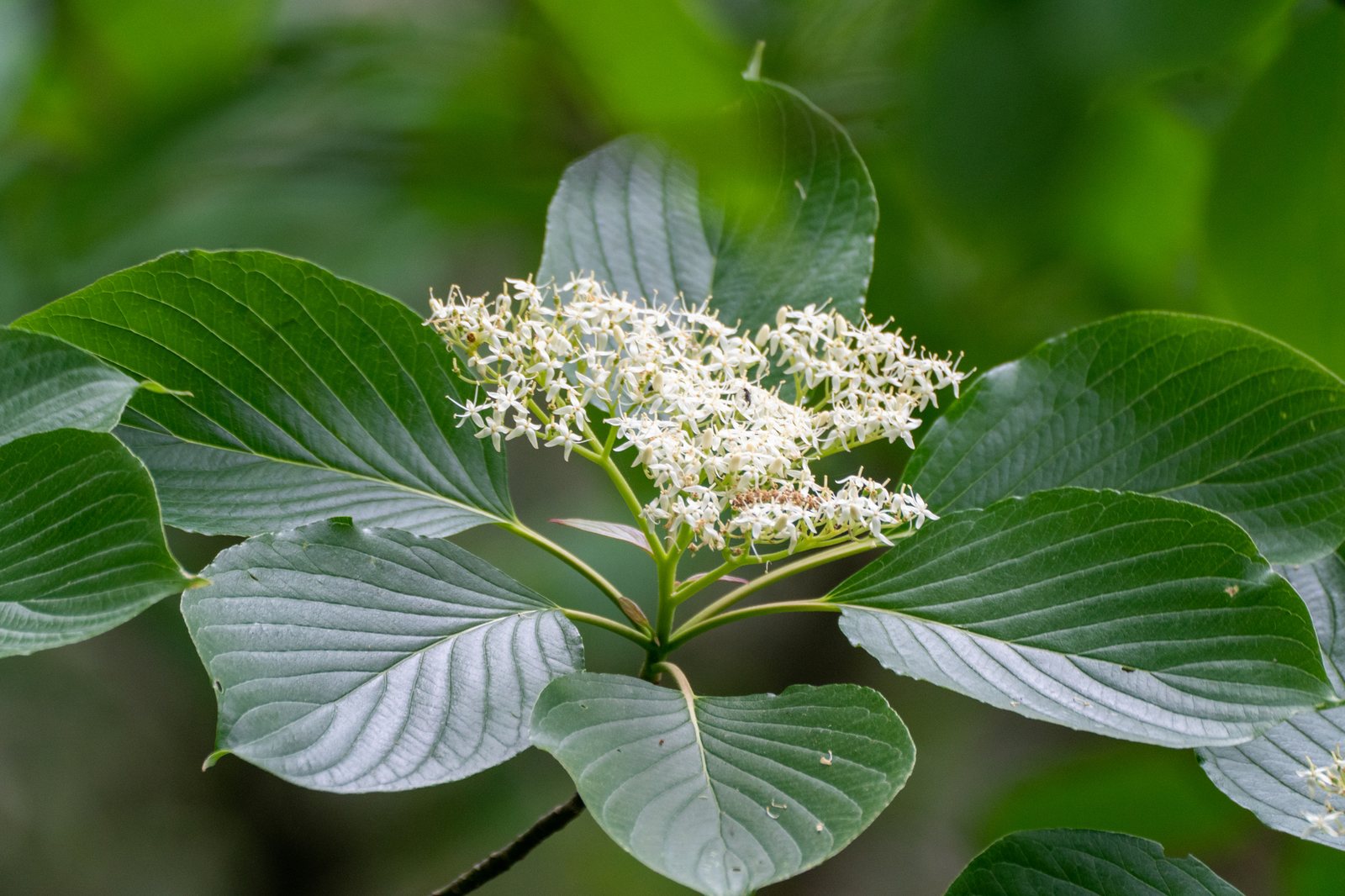
- Late spring to early summer; small creamy-white flowers in broad, flat clusters.
- Foliage
- Broad green leaves with irregular creamy-white margins, arranged alternately along the branches; autumn colour may include pink, red and purple.
- Growth
- Slow to moderate; the tiered framework takes several years to develop.
- Care needed
- Medium
The year at a glance
- Pollinators
- Wildlife
- Low allergen
| J | F | M | A | M | J | J | A | S | O | N | D | |
|---|---|---|---|---|---|---|---|---|---|---|---|---|
| Flowers | ||||||||||||
| Fruit | ||||||||||||
| Plant |
Northern hemisphere months. In Australia, shift them by six.
- Difficulty
- Moderate
- Toughness
- Fairly tough
Will it suit your garden?
Pick your zone, country, light and whether you have pets.
Full sun is 6 or more hours of direct sun a day, part shade 3 to 6 hours, shade under 3.
How it grows
Planting day
7 ft (2 m)
After 1 year
7 ft (2.2 m)
After 2 years
8 ft (2.4 m)
After 3 years
9 ft (2.6 m)
After 5 years
10 ft (3.1 m)
About 26 years to full size.
From a typical nursery size, at an average rate for this kind of plant. A rule of thumb, not a forecast.
Good to know
- Cats and dogs
- Safe
- Growth rate
- Slow
Care
Jobs through the year
- WaterApr–May, Sep–Oct, every 14 days
- Water established trees deeply during dry spells; young trees need more frequent watering for two to three years.
- WaterJun–Aug, every 7 days
- Soak the root zone during dry weather to prevent scorch; avoid watering wet soil.
- MulchMar
- Top-dress with compost and maintain 5–8 cm of mulch, clear of the trunk.
- FeedMar–Apr
- Use fertilizer only if growth is weak and soil fertility is low.
- PruneMay–Sep
- Remove entirely green reverted shoots at their origin as soon as noticed.
- PruneJan, Nov–Dec
- In dry, frost-free weather, remove only damaged or crossing branches without disrupting the tiers.
- ProtectJan–Feb, Nov–Dec
- Check young trees after strong winds and loosen tight supporting ties.
- Plant where the full canopy can spread without regular cutting back.
- Water deeply during dry weather for the first two to three growing seasons, and during prolonged drought thereafter.
- Apply a 2-3 in (5-8 cm) organic mulch over the root area, keeping it clear of the trunk.
- Top-dress with compost in spring; use fertiliser only if growth is weak and soil fertility is low.
- Stake only if the root ball moves in wind, using a low, flexible tie; remove the stake once the roots hold firmly.
Pruning. Prune sparingly in late autumn to midwinter, during dry, frost-free weather, removing dead, damaged or crossing branches without disturbing the horizontal tiers. Cut any entirely green reverted shoots back to their point of origin as soon as you notice them.
Through the year
- Early spring
- Check ties and renew mulch without piling it against the trunk.
- Late spring
- Check new growth for entirely green reverted shoots and remove them at their origin.
- Summer
- Water deeply during dry spells and watch for browning leaf margins.
- Autumn
- Plant while the soil is moist and workable, avoiding frozen or waterlogged conditions.
- Late autumn
- Inspect the bare framework and remove only dead, damaged or badly crossing branches.
- Winter
- Check newly planted trees after strong winds and loosen any tight ties.
In the garden
- Use as a lawn specimen with open space around it so the horizontal branch tiers remain visible.
- Place at a woodland edge above shade-tolerant perennials, keeping taller shrubs away from the lower branches.
- Set against dark evergreen planting to make the cream leaf margins stand out.
- Use beside a broad path or seating area as a focal point, allowing for its mature spread.
Garden styles it suits: Architectural minimal, Woodland, Japanese, English country, White garden and Pacific Northwest woodland.
Plant it with: Japanese painted fern, Hosta, Hellebore, Japanese forest grass, Siberian bugloss and Snowdrop.
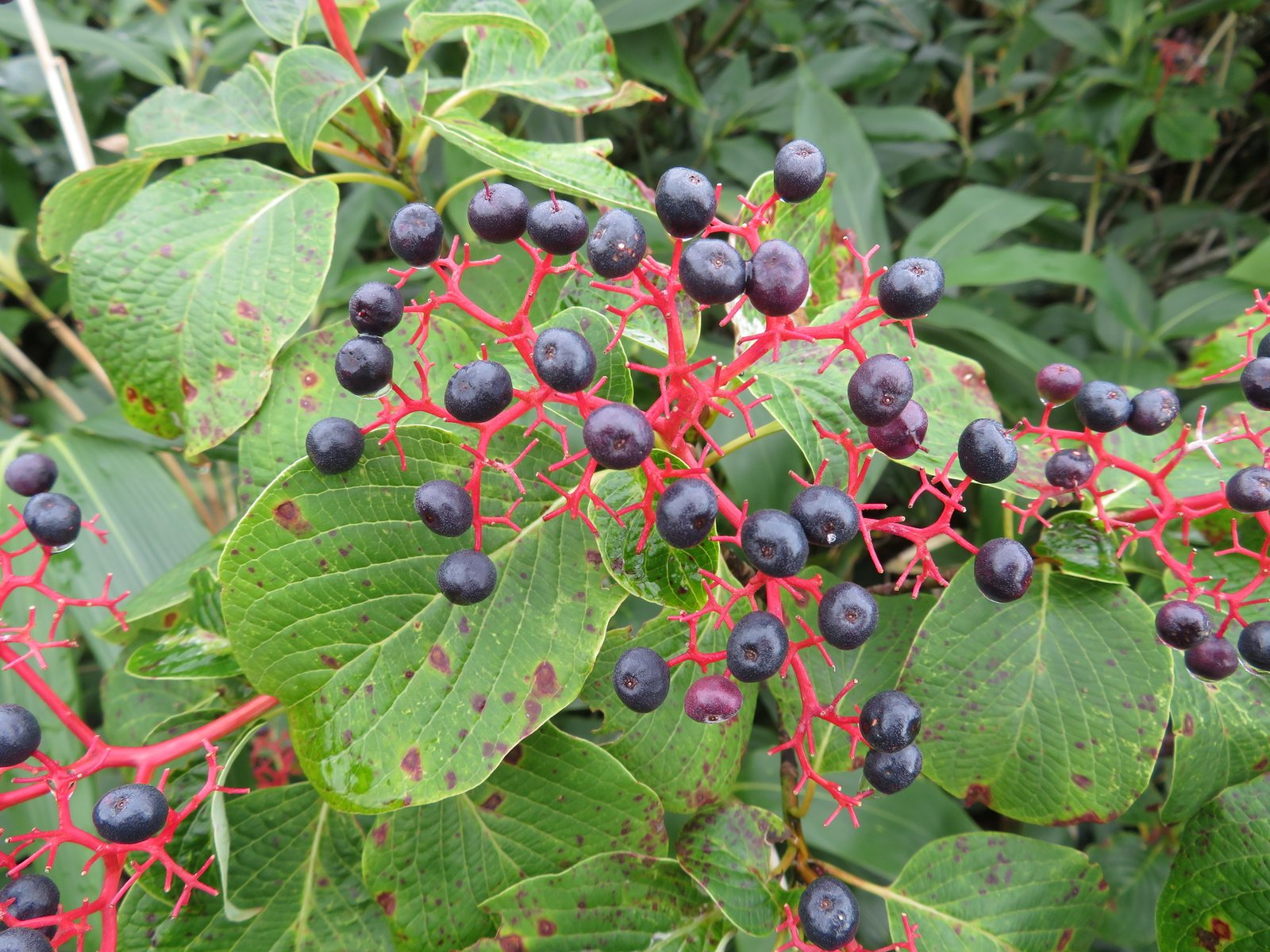
Wildlife: Flower clusters provide pollen and nectar for visiting insects. Small blue-black fruits, when produced, are eaten by birds, and the branching canopy provides shelter.
Problems to watch for
- Leaf scorch: brown margins often follow drought, hot wind or strong afternoon sun; water deeply, mulch and provide a sheltered position.
- Green reversion: vigorous shoots with plain green leaves can overwhelm the variegated growth; remove them completely at their origin.
- Powdery mildew: improve airflow without heavily thinning the tree, avoid excess nitrogen and collect badly affected fallen leaves.
- Cankers and branch dieback: remove affected branches back to healthy wood in dry weather, disinfect tools between cuts and correct drought or drainage stress.
Safety
Not known to be toxic to people, cats, dogs or horses, although information specific to this cultivar is limited. The fruits are not a recommended human food; eating plant material may cause digestive upset.
Easily confused with
Variegated pagoda dogwood (Cornus alternifolia 'Argentea')
Also has cream-edged, alternate leaves and tiered branches, but usually forms a smaller tree or large shrub with smaller leaves.
Giant dogwood (Cornus controversa)
The unvariegated species has the same layered habit and alternate leaves, but its foliage is green without cream margins.
Kousa dogwood (Cornus kousa)
Has opposite leaves and conspicuous four-pointed white or pink flower bracts, followed by rounded red fruits; wedding cake tree has alternate leaves and flat clusters of small flowers.
The name
The common name refers to the stacked, spreading branch tiers resembling a wedding cake, while 'Variegata' describes the cream-marked foliage.
Propagation. Usually propagated by grafting or budding onto suitable dogwood rootstock; this is specialist work. Seedlings do not reliably retain the cream-edged foliage or other cultivar characteristics.
Checked against open data
- Accepted botanical name
- Cornus controversa
- Native range
- China North-Central, China South-Central, China Southeast, East Himalaya, Hainan, Japan, Korea, Kuril Is., Manchuria, Myanmar, Nepal and Taiwan.
- Measured
- Average height 1005 cm.
Sources: GBIF (CC BY 4.0) and Trefle (CC BY 4.0). The care and design notes are LandscapeGPT's own.
See it in your own yard.
Upload a photo of your yard and see it redesigned with plants that suit your climate, each checked against your zone.