Winter jasmine
Jasminum nudiflorum. Family Oleaceae. Shrub.
Also called Winter-flowering jasmine.
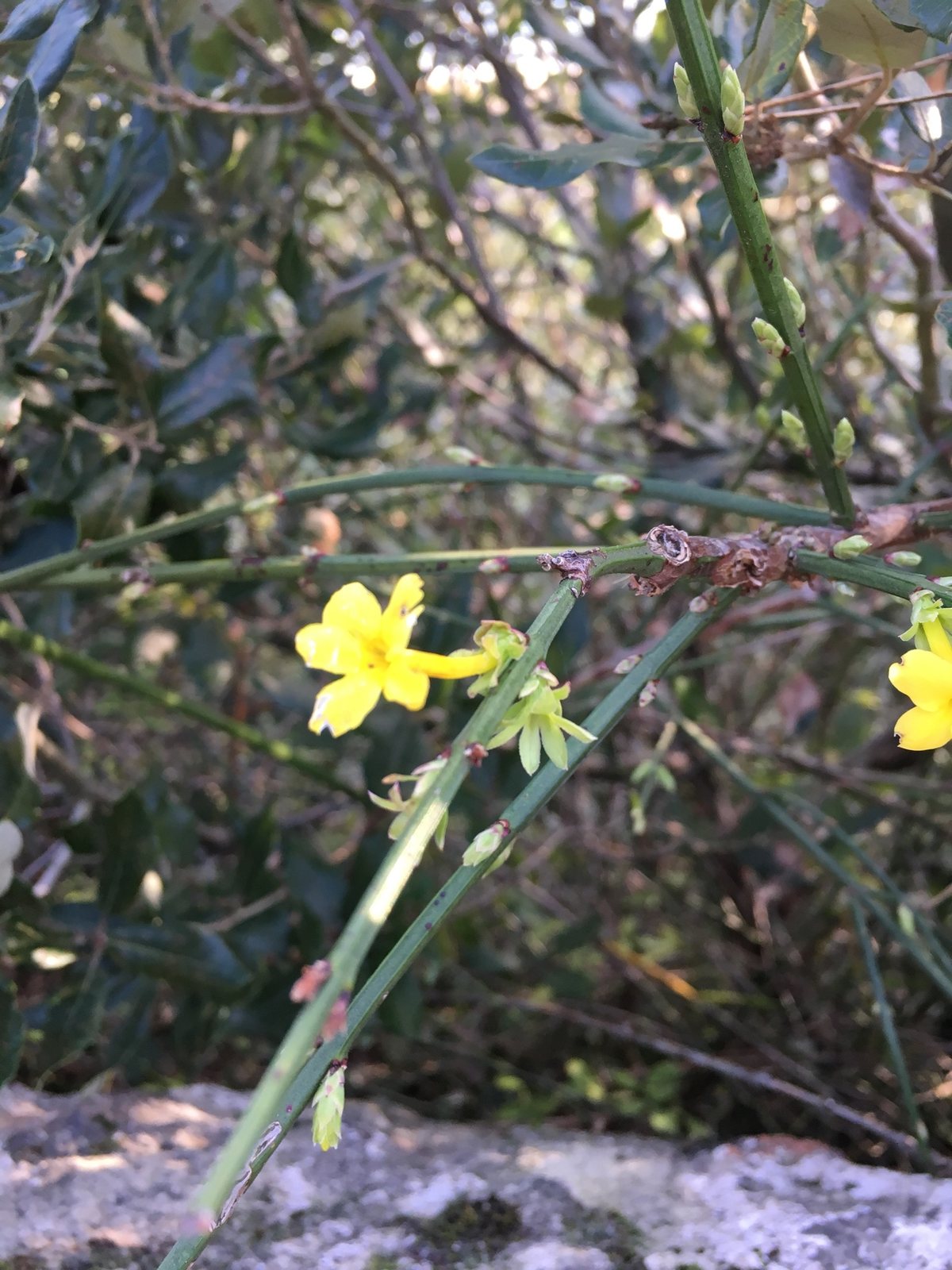
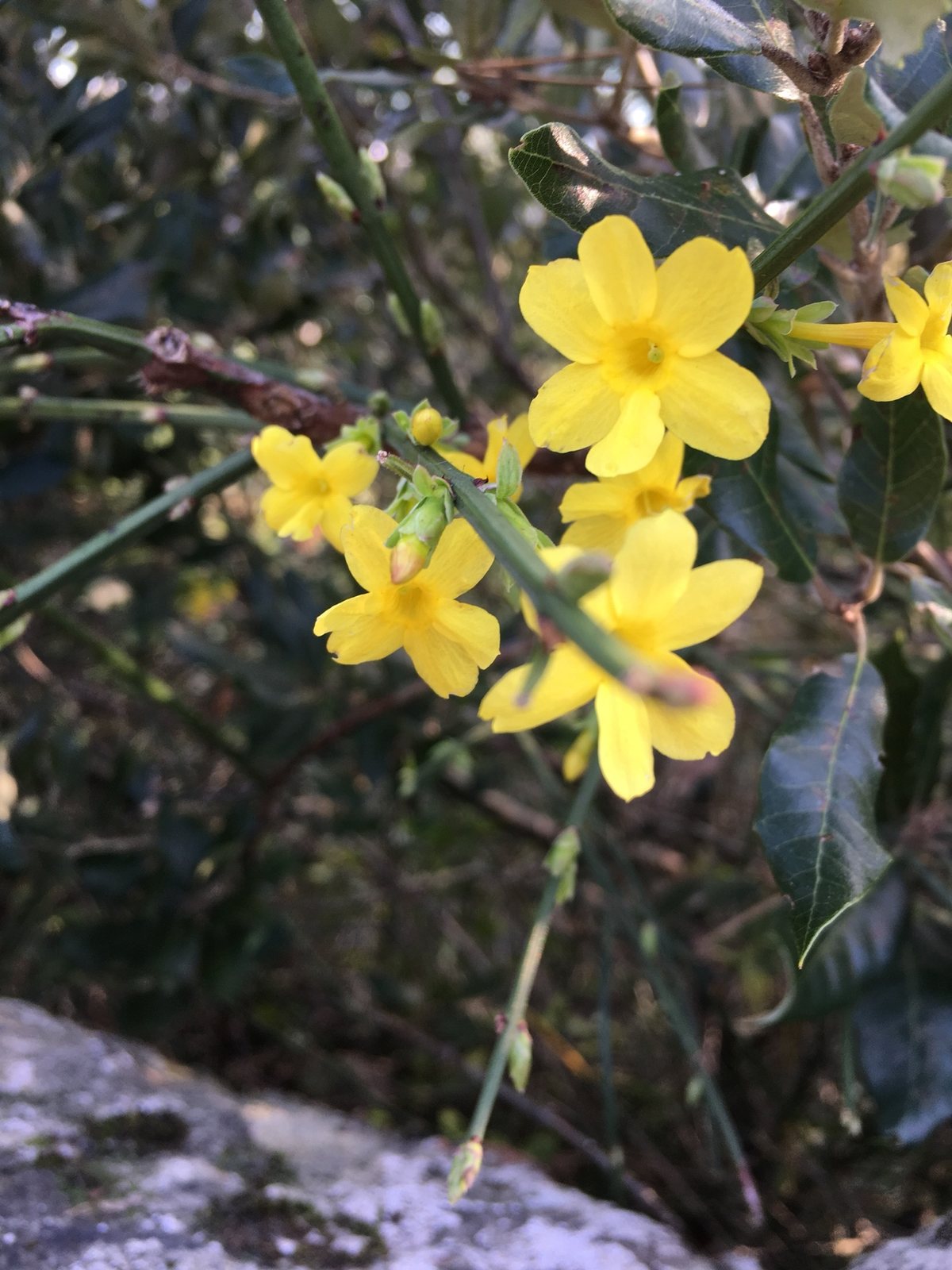
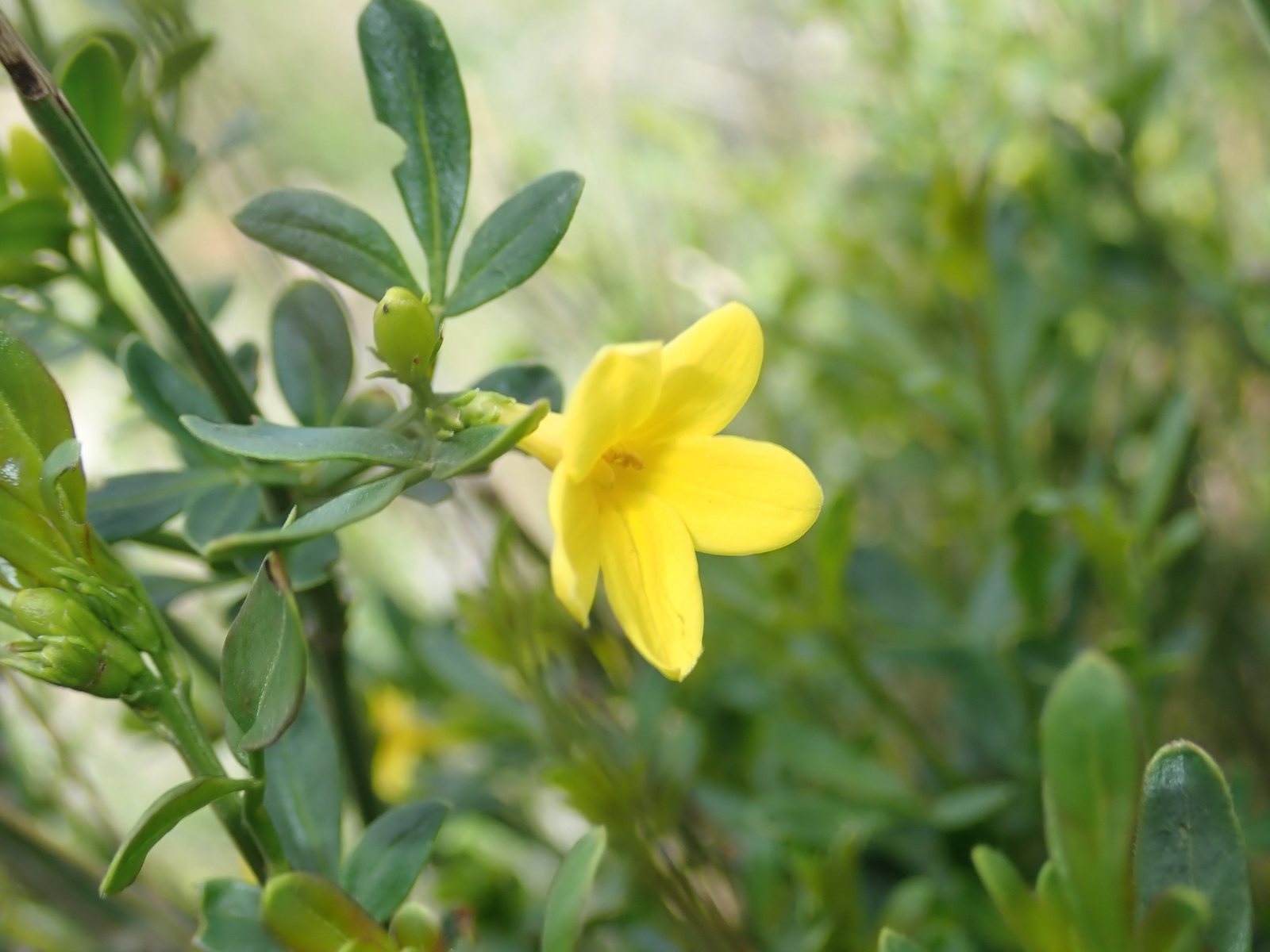
Winter jasmine is a deciduous shrub with long, arching green stems and bright yellow flowers on bare branches in winter and early spring. Grow it spilling over a wall, covering a bank or tied to supports; it does not climb by itself, and its flowers are not fragrant.
At a glance
- Sun
- Full sun to partial shade; flowering is best in sun.
- Water
- Water regularly during the first growing season. Established plants tolerate some drought, but benefit from deep watering during prolonged dry spells.
- Soil
- Most well-drained soils, including chalk, clay and loam; tolerates acidic to alkaline conditions. Avoid persistently waterlogged ground.
- Height
- 3-4 ft (0.9-1.2 m) unsupported; 10-15 ft (3-4.6 m) when trained against a wall
- Spread
- 6-10 ft (1.8-3 m), potentially wider where stems root into the ground
- Flowers
- Yellow flowers in winter and early spring, sometimes beginning in late autumn in mild climates; flowering is later and may be reduced in cold regions.
- Foliage
- Small, dark green leaves divided into three leaflets; leaves fall in autumn, leaving slender green stems visible.
- Growth
- Moderate to fast once established
- Care needed
- Low
The year at a glance
- Pollinators
- Deer resistant
- Drought tolerant
- Heat tolerant
- Low allergen
| J | F | M | A | M | J | J | A | S | O | N | D | |
|---|---|---|---|---|---|---|---|---|---|---|---|---|
| Flowers | ||||||||||||
| Plant |
Northern hemisphere months. In Australia, shift them by six.
- Difficulty
- Easy
- Toughness
- Very tough
Will it suit your garden?
Pick your zone, country, light and whether you have pets.
Full sun is 6 or more hours of direct sun a day, part shade 3 to 6 hours, shade under 3.
How it grows
Planting day
1.6 ft (0.5 m)
After 1 year
2.1 ft (0.64 m)
After 2 years
2.5 ft (0.78 m)
After 3 years
3 ft (0.91 m)
After 5 years
3 ft (1.1 m)
full size
About 4 years to full size.
From a typical nursery size, at an average rate for this kind of plant. A rule of thumb, not a forecast.
Good to know
- Cats and dogs
- Safe
- Growth rate
- Fast
Care
Jobs through the year
- WaterApr–May, Sep–Oct, every 21 days
- Water established plants only during prolonged dry spells; new plants need more frequent watering.
- WaterJun–Aug, every 14 days
- Water deeply during prolonged drought, letting surface soil dry between waterings.
- MulchMar–Apr
- Apply compost or leaf mould around the roots, keeping main stems clear.
- PruneMar–Apr
- Immediately after flowering, shorten flowered shoots and remove a few old stems from crowded plants.
- PruneJun–Aug
- Lift or cut shoots touching the soil to prevent unwanted rooting.
- FeedApr
- Feed lightly only if growth is weak; avoid excess nitrogen.
- Water deeply during dry weather in the first growing season, allowing the soil surface to dry between waterings.
- Apply a spring mulch of compost or leaf mould, keeping it clear of the main stems.
- Tie stems loosely to wires or a trellis if you want upright coverage; they neither twine nor cling.
- Lift or cut back stems that touch the soil if you do not want them to root and spread.
- Feed only if growth is weak; avoid heavy nitrogen feeding, which encourages leafy growth rather than flowers.
Pruning. Prune immediately after flowering, shortening flowered shoots to strong young growth and removing dead, crowded or badly placed stems. On older plants, cut a few of the oldest stems to the base each year; hard renovation pruning sacrifices some of the following winter's display.
Through the year
- Winter
- Enjoy the flowers and check that ties and supports remain secure after storms.
- Early spring
- Once flowering finishes, prune flowered shoots and remove a few old stems from congested plants.
- Spring
- Mulch with compost and water newly planted shrubs during dry weather.
- Summer
- Tie in new stems and remove unwanted shoots rooting into nearby soil.
- Late summer
- Take semi-ripe cuttings from healthy, non-flowering shoots.
- Autumn
- Plant while soil is workable and moist, or wait until spring in colder regions.
In the garden
- Train against a sunny wall or fence for winter flowers and a framework of green stems.
- Let stems cascade over a retaining wall to soften its edge.
- Use on a broad bank where rooting stems can provide informal ground cover.
- Combine with hellebores, snowdrops and early bulbs near a path where winter flowers are easy to see.
Garden styles it suits: Winter interest, Cottage garden, English country, Traditional, Low-maintenance and Chinese scholar garden.
Plant it with: Snowdrops, Lenten roses, Crocuses, Daffodils, Bergenias and Witch hazel.
Wildlife: Open flowers can provide nectar and pollen for bees active during mild winter weather. Dense stems offer shelter, though this is not a major wildlife food plant.
Problems to watch for
- Few flowers: move or train growth into better light, avoid heavy nitrogen feeding, and prune after flowering rather than in autumn.
- Unwanted spread: stems root where they touch moist soil; lift them promptly or sever and remove rooted sections.
- Root decline in wet soil: improve drainage or move the plant to a better-drained position; do not keep the root zone saturated.
- Aphids on young shoots: wash them off with water and encourage natural predators; serious damage is uncommon.
Safety
Not known to be toxic to cats, dogs, horses or people. No part is generally recognised as poisonous, but it is not an edible plant and eating plant material may cause mild stomach upset.
Easily confused with
Forsythia (Forsythia × intermedia)
Forsythia usually flowers later, has four-lobed yellow flowers and simple leaves; winter jasmine usually has six-lobed flowers, three-part leaves and conspicuously green young stems.
Primrose jasmine (Jasminum mesnyi)
Primrose jasmine is evergreen or semi-evergreen in mild climates, with larger leaves and larger yellow flowers that are often semi-double; it is also less cold-hardy.
Carolina jessamine (Gelsemium sempervirens)
Carolina jessamine is a twining evergreen climber with simple leaves and fragrant, trumpet-shaped yellow flowers. Unlike winter jasmine, it is highly poisonous.
The name
The species name nudiflorum means 'naked-flowered', referring to flowers appearing on leafless stems, while winter jasmine describes its flowering season.
Propagation. Layer a low stem into moist soil and detach it once well rooted, or take semi-ripe cuttings in late summer. Naturally rooted stems can also be lifted and replanted.
Checked against open data
- Accepted botanical name
- Jasminum nudiflorum
- In the US and Canada
- Introduced in the lower 48 states.
- Native range
- China North-Central, China South-Central and Tibet.
- Measured
- Soil pH 6.5 to 7. Average height 150 cm.
Sources: GBIF (CC BY 4.0), USDA PLANTS and Trefle (CC BY 4.0). The care and design notes are LandscapeGPT's own.
See it in your own yard.
Upload a photo of your yard and see it redesigned with plants that suit your climate, each checked against your zone.