Witch hazel 'Jelena'
Hamamelis × intermedia 'Jelena'. Family Hamamelidaceae. Shrub.
Also called Copper Beauty witch hazel, Hybrid witch hazel 'Jelena'.
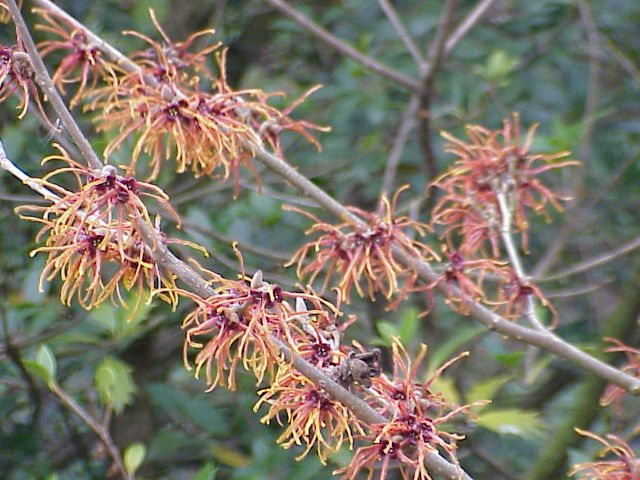
A broad, deciduous shrub grown for its copper-orange, ribbon-like flowers on bare branches in winter and its yellow, orange and red autumn leaves. Give it room to develop its spreading shape, preferably where you can see the flowers from a window or winter path.
At a glance
- Sun
- Full sun to partial shade; flowering is usually best in sun. In hotter climates, provide afternoon shade and shelter from drying winds.
- Water
- Keep the root zone evenly moist but not waterlogged. Water deeply during dry spells, especially for the first two growing seasons.
- Soil
- Humus-rich, moist, well-drained soil, preferably acidic to neutral. Avoid shallow chalky soil and sites that stay waterlogged.
- Height
- 10-15 ft (3-4.5 m)
- Spread
- 10-15 ft (3-4.5 m)
- Flowers
- Midwinter to early spring; copper-orange flowers with narrow, crinkled petals, sometimes lightly fragrant. Timing varies with climate, and petals curl inward during freezing weather.
- Foliage
- Broad, rounded green leaves with wavy edges, turning yellow, orange and red in autumn. Some dry leaves may remain into winter and partly obscure the flowers.
- Growth
- Slow to moderate; allow several years for it to establish and develop a broad framework.
- Care needed
- Low
The year at a glance
- Pollinators
- Wildlife
- Low allergen
- Fragrant
| J | F | M | A | M | J | J | A | S | O | N | D | |
|---|---|---|---|---|---|---|---|---|---|---|---|---|
| Flowers | ||||||||||||
| Fruit | ||||||||||||
| Plant |
Northern hemisphere months. In Australia, shift them by six.
- Difficulty
- Moderate
- Toughness
- Fairly tough
Will it suit your garden?
Pick your zone, country, light and whether you have pets.
Full sun is 6 or more hours of direct sun a day, part shade 3 to 6 hours, shade under 3.
How it grows
Planting day
1.6 ft (0.5 m)
After 1 year
3 ft (1 m)
After 2 years
5 ft (1.5 m)
After 3 years
7 ft (2 m)
After 5 years
10 ft (3 m)
About 7 years to full size.
From a typical nursery size, at an average rate for this kind of plant. A rule of thumb, not a forecast.
Good to know
- Cats and dogs
- Mildly toxic: may upset a stomach
- Growth rate
- Slow
Care
Jobs through the year
- WaterApr–May, Sep–Oct, every 14 days
- Water established shrubs deeply if soil is drying; keep new plants evenly moist for two years.
- WaterJun–Aug, every 7 days
- Water deeply in dry weather, skipping watering when the root zone remains moist.
- MulchMar–Apr
- Apply 5–8 cm of leaf mould or composted bark, clear of stems.
- PruneMar–Apr
- Prune only if needed immediately after flowering; avoid hard pruning or shearing.
- PruneMay–Sep
- Remove any shoots arising below the graft at their point of origin.
- FeedMar–Apr
- Give a light balanced shrub feed only if growth is weak.
- Plant with the root flare at soil level, leaving enough space for the mature spread.
- Water deeply during dry weather; do not let newly planted shrubs dry out.
- Apply 2-3 in (5-8 cm) of leaf mould or composted bark over the roots, keeping it clear of the stems.
- If growth is weak, apply a light dressing of balanced shrub fertiliser in spring; avoid heavy feeding.
- Remove shoots arising below the graft union, tracing them back to their point of origin.
Pruning. Prune only when needed, immediately after flowering, removing dead, damaged or crossing branches and lightly shortening misplaced shoots. Avoid routine shearing or hard pruning, which spoils the natural shape and reduces flowering.
Through the year
- Winter
- Enjoy the flowers; gently remove persistent dead leaves if they obscure the display and are easy to reach.
- Late winter to early spring
- After flowering, remove damaged or crossing branches if necessary.
- Spring
- Refresh the mulch and check for shoots growing from below the graft union.
- Summer
- Water deeply during dry spells, especially while the shrub is establishing.
- Autumn
- Plant while the soil is moist and workable, or wait until spring in areas with severe winters.
- Late autumn
- Check that mulch is clear of the stems and drainage is adequate before winter rain.
In the garden
- Use as a specimen beside a lawn, allowing space for its wide, open branches.
- Plant near a frequently used winter path or a window to make the cold-season flowers easy to see.
- Set against dark evergreen shrubs so the copper flowers stand out.
- Combine with snowdrops, hellebores and other low woodland plants beneath its deciduous canopy.
- Include in a mixed shrub border for both winter flowers and strong autumn colour.
Garden styles it suits: Woodland, Winter interest, Autumn colour, English country, Japanese and Sensory garden.
Plant it with: Snowdrops, Lenten roses, Winter aconites, Hardy cyclamen, Japanese maples and Camellias.
Wildlife: Flowers can provide pollen and nectar for insects active during mild winter weather, although visits depend on local conditions. The mature branching structure offers shelter for small birds.
Problems to watch for
- Leaf scorch or early leaf fall in drought: water deeply, maintain mulch and provide protection from hot, drying winds.
- Yellow leaves with green veins on alkaline soil: check soil pH; improve growing conditions, but relocate if the soil is strongly chalky rather than relying on repeated iron treatments.
- Root rot in waterlogged soil: improve drainage or move to a better-drained site; avoid watering soil that is already wet.
- Vigorous rootstock suckers on grafted plants: remove them at their origin before they overtake the named cultivar.
Safety
Not known to be toxic to people, cats, dogs or horses, although specific information for this cultivar is limited. It is an ornamental, not a food plant; avoid eating the leaves, bark or seeds, as ingestion may cause stomach upset.
Easily confused with
Witch hazel 'Diane' (Hamamelis × intermedia 'Diane')
Similar shape and flowering season, but its flowers are deep red rather than the copper-orange of 'Jelena'.
Witch hazel 'Arnold Promise' (Hamamelis × intermedia 'Arnold Promise')
Has bright yellow flowers and generally a more upright habit; it often flowers later than 'Jelena'.
American witch hazel (Hamamelis virginiana)
Usually flowers yellow in autumn, often while leaves are still present, rather than producing copper-orange flowers in winter.
The name
The cultivar name honours Jelena de Belder, the horticulturist associated with Arboretum Kalmthout in Belgium.
Propagation. Usually propagated by specialist grafting or budding to preserve the cultivar. Layering is possible but slow; cuttings are difficult to root, and seedlings will not reliably resemble 'Jelena'.
Checked against open data
- Accepted botanical name
- Hamamelis intermedia
Sources: GBIF (CC BY 4.0). The care and design notes are LandscapeGPT's own.
See it in your own yard.
Upload a photo of your yard and see it redesigned with plants that suit your climate, each checked against your zone.