Wonderful pomegranate
Punica granatum 'Wonderful'. Family Lythraceae. Shrub.
Also called Punica granatum 'Wonderful'.
A deciduous, often thorny shrub or small tree grown for orange-red flowers and large, red-skinned pomegranates with tart-sweet, deep red arils. 'Wonderful' is self-fertile and late-ripening, needing a long, hot growing season for good fruit; outdoor crops are unreliable in most of the United Kingdom and Canada.
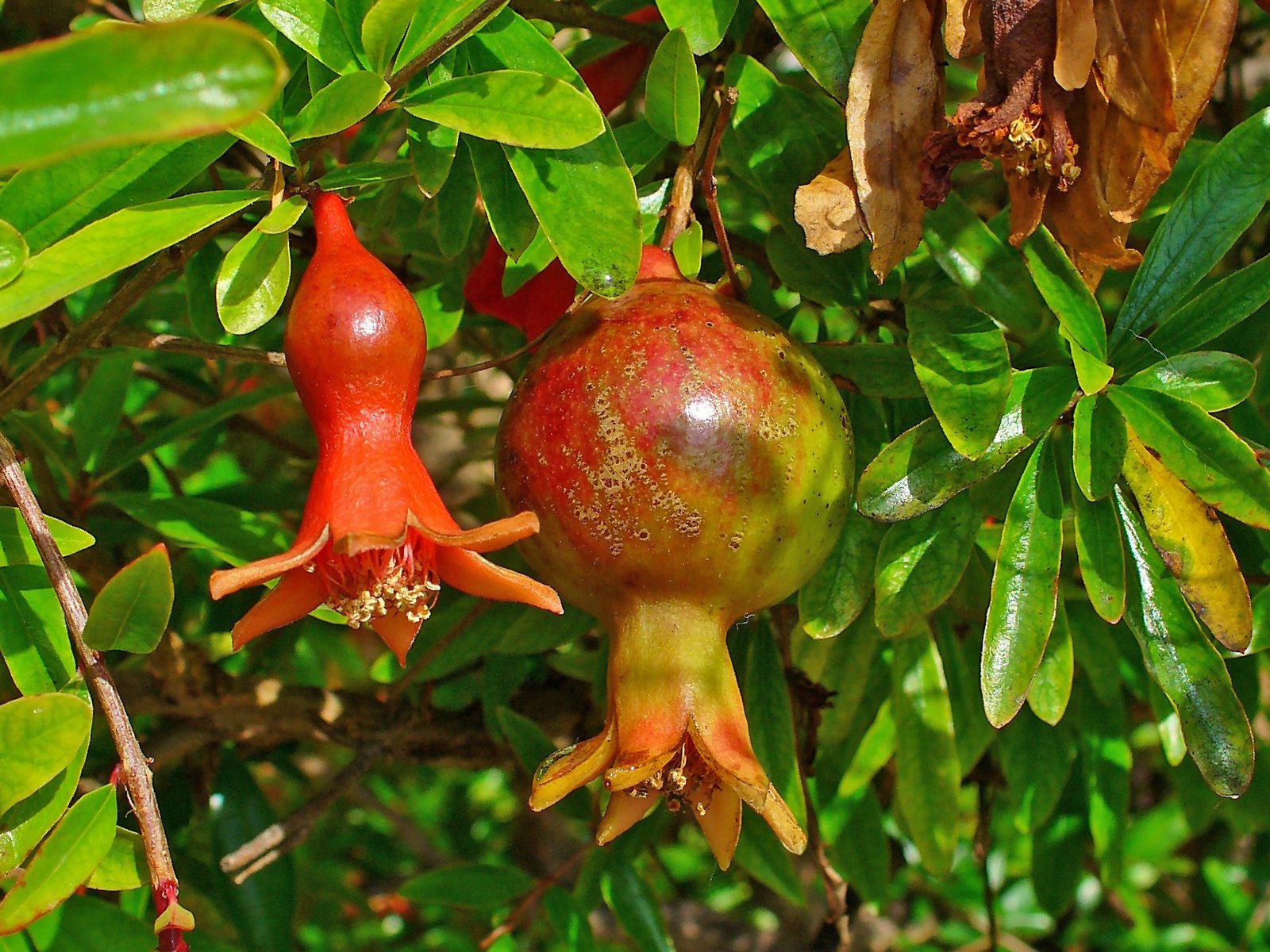
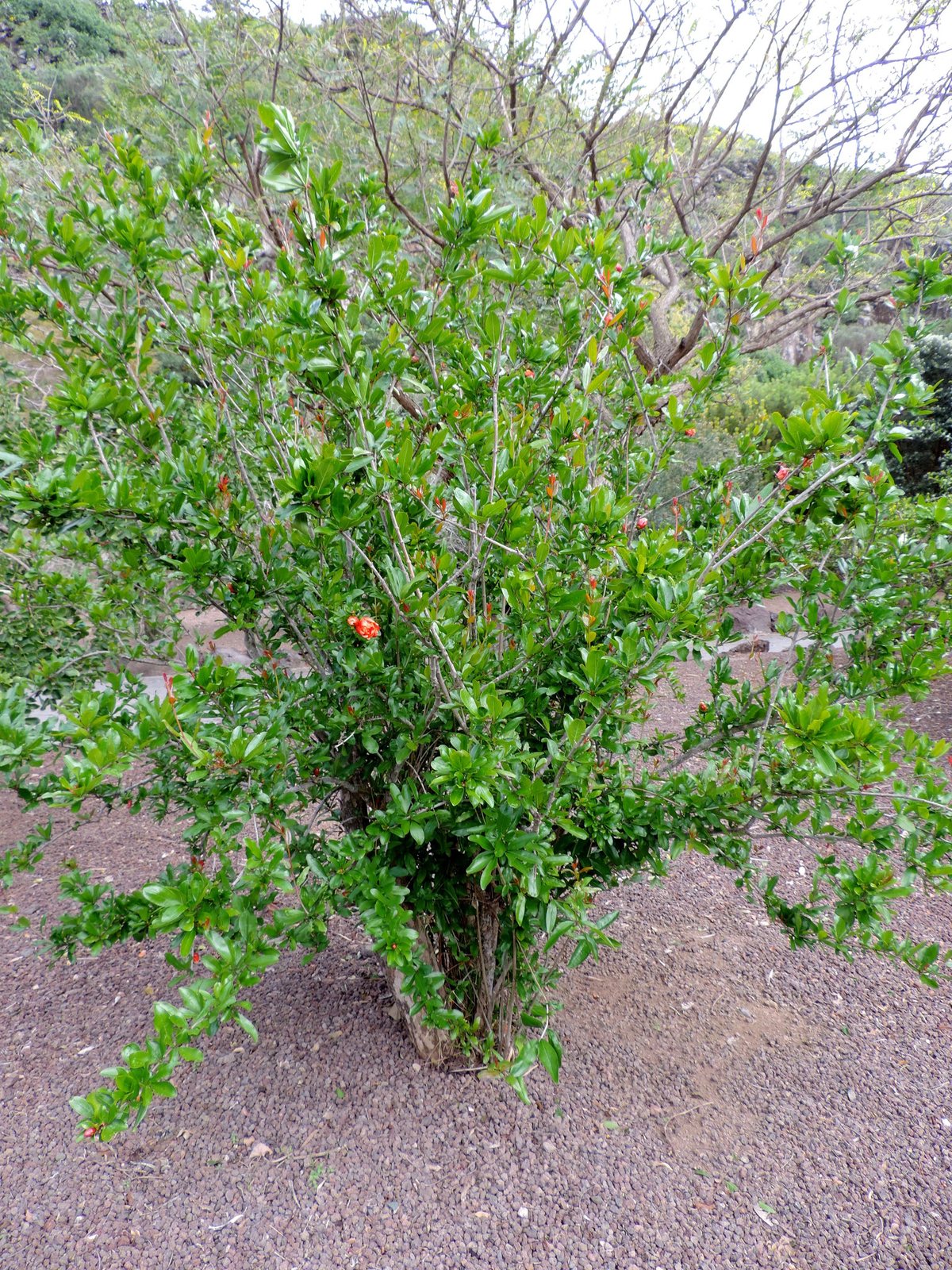
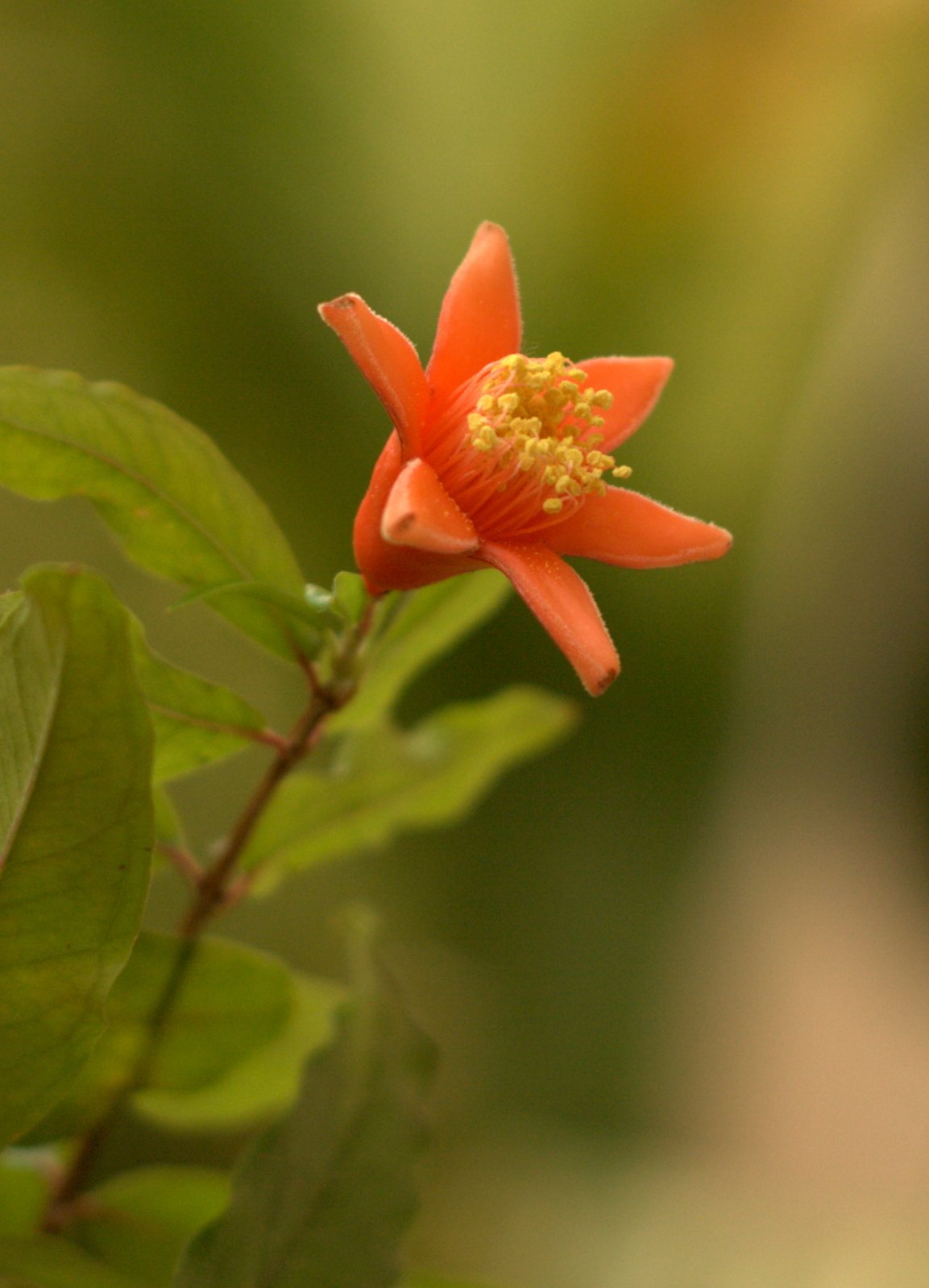
At a glance
- Sun
- Full sun; choose a sheltered position with reflected warmth in cooler climates.
- Water
- Water regularly while establishing and during fruit development, allowing the surface soil to dry between waterings. Established plants tolerate drought, but irregular watering can reduce fruit quality and encourage splitting.
- Soil
- Well-drained soil, including sandy, loamy or clay soil that does not remain waterlogged; tolerates moderately alkaline conditions.
- Height
- 12-20 ft (3.7-6.1 m)
- Spread
- 8-15 ft (2.4-4.6 m)
- Flowers
- Orange-red flowers from late spring through summer.
- Foliage
- Glossy, narrow green leaves, often bronze when young and yellow before falling in autumn.
- Growth
- Moderate, faster with warmth and regular water.
- Care needed
- Medium
The year at a glance
- Pollinators
- Drought tolerant
- Heat tolerant
- Wildlife
- Low allergen
- Edible
| J | F | M | A | M | J | J | A | S | O | N | D | |
|---|---|---|---|---|---|---|---|---|---|---|---|---|
| Flowers | ||||||||||||
| Fruit | ||||||||||||
| Plant |
Northern hemisphere months. In Australia, shift them by six.
- Difficulty
- Hard
- Toughness
- Fairly tough
Will it suit your garden?
Pick your zone, country, light and whether you have pets.
Full sun is 6 or more hours of direct sun a day, part shade 3 to 6 hours, shade under 3.
How it grows
Planting day
1.9 ft (0.59 m)
After 1 year
5 ft (1.7 m)
After 2 years
9 ft (2.7 m)
After 3 years
13 ft (3.8 m)
After 5 years
16 ft (4.9 m)
full size
About 4 years to full size.
From a typical nursery size, at an average rate for this kind of plant. A rule of thumb, not a forecast.
Good to know
- Cats and dogs
- Toxic
- Growth rate
- Fast
Care
Jobs through the year
- WaterApr–May, Sep–Oct, every 14 days
- Water established in-ground plants during dry spells; pots and young plants need more frequent checks.
- WaterJun–Aug, every 7 days
- Water deeply if dry, maintaining even moisture during fruit swelling; check pots more often.
- WaterJan–Mar, Nov–Dec, every 21 days
- Check overwintering pots and water sparingly to prevent the root ball drying completely.
- FeedApr
- Apply a modest balanced feed only if growth is weak.
- MulchApr–May
- Mulch the root area while leaving a clear gap around stems.
- PruneFeb–Mar
- Thin dead, crossing and crowded shoots lightly before growth starts; retain fruiting wood.
- PruneJun–Aug
- Remove unwanted basal suckers if training as a small tree.
- ProtectJan–Mar, Oct–Dec
- In zones 6–7, overwinter a container plant frost-free; cool summers may not ripen this cultivar.
- ProtectMay–Jun
- Protect tender growth and flowers from late frost where practical.
- HarvestSep–Nov
- If fruit ripens, sample for sweetness and clip mature fruit before frost or prolonged rain.
- Plant after severe frost risk has passed, keeping the root flare at soil level.
- Water deeply during dry spells, especially while fruit is swelling; avoid alternating drought with heavy watering.
- Apply a modest balanced fertiliser in spring only if growth is weak; excess nitrogen encourages shoots rather than fruit.
- Mulch the root area, leaving a clear gap around the stems.
- Remove unwanted basal suckers if training as a small tree.
- In cold regions, grow in a large container and overwinter in a cool, frost-free place with good light.
Pruning. Prune in late winter or early spring before growth starts, removing dead, crossing and crowded shoots while retaining a framework of several main stems or a single trunk. Avoid hard annual pruning, which removes fruiting wood and stimulates vigorous, unproductive growth.
Harvest
Expect the first substantial crop about 3-5 years after planting a nursery-grown plant. Harvest in autumn when fruit is full-sized, deeply coloured and becoming slightly angular, checking a sample for ripe flavour because colour alone is unreliable. Clip the stem rather than pulling the fruit; pomegranates do not ripen further after picking, and ripe fruit should be gathered before heavy rain or frost.
Through the year
- Late winter
- Prune lightly, remove dead wood and thin crowded stems before buds open.
- Spring
- Plant once severe frost risk has passed; renew mulch and feed lightly if needed.
- Late spring
- Check new growth for aphids and protect flowers from late frost where practical.
- Summer
- Keep watering consistent as fruit develops and remove unwanted suckers.
- Autumn
- Sample fruit for ripeness and clip mature pomegranates before frost or prolonged rain.
- Late autumn
- Move container plants under frost-free cover in cold climates and reduce watering as leaves fall.
In the garden
- Train as a small specimen tree in a sunny courtyard, allowing room for the spreading crown.
- Use as a fruiting focal point in an edible garden with herbs beneath the outer canopy.
- Grow as an informal, thorny boundary shrub in warm gardens.
- Pair with lavender, rosemary and santolina in a sunny Mediterranean-style border, keeping their crowns away from regularly irrigated soil.
- Train against a warm, sunny wall to improve shelter and fruit ripening in marginal climates.
Garden styles it suits: Mediterranean, Modern courtyard, Edible landscape, Backyard orchard, Persian (chahar bagh) and Spanish courtyard.
Plant it with: Lavender, Rosemary, Santolina, Thyme, Sage and Yarrow.
Wildlife: Flowers attract bees and, where present, hummingbirds. Birds and other animals may feed on split fruit; the dense, thorny branches can provide shelter.
Problems to watch for
- Fruit splitting: maintain even soil moisture and harvest ripe fruit promptly, especially before heavy rain.
- Poor fruiting or unripe fruit: provide full sun and maximum summer warmth, avoid excessive nitrogen and heavy pruning, and recognise that cool summers may not ripen this late cultivar.
- Aphids and scale insects: inspect shoots and stems; wash off aphids and treat persistent infestations with a locally approved horticultural oil or insecticidal soap according to the label.
- Frost damage: choose a sheltered site, protect young plants during cold spells and remove dead growth after new growth reveals the extent of damage.
Safety
The ripe arils are edible for people. Pomegranate is not generally listed as toxic to cats, dogs or horses, but eating peel or large amounts of fruit may cause digestive upset. Roots and bark contain potentially poisonous alkaloids and should not be eaten or used in homemade remedies; keep prunings away from pets and livestock.
Easily confused with
Dwarf pomegranate (Punica granatum var. nana)
Much smaller in habit, with smaller leaves, flowers and fruit; its small fruit is usually grown for decoration rather than eating.
Flowering quince (Chaenomeles speciosa)
Usually flowers on bare stems in late winter or early spring, has toothed leaves and produces hard, yellow, apple-like fruit rather than leathery red pomegranates.
The name
Pomegranate comes from words meaning 'seeded apple', while the botanical name granatum also refers to the fruit's many seeds.
Propagation. Take hardwood cuttings during dormancy or root leafy cuttings in summer with warmth and humidity. Seedlings do not reliably retain the fruit quality or other characteristics of 'Wonderful'.
Checked against open data
- Accepted botanical name
- Punica granatum
- In the US and Canada
- Introduced in the lower 48 states, Pacific Basin, Puerto Rico and US Virgin Islands.
- Native range
- Afghanistan, Iran, Iraq, North Caucasus, Pakistan, Tadzhikistan, Transcaucasus, Turkey and Turkmenistan.
- Measured
- Soil pH 6 to 6.9. Average height 610 cm.
Sources: GBIF (CC BY 4.0), USDA PLANTS and Trefle (CC BY 4.0). The care and design notes are LandscapeGPT's own.
See it in your own yard.
Upload a photo of your yard and see it redesigned with plants that suit your climate, each checked against your zone.