Yellow horned poppy
Glaucium flavum. Family Papaveraceae. Perennial.
Also called Sea poppy, Yellow hornpoppy.
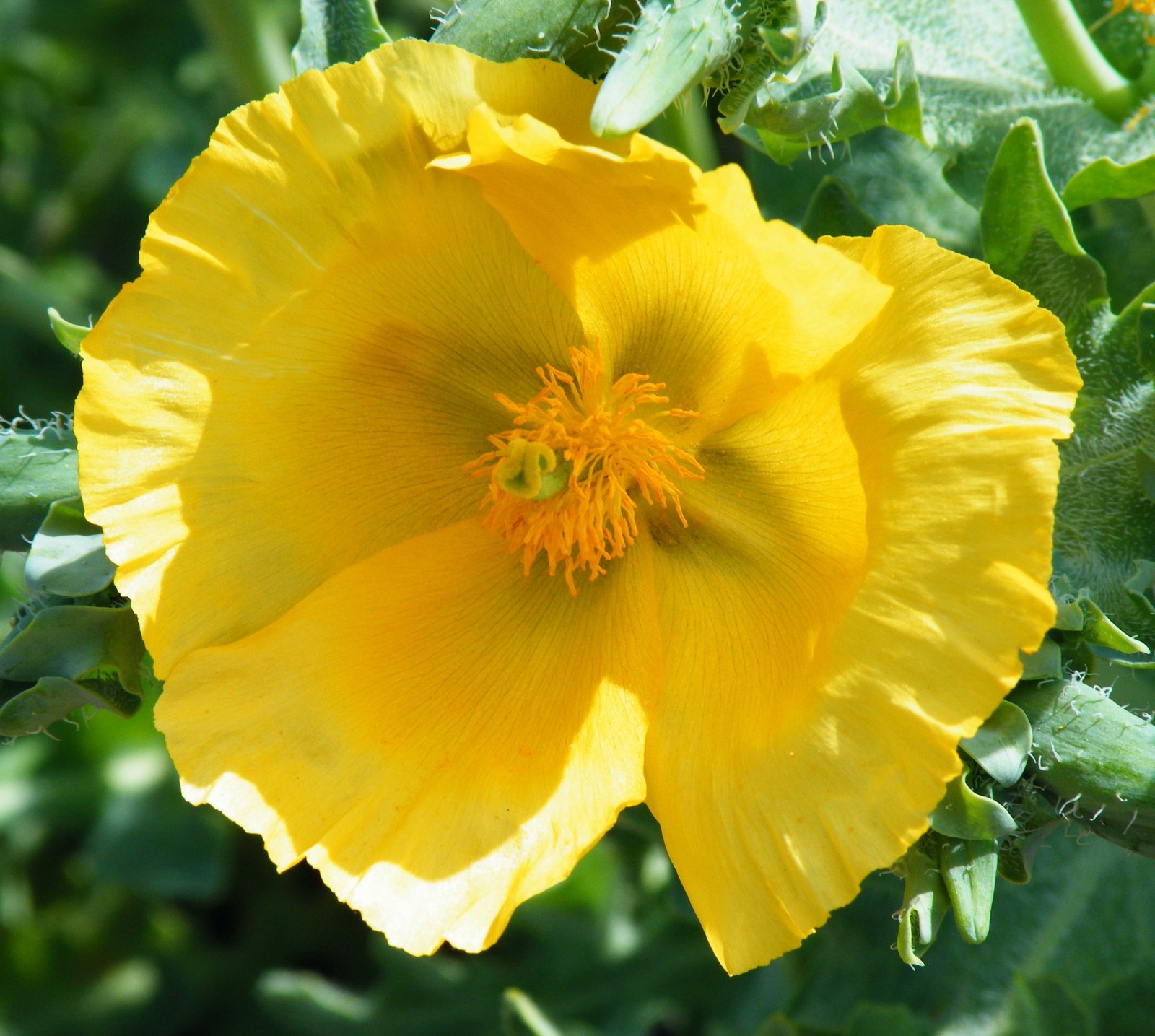
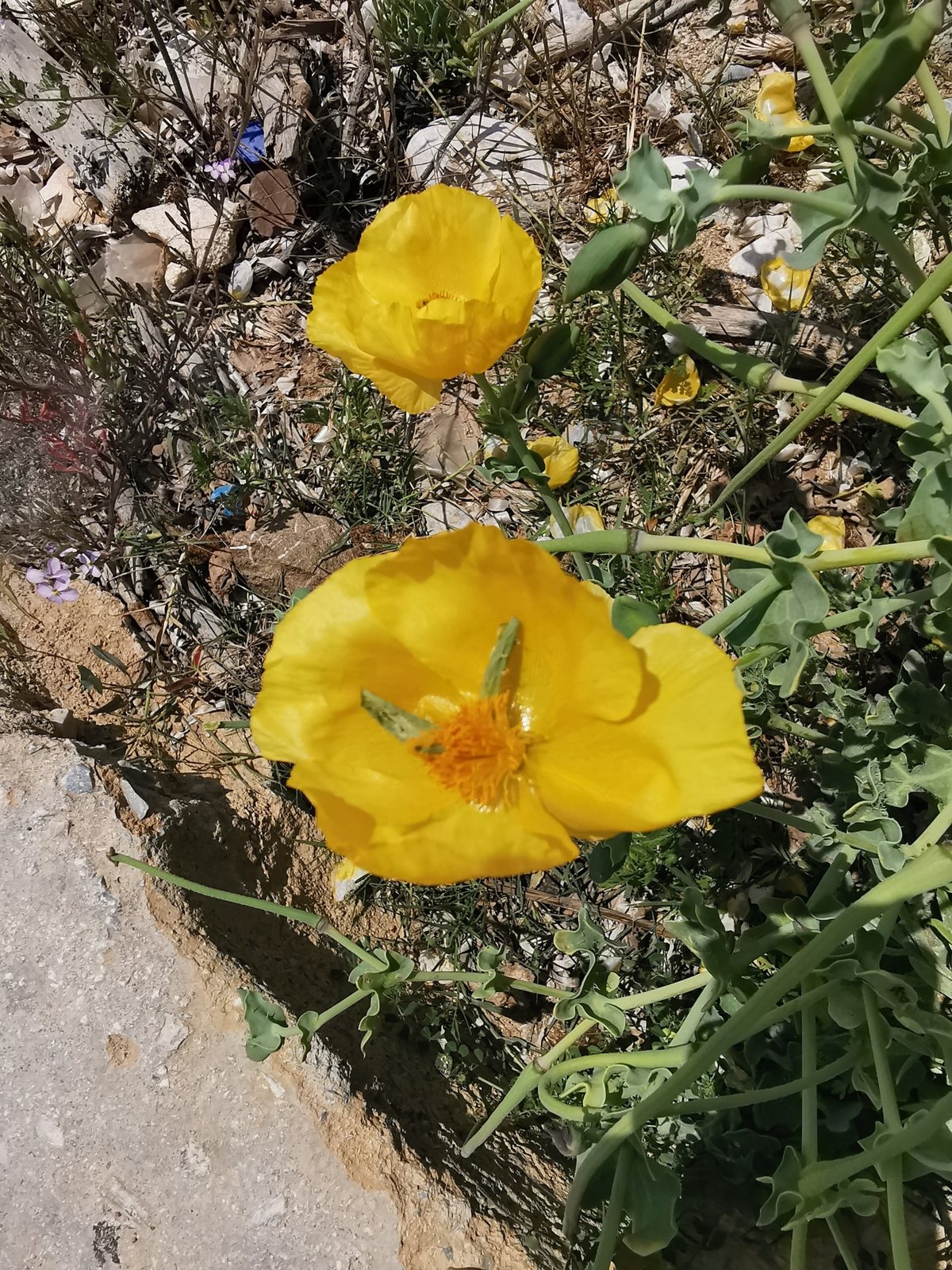
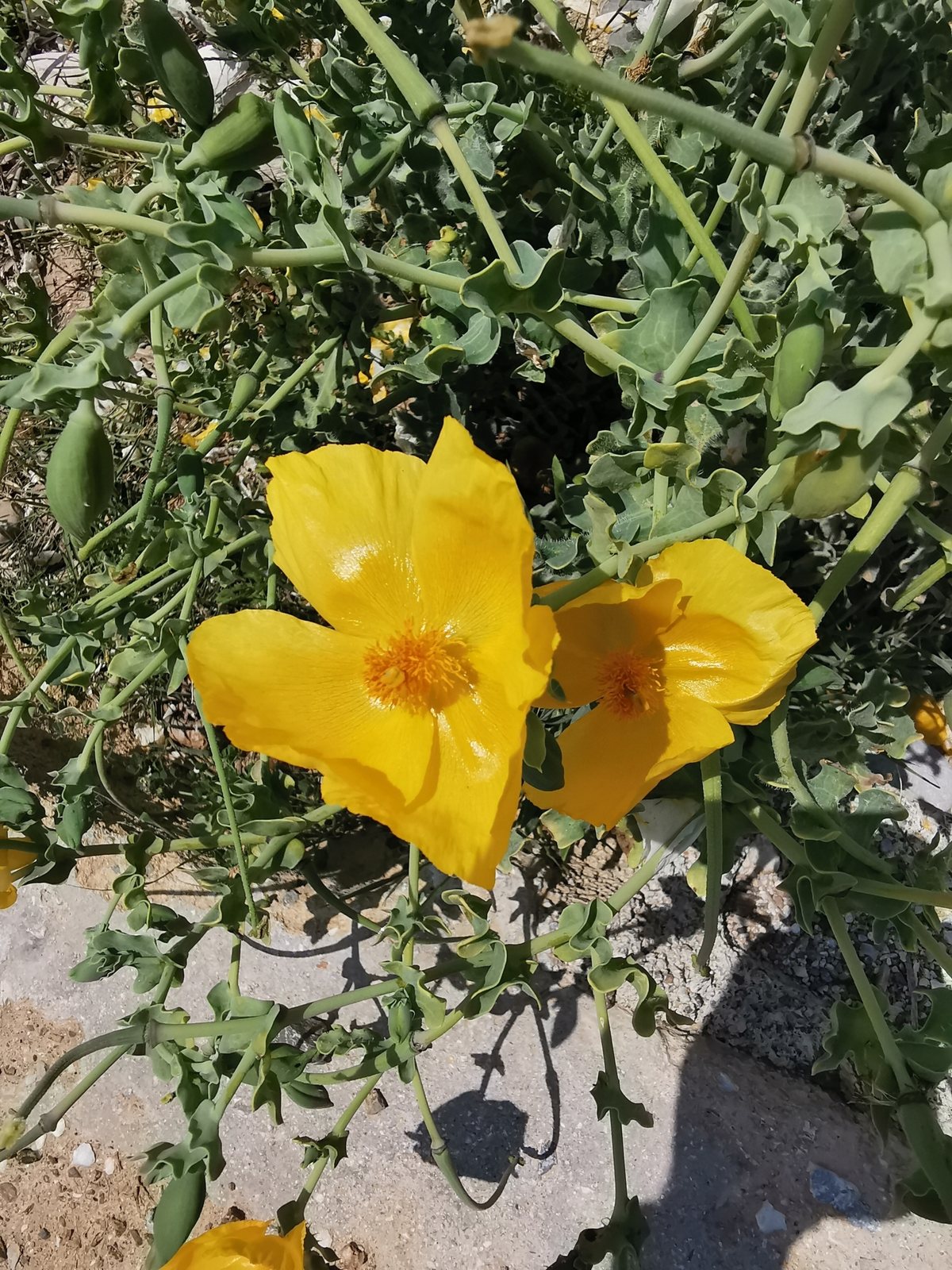
Yellow horned poppy is a short-lived coastal perennial, often behaving as a biennial, with crinkled silver-blue leaves, yellow flowers and long, curved seed pods. Gardeners grow it in sunny gravel gardens and seaside borders, where it tolerates salt spray and drought but needs excellent drainage.
At a glance
- Sun
- Full sun.
- Water
- Low once established; water young plants during dry spells, then allow the soil to dry between waterings.
- Soil
- Poor to moderately fertile, sharply drained sandy, stony or gravelly soil; tolerates alkaline conditions. Avoid heavy, wet soil.
- Height
- 1-2 ft (0.3-0.6 m)
- Spread
- 1-2 ft (0.3-0.6 m)
- Flowers
- Late spring through summer, sometimes into early autumn; bright yellow flowers with four broad petals.
- Foliage
- Evergreen. Thick, deeply lobed, wavy-edged silver-blue leaves form a basal rosette, with smaller leaves clasping the flowering stems.
- Growth
- Moderate to fast; usually forms a rosette before flowering.
- Care needed
- Low
The year at a glance
- Pollinators
- Deer resistant
- Drought tolerant
- Heat tolerant
- Low allergen
| J | F | M | A | M | J | J | A | S | O | N | D | |
|---|---|---|---|---|---|---|---|---|---|---|---|---|
| Flowers | ||||||||||||
| Fruit | ||||||||||||
| Plant |
Northern hemisphere months. In Australia, shift them by six.
- Difficulty
- Easy
- Toughness
- Very tough
Will it suit your garden?
Pick your zone, country, light and whether you have pets.
Full sun is 6 or more hours of direct sun a day, part shade 3 to 6 hours, shade under 3.
How it grows
Planting day
1 ft (0.3 m)
After 1 year
1.2 ft (0.36 m)
After 2 years
1.4 ft (0.42 m)
After 3 years
1.5 ft (0.45 m)
full size
About 2 years to full size.
From a typical nursery size, at an average rate for this kind of plant. A rule of thumb, not a forecast.
Good to know
- Cats and dogs
- Toxic
- Native to
- the UK
- Invasive in
- the US and Australia
- In the garden
- Spreads vigorously: plan to contain it.
- Growth rate
- Fast
Care
Jobs through the year
- WaterApr–May, Sep, every 21 days
- Water established plants only in prolonged drought; seedlings need more frequent watering.
- WaterJun–Aug, every 14 days
- Water only during prolonged dry weather, allowing soil to dry between soakings.
- MulchMar–Apr
- Use a thin gravel mulch around the rosette; avoid damp organic material against the crown.
- PruneMar
- Remove dead leaves without damaging the healthy basal rosette.
- DeadheadMay–Sep, every 7 days
- Remove spent flowers and immature pods if unwanted self-seeding is a concern.
- PruneOct–Nov
- Cut dead flowering stems back to the rosette, leaving healthy leaves intact.
- ProtectOct–Nov
- Clear crown debris and ensure sharp drainage before winter rain.
- Plant in full sun with sharp drainage; use a raised gravel bed if your soil stays wet.
- Water regularly while seedlings establish, then only during prolonged dry weather.
- Avoid routine feeding; rich soil encourages soft, sprawling growth.
- Keep damp organic mulch away from the crown; use gravel around the plant instead.
- Remove unwanted seedlings while small, before their taproots develop.
Pruning. During flowering, remove spent flowers before the long pods ripen if you want to limit seedlings. Cut dead flowering stems back to the basal rosette in autumn, leaving healthy leaves intact.
Through the year
- Early spring
- Remove dead leaves and check that gravel and soil are not trapping moisture against the crown.
- Spring
- Sow seed directly into prepared, free-draining ground where plants are to grow.
- Late spring
- Thin seedlings to about 1-2 ft (0.3-0.6 m) apart and remove volunteers outside the planting area.
- Summer
- Remove developing pods to prevent unwanted spread; water established plants only during prolonged drought.
- Early autumn
- Where growing it is appropriate, sow fresh seed outdoors for plants that may flower the following year.
- Late autumn
- Cut away dead flower stems and clear fallen debris from around the rosette.
In the garden
- Use in a seaside gravel border with sea thrift and sea holly for contrasting flowers and silver foliage.
- Place among stones in a sunny dry garden, where its leaf rosettes soften hard edges.
- Combine with lavender and santolina in a lean-soil Mediterranean planting.
- Use in an informal sunny border where occasional replacement seedlings are welcome, away from vulnerable natural habitats.
Garden styles it suits: Coastal, Dry gravel garden, Mediterranean, Desert / xeriscape, Cottage garden and Pollinator garden.
Plant it with: Sea thrift, Sea holly, English lavender, Santolina, Rockrose and Blue fescue.
Wildlife: The flowers provide pollen for bees and other pollen-feeding insects. They offer little or no nectar.
Problems to watch for
- Crown and root rot in wet soil: improve drainage or move replacement plants to a raised gravel bed; avoid winter waterlogging.
- Slugs and snails damaging young rosettes: inspect seedlings after dark and remove pests or use an appropriate labelled bait.
- Poor establishment after transplanting: sow directly or plant young seedlings before their taproots become crowded.
- Excessive self-seeding: remove pods before they open and pull unwanted seedlings promptly.
Safety
All parts contain toxic alkaloids, including the roots and milky sap. Ingestion can cause serious poisoning in people and animals; keep it away from children, cats, dogs and grazing horses. Species-specific reports for pets are limited, so do not assume any part is safe. Wear gloves when cutting it because the sap can irritate skin.
Where it spreads. Can spread freely by seed. It is treated as an invasive weed in Colorado and has naturalised in parts of coastal southern Australia, including South Australia and Victoria, where it can invade coastal vegetation. Check local weed restrictions before planting, and do not allow seed to spread into dunes, shingle or other natural habitats.
Easily confused with
Welsh poppy (Papaver cambricum)
Welsh poppy has softer green, finely divided foliage and short seed capsules rather than long horn-like pods; it usually grows in cooler, moister places.
California poppy (Eschscholzia californica)
California poppy has finely cut, threadlike foliage and usually orange flowers, rather than broad, crinkled leaves and bright yellow flowers.
Red horned poppy (Glaucium corniculatum)
Usually has orange-red or red flowers with dark basal patches and hairier, less silvery foliage; both species produce elongated horn-like pods.
The name
Glaucium refers to the plant's glaucous, blue-grey foliage, flavum means yellow, and 'horned' describes its long, curved seed pods.
Propagation. Propagate by seed sown outdoors in spring or autumn. Sow shallowly in a well-drained seedbed and allow several weeks for germination; timing can be irregular. Direct sowing is preferable because established plants have a taproot and resent disturbance.
Checked against open data
- Accepted botanical name
- Glaucium flavum
- In the US and Canada
- Introduced in the lower 48 states.
- Native range
- Albania, Algeria, Baleares, Belgium, Bulgaria, Canary Is., Corse, Denmark, East Aegean Is., France, Germany and Great Britain.
- Measured
- Average height 38 cm.
Sources: GBIF (CC BY 4.0), USDA PLANTS and Trefle (CC BY 4.0). The care and design notes are LandscapeGPT's own.
See it in your own yard.
Upload a photo of your yard and see it redesigned with plants that suit your climate, each checked against your zone.