American chestnut
Castanea dentata. Family Fagaceae. Tree.
Also called Eastern American chestnut.
American chestnut is a large deciduous tree native to eastern North America, grown for its edible nuts, handsome toothed leaves and value to wildlife. Chestnut blight kills the stems of most susceptible trees, often leaving roots that repeatedly sprout, so an ordinary seedling is not a dependable long-lived shade or nut tree. It is best suited to spacious gardens where you can accept that risk or take part in a locally supported restoration planting.
At a glance
- Sun
- Full sun for good growth and nut production; tolerates partial shade but crops poorly.
- Water
- Moderate; water young trees during dry spells, keeping the root zone moist but never waterlogged.
- Soil
- Deep, well-drained, acidic soil, preferably sandy or loamy; avoid alkaline ground, compacted clay and sites that remain wet.
- Height
- 60-100 ft (18-30 m) if healthy; blight often prevents trees reaching this size.
- Spread
- 40-60 ft (12-18 m) if healthy.
- Flowers
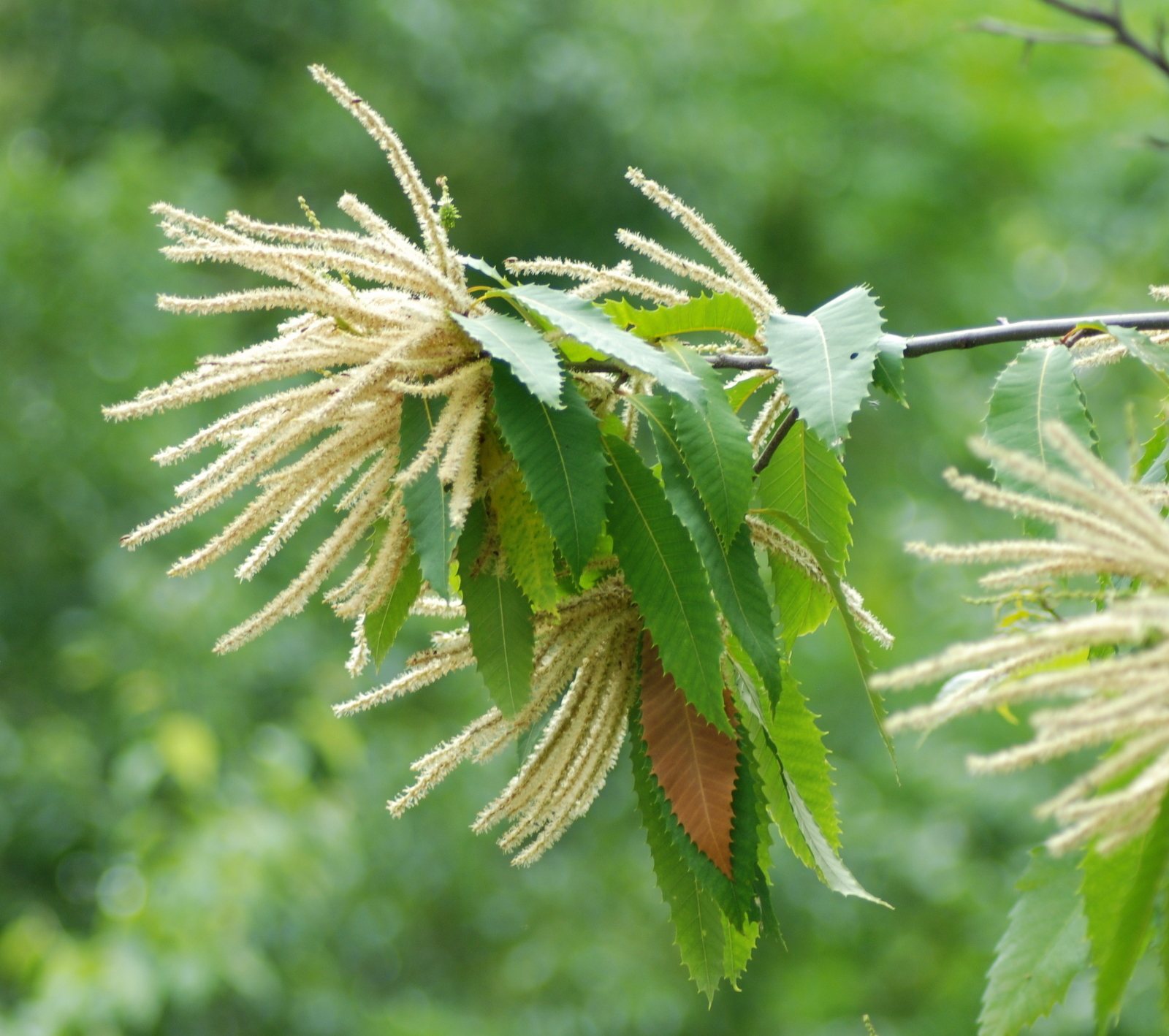
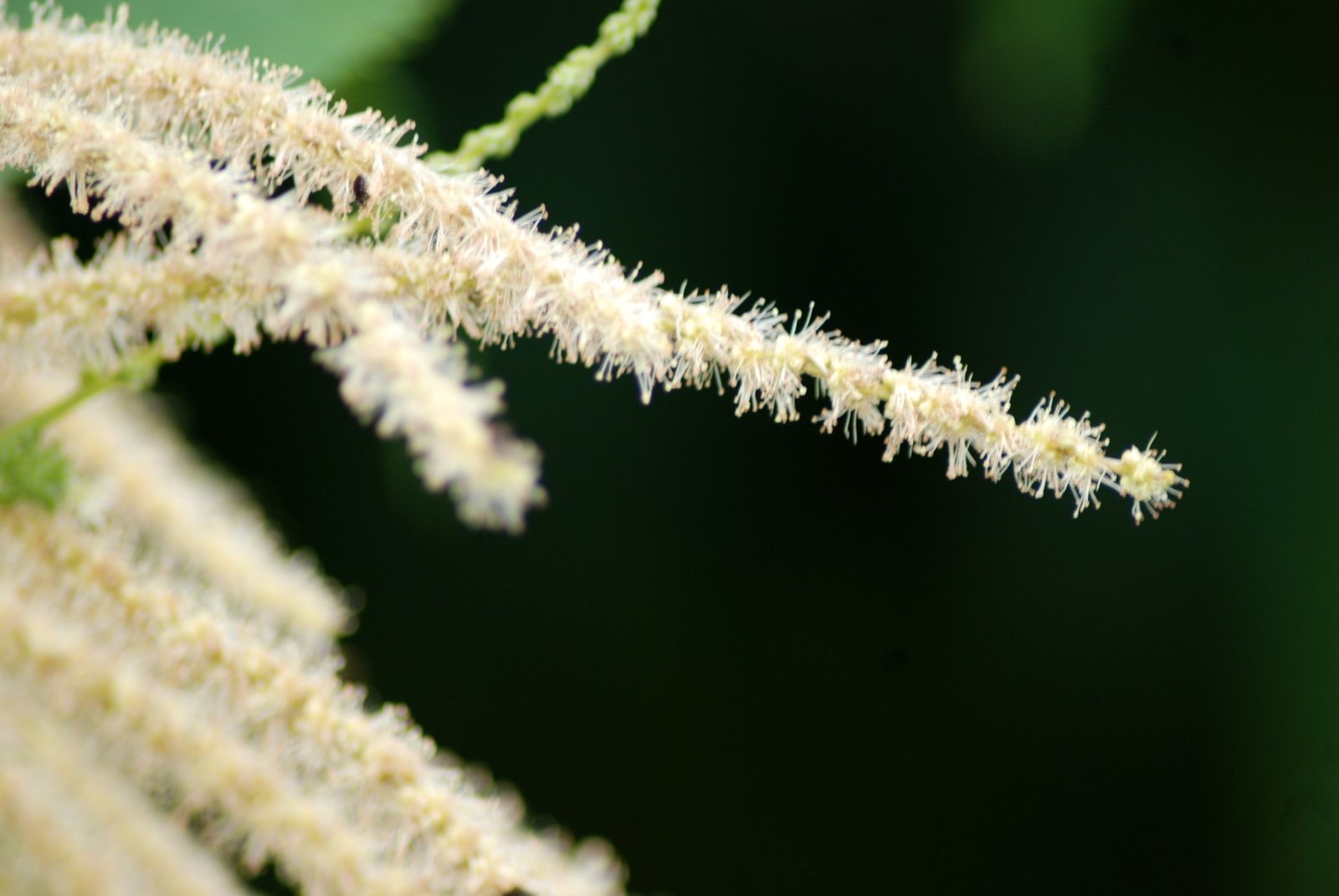
- Late spring to early summer; long, creamy-white male catkins with small female flowers near the bases of some catkins.
- Foliage
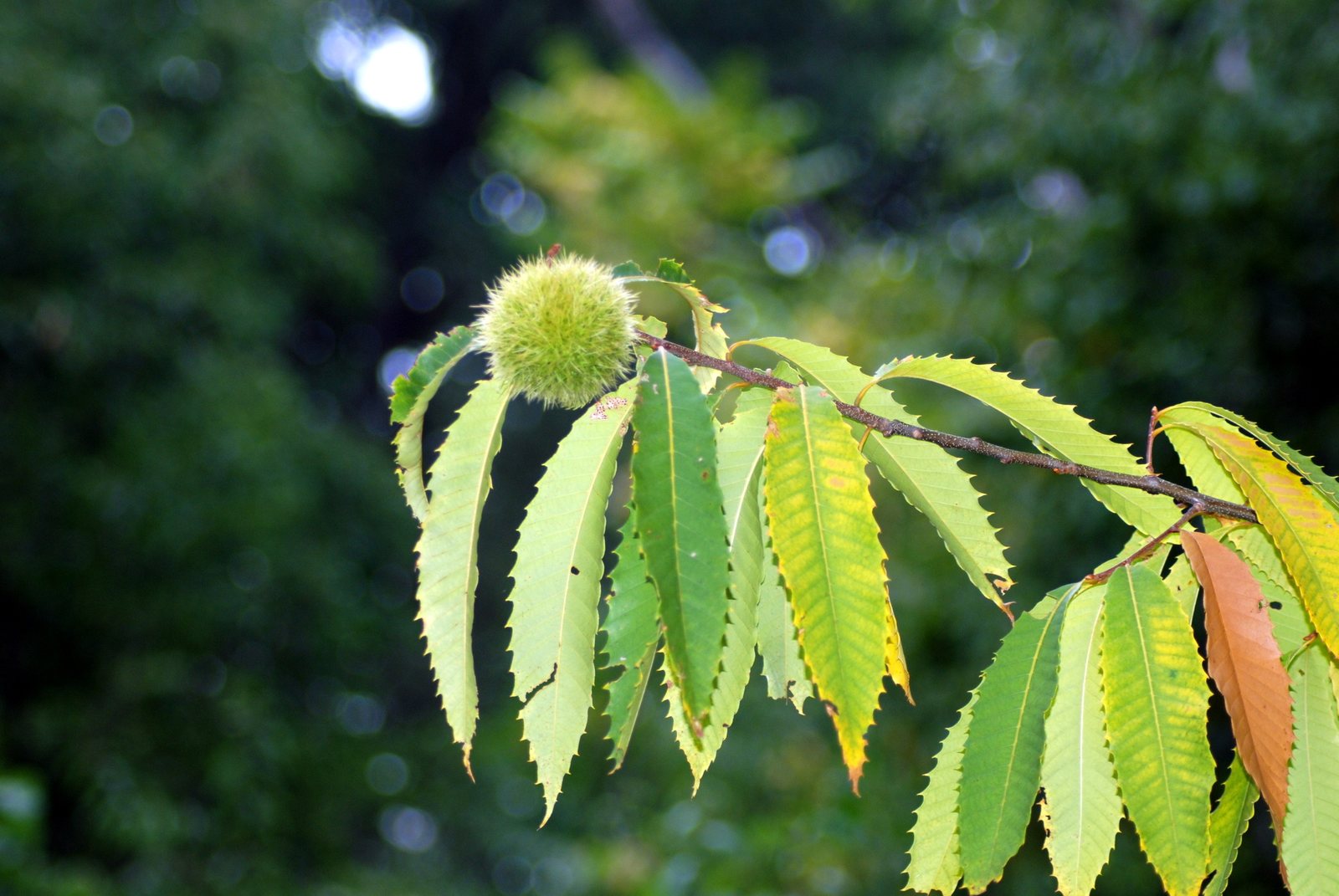
- Long, pointed, glossy green leaves with prominent straight side veins and sharp, bristle-tipped teeth; yellow to brown in autumn.
- Growth
- Fast when young in suitable soil, unless checked by drought or disease.
- Care needed
- High
The year at a glance
- Pollinators
- Cold hardy
- Wildlife
- Edible
| J | F | M | A | M | J | J | A | S | O | N | D | |
|---|---|---|---|---|---|---|---|---|---|---|---|---|
| Flowers | ||||||||||||
| Fruit | ||||||||||||
| Plant |
Northern hemisphere months. In Australia, shift them by six.
- Difficulty
- Hard
- Toughness
- Needs looking after
Will it suit your garden?
Pick your zone, country, light and whether you have pets.
Full sun is 6 or more hours of direct sun a day, part shade 3 to 6 hours, shade under 3.
How it grows
Planting day
9 ft (2.9 m)
After 1 year
15 ft (4.5 m)
After 2 years
20 ft (6.1 m)
After 3 years
25 ft (7.8 m)
After 5 years
36 ft (11 m)
About 13 years to full size.
From a typical nursery size, at an average rate for this kind of plant. A rule of thumb, not a forecast.
Good to know
- Cats and dogs
- Safe
- Native to
- the US and Canada
- Growth rate
- Fast
Care
Jobs through the year
- WaterApr–May, Sep–Oct, every 14 days
- Water established trees only if the root zone is dry; young trees need more frequent watering.
- WaterJun–Aug, every 14 days
- Water established trees deeply during prolonged drought; check young trees weekly for their first three seasons.
- PruneFeb–Mar
- Train young trees to one leader with minimal cuts; have large dead or blight-weakened limbs assessed professionally.
- MulchApr–May
- Renew organic mulch over the root zone, keeping it away from the trunk.
- FeedApr
- Feed only if a soil test identifies a need; avoid heavy nitrogen and unnecessary lime.
- ProtectMay–Sep, every 30 days
- Inspect for sunken cankers, orange pustules and dying branches; seek forestry advice for suspected blight.
- HarvestSep–Oct
- Wear gloves to collect fallen nuts as burrs open; refrigerate promptly, discard damaged nuts and cook before eating.
- ProtectJan–Feb, Nov–Dec
- Check young-tree deer and rodent guards for damage, rubbing or constriction.
- Plant in a sunny, freely draining position with room for the mature crown, away from paths where spiny burrs would be troublesome.
- For nuts, plant at least two genetically different, compatible chestnut trees within about 100 ft (30 m); one isolated tree usually will not crop well.
- Water deeply during dry periods for the first two or three growing seasons.
- Mulch over the root zone, keeping mulch clear of the trunk, and protect young stems from deer and rodents.
- Test the soil before feeding; avoid heavy nitrogen applications and do not add lime unless testing shows it is needed.
- Ask suppliers whether stock is pure American chestnut or a hybrid, what disease resistance is supported by testing, and whether local planting or movement restrictions apply.
Pruning. In late winter, establish one main leader and remove crossing, damaged or badly placed branches while they are small. Avoid unnecessary wounds, and have large dead or blight-weakened limbs assessed by a qualified arborist.
Harvest
Collect nuts promptly from the ground in autumn as the spiny burrs split and release glossy brown nuts; wear thick gloves and refrigerate the nuts soon after collection. Seed-grown trees may produce a first useful crop roughly 7-15 years after planting, depending on growing conditions, pollination and survival without serious blight. Cook before eating, and discard mouldy or damaged nuts.
Through the year
- Late winter
- Prune young trees lightly to establish a sound framework, and check guards for rubbing or constriction.
- Spring
- Plant nursery trees while dormant or as growth begins, provided the soil is workable and well drained.
- Late spring
- Refresh mulch, check soil moisture and inspect trunks for sunken cankers, cracked bark or orange fungal pustules.
- Summer
- Water young trees during dry spells and watch for wilting branches or leaves remaining on dead shoots.
- Autumn
- Gather fallen nuts frequently as burrs open, and remove burrs from lawns and walking routes.
- Late autumn
- Check deer and rodent protection and assess any dead branches before winter storms.
In the garden
- A restoration tree in a large eastern North American woodland planting, where disease losses can be accommodated.
- A potential canopy tree in an acidic-soil food forest, with a second compatible chestnut for pollination.
- A historical planting on a spacious estate or homestead, set well away from buildings and busy paths.
- A wildlife woodland edge with native shrubs and spring-flowering ground plants, allowing for its eventual shade.
Garden styles it suits: Woodland, Wildlife garden, Rewilded, Food forest, Homestead and Grand estate.
Plant it with: Eastern redbud, Flowering dogwood, Highbush blueberry, Mountain laurel, Christmas fern and Wild geranium.
Wildlife: Nuts feed squirrels, deer, turkeys and other wildlife. Flowers attract insects, and the foliage supports native moth and butterfly larvae within its North American range; blight limits the tree's long-term canopy and nut production.
Problems to watch for
- Chestnut blight: sunken bark cankers and dying branches can girdle stems. There is no dependable homeowner cure for a susceptible tree; seek local forestry advice, remove hazardous dead wood and use restoration stock only with realistic expectations.
- Phytophthora root rot: wet soil can lead to declining foliage and dying roots. Choose a freely draining site and clean nursery stock; do not replant chestnuts into persistently waterlogged ground.
- Chestnut weevils: larvae tunnel inside nuts. Collect nuts promptly, refrigerate them and ask your local extension or plant-health service about locally appropriate control.
- Poor nut set: an isolated tree, incompatible pollen or poor flowering weather can leave empty burrs. Provide a genetically different compatible chestnut nearby and give both trees full sun.
Safety
American chestnut is not known to be toxic to people, cats, dogs or horses. The nuts are edible, preferably cooked, but whole nuts can cause choking or digestive blockage in pets, and the sharp burrs can injure mouths, paws and bare feet. Do not confuse it with poisonous horse chestnut.
Easily confused with
Chinese chestnut (Castanea mollissima)
Usually has a broader, lower crown, hairy young shoots and softly hairy leaf undersides; American chestnut generally has narrower leaves with mostly hairless undersides and sharper teeth.
Sweet chestnut (Castanea sativa)
Has similar edible nuts and toothed leaves, but its buds and young shoots are generally stouter and mature trunks often develop strongly spiralling bark ridges. Identification of young trees can be difficult.
Horse chestnut (Aesculus hippocastanum)
Has opposite leaves divided into five to seven large leaflets and upright flower clusters, rather than single alternate leaves and slender catkins.
The name
The species name dentata means 'toothed', referring to the conspicuously toothed leaf margins, while American chestnut identifies its North American origin.
Propagation. Grow from fresh nuts that have been kept moist and cold through winter; they lose viability if allowed to dry out. Sow in deep pots or a protected nursery bed and shield them from rodents. Seedlings vary genetically, and seed collected from trees near other chestnut species may be hybrid;
Checked against open data
- Accepted botanical name
- Castanea dentata
- In the US and Canada
- Native in Canada and the lower 48 states.
- Native range
- Alabama, Connecticut, Delaware, Florida, Georgia, Illinois, Indiana, Kentucky, Louisiana, Maine, Maryland and Masachusettes.
- Measured
- Average height 3300 cm.
Sources: GBIF (CC BY 4.0), USDA PLANTS and Trefle (CC BY 4.0). The care and design notes are LandscapeGPT's own.
See it in your own yard.
Upload a photo of your yard and see it redesigned with plants that suit your climate, each checked against your zone.