Arabian jasmine
Jasminum sambac. Family Oleaceae. Shrub.
Also called Sambac jasmine, Sampaguita, Pikake.
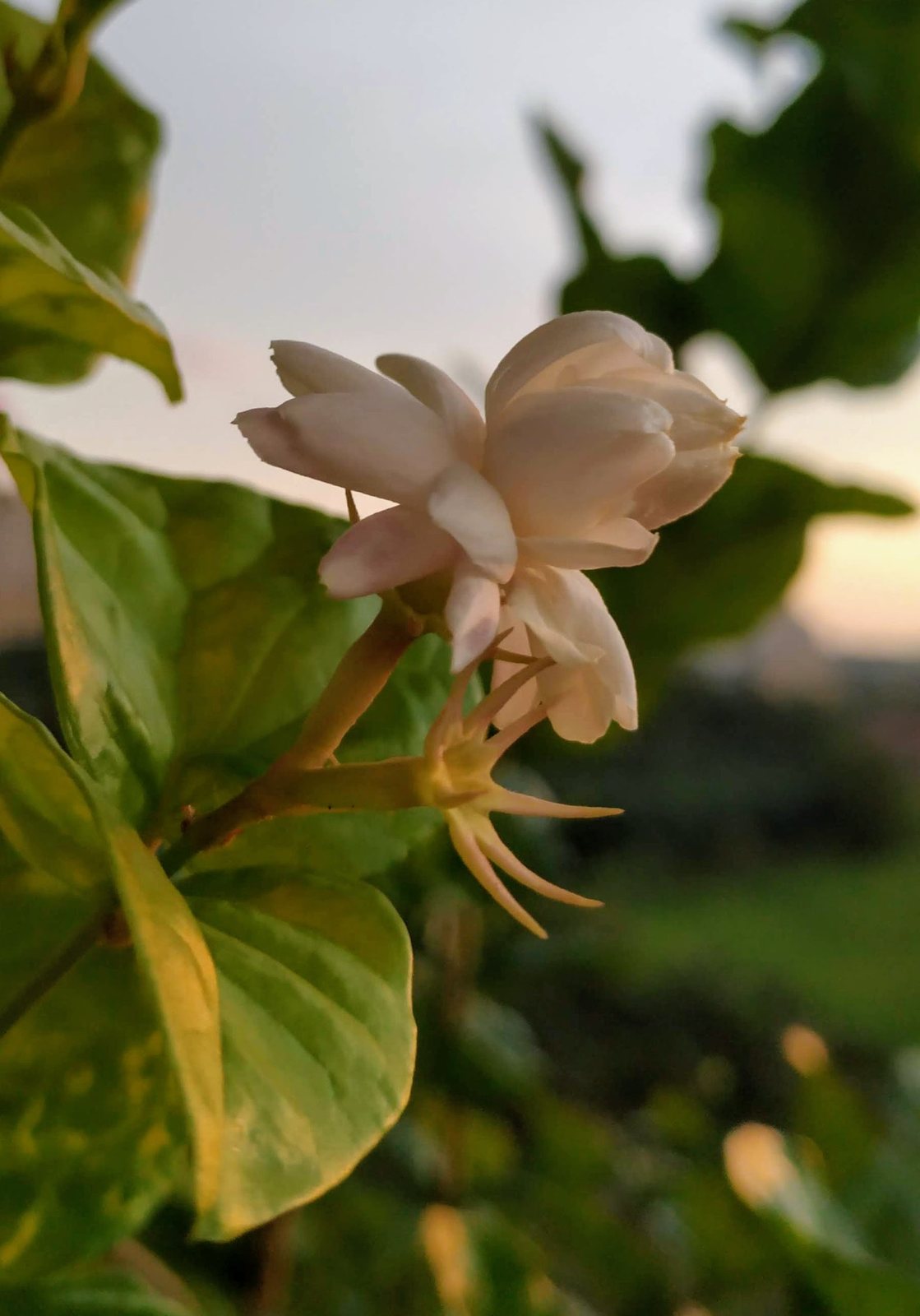
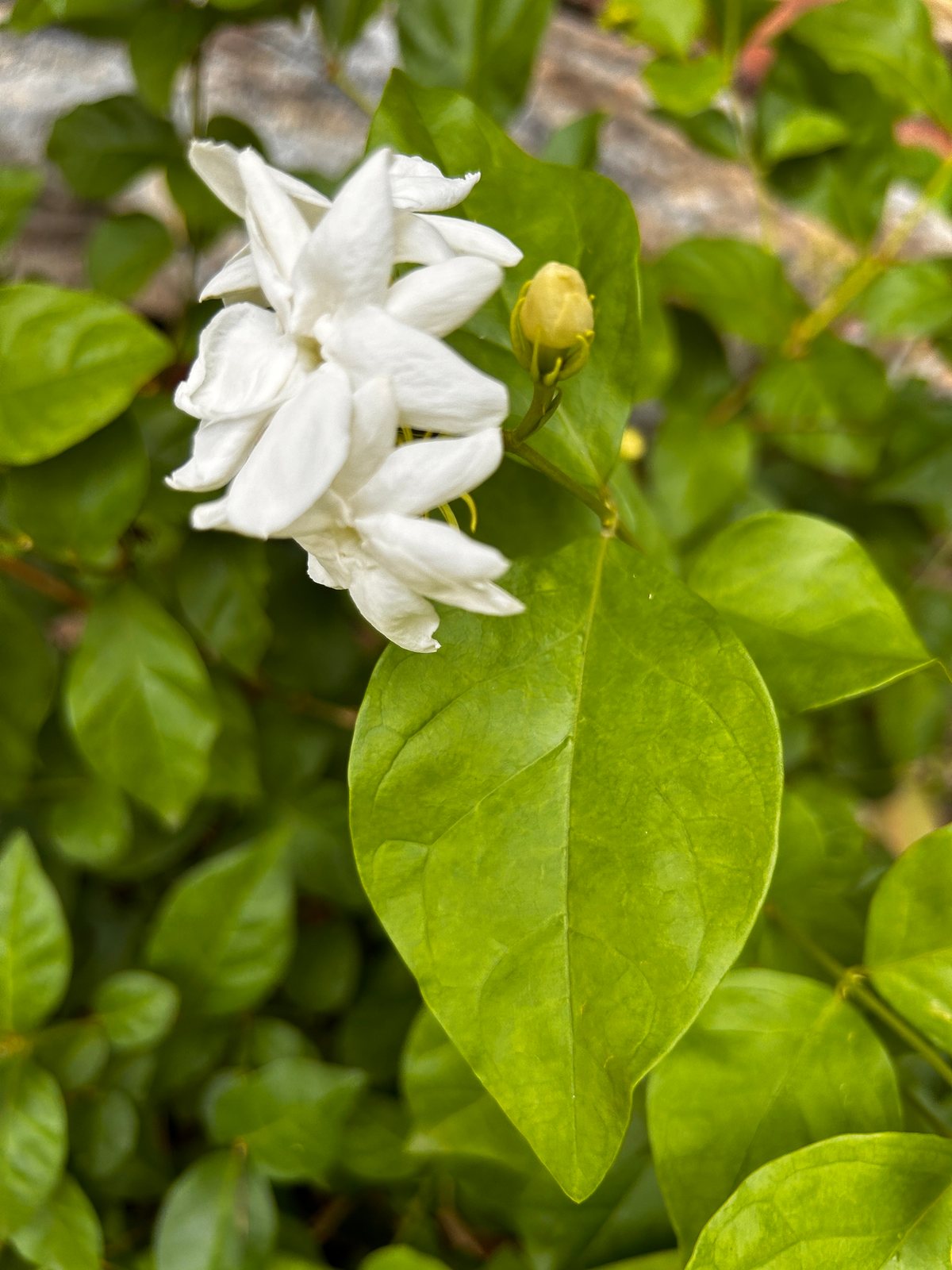
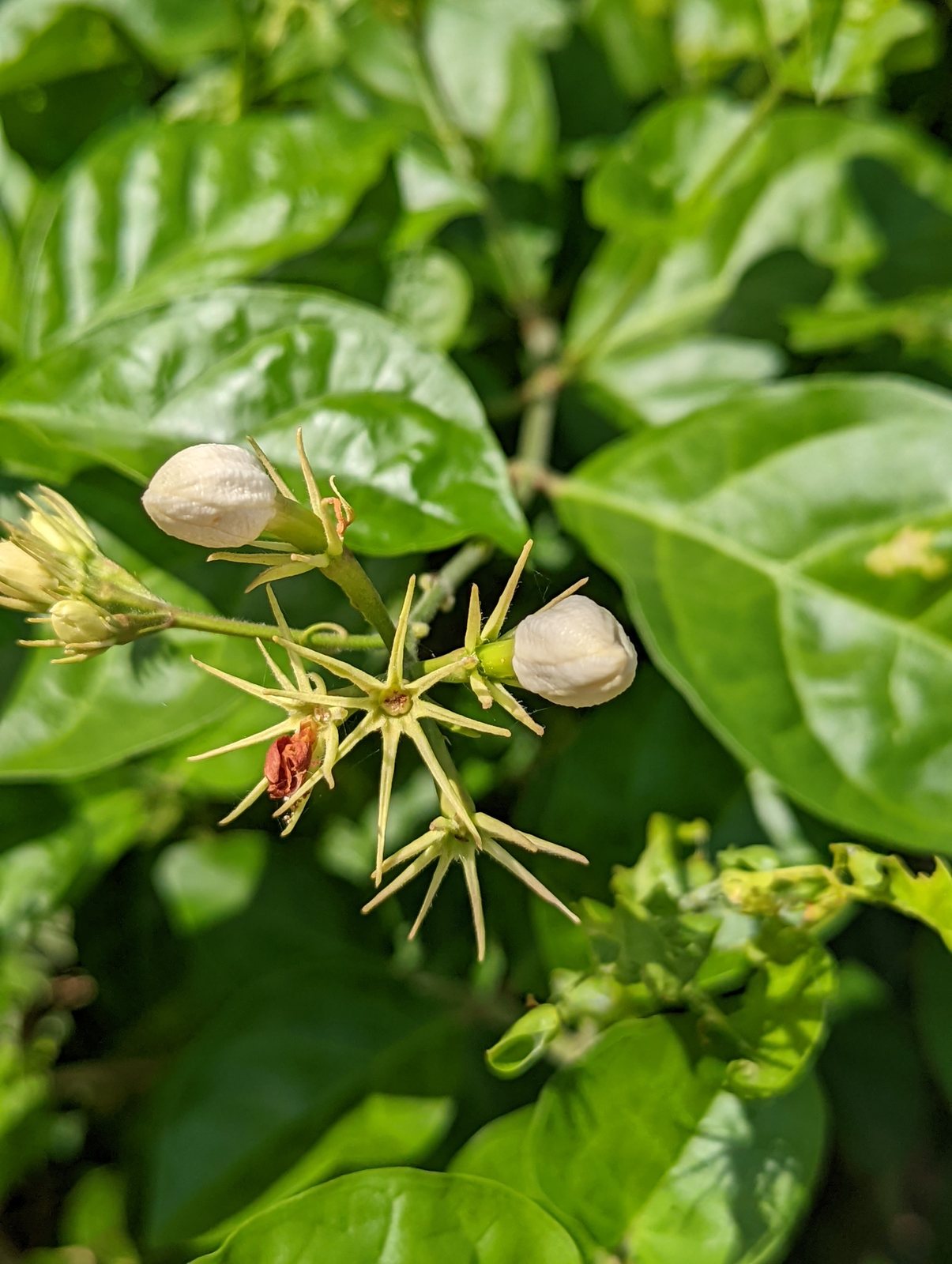
Arabian jasmine is an evergreen shrub with glossy leaves and intensely fragrant white flowers, often opening in the evening. Its loose, scrambling stems can be trained onto a small support or pruned into a bushy container plant. Grow it outdoors in warm climates, or bring it into a bright, frost-free space for winter.
At a glance
- Sun
- Full sun to partial shade; provide afternoon shade in very hot, dry climates. Indoors, use your brightest window.
- Water
- Keep evenly moist during active growth, allowing the soil surface to dry slightly between waterings. Water less in winter, but do not let the root ball dry out completely.
- Soil
- Fertile, well-drained soil, preferably slightly acidic to neutral. For containers, use a good-quality potting mix with added drainage material.
- Height
- 5-10 ft (1.5-3 m)
- Spread
- 3-6 ft (0.9-1.8 m)
- Flowers
- White, single or double flowers from late spring into autumn; flowering may continue intermittently throughout the year in consistently warm conditions.
- Foliage
- Evergreen. Glossy, dark green, oval leaves, usually arranged in opposite pairs; foliage may thin or drop in cold conditions.
- Growth
- Moderate; faster with sustained warmth and regular watering.
- Care needed
- Medium
The year at a glance
- Pollinators
- Heat tolerant
- Low allergen
- Fragrant
| J | F | M | A | M | J | J | A | S | O | N | D | |
|---|---|---|---|---|---|---|---|---|---|---|---|---|
| Flowers | ||||||||||||
| Plant |
Northern hemisphere months. In Australia, shift them by six.
- Difficulty
- Hard
- Toughness
- Needs looking after
Will it suit your garden?
Pick your zone, country, light and whether you have pets.
Full sun is 6 or more hours of direct sun a day, part shade 3 to 6 hours, shade under 3.
How it grows
Planting day
1.6 ft (0.5 m)
After 1 year
3 ft (0.94 m)
After 2 years
5 ft (1.4 m)
After 3 years
6 ft (1.8 m)
After 5 years
7 ft (2.3 m)
full size
About 4 years to full size.
From a typical nursery size, at an average rate for this kind of plant. A rule of thumb, not a forecast.
Good to know
- Cats and dogs
- Safe
- Invasive in
- the US
- Growth rate
- Fast
Care
Jobs through the year
- WaterMar–May, Sep–Oct, every 7 days
- In this climate grow in a movable pot; water when the surface dries slightly and empty saucers.
- WaterJun–Aug, every 3 days
- For outdoor pots, check moisture daily in heat and water when the surface dries slightly.
- WaterJan–Feb, Nov–Dec, every 14 days
- Indoors, water sparingly as the surface dries; never let the root ball dry completely.
- FeedApr–Sep, every 14 days
- Feed actively growing potted plants with flowering-plant fertiliser at the label rate; stop if growth stalls.
- PruneFeb–Mar
- Lightly shorten long stems and remove weak or dead growth before vigorous growth starts.
- ProtectMay–Jun
- Gradually acclimatise pots outdoors only when nights reliably stay above 10°C.
- ProtectSep–Oct
- Inspect for pests and bring pots indoors before nights regularly fall below 10°C.
- ProtectJan–Apr, Nov–Dec
- Keep bright and frost-free indoors, away from heating vents; inspect for mites, scale and mealybugs.
- Water deeply when the soil surface begins to dry; empty container saucers after watering.
- Feed container plants with a balanced flowering-plant fertiliser at the label rate during active growth.
- Mulch outdoor plants, keeping mulch clear of the stems.
- Tie long stems loosely to a small trellis if you want an upright plant; they do not cling to walls.
- In cold climates, bring pots indoors before nights regularly fall below 50°F (10°C), and keep them in bright light away from heating vents.
Pruning. Shorten long stems and remove weak or dead growth in late winter or early spring, before vigorous growth begins. Lightly trim after a flowering flush to encourage branching, but avoid repeated hard clipping, which removes developing flowers.
Through the year
- Late winter
- Prune lightly to shape the plant and remove dead or weak stems.
- Spring
- Repot crowded container plants and resume feeding as new growth starts.
- Late spring
- In cool climates, move pots outdoors once nights remain above 50°F (10°C), gradually acclimatising them to direct sun.
- Summer
- Check container moisture frequently, tie in long stems and inspect new growth for pests.
- Early autumn
- In cool climates, inspect for pests and bring pots under cover before nights turn cold.
- Winter
- Keep overwintering plants bright and frost-free; reduce watering and pause feeding if growth stops.
In the garden
- Place a container beside a patio or doorway where you can enjoy the evening fragrance.
- Train the loose stems onto a small courtyard trellis for a leafy, flowering backdrop.
- Use as a loose shrub among hibiscus and other warm-climate plants.
- Include near seating in a white-flowered or night garden, where the blooms remain visible after dusk.
Garden styles it suits: Tropical, Modern courtyard, Sensory garden, White garden, Evening garden and Small-space.
Plant it with: Gardenia, Hibiscus, Pentas, Dwarf ixora and Bird of paradise.
Wildlife: Fragrant single flowers can attract moths and other nectar-feeding insects in warm climates. Densely double flowers offer less accessible nectar.
Problems to watch for
- Spider mites cause pale stippling and fine webbing, especially indoors: rinse leaf undersides regularly and use insecticidal soap labelled for the plant if needed.
- Mealybugs and scale leave sticky residue and weaken growth: isolate affected pots, remove visible pests and treat with a labelled horticultural oil or insecticidal soap.
- Waterlogged roots cause yellowing leaves and dieback: improve drainage, empty saucers and let the soil surface dry slightly before watering again.
- Few flowers usually reflect insufficient light, cool conditions or excessive nitrogen: move to a brighter, warmer position and avoid high-nitrogen feeding.
Safety
Not known to be toxic to cats, dogs, horses or people; no part is recognised as a serious poisoning hazard. Eating plant material can still cause stomach upset. Do not confuse it with toxic plants also called jasmine, including Carolina jessamine and night-blooming jasmine.
Where it spreads. Reported as invasive in Hawaii and Florida. Check current local guidance before planting outdoors in these regions, and prevent garden waste from establishing beyond your property.
Easily confused with
Common jasmine (Jasminum officinale)
Common jasmine is a more vigorous climber with leaves divided into several leaflets; Arabian jasmine has simple, undivided leaves.
Star jasmine (Trachelospermum jasminoides)
Star jasmine has narrow, twisted flower lobes that form a pinwheel and releases milky sap when damaged; Arabian jasmine has broader flower lobes and no milky sap.
Night-blooming jasmine (Cestrum nocturnum)
Night-blooming jasmine bears clusters of long, narrow, greenish-white tubular flowers and alternate leaves; Arabian jasmine has broader white flowers and usually opposite leaves. Cestrum is toxic.
The name
Jasminum comes from the Persian name for jasmine, while the common name Arabian jasmine reflects its long cultivation in Arabia rather than an Arabian origin.
Propagation. Take semi-ripe stem cuttings during warm weather and root them in a moist, free-draining medium with high humidity. Low stems can also be layered while still attached to the parent plant.
Checked against open data
- Accepted botanical name
- Jasminum sambac
- In the US and Canada
- Introduced in the lower 48 states, Pacific Basin, Puerto Rico and US Virgin Islands.
- Native range
- East Himalaya and India.
Sources: GBIF (CC BY 4.0), USDA PLANTS and Trefle (CC BY 4.0). The care and design notes are LandscapeGPT's own.
See it in your own yard.
Upload a photo of your yard and see it redesigned with plants that suit your climate, each checked against your zone.