Black mondo grass
Ophiopogon planiscapus 'Nigrescens'. Family Asparagaceae. Perennial.
Also called Black lilyturf, Black dragon grass.
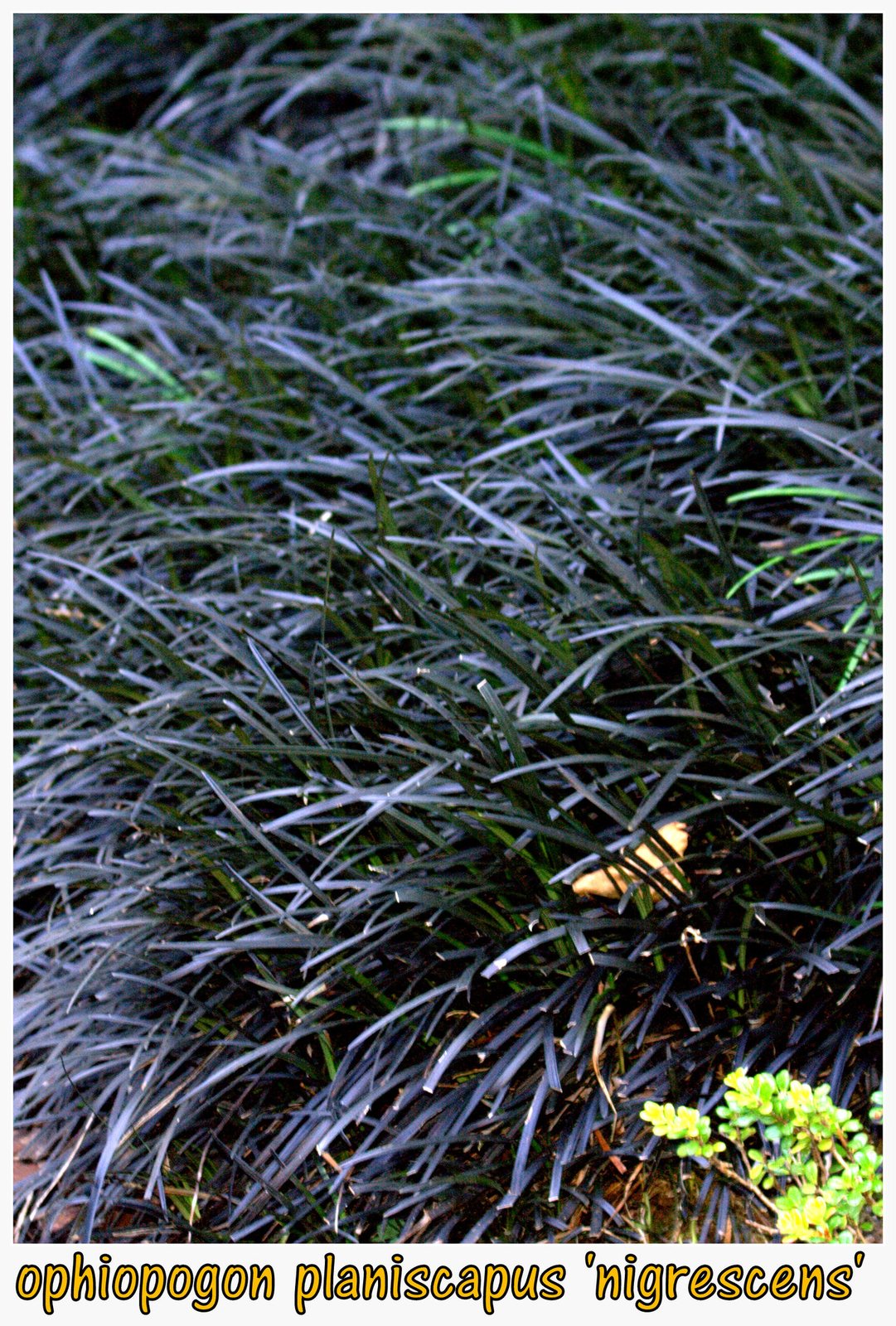
Black mondo grass is a slow-spreading, grass-like perennial grown for its arching, nearly black leaves. It is not a true grass; its low evergreen clumps provide a dark contrast to pale paving, golden foliage and shade-loving perennials.
At a glance
- Sun
- Full sun to partial shade. Afternoon shade helps in hot climates; foliage may be greener in deep shade.
- Water
- Keep evenly moist while establishing. Established clumps tolerate brief dry spells, but prolonged drought causes browning and slows growth.
- Soil
- Humus-rich, well-drained soil, from slightly acidic to neutral. Avoid ground that stays waterlogged in winter.
- Height
- 0.5-1 ft (0.15-0.3 m)
- Spread
- 0.5-1 ft (0.15-0.3 m) per clump, gradually spreading farther by short underground stems
- Flowers
- Small pale lilac to pinkish-white flowers in summer, followed by glossy blue-black berries.
- Foliage
- Evergreen. Narrow, arching, leathery leaves mature to purple-black. New growth can emerge green before darkening; winter cold may scorch the tips.
- Growth
- Slow
- Care needed
- Low
The year at a glance
- Pollinators
- Deer resistant
- Heat tolerant
- Low allergen
| J | F | M | A | M | J | J | A | S | O | N | D | |
|---|---|---|---|---|---|---|---|---|---|---|---|---|
| Flowers | ||||||||||||
| Fruit | ||||||||||||
| Plant |
Northern hemisphere months. In Australia, shift them by six.
- Difficulty
- Easy
- Toughness
- Fairly tough
Will it suit your garden?
Pick your zone, country, light and whether you have pets.
Full sun is 6 or more hours of direct sun a day, part shade 3 to 6 hours, shade under 3.
How it grows
Planting day
0.7 ft (0.22 m)
full size
About 5 years to full size.
From a typical nursery size, at an average rate for this kind of plant. A rule of thumb, not a forecast.
Good to know
- Cats and dogs
- Mildly toxic: may upset a stomach
- Growth rate
- Slow
Care
Jobs through the year
- WaterApr–May, Sep–Oct, every 14 days
- Water established clumps if soil is dry; keep new plants more consistently moist.
- WaterJun–Aug, every 7 days
- Water during extended dry spells, allowing excess water to drain away.
- MulchMar–Apr
- Apply a thin compost mulch around clumps, leaving crowns uncovered.
- PruneFeb–Mar
- Cut dead or scorched leaves at their bases; do not shear healthy foliage.
- DivideApr–May
- Divide only crowded clumps, or leave undisturbed to form a carpet.
- ProtectJan–Feb, Nov–Dec
- Insulate exposed container roots during prolonged freezes and maintain free drainage.
- Water regularly during the first growing season, allowing excess water to drain away.
- Water established plants during prolonged dry weather, especially in containers.
- Apply a thin layer of compost in spring; rich soil rarely needs additional fertiliser.
- Mulch around clumps to conserve moisture, keeping mulch off the crowns.
- Divide crowded clumps in spring, or leave them undisturbed to form a slow-growing carpet.
Pruning. In late winter or early spring, cut out dead or badly scorched leaves at their bases before new growth starts. Do not routinely shear or mow healthy foliage.
Through the year
- Early spring
- Remove winter-damaged leaves and check that crowns are not buried under mulch.
- Spring
- Plant or divide clumps, water well and top-dress with compost.
- Summer
- Water during extended dry spells and inspect young foliage for slug or snail damage.
- Late summer
- Leave flower stems in place if you want the blue-black berries.
- Autumn
- Remove fallen leaves that collect densely over the clumps.
- Winter
- Check drainage and protect container roots from prolonged freezing in colder areas.
In the garden
- Edge paths with low black clumps against pale gravel or light-coloured paving.
- Plant beneath open-canopied shrubs alongside golden Japanese forest grass for strong foliage contrast.
- Use in shaded containers with silver-leaved coral bells and small ferns.
- Repeat small groups among rocks in Japanese-style gardens for a restrained, evergreen ground layer.
- Underplant snowdrops or pale hellebores so their flowers stand out against the dark leaves.
Garden styles it suits: Japanese, Zen dry garden, Contemporary minimal, Woodland, Modern courtyard and Winter interest.
Plant it with: Golden Japanese forest grass, Snowdrops, Hellebores, Coral bells, Hostas and Japanese painted fern.
Wildlife: The small summer flowers can attract visiting insects. Dense clumps provide shelter for small invertebrates, but this is not a major wildlife food plant.
Problems to watch for
- Slugs and snails can chew young leaves: remove hiding places, hand-pick at dusk or use an approved iron phosphate bait as directed.
- Crown or root rot in wet soil: improve drainage, reduce watering and remove badly rotted plants.
- Brown leaf tips from drought or winter exposure: water during dry spells, provide shelter and trim damaged leaves in spring.
- Green shoots among black foliage: allow young leaves time to darken; remove divisions that remain persistently green.
Safety
Not known to be toxic to cats, dogs, horses or people, although species-specific safety information is limited. No part is established as seriously poisonous; the leaves and berries are not food, and eating plant material may cause stomach upset.
Easily confused with
Mondo grass (Ophiopogon japonicus)
Usually has green rather than purple-black leaves and tends to form a finer-textured green carpet.
Big blue lilyturf (Liriope muscari)
Usually has broader green leaves, larger clumps and conspicuous upright purple flower spikes rather than small, partly hidden pale flowers.
Black New Zealand flax (Phormium tenax and dark-leaved hybrids)
Has much broader, stiffer, sword-shaped leaves arranged in fans and grows substantially taller.
The name
The cultivar name 'Nigrescens' means 'becoming black', referring to the foliage darkening as it matures.
Propagation. Divide established clumps in spring, keeping roots and several shoots on each division. Replant promptly and keep moist until established. Seedlings may not retain the cultivar's black foliage.
Checked against open data
- Accepted botanical name
- Ophiopogon planiscapus
- Native range
- Japan.
Sources: GBIF (CC BY 4.0) and Trefle (CC BY 4.0). The care and design notes are LandscapeGPT's own.
See it in your own yard.
Upload a photo of your yard and see it redesigned with plants that suit your climate, each checked against your zone.