Blue sky vine
Thunbergia grandiflora. Family Acanthaceae. Climber.
Also called Bengal clock vine, Blue trumpet vine, Skyflower.
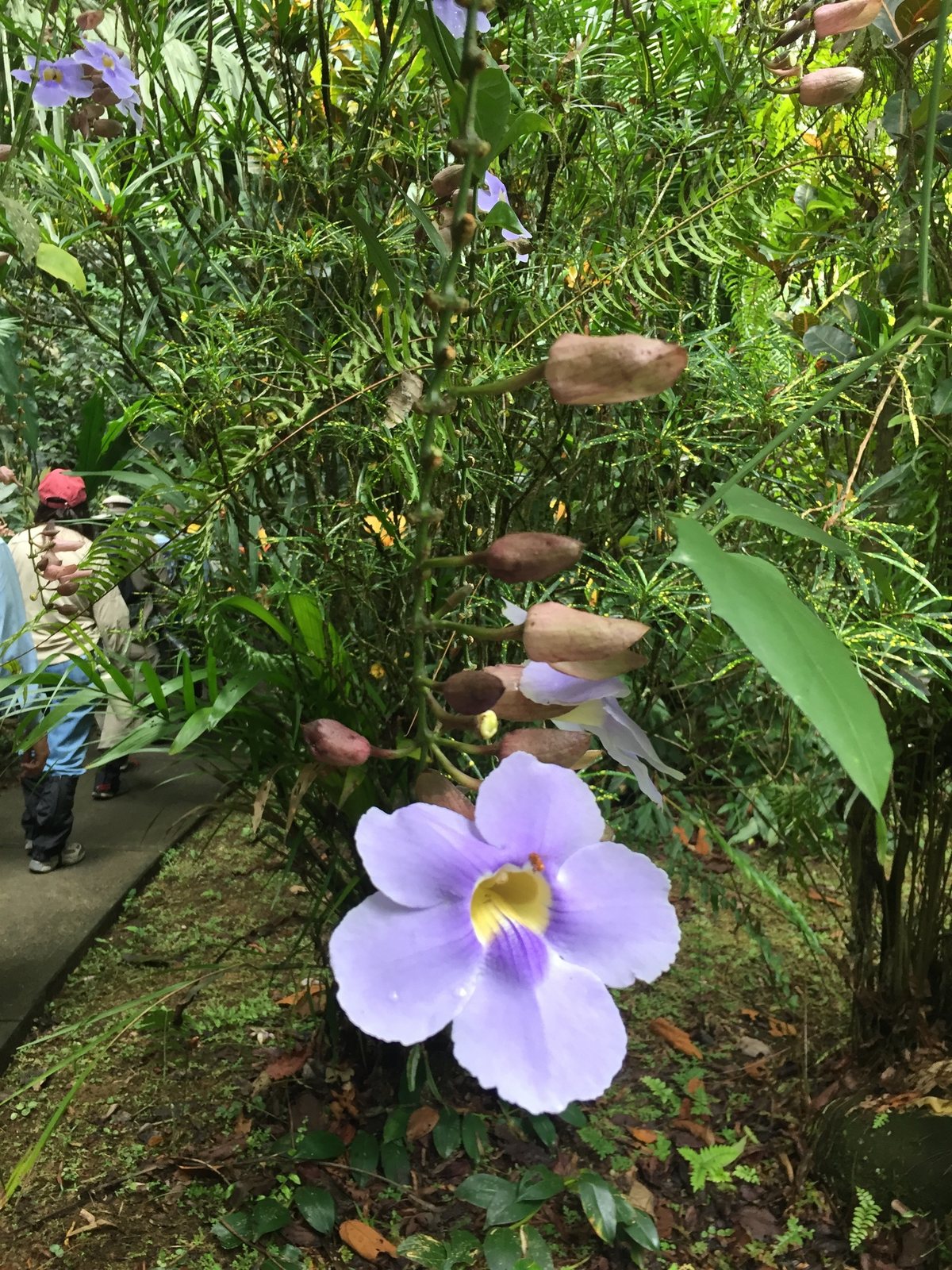
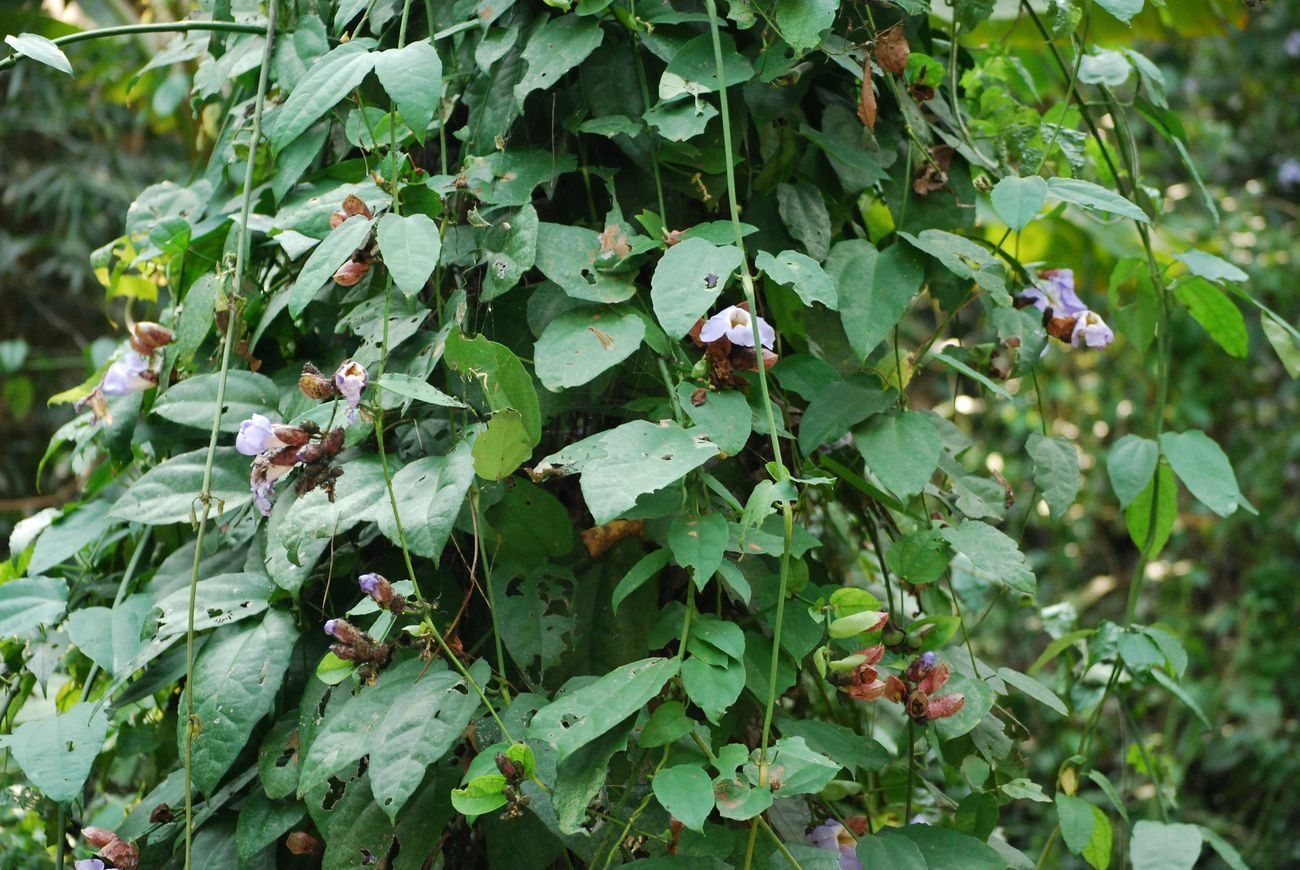
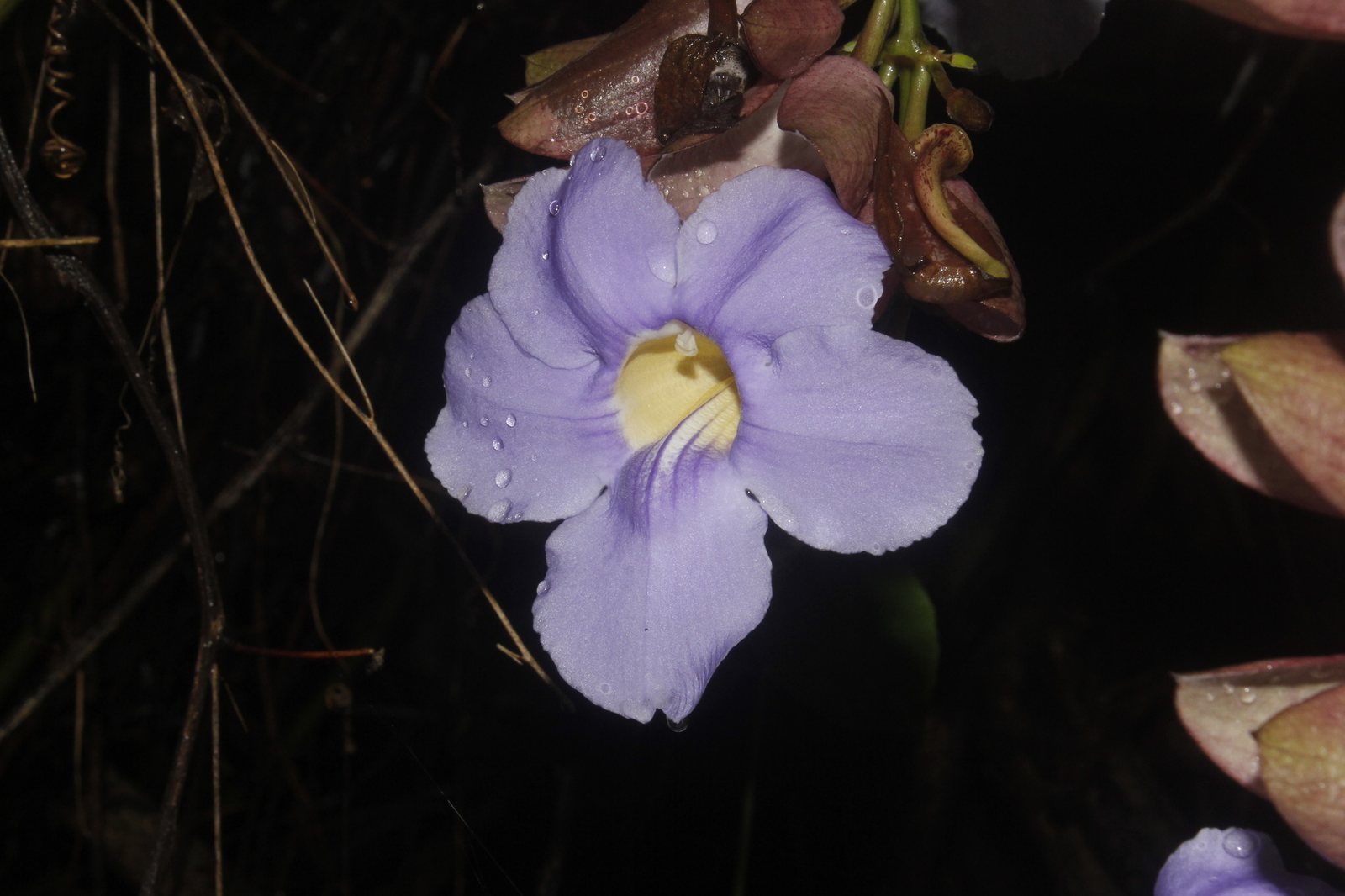
Blue sky vine is a vigorous tropical climber grown for hanging clusters of large, pale blue to lavender flowers with creamy throats. It needs a substantial support and frost-free conditions; in the UK and most of Canada, grow it in a conservatory or a container brought indoors for winter. Check local restrictions before planting, as it is invasive in several warm regions.
At a glance
- Sun
- Full sun to partial shade; afternoon shade helps in very hot, dry locations. Indoors, provide strong light.
- Water
- Water deeply during active growth, keeping the root zone moist but not waterlogged. Reduce watering in winter, especially under cool indoor conditions.
- Soil
- Fertile, moisture-retentive soil with good drainage; use a free-draining potting mix in containers.
- Height
- 20-40 ft (6-12 m), potentially taller in tropical conditions
- Spread
- 6-15 ft (1.8-4.6 m), wider if left uncontrolled
- Flowers
- Pale blue to lavender trumpet-shaped flowers with creamy yellow throats, mainly summer to autumn; flowering can continue much longer in tropical climates.
- Foliage
- Evergreen. Large, rough-textured green leaves, usually heart-shaped with angular or shallowly lobed edges.
- Growth
- Fast in warm weather
- Care needed
- High
The year at a glance
- Pollinators
- Heat tolerant
- Low allergen
| J | F | M | A | M | J | J | A | S | O | N | D | |
|---|---|---|---|---|---|---|---|---|---|---|---|---|
| Flowers | ||||||||||||
| Plant |
Northern hemisphere months. In Australia, shift them by six.
- Difficulty
- Hard
- Toughness
- Fairly tough
Will it suit your garden?
Pick your zone, country, light and whether you have pets.
Full sun is 6 or more hours of direct sun a day, part shade 3 to 6 hours, shade under 3.
How it grows
Planting day
2 ft (0.6 m)
After 1 year
3 ft (1.1 m)
After 2 years
5 ft (1.5 m)
After 3 years
6 ft (1.8 m)
full size
About 3 years to full size.
From a typical nursery size, at an average rate for this kind of plant. A rule of thumb, not a forecast.
Good to know
- Cats and dogs
- Safe
- Invasive in
- the US and Australia
- In the garden
- Spreads vigorously: plan to contain it.
- Growth rate
- Fast
Care
Jobs through the year
- WaterApr–May, Sep, every 7 days
- Keep established roots moist but drained; young plants and containers need more frequent checks.
- WaterJun–Aug, every 5 days
- Water established plants deeply as the surface dries; containers may need daily watering.
- WaterJan–Mar, Oct–Dec, every 14 days
- In winter shelter, water sparingly without letting the root ball dry completely.
- FeedApr–Sep, every 14 days
- Feed container plants with balanced liquid fertiliser at the label rate during active growth.
- MulchApr–May
- Refresh root-zone mulch without covering stems.
- PruneFeb–Mar
- Remove dead and tangled stems and shorten vigorous growth to fit its support.
- PruneMay–Sep, every 14 days
- Cut escaping shoots and remove rooted stems; keep cuttings off moist ground.
- ProtectJan–Apr, Sep–Dec
- Bring indoors before cold nights; overwinter brightly, preferably above 10°C.
- Provide a strong pergola or trellis and tie young shoots in before they become tangled.
- Water deeply when the soil surface starts to dry; empty container saucers after watering.
- Feed container plants with a balanced liquid fertiliser during active growth, following the label rate.
- Mulch the root zone, keeping mulch clear of the stems.
- Bring container plants indoors before frost and overwinter in bright conditions, preferably above 50°F (10°C).
- Inspect surrounding ground for rooted stems and unwanted shoots; remove them promptly.
Pruning. In late winter or early spring, remove dead and tangled stems and shorten vigorous growth to fit its support. Trim escaping shoots during the growing season, and do not leave cut stems on moist ground where they may root.
Through the year
- Late winter
- Prune established plants before strong new growth begins and inspect the support for damage.
- Spring
- Refresh container compost or repot if root-bound, then resume feeding as growth starts.
- Late spring
- After frost risk has passed and nights are consistently warm, gradually acclimatise overwintered plants to outdoor conditions.
- Summer
- Water regularly, tie in new shoots and cut back growth that reaches gutters, trees or neighbouring plants.
- Early autumn
- In cool climates, check plants for pests and bring them indoors before cold nights.
- Winter
- Keep sheltered plants in bright light and water sparingly without allowing the root ball to dry out completely.
In the garden
- Train over a substantial pergola in a frost-free garden so the flower clusters hang below the framework.
- Use on a freestanding trellis as a leafy screen, with room to prune both sides.
- Grow in a large container with a sturdy support on a warm terrace, allowing for indoor winter storage.
- Pair with bold-leaved tropical plants for contrasting leaf shapes and a cool blue flower colour.
Garden styles it suits: Tropical, Modern tropical, Luxury resort, Modern courtyard, Romantic rose garden and Blues and silvers.
Plant it with: Canna, Ginger lily, Elephant's ear, Clivia and Bird of paradise.
Wildlife: Flowers attract bees and other nectar-feeding insects. In invaded habitats, dense growth can smother native vegetation and reduce habitat quality.
Problems to watch for
- Uncontrolled growth: stems can overwhelm shrubs and small trees; use a separate strong support and prune escaping growth frequently.
- Red spider mites: common under warm, dry cover; rinse leaf undersides and use an appropriate insecticidal soap or biological control if needed.
- Whitefly or scale insects: inspect sheltered plants regularly, remove heavily affected shoots and treat with a labelled horticultural soap or oil.
- Yellowing and root rot in wet soil: improve drainage, empty saucers and reduce watering during cool weather.
Safety
Not known to be toxic to people, cats, dogs or horses, but reliable species-specific toxicity information is limited. No part should be treated as edible.
Where it spreads. Spreads aggressively in humid tropical and subtropical climates, including Hawaii, Florida and parts of northern Australia. It is a regulated invasive plant in Queensland, the Northern Territory and Western Australia; check current local rules before buying, growing or moving it. Root fragments and stems can establish new plants, so never dump garden waste in bushland or waterways.
Easily confused with
Laurel clock vine (Thunbergia laurifolia)
Has similar blue flowers, but its leaves are generally narrower, smoother and unlobed, unlike the broad, rough, often angular leaves of blue sky vine.
Black-eyed Susan vine (Thunbergia alata)
A smaller, lighter climber with smaller flowers, usually orange, yellow or white, and a conspicuous dark central eye.
King's mantle (Thunbergia erecta)
Forms a shrub rather than a large twining vine and has much smaller leaves, with purple-blue flowers borne singly.
The name
Thunbergia honours Swedish botanist Carl Peter Thunberg, grandiflora means large-flowered, and blue sky vine refers to the flower colour.
Propagation. Where cultivation is permitted, take softwood or semi-ripe stem cuttings during warm weather, or layer a shoot. Keep propagating material contained and dispose of unwanted roots and stems through locally approved weed-waste services.
Checked against open data
- Accepted botanical name
- Thunbergia grandiflora
- In the US and Canada
- Introduced in Hawaii, the lower 48 states and Puerto Rico.
- Native range
- Assam, Bangladesh, Cambodia, China South-Central, China Southeast, East Himalaya, Hainan, Laos, Malaya, Myanmar, Nepal and Thailand.
Sources: GBIF (CC BY 4.0), USDA PLANTS and Trefle (CC BY 4.0). The care and design notes are LandscapeGPT's own.
See it in your own yard.
Upload a photo of your yard and see it redesigned with plants that suit your climate, each checked against your zone.