Bolivian begonia
Begonia boliviensis. Family Begoniaceae. Perennial.
Also called Bolivia begonia.
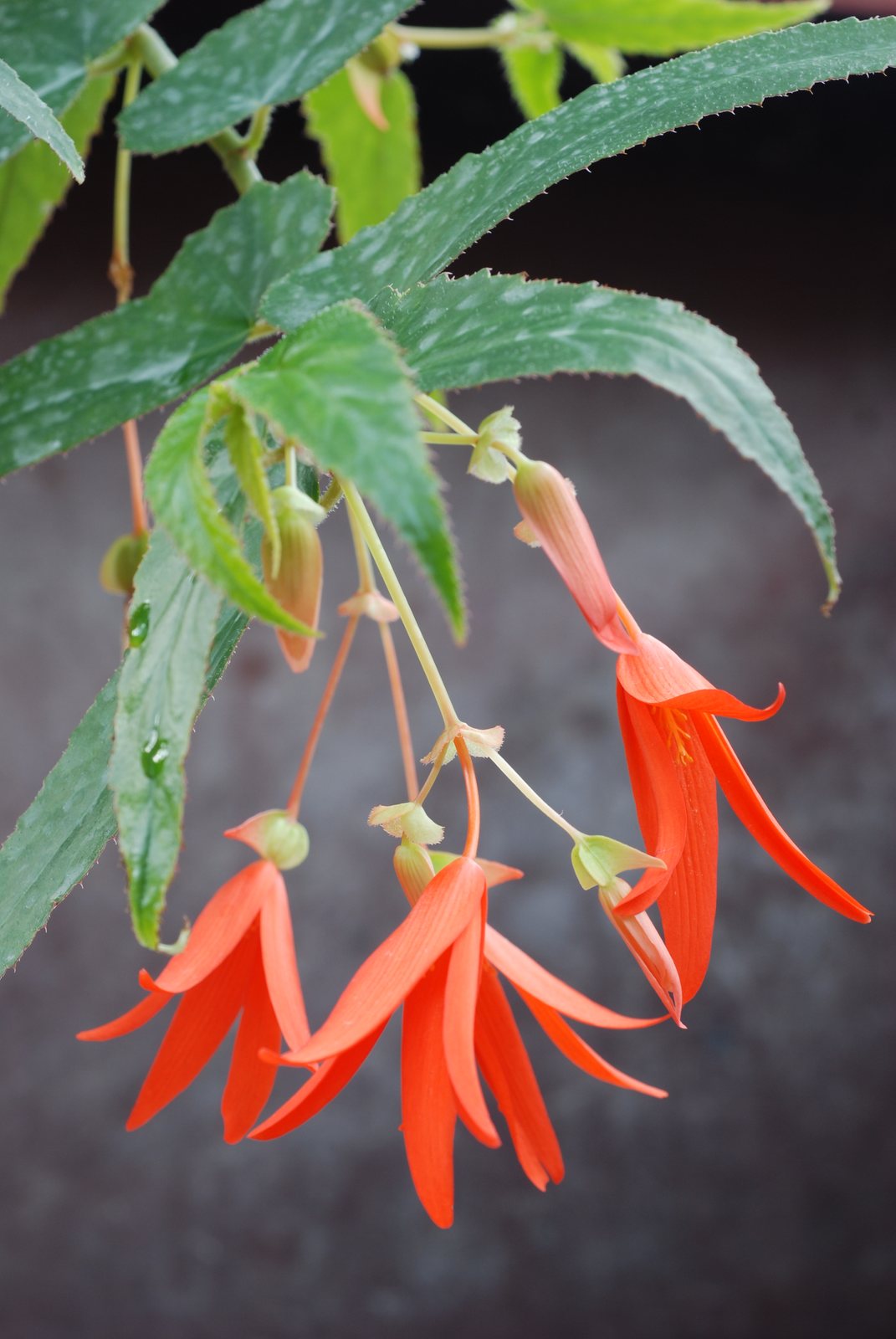
Bolivian begonia is a frost-tender, tuberous perennial with arching stems and narrow, hanging flowers. Gardeners grow it for its long summer display in baskets and containers; in colder climates it is grown as an annual or its tubers are stored indoors over winter.
At a glance
- Sun
- Partial shade or bright filtered light; morning sun is suitable, but protect it from strong afternoon sun in hot climates.
- Water
- Keep evenly moist during active growth, allowing the surface to dry slightly between waterings. Keep dormant tubers nearly dry.
- Soil
- Humus-rich, freely draining soil or container compost; avoid heavy soil that stays wet.
- Height
- 1-2 ft (0.3-0.6 m)
- Spread
- 1-2 ft (0.3-0.6 m)
- Flowers
- Summer into autumn, until frost; slender, pendulous orange-red flowers. Cultivars and hybrids sold under this name offer other colours.
- Foliage
- Narrow, pointed green leaves with toothed edges and an asymmetrical base, carried on fleshy, arching stems.
- Growth
- Fast during the growing season.
- Care needed
- Medium
The year at a glance
- Deer resistant
- Low allergen
| J | F | M | A | M | J | J | A | S | O | N | D | |
|---|---|---|---|---|---|---|---|---|---|---|---|---|
| Flowers | ||||||||||||
| Plant |
Northern hemisphere months. In Australia, shift them by six.
- Difficulty
- Moderate
- Toughness
- Needs looking after
Will it suit your garden?
Pick your zone, country, light and whether you have pets.
Full sun is 6 or more hours of direct sun a day, part shade 3 to 6 hours, shade under 3.
How it grows
Planting day
1 ft (0.3 m)
After 1 year
1.2 ft (0.38 m)
After 2 years
1.5 ft (0.45 m)
full size
About 2 years to full size.
From a typical nursery size, at an average rate for this kind of plant. A rule of thumb, not a forecast.
Good to know
- Cats and dogs
- Toxic
- Growth rate
- Fast
Care
Jobs through the year
- WaterMay, Sep, every 7 days
- For established ground plants, water when the surface dries slightly; new plants and containers need closer checks.
- WaterJun–Aug, every 4 days
- Check established ground plants and water if the surface is drying; baskets may need daily attention.
- WaterOct, every 14 days
- Water only if still leafy and drying out; reduce sharply as foliage yellows and stop when dormant.
- FeedJun–Sep, every 21 days
- Feed actively growing container plants with balanced liquid fertilizer; feed ground plants only if soil is poor.
- PruneMay–Jun
- Pinch young tips if more branching is needed.
- ProtectJun–Aug
- Shelter fleshy stems from strong wind and protect leaves from harsh afternoon sun.
- ProtectSep–Oct
- Before frost, lift plants or move pots under cover and let foliage yellow naturally.
- PruneOct–Nov
- Cut away dead stems only after foliage has yellowed and died back.
- ProtectJan–Mar, Nov–Dec, every 30 days
- Keep dormant tubers nearly dry, cool and frost-free; inspect and discard soft or rotten tubers.
- Plant outside only after frost risk has passed and nights have warmed.
- Use containers with drainage holes and shelter hanging baskets from strong wind.
- Water the compost rather than the foliage, and empty standing water from saucers.
- Feed container plants every two to three weeks with a balanced liquid fertiliser at the label rate during active growth.
- Where winters are cold or wet, lift tubers as growth dies back and store them dry, cool and frost-free.
Pruning. Pinch young shoot tips in spring if plants need more branching, and remove damaged stems during growth. Let foliage yellow naturally before cutting dead stems back for winter storage.
Through the year
- Early spring
- Start stored tubers in fresh, free-draining compost under frost-free cover; water sparingly until shoots develop.
- Late spring
- Gradually acclimatise plants to outdoor conditions, then plant out after frost risk has passed.
- Summer
- Check baskets frequently for drying and feed regularly while plants are growing strongly.
- Late summer
- Remove damaged growth and check leaf undersides for pests.
- Autumn
- Reduce watering as foliage yellows; move plants under cover before frost in cold regions.
- Winter
- Check stored tubers occasionally and discard any that have become soft or rotten; keep sound tubers dry and frost-free.
In the garden
- Use in hanging baskets where the arching stems and hanging flowers can be seen from below.
- Plant along the edge of raised containers to soften their sides with cascading growth.
- Combine with ferns and small hostas in sheltered, partly shaded courtyards for contrasting leaf shapes.
- Group pots beside a shaded entrance or seating area for summer and autumn colour.
Garden styles it suits: Modern courtyard, Cottage garden, Tropical, Victorian, Small-space and Romantic rose garden.
Plant it with: Ferns, Hostas, Fuchsias, Impatiens, Coleus and Wishbone flower.
Wildlife: The flowers may attract hummingbirds where these occur in the Americas, but this is not a major wildlife-supporting plant.
Problems to watch for
- Tuber or root rot: prevent waterlogging, use freely draining compost and reduce watering sharply during dormancy; discard rotten tubers.
- Powdery mildew: improve air circulation, avoid crowding and remove badly affected leaves.
- Aphids and whiteflies: inspect young shoots and leaf undersides; treat infestations with insecticidal soap labelled for begonias, testing a small area first.
- Leaf scorch and wilting: move plants out of hot afternoon sun and check compost moisture before adding more water.
Safety
Toxic to cats, dogs and horses if eaten, with the highest concentration of soluble oxalates in the tubers. Ingestion can cause salivation and vomiting; substantial ingestion may cause more serious illness. People should not eat the plant, as it can cause irritation and stomach upset. Seek veterinary or medical advice after significant ingestion.
Easily confused with
Tuberous garden begonia (Begonia × tuberhybrida)
Usually has broader leaves and larger, more open or double flowers; Bolivian begonia has narrower leaves and slender, hanging flowers. Hybrids between these groups can blur the distinction.
Fuchsia begonia (Begonia fuchsioides)
Has a woody, shrubby framework and many smaller leaves, rather than the seasonal, fleshy shoots arising from a tuber.
The name
Begonia honours Michel Bégon, a French administrator and patron of botany, while boliviensis refers to Bolivia.
Propagation. Take soft stem cuttings in spring or early summer and root them in a moist, airy medium under cover. Seed is another option, but seed from garden hybrids may not produce plants like the parent.
Checked against open data
- Accepted botanical name
- Begonia boliviensis
- Native range
- Argentina Northwest and Bolivia.
Sources: GBIF (CC BY 4.0) and Trefle (CC BY 4.0). The care and design notes are LandscapeGPT's own.
See it in your own yard.
Upload a photo of your yard and see it redesigned with plants that suit your climate, each checked against your zone.