Broad-leaved paperbark
Melaleuca quinquenervia. Family Myrtaceae. Tree.
Also called Broadleaf paperbark, Paperbark tea tree, Punk tree, Niaouli.
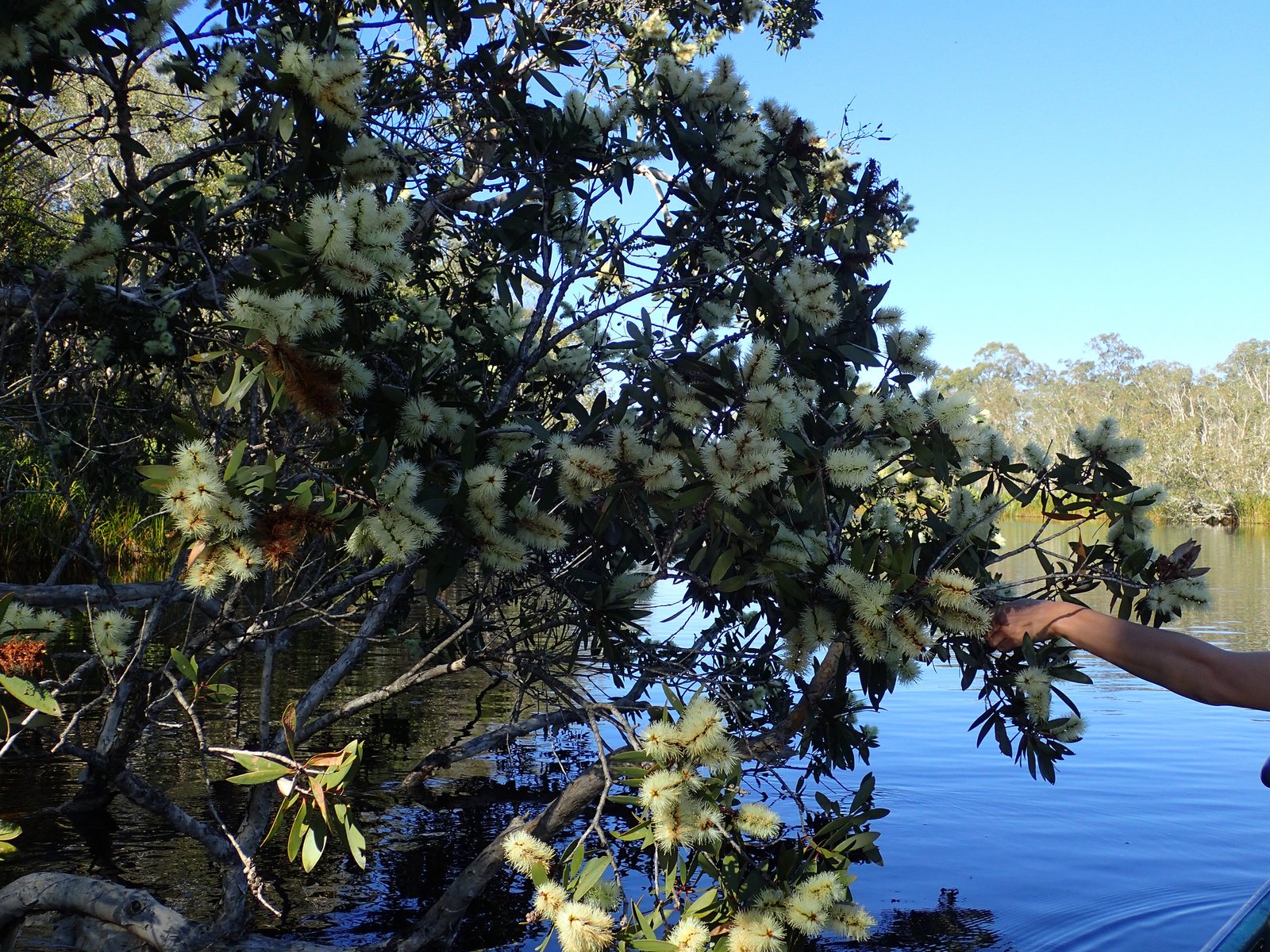
A large evergreen tree from eastern Australia, New Caledonia and nearby islands, grown for its thick, peeling cream bark and pale bottlebrush flowers. It suits spacious, warm-climate gardens and wet ground, but is unsuitable for most outdoor sites in the UK and Canada. It is a serious invasive tree in Florida and some other tropical regions; check local restrictions before planting.
At a glance
- Sun
- Full sun; tolerates light shade but develops a denser crown and flowers better in sun.
- Water
- Water regularly while establishing. Established trees tolerate seasonal flooding and some drought, though prolonged dryness can thin the canopy.
- Soil
- Tolerates sand, loam and clay, including seasonally waterlogged ground; prefers acidic to neutral soil.
- Height
- 30-70 ft (9-21 m), occasionally taller in favorable conditions
- Spread
- 20-40 ft (6-12 m)
- Flowers
- Creamy white bottlebrush spikes, mainly from summer into autumn in Australia; flowering can occur at other times in warm climates.
- Foliage
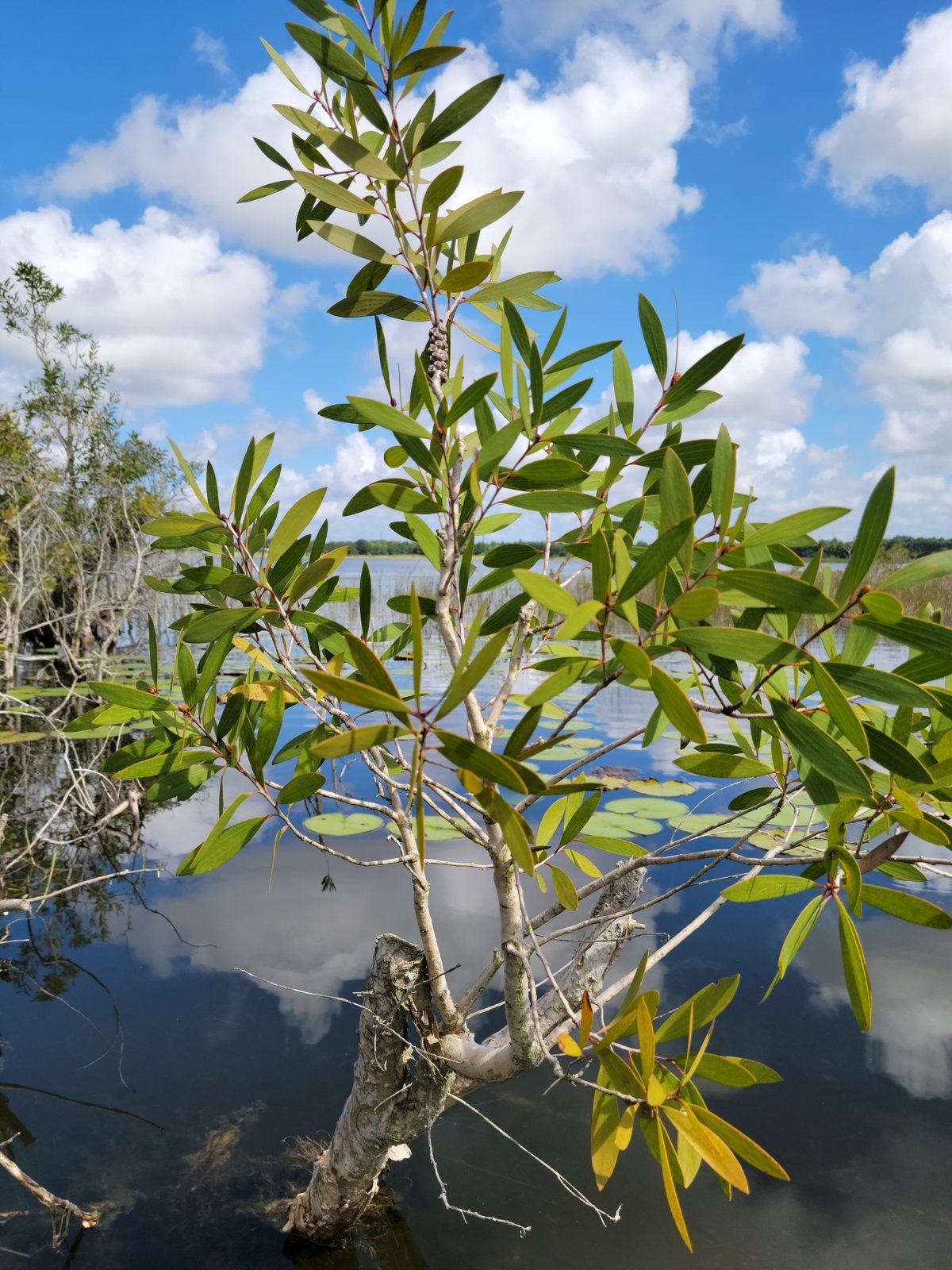
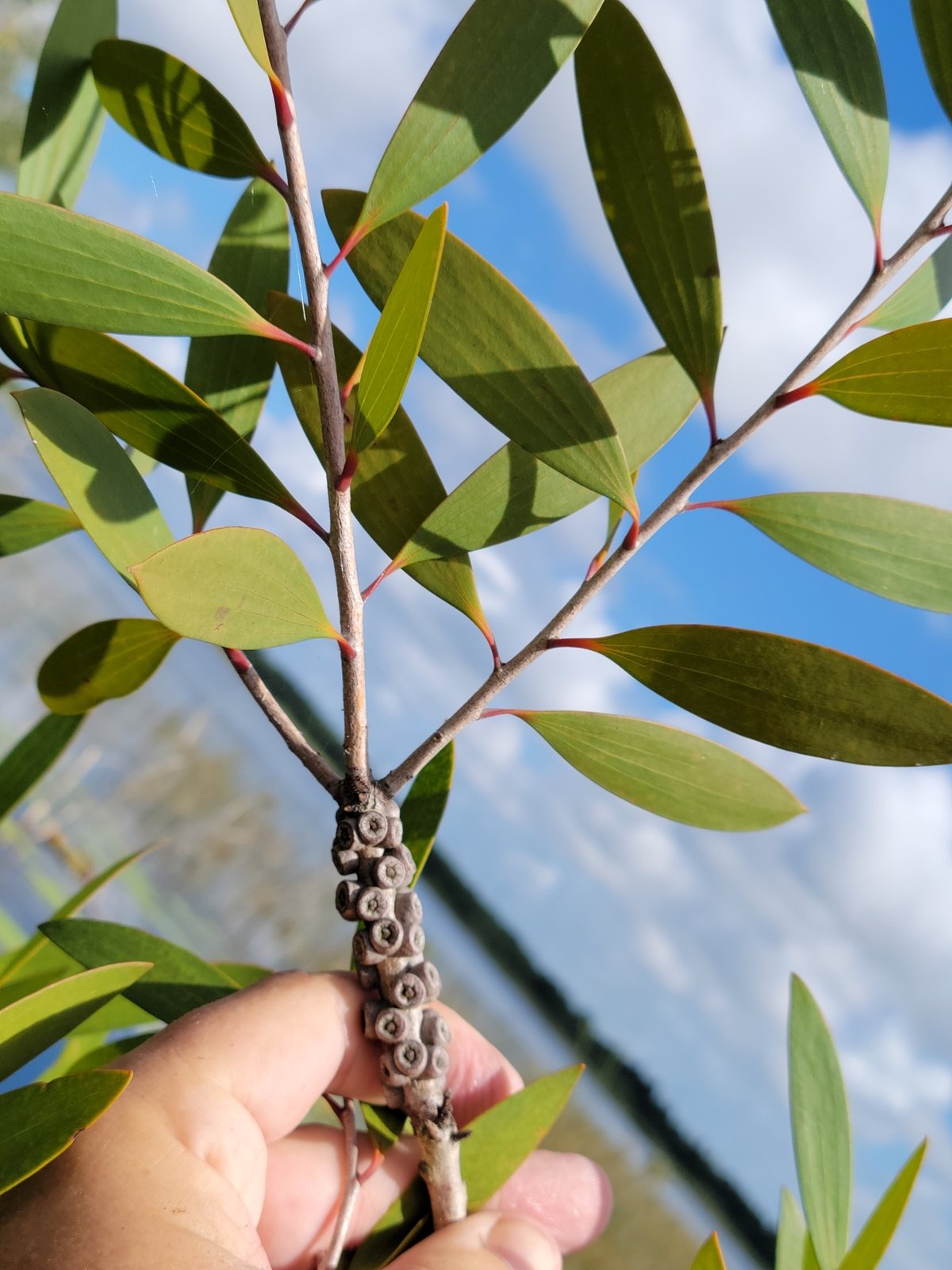
- Evergreen. Leathery, aromatic, grey-green to green leaves with usually five prominent lengthwise veins.
- Growth
- Fast in warm conditions with adequate moisture.
- Care needed
- Medium
The year at a glance
- Pollinators
- Drought tolerant
- Heat tolerant
- Wildlife
- Low allergen
| J | F | M | A | M | J | J | A | S | O | N | D | |
|---|---|---|---|---|---|---|---|---|---|---|---|---|
| Flowers | ||||||||||||
| Fruit | ||||||||||||
| Plant |
Northern hemisphere months. In Australia, shift them by six.
- Difficulty
- Hard
- Toughness
- Fairly tough
Will it suit your garden?
Pick your zone, country, light and whether you have pets.
Full sun is 6 or more hours of direct sun a day, part shade 3 to 6 hours, shade under 3.
How it grows
Planting day
7 ft (2 m)
After 1 year
10 ft (3 m)
After 2 years
13 ft (4 m)
After 3 years
16 ft (5 m)
After 5 years
23 ft (7 m)
About 13 years to full size.
From a typical nursery size, at an average rate for this kind of plant. A rule of thumb, not a forecast.
Good to know
- Cats and dogs
- Mildly toxic: may upset a stomach
- Native to
- Australia
- Invasive in
- the US
- In the garden
- Spreads vigorously: plan to contain it.
- Growth rate
- Fast
Care
Jobs through the year
- ProtectApr–Jun
- Check invasive-plant restrictions before planting; do not plant where it threatens wetlands.
- WaterApr–May, Sep–Oct, every 14 days
- Water established ground-grown trees deeply during dry spells; young trees and containers need more.
- WaterJun–Aug, every 14 days
- Deep-water established ground-grown trees during prolonged drought; water young trees more frequently.
- WaterJan–Mar, Nov–Dec, every 14 days
- Check frost-free container plants and water lightly when the compost begins to dry.
- MulchMay
- Refresh a broad organic mulch layer, keeping the trunk clear.
- FeedMay
- Only if growth is poor, apply a small amount of low-phosphorus fertilizer.
- PruneFeb–Mar
- Train young trees by removing competing leaders; never top mature trees.
- ProtectSep–Oct
- Pull unwanted seedlings promptly, especially near wet ground and drains.
- ProtectJan–Apr, Oct–Dec
- Unsuitable outdoors year-round in zones 6–7; needs a large, bright, frost-free winter space.
- Check invasive-plant regulations before buying; do not plant where it threatens nearby wetlands.
- Allow room for a large tree, well away from buildings, drains and overhead wires.
- Water deeply during dry spells for the first two growing seasons.
- Apply a broad layer of organic mulch, keeping it clear of the trunk.
- Feed only if growth is poor; in Australian native plantings, use a low-phosphorus fertilizer sparingly.
Pruning. Train young trees in late winter or after the main flowering period, retaining well-spaced branches and removing competing leaders where a single trunk is wanted. Remove dead or damaged wood as needed; avoid topping mature trees and use a qualified arborist for large limbs.
Through the year
- Spring
- Where planting is permitted, plant after frost risk has passed and water the root area thoroughly.
- Late spring
- Refresh mulch and check that any tree ties are loose enough to allow trunk movement.
- Summer
- Water young trees deeply during dry weather; check new shoots for distorted growth or rust pustules.
- Autumn
- Remove unwanted seedlings while small, especially beside drains and wet ground.
- Winter
- Check for frost damage and broken branches; delay cutting frost-damaged shoots until new growth shows what has survived.
- Late winter
- Lightly shape young trees before vigorous growth resumes, unless they are flowering.
In the garden
- Use as a specimen in a large lawn where the layered pale bark can be seen clearly.
- Plant in spacious Australian native wetland gardens with swamp banksia and moisture-tolerant ground plants.
- Use a loose group to create a light evergreen canopy over robust sedges and flax-lilies.
- Set against darker evergreen planting to emphasize the pale trunk and cream flowers.
Garden styles it suits: Australian native, Coastal, Wildlife garden, Bog garden, Architectural minimal and Winter interest.
Plant it with: Swamp banksia, Swamp bottlebrush, Spiny-headed mat-rush, Blue flax-lily and Swamp lily.
Wildlife: Flowers provide nectar and pollen for bees and other insects, and attract nectar-feeding birds in its native range. The canopy and layered bark offer shelter, but outside its native range dense stands can displace much more valuable wetland habitat.
Problems to watch for
- Myrtle rust can cause yellow-orange pustules and distorted young shoots. Avoid overhead watering, do not move infected plants, and follow local plant-health advice.
- Scale insects can cause sticky honeydew and sooty mould. Encourage natural predators and treat accessible infestations with a horticultural oil labeled for the plant and pest.
- Frost can scorch foliage and kill young shoots. Choose a sheltered, frost-light site and protect young trees during cold snaps.
- Heavy seed production can lead to unwanted seedlings. Pull seedlings early; where the tree is invasive, seek approved removal advice rather than relying on pruning.
Safety
Species-specific information on poisoning from garden exposure is limited, so the leaves and bark should not be assumed safe for people, cats, dogs or horses to eat. Concentrated niaouli essential oil distilled from the foliage can be harmful if swallowed and should be kept away from children and pets; do not apply it to animals.
Where it spreads. Highly invasive in southern Florida, especially the Everglades, where it forms dense stands and alters wetland habitats and fire behavior. It is a US federal noxious weed and a prohibited plant in Florida. It is also reported invasive in Hawaii and parts of the Caribbean; check current local rules before planting or moving seed.
Easily confused with
Weeping paperbark (Melaleuca leucadendra)
Usually has narrower, longer leaves and more noticeably drooping branchlets; broad-leaved paperbark generally has broader, stiffer leaves and a less weeping crown.
Prickly-leaved paperbark (Melaleuca styphelioides)
Has small, sharply pointed leaves rather than the broad, leathery leaves with conspicuous lengthwise veins.
Swamp paperbark (Melaleuca ericifolia)
Has very narrow, short leaves and commonly forms a suckering thicket, unlike the broad-leaved, usually larger tree.
The name
Melaleuca comes from Greek words meaning black and white, referring to contrasting bark seen in the genus, while quinquenervia means five-veined and describes the prominent veins in the leaves.
Propagation. Usually raised from fine seed sown on the surface of moist propagation mix in warm conditions; do not bury deeply. Capsules can retain seed on branches for years and release it after drying or disturbance. Do not propagate where possession or distribution is restricted.
Checked against open data
- Accepted botanical name
- Melaleuca quinquenervia
- In the US and Canada
- Introduced in Hawaii, the lower 48 states, Pacific Basin and Puerto Rico.
- Native range
- New Caledonia, New Guinea, New South Wales and Queensland.
- Measured
- Average height 1200 cm.
Sources: GBIF (CC BY 4.0), USDA PLANTS and Trefle (CC BY 4.0). The care and design notes are LandscapeGPT's own.
See it in your own yard.
Upload a photo of your yard and see it redesigned with plants that suit your climate, each checked against your zone.