Swamp banksia
Banksia robur. Family Proteaceae. Shrub.
Also called Broad-leaved banksia.
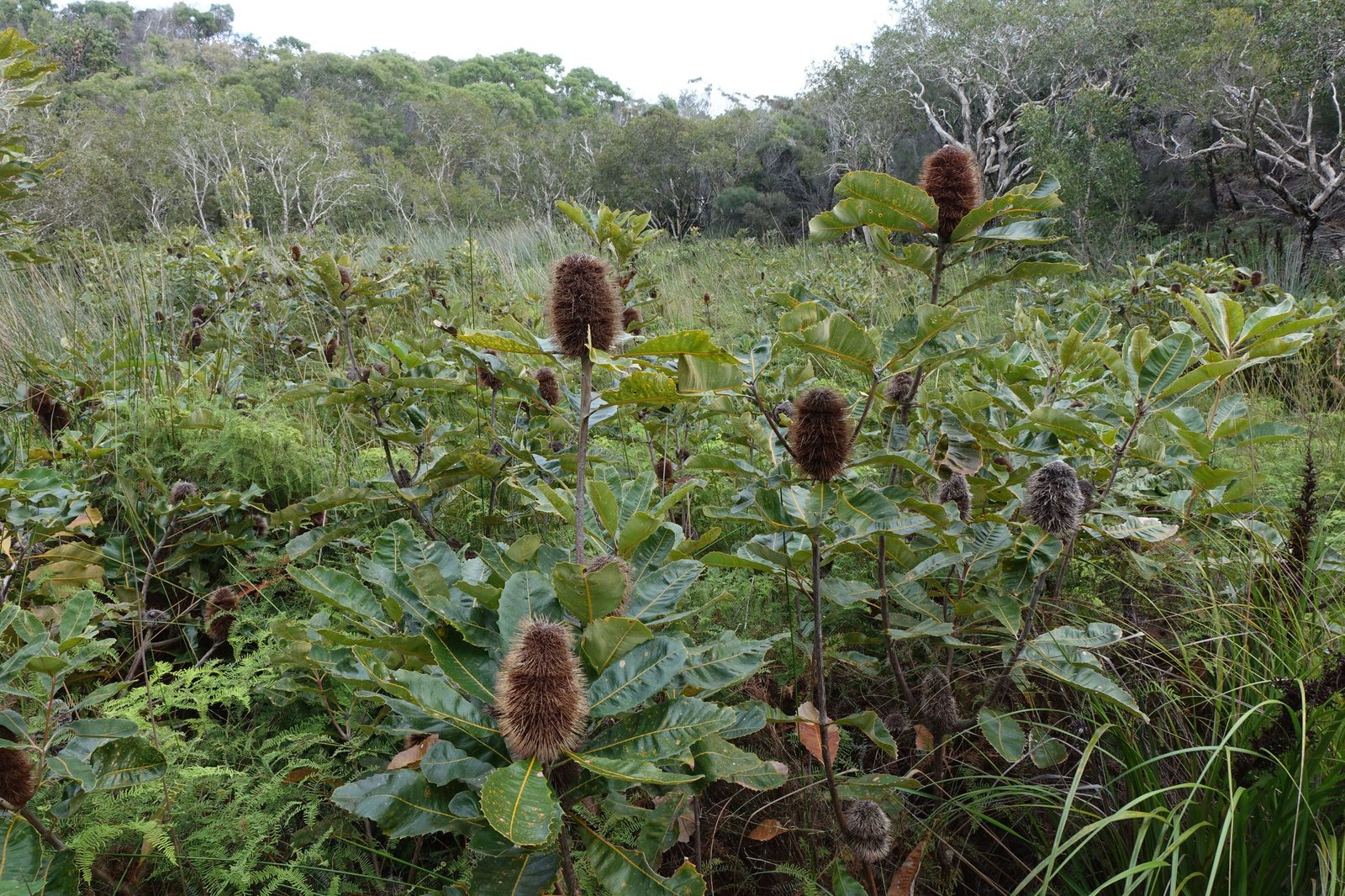
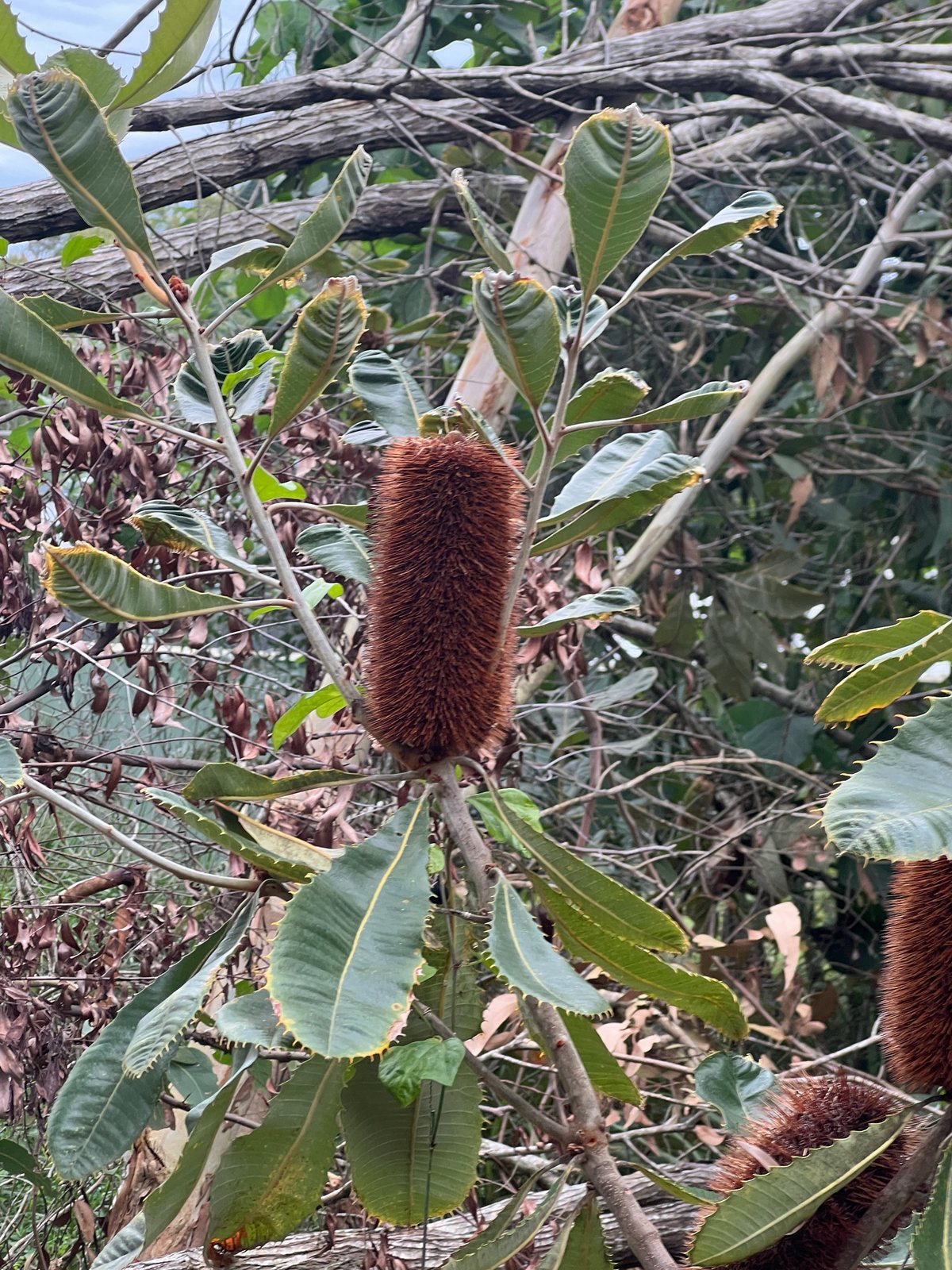
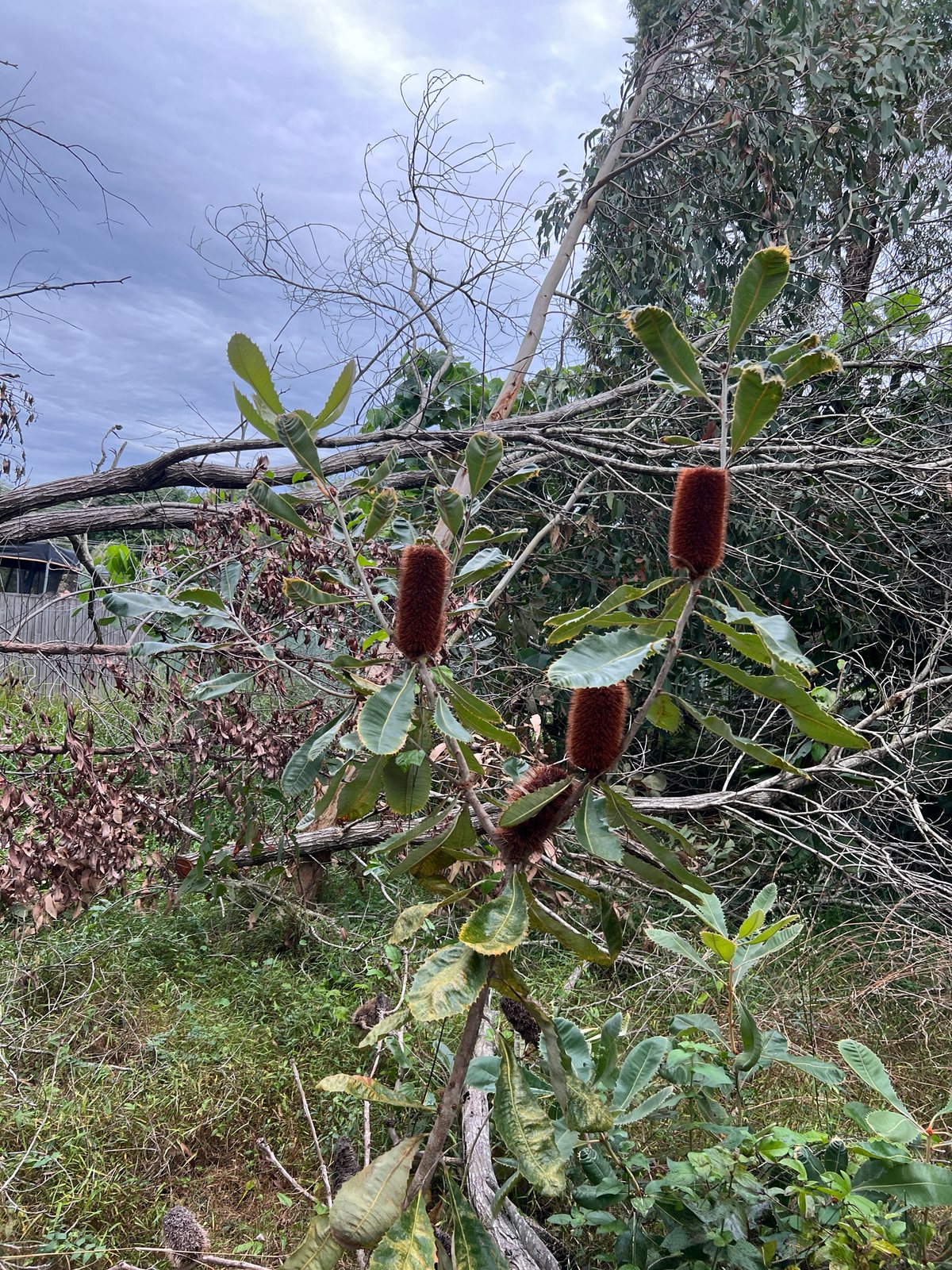
Swamp banksia is an evergreen Australian shrub with large, leathery leaves and upright flower spikes that change from metallic green-blue to yellow and then brown. Gardeners grow it for its bold foliage, nectar-rich flowers and ability to tolerate seasonally wet, acidic ground; it needs a mild climate and protection from hard frost.
At a glance
- Sun
- Full sun to light shade; flowering is usually best in sun.
- Water
- Moderate to high. Keep young plants consistently moist; established shrubs tolerate short dry periods but perform best with reliable moisture.
- Soil
- Acidic, low-phosphorus sand or sandy loam, including seasonally waterlogged ground. Avoid alkaline soil and permanently stagnant conditions.
- Height
- 6-10 ft (1.8-3 m)
- Spread
- 6-10 ft (1.8-3 m)
- Flowers
- Usually late summer through winter, though timing varies with climate and flowers can appear outside this period. Upright spikes open green-blue, turn yellow-green to yellow, then age brown.
- Foliage
- Evergreen. Large, broad, leathery green leaves with toothed edges and pale, hairy undersides; young growth is often rusty brown.
- Growth
- Moderate
- Care needed
- Medium
The year at a glance
- Pollinators
- Heat tolerant
- Wildlife
- Low allergen
| J | F | M | A | M | J | J | A | S | O | N | D | |
|---|---|---|---|---|---|---|---|---|---|---|---|---|
| Flowers | ||||||||||||
| Fruit | ||||||||||||
| Plant |
Northern hemisphere months. In Australia, shift them by six.
- Difficulty
- Hard
- Toughness
- Fairly tough
Will it suit your garden?
Pick your zone, country, light and whether you have pets.
Full sun is 6 or more hours of direct sun a day, part shade 3 to 6 hours, shade under 3.
How it grows
Planting day
1.6 ft (0.5 m)
After 1 year
2.9 ft (0.88 m)
After 2 years
4 ft (1.3 m)
After 3 years
5 ft (1.6 m)
After 5 years
8 ft (2.4 m)
full size
About 5 years to full size.
From a typical nursery size, at an average rate for this kind of plant. A rule of thumb, not a forecast.
Good to know
- Cats and dogs
- Safe
- Native to
- Australia
- Growth rate
- Moderate
Care
Jobs through the year
- WaterApr–May, Sep–Oct, every 7 days
- Check established ground plants and water when drying; keep young plants consistently moist.
- WaterJun–Aug, every 5 days
- Check established ground plants and soak before the root zone dries; avoid stagnant conditions.
- FeedApr–May
- Feed only for weak growth with a small dose of low-phosphorus banksia-safe fertiliser.
- MulchMay
- Spread coarse organic mulch without covering stems or disturbing shallow roots.
- PruneMar–Apr
- After the main flowering period, lightly shorten leafy shoots; avoid hard pruning.
- ProtectJan–Apr, Oct–Dec
- Use a movable container and bright, frost-free winter shelter; zone 6–7 ground winters are unsuitable.
- Water deeply during establishment and through prolonged dry weather; do not let a container root ball dry out completely.
- Feed sparingly, using only a low-phosphorus fertiliser labelled suitable for Australian native plants.
- Spread a light layer of coarse organic mulch over the root zone, keeping it clear of the stems.
- Avoid digging around the shallow roots or adding manure and rich general-purpose fertilisers.
- Shelter young plants from frost and cold winds; grow in a movable container where winters are too cold.
Pruning. After the main flowering period, lightly shorten leafy shoots to encourage branching and remove dead or damaged wood. Avoid routine hard pruning into bare old wood; although this species can reshoot from its woody base, recovery is not guaranteed in garden conditions.
Through the year
- Spring
- Plant after frost risk has passed in cooler districts, watering the root ball thoroughly.
- Spring
- Refresh mulch and, only if growth is weak, apply a small amount of low-phosphorus native-plant fertiliser.
- Summer
- Check soil moisture during hot spells and water deeply before the root zone dries out.
- Late summer
- Inspect developing flower spikes and young shoots for scale insects and honeydew.
- Autumn
- Plant in mild, frost-free districts while the soil is still warm; keep new plants moist.
- Winter
- Protect young shrubs from forecast frost and move container plants under bright, frost-free cover where necessary.
In the garden
- Use as a bold-leaved specimen beside a path or patio, leaving room for its broad mature shape.
- Plant along the upper edge of a rain garden where soil is moist but water does not remain stagnant.
- Combine with sedges and other moisture-loving Australian natives for contrasting leaf shapes.
- Include in a sunny wildlife border where nectar-feeding birds can reach the flowers.
Garden styles it suits: Australian native, Architectural minimal, Wildlife garden, Coastal, Bog garden and Modern tropical.
Plant it with: Swamp bottlebrush, Swamp paperbark, Knobby club-rush, Tall sedge and Flax-leaf paperbark.
Wildlife: The nectar-rich flowers attract honeyeaters in Australia and other nectar-feeding birds and insects where grown. Woody seed cones can provide food for seed-eating birds.
Problems to watch for
- Yellow leaves in alkaline soil: test soil pH and use a suitable acidic planting site or an acidic, low-phosphorus container mix rather than repeatedly adding fertiliser.
- Phosphorus toxicity, causing scorched leaves and declining growth: stop general-purpose feeding and avoid manure; use only products suitable for phosphorus-sensitive natives.
- Root rot, including Phytophthora, can cause sudden wilt and dieback: avoid contaminated soil and stagnant conditions, and remove badly affected plants.
- Scale insects can cause sticky honeydew and sooty mould: inspect stems and leaf undersides, remove small infestations by hand and use a labelled horticultural oil if needed.
Safety
Not known to be toxic to people, cats, dogs or horses. No particular part is recognised as poisonous, but species-specific safety information is limited; discourage pets and children from chewing leaves or woody cones.
Easily confused with
Saw banksia (Banksia serrata)
Usually develops rough, corky bark and a more tree-like form. Its leaves are generally narrower, while swamp banksia has especially broad leaves and smoother young stems.
Fern-leaved banksia (Banksia oblongifolia)
Has smaller, narrower leaves and rusty-hairy young shoots. Swamp banksia has much larger, broader leaves with a conspicuously pale underside.
The name
Banksia honours botanist Joseph Banks, while robur is Latin for strength or oak, referring to the sturdy, oak-like leaves; swamp banksia describes its naturally wet habitat.
Propagation. Usually grown from seed sown in a free-draining, low-phosphorus propagation mix and kept moist in a warm, bright place. Collect seed from mature woody cones that open naturally; semi-ripe cuttings are possible but can be difficult to root.
Checked against open data
- Accepted botanical name
- Banksia robur
- Native range
- New South Wales and Queensland.
- Measured
- Average height 185 cm.
Sources: GBIF (CC BY 4.0) and Trefle (CC BY 4.0). The care and design notes are LandscapeGPT's own.
See it in your own yard.
Upload a photo of your yard and see it redesigned with plants that suit your climate, each checked against your zone.