Bunchberry
Cornus canadensis. Family Cornaceae. Groundcover.
Also called Canadian dwarf cornel, Creeping dogwood, Dwarf dogwood.
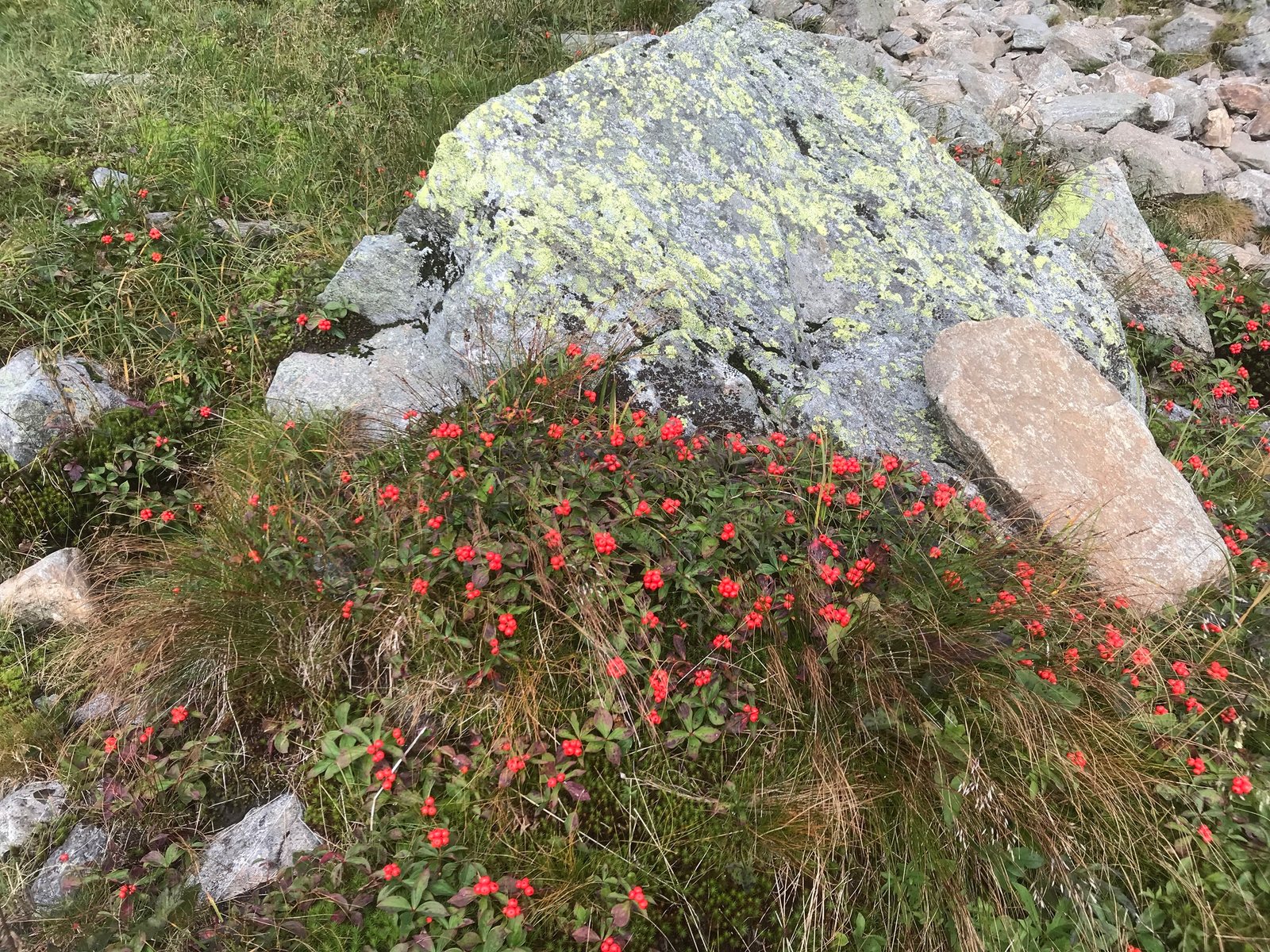
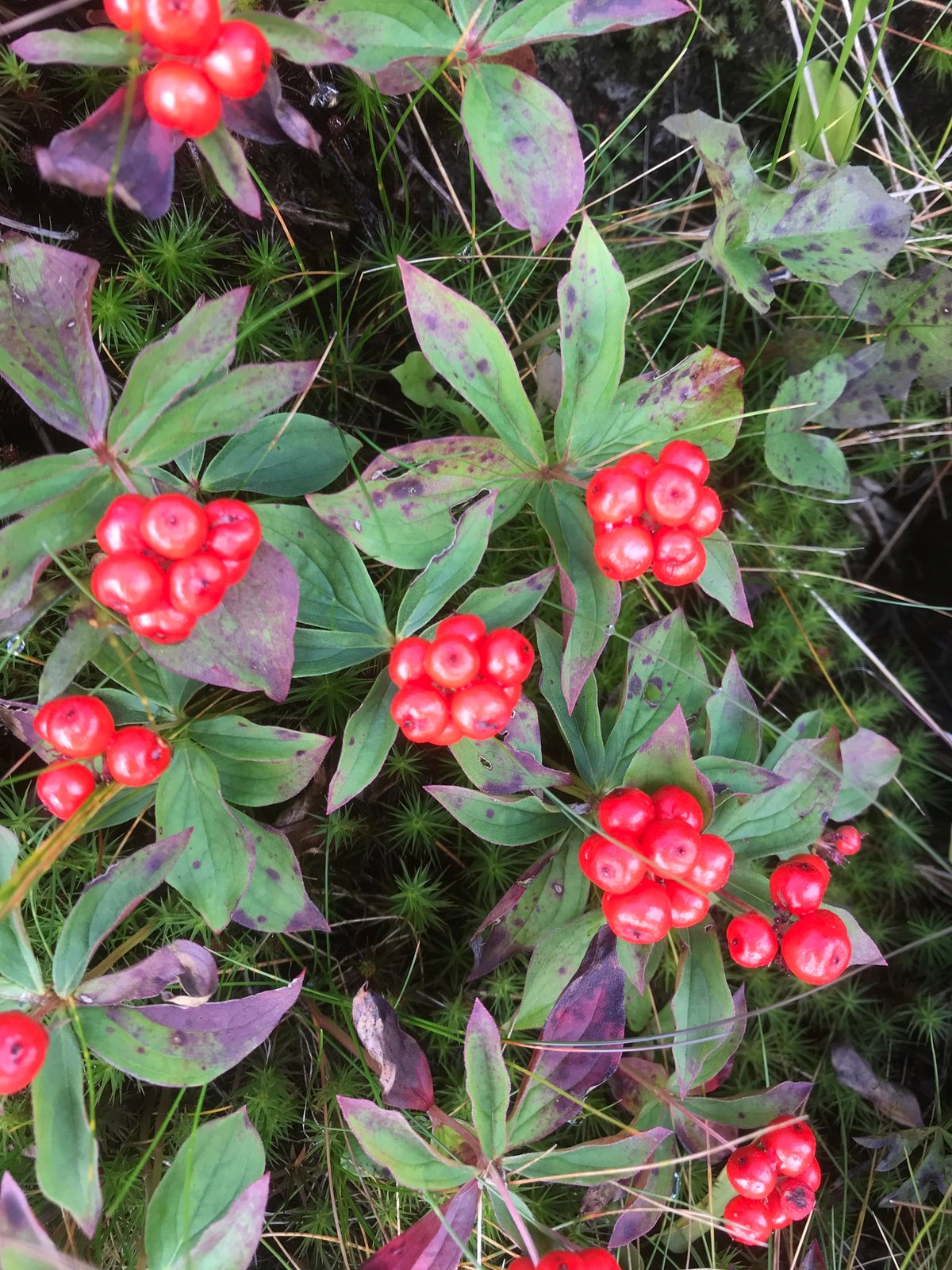
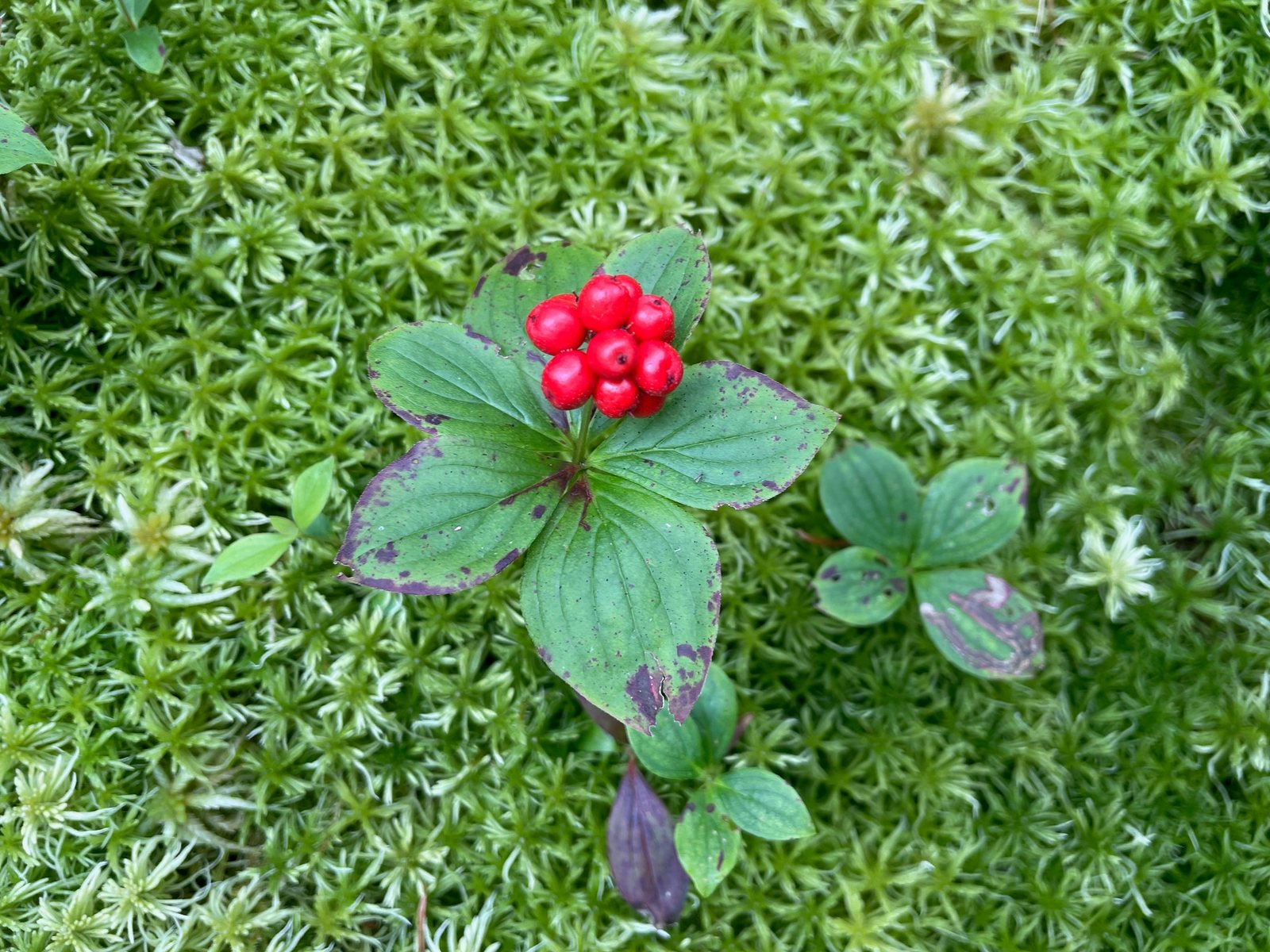
Bunchberry is a low, spreading woodland perennial with white flower-like bracts, whorled leaves and clusters of red berries. Grow it beneath trees or among ferns where the soil stays cool, moist and acidic. It suits cool climates and often struggles where summers are hot or the soil dries out.
At a glance
- Sun
- Partial shade or dappled woodland shade; tolerates more sun in cool climates if the soil remains moist.
- Water
- Keep consistently moist but not waterlogged; shallow roots are vulnerable to drying out.
- Soil
- Acidic, humus-rich, well-drained soil, preferably around pH 4.5-6. Avoid chalky soil and heavy, poorly drained clay.
- Height
- 0.3-0.7 ft (0.1-0.2 m)
- Spread
- 1-3 ft (0.3-0.9 m), eventually forming wider colonies through creeping rhizomes
- Flowers
- Late spring to early summer; tiny greenish flowers surrounded by four showy white bracts.
- Foliage
- Oval, prominently veined green leaves clustered near the stem tips; often turn red or purple in autumn.
- Growth
- Slow to establish, then moderate spreading in suitable conditions
- Care needed
- Medium
The year at a glance
- Pollinators
- Cold hardy
- Wildlife
- Low allergen
| J | F | M | A | M | J | J | A | S | O | N | D | |
|---|---|---|---|---|---|---|---|---|---|---|---|---|
| Flowers | ||||||||||||
| Fruit | ||||||||||||
| Plant |
Northern hemisphere months. In Australia, shift them by six.
- Difficulty
- Moderate
- Toughness
- Needs looking after
Will it suit your garden?
Pick your zone, country, light and whether you have pets.
Full sun is 6 or more hours of direct sun a day, part shade 3 to 6 hours, shade under 3.
How it grows
Planting day
0.1 ft (0.04 m)
After 1 year
0.2 ft (0.07 m)
After 2 years
0.4 ft (0.11 m)
After 3 years
0.5 ft (0.14 m)
After 5 years
0.5 ft (0.15 m)
full size
About 3 years to full size.
From a typical nursery size, at an average rate for this kind of plant. A rule of thumb, not a forecast.
Good to know
- Cats and dogs
- Safe
- Native to
- the US and Canada
- Growth rate
- Slow
Care
Jobs through the year
- WaterApr–May, Sep–Oct, every 7 days
- Water if rainfall is insufficient; keep the shallow root zone consistently moist.
- WaterJun–Aug, every 3 days
- Check moisture and water before roots dry out; new plants need closer attention.
- MulchApr–May
- Spread a thin layer of leaf mould or fine composted bark over the root zone.
- PruneMar
- Remove dead stems without disturbing shallow rhizomes.
- DivideApr, Sep
- If propagation or containment is needed, lift small rooted sections and replant promptly.
- ProtectOct–Nov
- Retain a light leaf covering but remove thick mats that smother shoots.
- Plant in spring or early autumn, keeping the root ball at its original depth.
- Water during dry spells before the shallow root zone dries out.
- Apply a thin mulch of leaf mould or fine composted bark each spring.
- Avoid heavy feeding; use a light application of fertiliser for acid-loving plants only if growth is poor.
- Keep fallen leaves as a light woodland mulch, but remove thick, smothering mats.
- Avoid hoeing or walking through established patches, which damages shallow rhizomes.
Pruning. No routine pruning is needed. Remove dead stems in early spring and lift unwanted rooted growth at the edge of the patch.
Through the year
- Early spring
- Remove dead stems and check that winter debris is not smothering emerging shoots.
- Spring
- Plant or divide small sections and water them in thoroughly.
- Late spring
- Apply a thin layer of leaf mould and enjoy the white bracts.
- Summer
- Check soil moisture during warm weather and water deeply enough to moisten the root zone.
- Late summer
- Leave red berries for birds and check whether spreading shoots need containing.
- Autumn
- Plant in cool, moist conditions and retain a light covering of fallen leaves.
In the garden
- Use as a low carpet beneath deciduous trees where roots do not make the soil too dry.
- Plant with ferns and woodland perennials for contrasting leaf shapes.
- Edge shaded paths with colonies that provide white spring bracts and red late-season fruit.
- Combine with rhododendrons and other acid-soil shrubs in cool woodland borders.
Garden styles it suits: Woodland, Wildlife garden, Moss and fern garden, Pacific Northwest woodland, Japanese and New England.
Plant it with: Christmas fern, Lady fern, Foamflower, Wild ginger, Rhododendron and Trillium.
Wildlife: Flowers attract small pollinating insects, and birds and small mammals eat the berries. Dense patches provide low cover for woodland invertebrates.
Problems to watch for
- Scorched or collapsing growth in hot, dry weather: increase shade, maintain moisture and mulch; choose another groundcover if summers are consistently hot.
- Yellow leaves on alkaline soil: test the pH and move plants to naturally acidic soil or a suitable acidic growing medium.
- Root and rhizome rot in saturated soil: improve drainage or relocate plants; do not leave roots standing in water.
- Slugs and snails damaging young shoots: remove hiding places near affected plants and use wildlife-conscious controls where necessary.
Safety
Not known to be toxic to people, cats, dogs or horses. The red fruit is edible but bland and seedy; specific animal safety information is limited, so discourage pets from eating large quantities.
Easily confused with
Dwarf cornel (Cornus suecica)
Has dark purple central flowers within the white bracts and more clearly spaced pairs of leaves along the stems; bunchberry has pale greenish flowers and leaves crowded near the stem tips.
Canada mayflower (Maianthemum canadense)
Has alternate, heart-based leaves and a short cluster of small white flowers without four large white bracts.
The name
Bunchberry refers to the tight clusters of red fruit, while canadensis means 'of Canada'.
Propagation. Divide rooted sections of the creeping rhizomes in spring or early autumn and replant promptly without letting them dry out. Seed is slow and irregular to germinate and may need successive warm and cold periods.
Checked against open data
- Accepted botanical name
- Cornus canadensis
- In the US and Canada
- Native in Alaska, Canada, Greenland, the lower 48 states and St. Pierre and Miquelon.
- Native range
- Alaska, Alberta, Aleutian Is., Amur, British Columbia, Colorado, Connecticut, Greenland, Idaho, Illinois, Indiana and Iowa.
- Measured
- Average height 14 cm.
Sources: GBIF (CC BY 4.0), USDA PLANTS and Trefle (CC BY 4.0). The care and design notes are LandscapeGPT's own.
See it in your own yard.
Upload a photo of your yard and see it redesigned with plants that suit your climate, each checked against your zone.