Burro's tail
Sedum morganianum. Family Crassulaceae. Succulent.
Also called Donkey's tail, Lamb's tail.
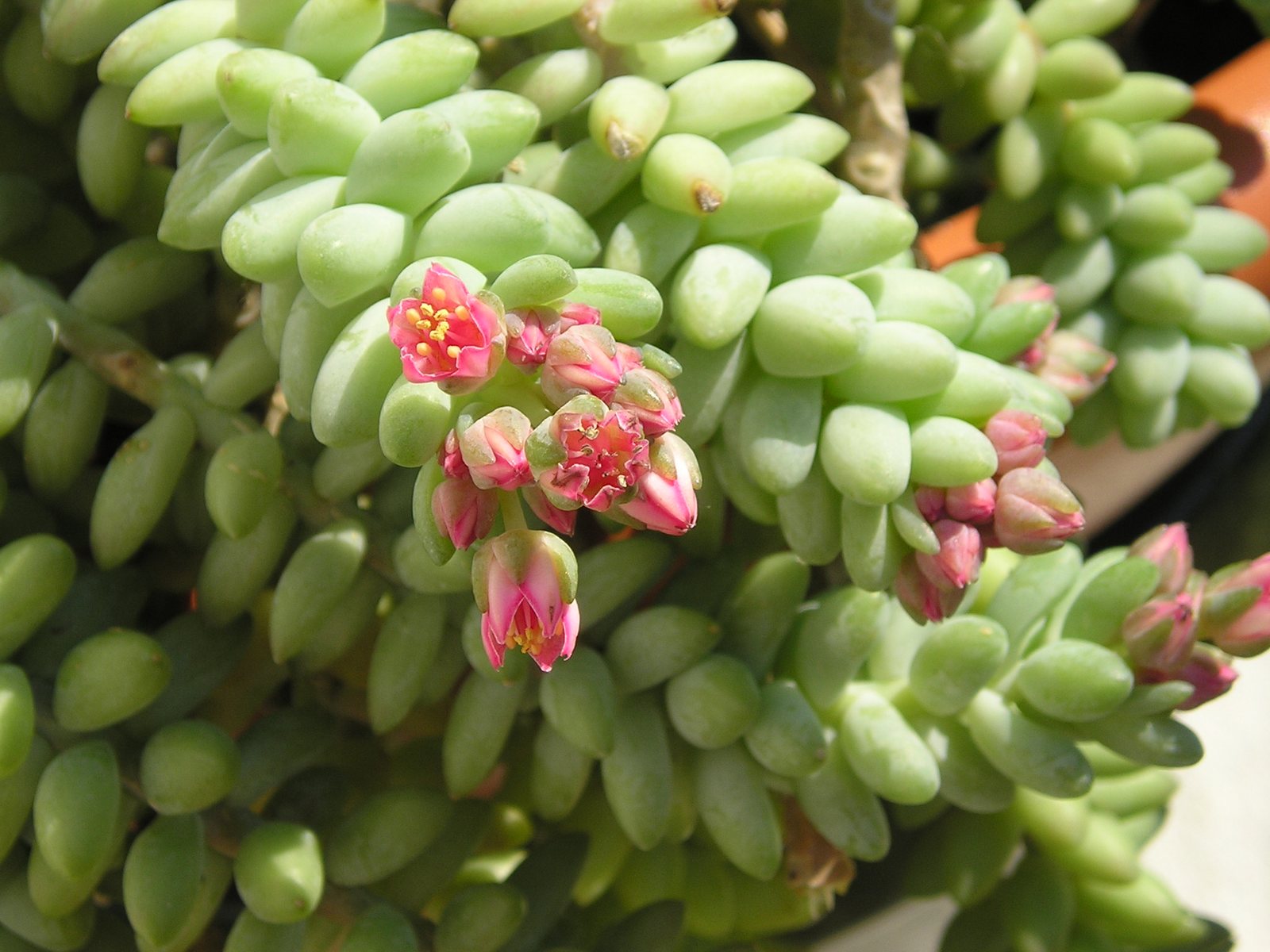
Burro's tail is an evergreen succulent with trailing stems densely packed with fleshy, blue-green leaves. Grow it in a hanging basket or raised pot where its stems can hang freely without being knocked. It needs frost-free conditions and is usually kept as a houseplant or moved indoors for winter in colder regions.
At a glance
- Sun
- Bright filtered light or gentle morning sun; protect from harsh afternoon sun, especially in hot Australian and southern US gardens. Indoors, use a bright window and introduce direct sun gradually.
- Water
- Let the potting mix dry thoroughly between waterings, then water deeply and let it drain. Water much less in winter, particularly in cool conditions.
- Soil
- A sharply draining cactus mix with added pumice, grit or perlite, in a container with drainage holes.
- Height
- 4-6 in (0.1-0.15 m) above the pot rim; trailing stems can reach 2-4 ft (0.6-1.2 m)
- Spread
- 1-2 ft (0.3-0.6 m)
- Flowers
- Small pink to reddish flowers at stem tips, usually in summer; flowering is uncommon indoors.
- Foliage
- Evergreen. Plump, pointed, blue-green leaves tightly overlap along trailing stems. A pale, powdery coating covers the leaves, which detach very easily when touched.
- Growth
- Slow to moderate in warm, bright conditions.
- Care needed
- Low
The year at a glance
- Drought tolerant
- Heat tolerant
- Low allergen
| J | F | M | A | M | J | J | A | S | O | N | D | |
|---|---|---|---|---|---|---|---|---|---|---|---|---|
| Flowers | ||||||||||||
| Plant |
Northern hemisphere months. In Australia, shift them by six.
- Difficulty
- Easy
- Toughness
- Fairly tough
Will it suit your garden?
Pick your zone, country, light and whether you have pets.
Full sun is 6 or more hours of direct sun a day, part shade 3 to 6 hours, shade under 3.
How it grows
Planting day
0.4 ft (0.13 m)
full size
About 8 years to full size.
From a typical nursery size, at an average rate for this kind of plant. A rule of thumb, not a forecast.
Good to know
- Cats and dogs
- Safe
- Growth rate
- Slow
Care
Jobs through the year
- WaterMar–May, Sep–Oct, every 21 days
- Grow in a movable pot in this climate; water thoroughly only when the mix is dry throughout and drain fully.
- WaterJun–Aug, every 14 days
- For potted plants, water only when the entire mix is dry; empty saucers and adjust for heat or rain.
- WaterJan–Feb, Nov–Dec, every 42 days
- Overwinter indoors in bright light; water sparingly only when the mix is completely dry.
- FeedMay, Jul
- Give a light application of diluted cactus fertilizer during active growth.
- PruneApr–Jun
- If needed, shorten long or bare stems above a leaf or side shoot, handling gently.
- ProtectMay–Jun
- Move pots outside only once nights stay above about 10°C; acclimatize gradually to morning sun.
- ProtectSep–Oct
- Bring pots into a bright frost-free position before nights become cold.
- Use a pot with drainage holes and empty any saucer after watering.
- Wait until the potting mix is dry throughout before watering again.
- Feed lightly with a diluted cactus fertiliser once or twice during spring and summer.
- Keep above freezing; bring outdoor pots under cover before cold nights arrive.
- Handle as little as possible and keep hanging stems away from busy paths.
Pruning. In spring or early summer, shorten overly long or bare stems with clean scissors, cutting just above a leaf or side shoot. Remove dead stems carefully and keep healthy cuttings for propagation.
Through the year
- Spring
- Check drainage and repot only if needed, handling the stems gently to limit leaf loss.
- Late spring
- Move pots outdoors once nights are reliably mild, gradually introducing brighter light.
- Summer
- Water thoroughly when the mix dries out and give a light feed during active growth.
- Summer
- Take stem or leaf cuttings and check sheltered leaf joints for mealybugs.
- Autumn
- Bring plants into a bright, frost-free position before cold weather and reduce watering.
- Winter
- Keep in the brightest suitable position and water sparingly; do not feed.
In the garden
- Hang in a sheltered courtyard where the long stems form a curtain over the pot edge.
- Place in a tall, simple container to show off the blue-green foliage.
- Use at the edge of a mixed succulent container with upright plants that share its drainage needs.
- Display on a bright indoor shelf away from passing hands and pets.
Garden styles it suits: Modern, Modern courtyard, Desert modern, Mediterranean, Urban city garden and Small-space.
Plant it with: Haworthia, Gasteria, Echeveria and Jade plant.
Wildlife: Flowers may attract small insect visitors when plants bloom outdoors, but this is not a major wildlife-supporting plant.
Problems to watch for
- Root or stem rot: prevent standing water and prolonged wet soil; remove rotten material and root healthy stem tips in fresh, dry-draining mix.
- Mealybugs: isolate the plant, dab visible insects with a cotton bud lightly moistened with rubbing alcohol, and repeat inspections; test a small area first.
- Leaf drop: avoid brushing or moving the stems unnecessarily; sudden heavy shedding can also follow overwatering or cold damage.
- Scorched or stretched growth: introduce direct sun gradually to prevent pale, burned patches; move thin, widely spaced growth into brighter light.
Safety
Not known to be toxic to cats, dogs, horses or people. No part is recognised as poisonous, but it is not a food plant, and eating it may cause mild stomach upset.
Easily confused with
Burrito (Sedum burrito)
Has shorter, rounder leaves with blunt ends rather than the longer, pointed leaves of burro's tail; it is also sold as Sedum morganianum 'Burrito'.
String of bananas (Curio radicans)
Has curved, banana-shaped leaves spaced along slender stems, rather than densely overlapping, plump leaves.
The name
Burro's tail refers to the long, densely leafed stems resembling a donkey's tail; burro is Spanish for donkey.
Propagation. Propagate from stem cuttings or detached leaves in spring or summer. Let cut surfaces dry and callus for several days, then set stem cuttings into sharply draining mix or lay intact leaves on its surface. Keep in bright indirect light and avoid wet conditions while roots develop.
Checked against open data
- Accepted botanical name
- Sedum morganianum
- Native range
- Mexico Central, Mexico Gulf and Mexico Southeast.
Sources: GBIF (CC BY 4.0) and Trefle (CC BY 4.0). The care and design notes are LandscapeGPT's own.
See it in your own yard.
Upload a photo of your yard and see it redesigned with plants that suit your climate, each checked against your zone.