Canary creeper
Tropaeolum peregrinum. Family Tropaeolaceae. Climber.
Also called Canary bird vine, Canary flower.
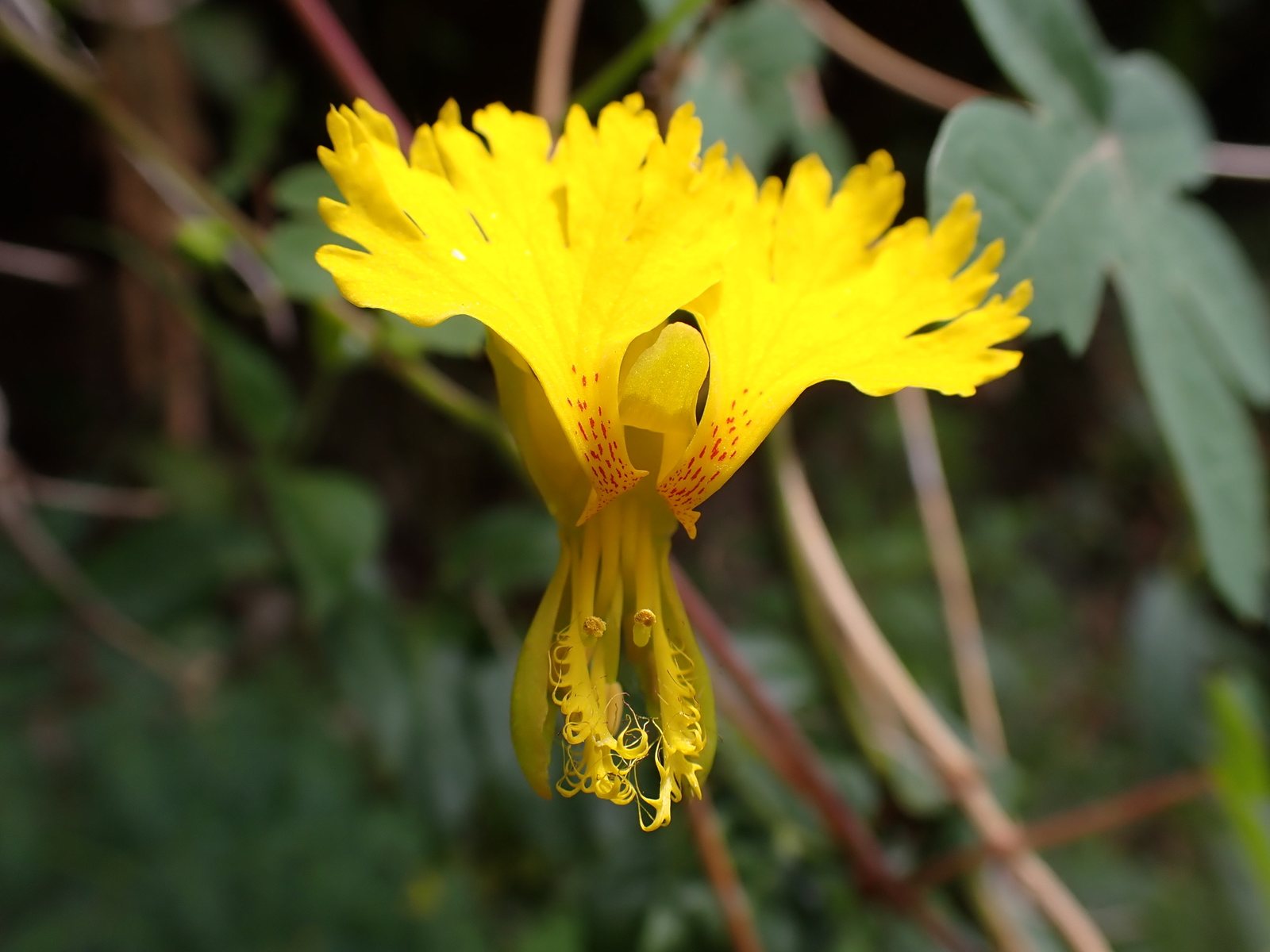
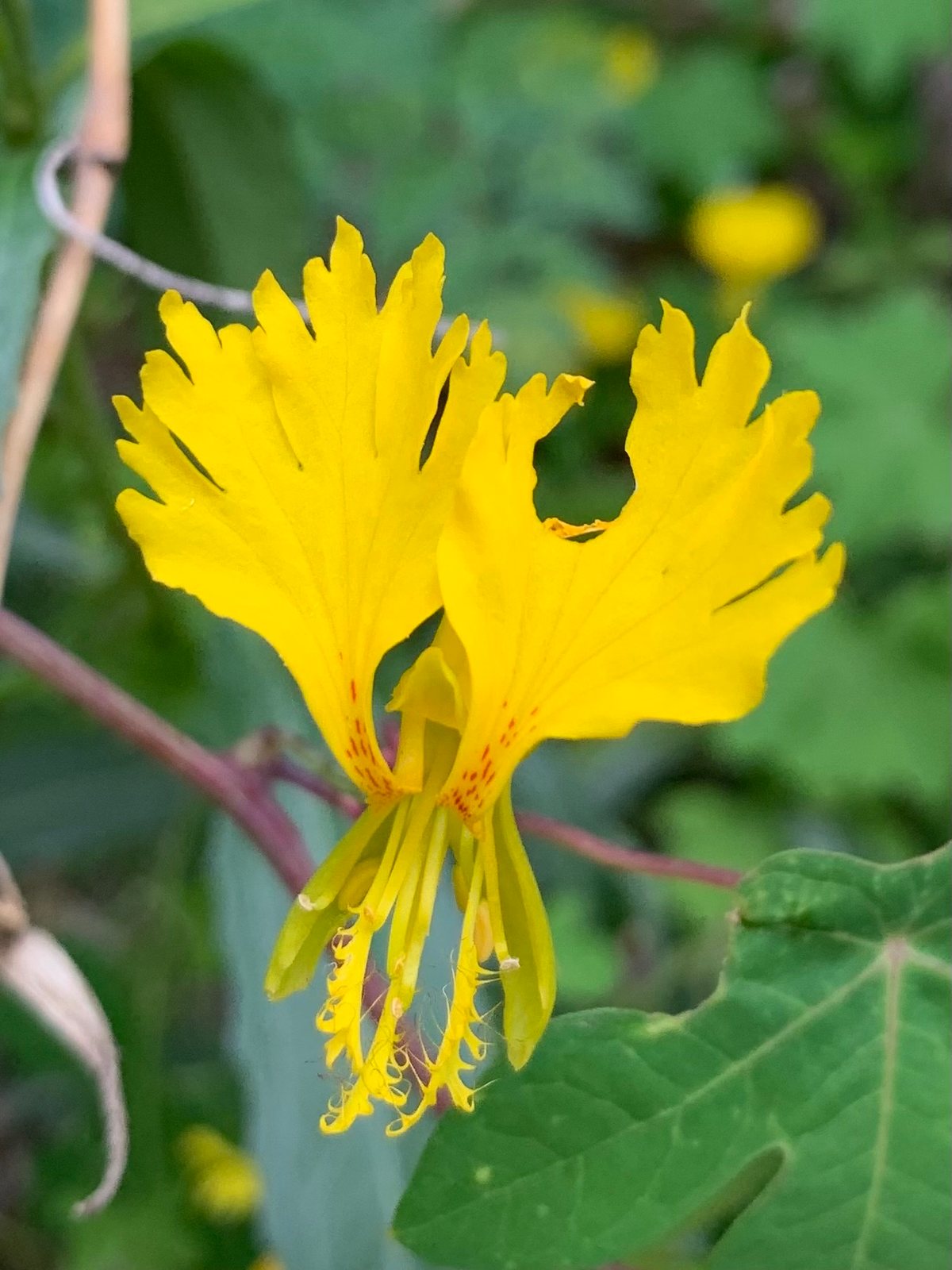
Canary creeper is a fast-growing climber grown as an annual, with deeply lobed leaves and small yellow flowers whose fringed petals resemble birds' wings. Its leaf stalks curl around slender supports, making it useful for covering a trellis or adding summer colour to an obelisk.
At a glance
- Sun
- Full sun to partial shade; afternoon shade is helpful in hot summers.
- Water
- Water regularly to keep the root zone lightly moist but not waterlogged; containers may need daily checks in warm weather.
- Soil
- Well-drained soil of average fertility; avoid heavily enriched soil and excessive nitrogen.
- Height
- 8-12 ft (2.4-3.7 m)
- Spread
- 2-3 ft (0.6-0.9 m) when trained on a support
- Flowers
- Summer to the first autumn frosts; bright yellow flowers with fringed upper petals.
- Foliage
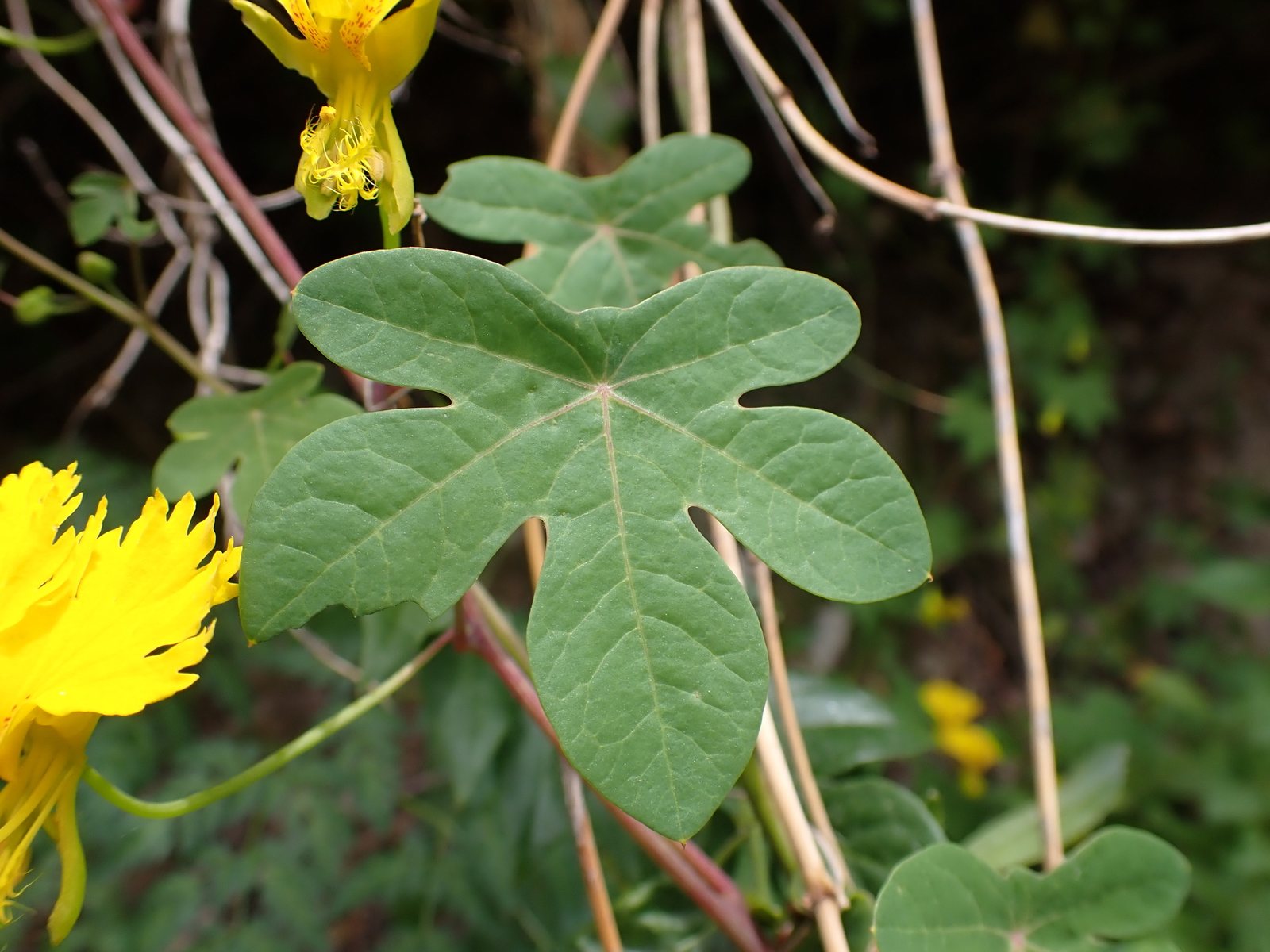
- Soft green, rounded leaves deeply divided into five to seven lobes.
- Growth
- Fast
- Care needed
- Low
The year at a glance
- Pollinators
- Low allergen
| J | F | M | A | M | J | J | A | S | O | N | D | |
|---|---|---|---|---|---|---|---|---|---|---|---|---|
| Flowers | ||||||||||||
| Fruit | ||||||||||||
| Plant |
Northern hemisphere months. In Australia, shift them by six.
- Difficulty
- Easy
- Toughness
- Fairly tough
Will it suit your garden?
Pick your zone, country, light and whether you have pets.
Full sun is 6 or more hours of direct sun a day, part shade 3 to 6 hours, shade under 3.
How it grows
Planting day
2 ft (0.6 m)
After 1 year
3 ft (1.1 m)
After 2 years
5 ft (1.5 m)
After 3 years
6 ft (1.8 m)
full size
About 3 years to full size.
From a typical nursery size, at an average rate for this kind of plant. A rule of thumb, not a forecast.
Good to know
- Cats and dogs
- Safe
- Growth rate
- Fast
Care
Jobs through the year
- WaterMay–Jun, Sep–Oct, every 7 days
- For established plants in the ground, water if the surface dries; seedlings need closer checks.
- WaterJul–Aug, every 4 days
- Keep established plants lightly moist during dry weather; skip watering after sufficient rain.
- MulchJun
- Apply a thin organic mulch after planting, keeping stems clear.
- ProtectMay–Jun
- Plant after frost, provide fine netting and protect seedlings from slugs and snails.
- PruneJun–Sep
- Guide stems onto their support and trim only shoots encroaching on other plants.
- PruneOct–Nov
- Remove frost-killed vines and clean reusable supports.
- Plant outside after the last frost, once seedlings have been gradually accustomed to outdoor conditions.
- Provide netting, strings or a fine trellis at planting; leaf stalks cannot grip thick posts.
- Water at soil level when the surface starts to dry, especially while plants establish.
- Avoid high-nitrogen fertilisers, which encourage leaves at the expense of flowers.
- Apply a thin mulch around established plants, keeping it clear of the stems.
Pruning. Guide young stems onto their support and trim stray shoots during summer if they encroach on nearby plants. Remove the dead vines after frost.
Through the year
- Early spring
- Sow seeds in individual pots indoors or under frost-free cover.
- Late spring
- Harden off seedlings and plant out after the last frost; install a fine climbing support.
- Early summer
- Guide new shoots onto their support and check regularly for aphids.
- Summer
- Water during dry spells and redirect stems before they scramble through neighbouring plants.
- Early autumn
- Collect mature seeds once they detach easily, if you want seed for next year.
- Late autumn
- Remove frost-killed growth and clean reusable supports.
In the garden
- Train over a slender obelisk in a mixed border for a light, seasonal vertical accent.
- Grow up netting on a fence to provide temporary summer cover without a woody framework.
- Use in a large container with a fine trellis beside a sunny patio.
- Pair with blue or purple summer flowers so the small yellow blooms stand out.
Garden styles it suits: Cottage garden, English country, Romantic rose garden, Modern courtyard, Small-space and Traditional.
Plant it with: Sweet alyssum, Verbena, Cosmos, French marigold and Salvia.
Wildlife: Flowers provide nectar for visiting insects; aphids on the shoots can also attract predatory insects.
Problems to watch for
- Aphids gather on tender shoots: wash them off with water and encourage ladybirds and other predators.
- Slugs and snails damage seedlings: check plants at dusk and use barriers or labelled slug controls where needed.
- Plenty of foliage but few flowers: stop high-nitrogen feeding and provide more sunlight.
- Yellowing or collapsing plants in wet soil: reduce watering and improve drainage; do not leave containers standing in water.
Safety
Not known to be toxic to people, cats, dogs or horses, but species-specific safety information is limited. No part is established as a serious poisoning hazard; do not assume it is suitable for eating simply because it is related to common nasturtium.
Easily confused with
Common nasturtium (Tropaeolum majus)
Has broad, shield-shaped leaves without deep divisions and larger, less finely fringed flowers, usually yellow, orange or red.
Flame flower (Tropaeolum speciosum)
Has scarlet flowers rather than yellow ones and is a perennial climber that returns from underground growth.
The name
The common name refers to the yellow, fringed flowers, which resemble small canaries in flight, not to an origin in the Canary Islands.
Propagation. Grow from seed. Soak seeds in lukewarm water overnight, then sow about 1/2 in (1 cm) deep in individual pots in spring; germination can be irregular. Alternatively, sow directly outdoors after the last frost where the growing season is long enough.
Checked against open data
- Accepted botanical name
- Tropaeolum peregrinum
- Native range
- Peru.
Sources: GBIF (CC BY 4.0) and Trefle (CC BY 4.0). The care and design notes are LandscapeGPT's own.
See it in your own yard.
Upload a photo of your yard and see it redesigned with plants that suit your climate, each checked against your zone.