Canterbury bells
Campanula medium. Family Campanulaceae. Perennial.
Also called Coventry bells, Cup-and-saucer plant.
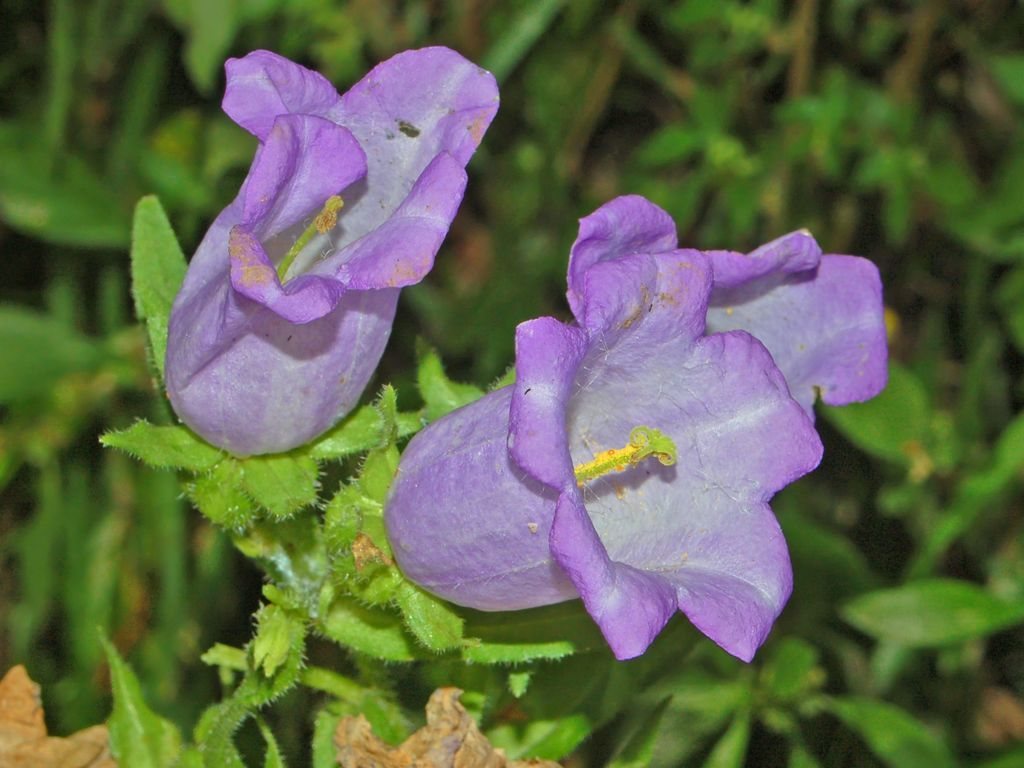
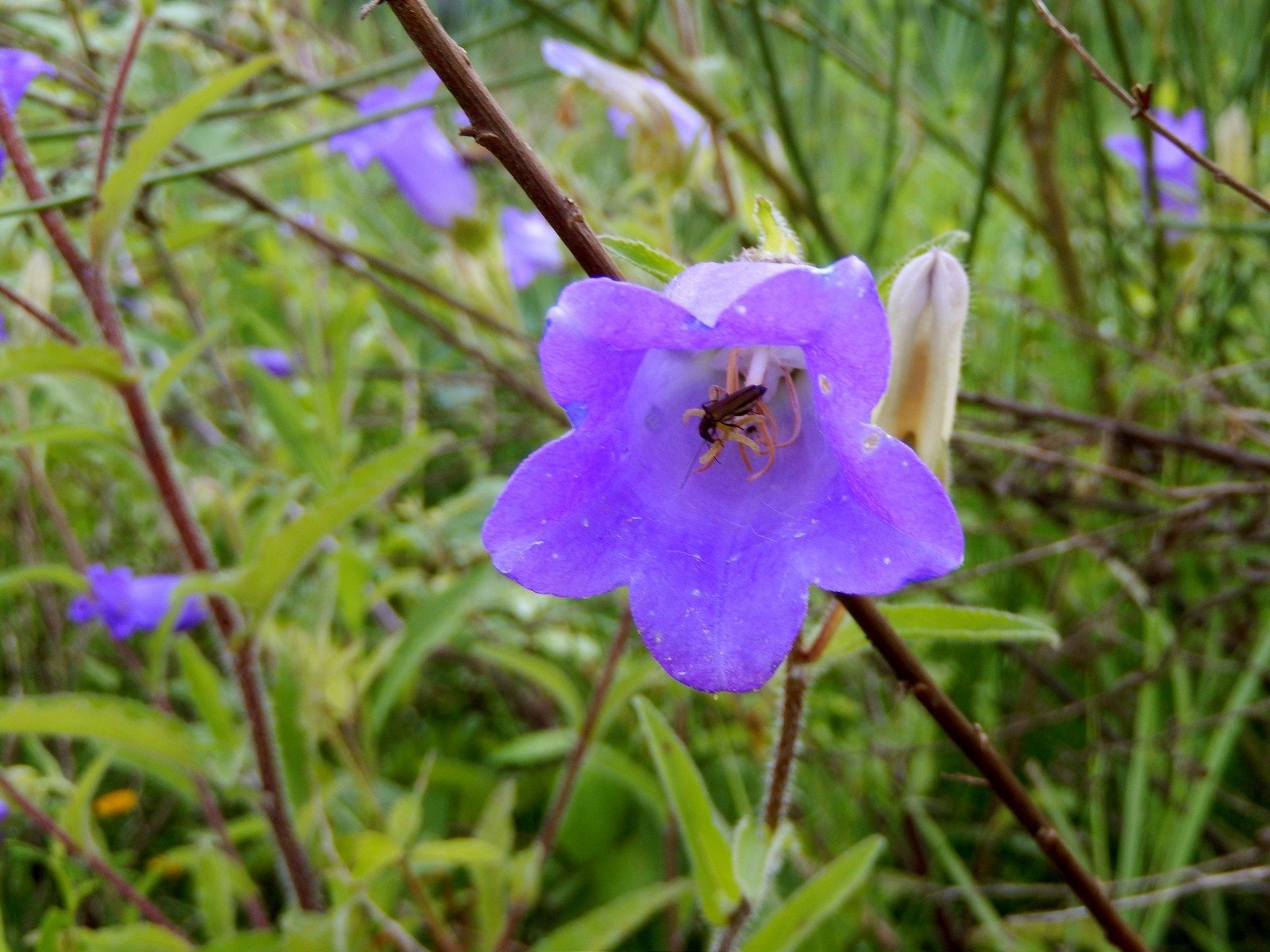
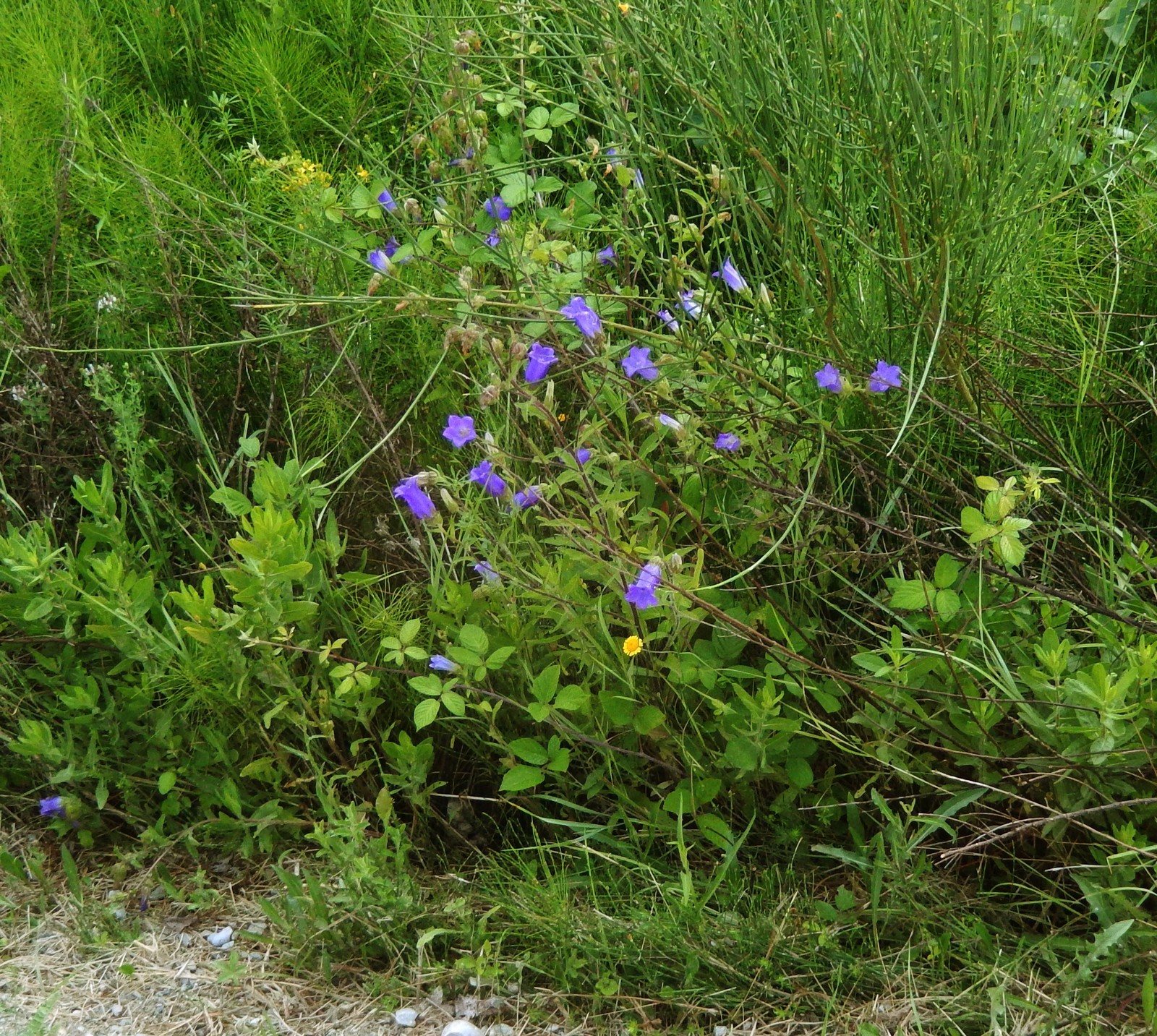
Canterbury bells is usually grown as a biennial, making a leafy rosette in its first year and tall stems of large, bell-shaped flowers in its second summer before dying. Gardeners grow it for cottage borders and cut flowers in shades of blue, purple, pink and white.
At a glance
- Sun
- Full sun to partial shade; afternoon shade helps in hot summers.
- Water
- Keep the soil evenly moist but not waterlogged, especially while plants establish and form flower buds.
- Soil
- Fertile, well-drained soil that holds some moisture; neutral to slightly alkaline soil is ideal.
- Height
- 2-3 ft (0.6-0.9 m)
- Spread
- 1-1.5 ft (0.3-0.45 m)
- Flowers
- Late spring to midsummer; blue, violet, purple, pink or white bells. Cup-and-saucer forms have a broad, flared calyx beneath each flower.
- Foliage
- Green, roughly hairy, oval to lance-shaped leaves form a basal rosette, with smaller leaves up the flowering stems. Rosettes can remain green through mild winters.
- Growth
- Moderate; usually forms a rosette in the first growing season and flowers in the second.
- Care needed
- Medium
The year at a glance
- Pollinators
- Low allergen
| J | F | M | A | M | J | J | A | S | O | N | D | |
|---|---|---|---|---|---|---|---|---|---|---|---|---|
| Flowers | ||||||||||||
| Plant |
Northern hemisphere months. In Australia, shift them by six.
- Difficulty
- Moderate
- Toughness
- Fairly tough
Will it suit your garden?
Pick your zone, country, light and whether you have pets.
Full sun is 6 or more hours of direct sun a day, part shade 3 to 6 hours, shade under 3.
How it grows
Planting day
1 ft (0.3 m)
After 1 year
1.5 ft (0.45 m)
After 2 years
2 ft (0.6 m)
After 3 years
2.5 ft (0.75 m)
full size
About 3 years to full size.
From a typical nursery size, at an average rate for this kind of plant. A rule of thumb, not a forecast.
Good to know
- Cats and dogs
- Safe
- Growth rate
- Moderate
Care
Jobs through the year
- WaterApr–May, Sep–Oct, every 7 days
- Water established rosettes if rain is insufficient; water seedlings and new transplants more often.
- WaterJun–Aug, every 5 days
- Water established plants at soil level during dry weather, keeping soil moist but not soggy.
- MulchApr
- Apply a light compost mulch clear of crowns; avoid heavy nitrogen feeding.
- ProtectApr–May
- Stake tall stems before flower buds open.
- ProtectMar–May, Sep–Oct, every 7 days
- Check young rosettes for slugs and snails; hand-pick or use labelled iron-phosphate bait.
- DeadheadMay–Jul, every 7 days
- Remove faded flowers to encourage side shoots; retain a few only if seed is wanted.
- PruneAug–Sep
- Remove dying plants after flowering and any desired seed collection; retain healthy young rosettes.
- ProtectJan–Feb, Nov–Dec, every 14 days
- Clear wet leaves from rosettes and ensure winter water drains freely.
- Water at soil level during dry spells; avoid leaving the crown in soggy soil.
- Work compost into the planting area before planting; avoid heavy nitrogen feeding.
- Space plants 1-1.5 ft (0.3-0.45 m) apart for airflow.
- Stake tall flower stems before the buds open, especially in exposed borders.
- Apply a light mulch to conserve moisture, keeping it clear of the crown.
- Raise a fresh batch from seed each year for flowers every summer; division is not normally useful.
Pruning. Remove faded flowers promptly to encourage smaller side shoots, or leave a few stems to ripen seed. Once flowering and seed collection are finished, remove dying plants.
Through the year
- Spring
- Plant out established rosettes when the soil is workable, and protect young growth from slugs.
- Late spring
- Install discreet stakes before flowering stems become heavy.
- Early summer
- Sow seed thinly on the surface of seed compost and press it in gently; keep moist and in bright, indirect light.
- Summer
- Water during dry weather and remove faded flowers unless you want seed.
- Late summer
- Collect seed when capsules turn brown, before they release it.
- Autumn
- Plant young rosettes in their flowering positions early enough to establish before winter.
- Winter
- Check that rosettes are not sitting in waterlogged soil or buried beneath wet leaves.
In the garden
- Plant in small groups through the middle of cottage borders for upright colour among softer, spreading plants.
- Combine with roses, foxgloves and hardy geraniums for a layered early-summer border.
- Use white and pale pink forms in romantic or pastel planting schemes.
- Grow in a cutting bed for substantial flowering stems, leaving replacement rosettes nearby for the following year.
Garden styles it suits: Cottage garden, English country, Romantic rose garden, Traditional, Pastel border and Pollinator garden.
Plant it with: Roses, Foxgloves, Hardy geraniums, Lady's mantle, Peonies and Sweet William.
Wildlife: The bell-shaped flowers provide pollen and nectar for bees, including bumblebees. Open, single flowers are generally more accessible than densely double forms.
Problems to watch for
- Slugs and snails chew young rosettes: check after dark, remove hiding places and use iron-phosphate bait according to the label where needed.
- Rust causes orange-brown pustules on leaves: remove affected foliage, improve spacing and avoid wetting leaves when watering.
- Crown and root rot develop in wet soil: improve drainage and keep mulch away from the crown.
- Plants fail to flower because they were sown too late to make strong rosettes before winter: sow in late spring or early summer for flowering the following year.
Safety
Not known to be toxic to cats, dogs, horses or people; no part is recognised as poisonous. It is an ornamental plant rather than a food crop, and eating plant material may still cause digestive upset.
Easily confused with
Peach-leaved bellflower (Campanula persicifolia)
Has much narrower leaves and more open, bowl-shaped flowers on slender stems; it is a longer-lived perennial.
Nettle-leaved bellflower (Campanula trachelium)
Has sharply toothed, nettle-like leaves and smaller, narrower bells, rather than the large, inflated flowers of Canterbury bells.
Foxglove (Digitalis purpurea)
Its tubular flowers usually hang along one side of the stem and have spotted throats; Canterbury bells has broader bells arranged around the stem.
The name
Campanula comes from the Latin for 'little bell', referring to the flower shape.
Propagation. Grow from seed sown in late spring or early summer for flowers the following year. Sow on the surface, press in gently and keep moist without waterlogging. It may self-seed where there is open soil; seedlings may not match the parent's colour or flower form.
Checked against open data
- Accepted botanical name
- Campanula medium
- In the US and Canada
- Introduced in Canada and the lower 48 states.
- Native range
- France and Italy.
- Measured
- Soil pH 7 to 7.5. Average height 69 cm.
Sources: GBIF (CC BY 4.0), USDA PLANTS and Trefle (CC BY 4.0). The care and design notes are LandscapeGPT's own.
See it in your own yard.
Upload a photo of your yard and see it redesigned with plants that suit your climate, each checked against your zone.