Chinese ixora
Ixora chinensis. Family Rubiaceae. Shrub.
Also called Chinese jungle flame.
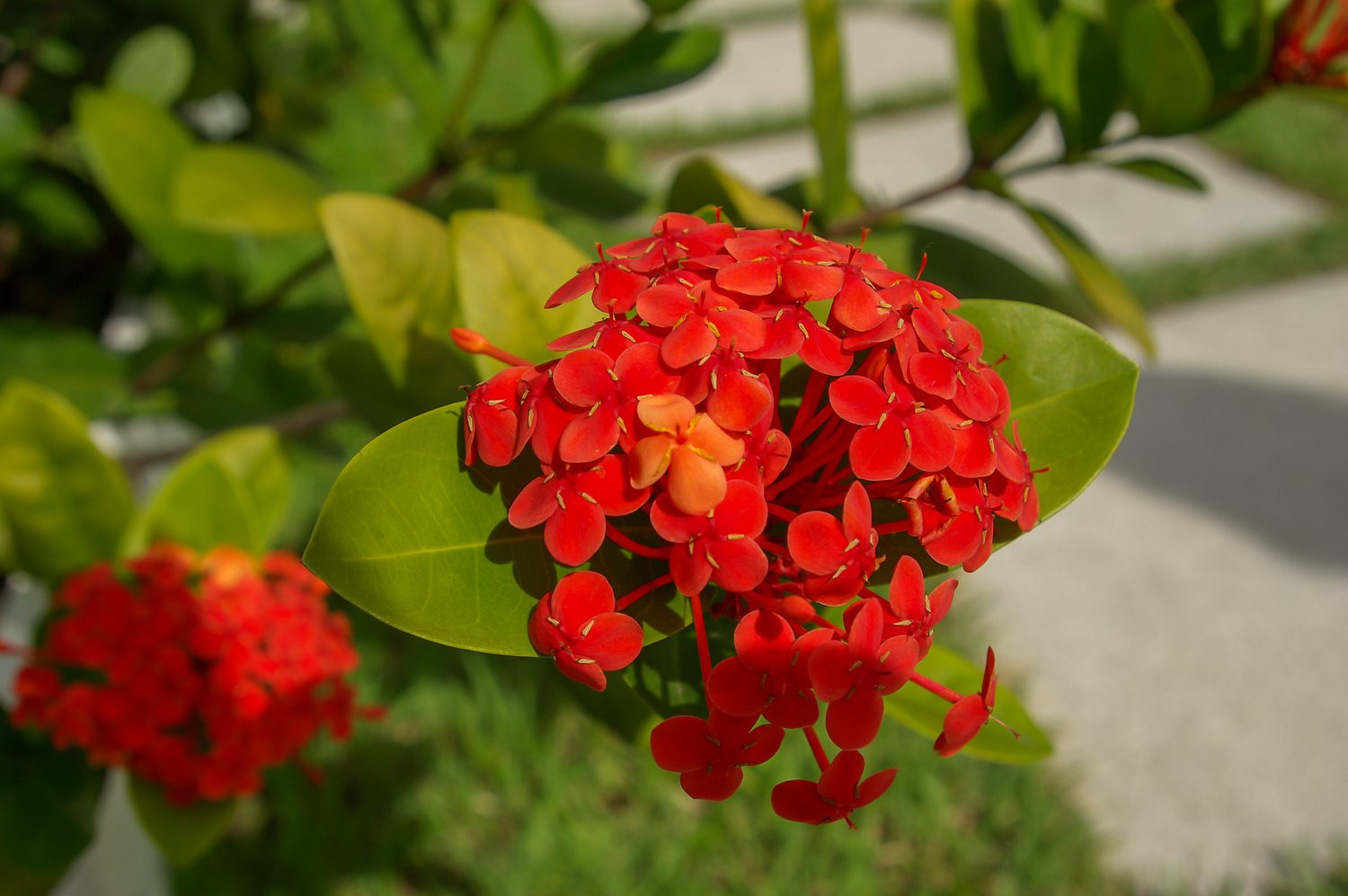
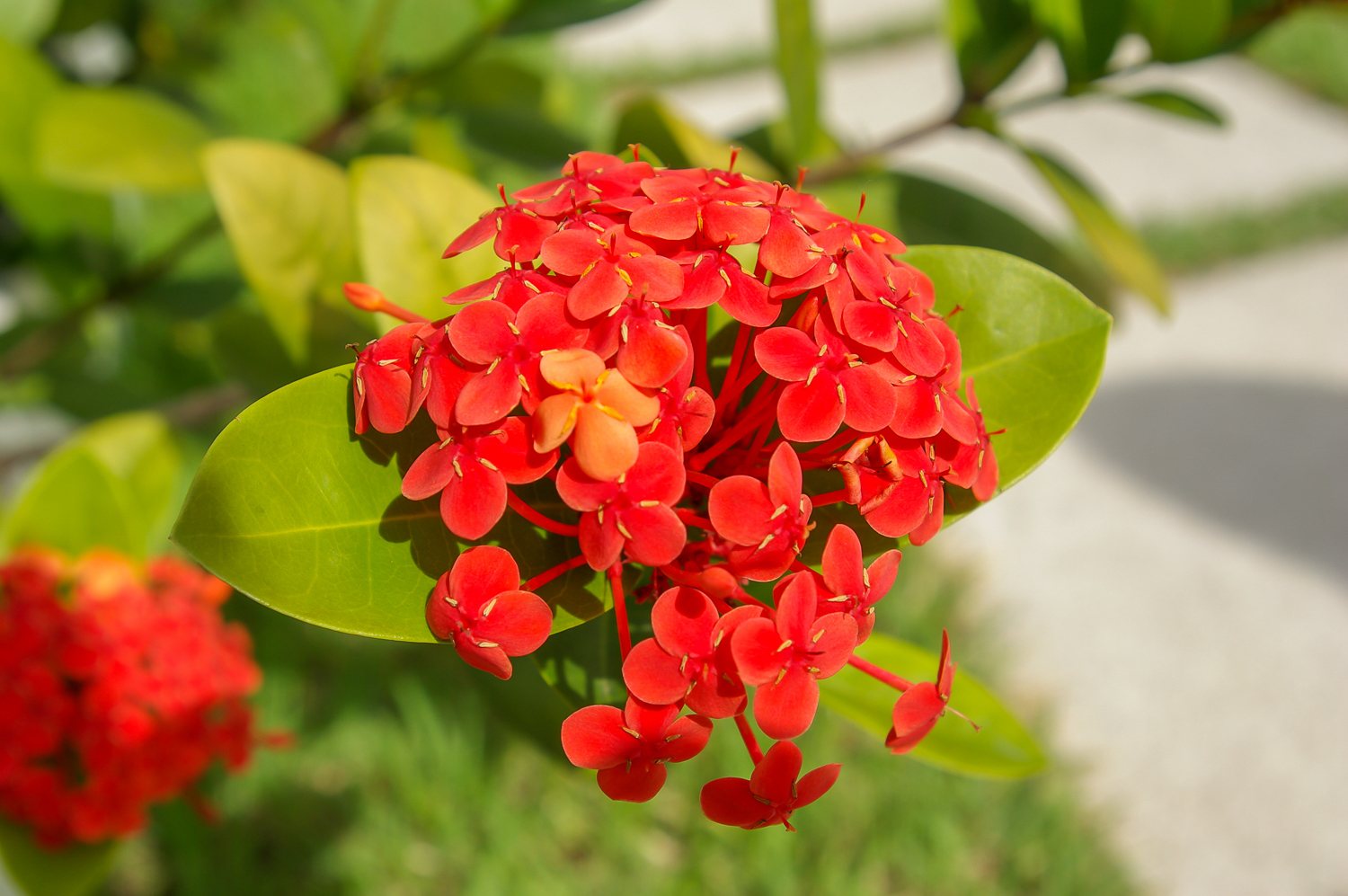
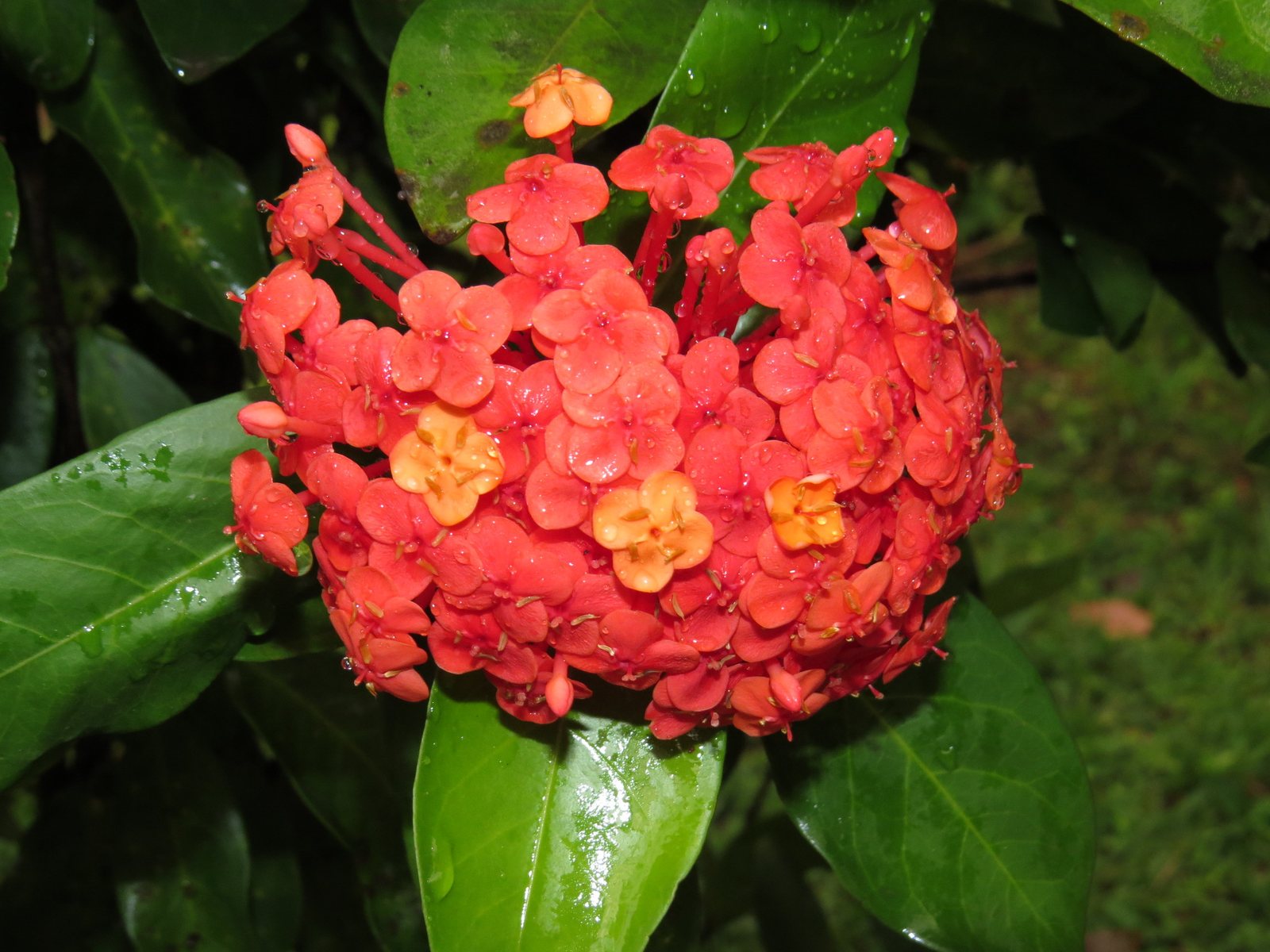
Chinese ixora is a frost-tender evergreen shrub grown for dense clusters of small, tubular flowers against glossy green leaves. It suits warm, humid gardens and containers; in most of the United Kingdom and Canada, and colder parts of the United States and Australia, it needs a heated greenhouse or a bright indoor winter position.
At a glance
- Sun
- Full sun to partial shade; provide afternoon shade in very hot, exposed gardens. Too much shade reduces flowering.
- Water
- Keep the root zone evenly moist but not waterlogged. Water less in cool weather, allowing the surface to dry slightly between waterings.
- Soil
- Humus-rich, well-drained, acidic soil, ideally pH 5.0-6.5. Alkaline soil and lime-rich irrigation water can cause yellow leaves.
- Height
- 3-6 ft (0.9-1.8 m)
- Spread
- 3-5 ft (0.9-1.5 m)
- Flowers
- Clusters of red, orange, pink or yellow tubular flowers, mainly from spring through autumn; flowering can continue intermittently all year in frost-free tropical conditions.
- Foliage
- Evergreen. Opposite pairs of glossy, leathery, dark green leaves, usually oval to obovate with short stalks.
- Growth
- Slow to moderate; faster in consistently warm, humid conditions.
- Care needed
- Medium
The year at a glance
- Pollinators
- Heat tolerant
- Low allergen
| J | F | M | A | M | J | J | A | S | O | N | D | |
|---|---|---|---|---|---|---|---|---|---|---|---|---|
| Flowers | ||||||||||||
| Plant |
Northern hemisphere months. In Australia, shift them by six.
- Difficulty
- Hard
- Toughness
- Needs looking after
Will it suit your garden?
Pick your zone, country, light and whether you have pets.
Full sun is 6 or more hours of direct sun a day, part shade 3 to 6 hours, shade under 3.
How it grows
Planting day
1.6 ft (0.5 m)
After 1 year
2.2 ft (0.67 m)
After 2 years
2.8 ft (0.84 m)
After 3 years
3 ft (1 m)
After 5 years
4 ft (1.4 m)
full size
About 5 years to full size.
From a typical nursery size, at an average rate for this kind of plant. A rule of thumb, not a forecast.
Good to know
- Cats and dogs
- Safe
- Growth rate
- Moderate
Care
Jobs through the year
- WaterApr–May, Sep–Oct, every 7 days
- Water established plants as the surface dries, preferably with rainwater; check young plants and pots more often.
- WaterJun–Aug, every 4 days
- Keep established roots evenly moist using rainwater where tap water is hard.
- WaterJan–Mar, Nov–Dec, every 14 days
- In warm shelter, let the surface dry slightly but not the whole root ball.
- FeedApr–Aug, every 28 days
- Feed lightly with fertiliser for acid-loving flowering shrubs, following the label.
- MulchMay
- Apply 5–8 cm of organic mulch, keeping it away from stems.
- PruneJul–Aug
- If shaping is needed, lightly shorten shoots after a flowering flush; avoid shearing.
- ProtectSep
- Bring into bright shelter before nights fall below 10°C; maintain warmth through winter.
- ProtectJun
- Move outdoors only when nights remain above 10°C, introducing stronger sun gradually.
- Water deeply when the soil surface starts to dry; never leave pots standing in water.
- Use an ericaceous potting mix for containers and rainwater where tap water is hard.
- Feed lightly with a fertilizer for acid-loving flowering shrubs during active growth, following the label.
- Apply 2-3 in (5-8 cm) of organic mulch, keeping it clear of the stems.
- Move container plants under cover before cold nights arrive; overwinter in bright light, preferably above 50°F (10°C).
Pruning. Lightly shorten shoots after a main flush of flowers to keep the shrub compact, and remove dead or damaged wood as needed. Avoid frequent shearing, which removes developing flower buds.
Through the year
- Spring
- Repot container plants if root-bound, using fresh acidic potting mix.
- Spring
- Begin light feeding as new growth starts, and renew mulch around outdoor plants.
- Late spring
- Move overwintered pots outside only when nights remain reliably above 50°F (10°C); introduce stronger sun gradually.
- Summer
- Check soil moisture frequently and inspect shoot tips and leaf undersides for pests.
- Summer
- Trim lightly after a main flowering flush if shaping is needed.
- Autumn
- Bring pots under cover before chilly nights and reduce feeding as growth slows.
- Winter
- Keep protected plants bright and warm, watering less often without letting the root ball dry out completely.
In the garden
- Plant in small groups beside patios or entrances in frost-free gardens for warm-coloured flowers and evergreen structure.
- Use as an informal low hedge, allowing enough space to avoid repeated clipping of flower buds.
- Grow in containers on sheltered terraces where alkaline garden soil would otherwise be unsuitable.
- Combine with gardenias, camellias and ferns in acidic soil for contrasting flowers and foliage.
Garden styles it suits: Tropical, Modern tropical, Luxury resort, Modern courtyard, Florida subtropical and Balinese.
Plant it with: Gardenia, Camellia, Azalea, Bird's nest fern and Bromeliads.
Wildlife: Flowers provide nectar for butterflies and other insects. Their long tubes favour visitors able to reach nectar deep inside.
Problems to watch for
- Yellow leaves with green veins: often caused by unavailable iron or manganese in alkaline soil. Check soil pH, switch to rainwater where practical, and use a suitable chelated micronutrient treatment if needed.
- Scale insects and mealybugs: inspect stems and leaf undersides, remove small colonies by hand, and treat persistent infestations with horticultural oil or insecticidal soap according to the label.
- Root rot: prevent prolonged saturation by improving drainage and using pots with open drainage holes; remove badly affected plants.
- Poor flowering or bud loss: provide more light, steady moisture and warmth, and avoid heavy nitrogen feeding or frequent shearing.
Safety
Not known to be toxic to people, cats, dogs or horses, but species-specific safety information is limited. No part should be treated as edible; discourage pets and children from eating the leaves, flowers or fruit.
Easily confused with
Jungle geranium (Ixora coccinea)
Usually has nearly stalkless leaves with rounded or slightly heart-shaped bases and more pointed tips. Chinese ixora generally has short but visible leaf stalks and blunter, often obovate leaves;
Egyptian starcluster (Pentas lanceolata)
Its flowers usually have five pointed lobes rather than ixora's four, and its leaves are softer and noticeably hairy rather than glossy and leathery.
The name
The botanical epithet chinensis means 'of China', which is also reflected in the common name.
Propagation. Take semi-ripe stem cuttings during warm weather. Root them in a free-draining medium with high humidity, bright indirect light and gentle bottom heat; rooting can be slow.
Checked against open data
- Accepted botanical name
- Ixora chinensis
- Native range
- Cambodia, China Southeast, Laos, Myanmar, Philippines, Thailand and Vietnam.
- Measured
- Average height 200 cm.
Sources: GBIF (CC BY 4.0) and Trefle (CC BY 4.0). The care and design notes are LandscapeGPT's own.
See it in your own yard.
Upload a photo of your yard and see it redesigned with plants that suit your climate, each checked against your zone.