Common mallow
Malva sylvestris. Family Malvaceae. Perennial.
Also called High mallow, Tall mallow, Wood mallow.
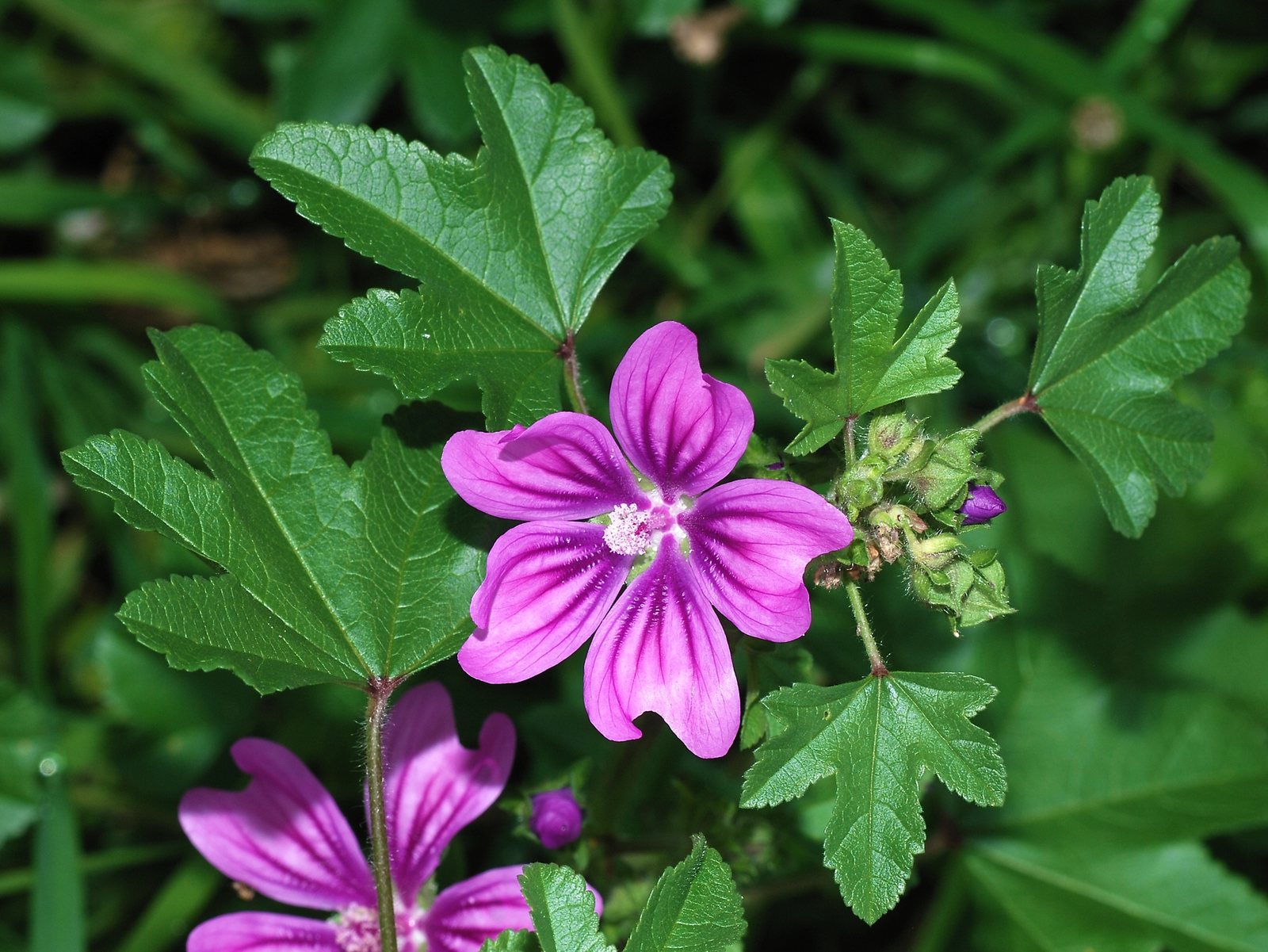
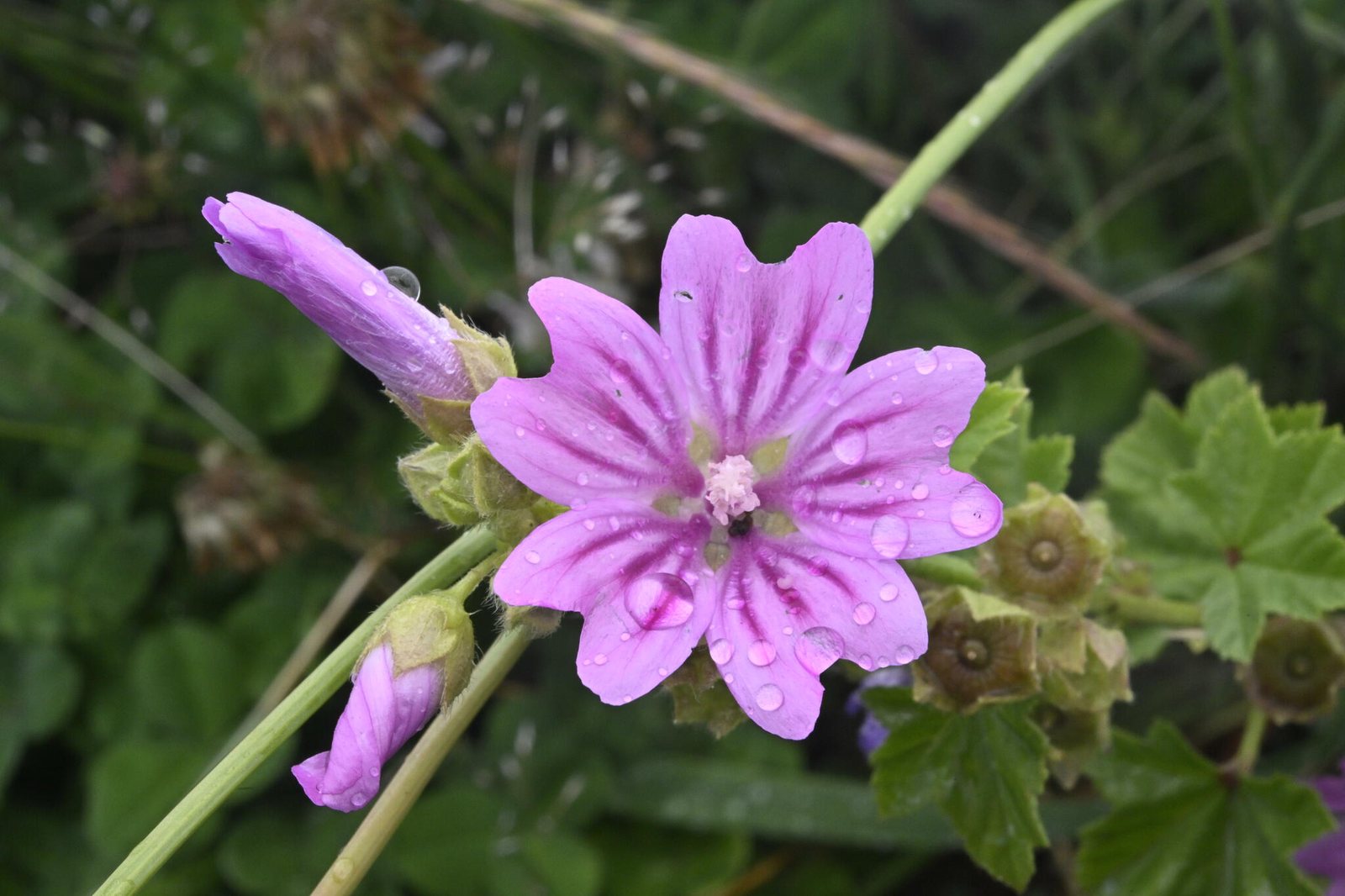
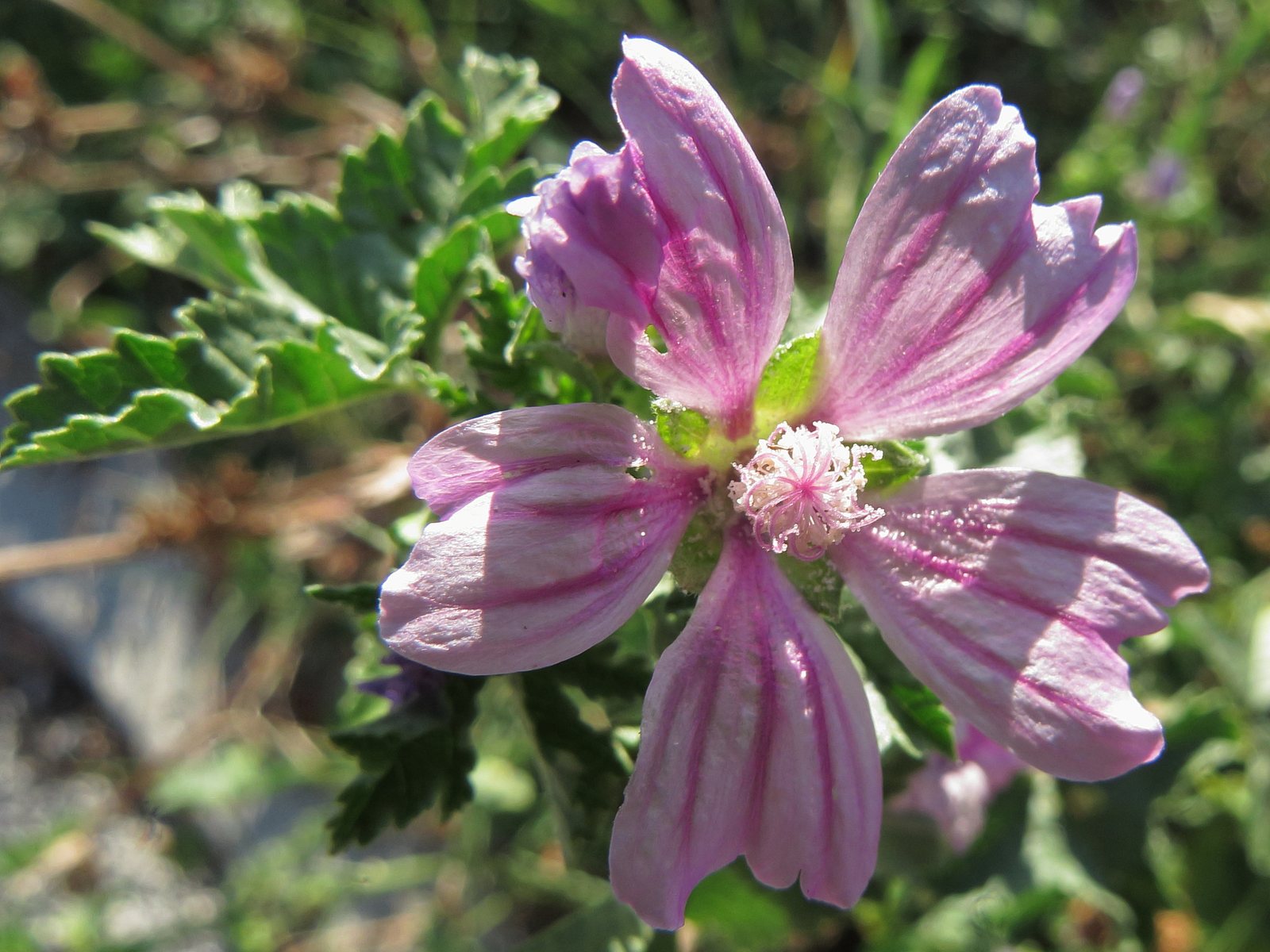
Common mallow is an upright, short-lived perennial, sometimes behaving as a biennial, with pink-purple flowers marked by dark veins. Gardeners grow it for a loose cottage-garden effect, a long flowering season and flowers that attract bees; its young leaves and flowers are also edible.
At a glance
- Sun
- Full sun is best; tolerates light partial shade, with fewer flowers and looser growth.
- Water
- Moderate while establishing; water established plants during prolonged dry spells. Avoid persistently wet soil.
- Soil
- Well-drained loam, chalky or sandy soil; tolerates clay if drainage is good. Average fertility is sufficient.
- Height
- 2-4 ft (0.6-1.2 m)
- Spread
- 1-2 ft (0.3-0.6 m)
- Flowers
- Late spring or early summer into autumn; pink to purple, five-petalled flowers with darker veins.
- Foliage
- Rounded, softly hairy green leaves with shallow, palm-shaped lobes and toothed edges.
- Growth
- Fast
- Care needed
- Low
The year at a glance
- Pollinators
- Drought tolerant
- Cold hardy
- Wildlife
- Low allergen
| J | F | M | A | M | J | J | A | S | O | N | D | |
|---|---|---|---|---|---|---|---|---|---|---|---|---|
| Flowers | ||||||||||||
| Fruit | ||||||||||||
| Plant |
Northern hemisphere months. In Australia, shift them by six.
- Difficulty
- Easy
- Toughness
- Very tough
Will it suit your garden?
Pick your zone, country, light and whether you have pets.
Full sun is 6 or more hours of direct sun a day, part shade 3 to 6 hours, shade under 3.
How it grows
Planting day
1 ft (0.3 m)
After 1 year
2 ft (0.61 m)
After 2 years
3 ft (0.9 m)
full size
About 2 years to full size.
From a typical nursery size, at an average rate for this kind of plant. A rule of thumb, not a forecast.
Good to know
- Cats and dogs
- Safe
- In the garden
- Spreads vigorously: plan to contain it.
- Growth rate
- Fast
Care
Jobs through the year
- WaterApr–May, Sep, every 21 days
- Water established plants only in extended drought; water seedlings whenever the surface soil dries.
- WaterJun–Aug, every 14 days
- In prolonged dry weather, water established plants deeply, allowing the surface to dry between waterings.
- MulchMar
- On poor soil, apply a thin compost dressing, keeping it away from the crown.
- ProtectMay
- Support tall stems with twiggy stakes in exposed positions.
- DeadheadJun–Oct, every 7 days
- Remove spent flowers to prolong flowering and limit unwanted seedlings.
- PruneFeb
- Cut remaining dead stems to the base and remove rust-infected debris.
- ProtectJun–Sep
- Remove rust-infected leaves promptly and pull unwanted seedlings before taproots establish.
- Water newly planted seedlings when the soil surface dries; once established, water mainly during extended drought.
- Avoid rich feeds, which encourage tall, floppy growth rather than flowers.
- Apply a thin layer of compost in spring on poor soil, keeping it clear of the crown.
- Support tall stems with twiggy stakes in exposed positions.
- Remove unwanted seedlings while small, before their taproots become established.
Pruning. Remove spent flowers regularly to prolong blooming and limit seedlings. Cut dead stems to the base in late autumn or late winter; remove rust-infected foliage promptly rather than leaving it through winter.
Harvest
Pick young, tender leaves before they become coarse, and use them cooked or sparingly raw; their texture is mucilaginous. Pick newly opened flowers for salads, and immature seed discs while they are still green and tender, before they turn brown and hard.
Through the year
- Early spring
- Sow seed in pots or directly into workable, well-drained soil.
- Spring
- Thin or transplant young seedlings to allow about 1-2 ft (0.3-0.6 m) between plants.
- Late spring
- Add discreet supports before tall flowering stems begin to lean.
- Summer
- Deadhead regularly, harvest tender leaves and flowers, and check leaf undersides for rust.
- Early autumn
- Collect ripe seed from a few healthy stems, or remove all seed heads to control spread.
- Late winter
- Cut down remaining dead stems and remove unwanted overwintered seedlings.
In the garden
- Plant through cottage borders with daisies and catmint for an informal summer display.
- Use behind lower-growing plants to add upright flowers without a dense, solid screen.
- Include in a sunny pollinator border where bees can reach its open flowers.
- Grow at the edge of a kitchen garden for edible flowers and young leaves, while controlling seedlings.
Garden styles it suits: Cottage garden, English country, Wildflower, Pollinator garden, Potager (kitchen garden) and Edible landscape.
Plant it with: Catmint, Yarrow, Oxeye daisy, Meadow sage, Hardy geranium and Calendula.
Wildlife: Open flowers provide pollen and nectar for bees and other insects. Leaves support some moth and butterfly caterpillars, depending on the region.
Problems to watch for
- Mallow rust causes orange-brown pustules beneath leaves and premature leaf loss; remove affected leaves, clear infected debris and improve airflow.
- Aphids gather on soft shoots; dislodge small colonies with water and encourage ladybirds and other predators.
- Stems flop in shade or rich soil; grow in sun, avoid high-nitrogen feed and provide discreet supports.
- Heavy self-seeding creates unwanted plants; deadhead before seed discs ripen and pull seedlings promptly.
Safety
Not known to be toxic to people, cats or dogs; the leaves, flowers and immature seed discs are edible. Mallows can accumulate nitrates under some growing conditions, so do not treat large quantities of foliage as safe fodder for horses or other livestock; nitrate poisoning can be serious.
Where it spreads. Self-seeds readily and can become weedy in open or disturbed ground. It is naturalised and locally troublesome in California and parts of southern Australia, including Western Australia, South Australia and Victoria; local weed status varies. It is not uniformly classed as invasive across these regions.
Easily confused with
Dwarf mallow (Malva neglecta)
Usually low and spreading, with much smaller, pale pink or nearly white flowers rather than tall stems bearing large, strongly veined flowers.
Musk mallow (Malva moschata)
Upper leaves are deeply cut into narrow segments, and the pink or white flowers lack the conspicuous dark striping typical of common mallow.
French mallow (Malva parviflora)
Has tiny, pale flowers, often partly hidden in the leaf axils; common mallow has much larger, showier flowers with long, notched petals.
The name
Malva is the Latin name for mallow, and sylvestris means 'of woods' or 'growing wild'.
Propagation. Sow seed in spring or early autumn where winters are mild. Move self-sown seedlings while small, because established plants develop a substantial taproot and resent disturbance.
Checked against open data
- Accepted botanical name
- Malva sylvestris
- In the US and Canada
- Introduced in Canada and the lower 48 states.
- Native range
- Afghanistan, Albania, Algeria, Altay, Austria, Azores, Baleares, Baltic States, Belarus, Belgium, Bulgaria and Central European Rus.
- Measured
- Soil pH 7 to 7.5. Average height 65 cm.
Sources: GBIF (CC BY 4.0), USDA PLANTS and Trefle (CC BY 4.0). The care and design notes are LandscapeGPT's own.
See it in your own yard.
Upload a photo of your yard and see it redesigned with plants that suit your climate, each checked against your zone.