Common milkweed
Asclepias syriaca. Family Apocynaceae. Perennial.
Also called Virginia silkweed, Silkweed.
Common milkweed is a tall, colony-forming perennial native to eastern and central North America, grown for its fragrant pink flowers and value to insects, including monarch butterfly caterpillars. Its underground stems spread vigorously, so give it room in a meadow or wildlife planting rather than a small, closely managed border.
At a glance
- Sun
- Full sun; tolerates light shade but flowers less and may lean.
- Water
- Water regularly during establishment. Established plants tolerate drought and usually need watering only during prolonged dry spells.
- Soil
- Well-drained sandy, loamy or clay soil; tolerates poor soil and a broad pH range. Avoid permanently wet ground.
- Height
- 3-5 ft (0.9-1.5 m)
- Spread
- 1-3 ft (0.3-0.9 m) per clump initially; underground stems can form colonies much wider than this.
- Flowers
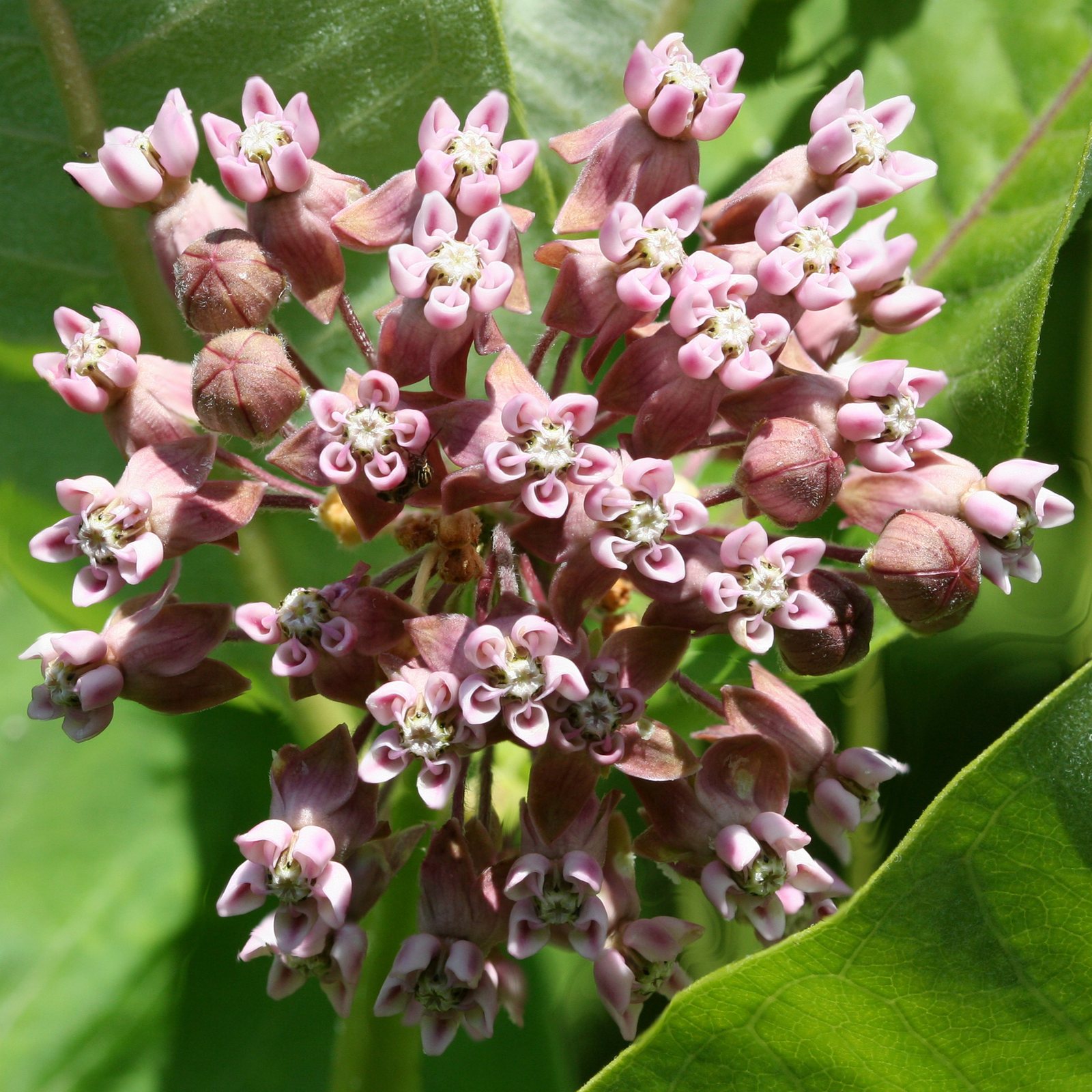
- Early to midsummer, with rounded clusters of fragrant, dusty pink to mauve flowers.
- Foliage
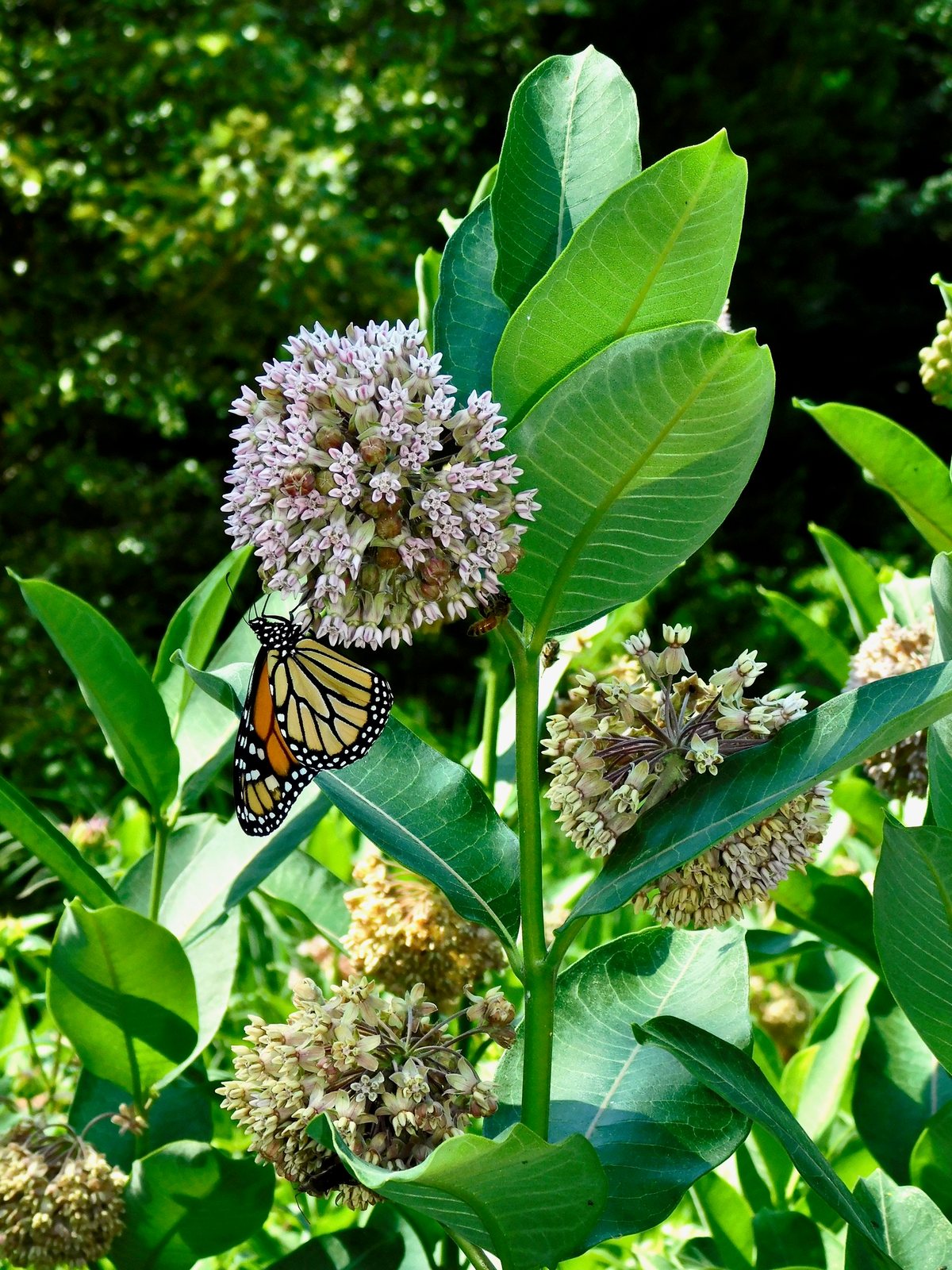
- Large, opposite, oval leaves with prominent veins and softly hairy undersides; stems and leaves release white latex when damaged.
- Growth
- Fast once established; seedlings may take two or three years to flower.
- Care needed
- Medium
The year at a glance
- Pollinators
- Deer resistant
- Drought tolerant
- Cold hardy
- Heat tolerant
- Wildlife
- Low allergen
- Fragrant
| J | F | M | A | M | J | J | A | S | O | N | D | |
|---|---|---|---|---|---|---|---|---|---|---|---|---|
| Flowers | ||||||||||||
| Fruit | ||||||||||||
| Plant |
Northern hemisphere months. In Australia, shift them by six.
- Difficulty
- Moderate
- Toughness
- Very tough
Will it suit your garden?
Pick your zone, country, light and whether you have pets.
Full sun is 6 or more hours of direct sun a day, part shade 3 to 6 hours, shade under 3.
How it grows
Planting day
1 ft (0.3 m)
After 1 year
2.5 ft (0.76 m)
After 2 years
4 ft (1.2 m)
full size
About 2 years to full size.
From a typical nursery size, at an average rate for this kind of plant. A rule of thumb, not a forecast.
Good to know
- Cats and dogs
- Toxic
- Native to
- the US and Canada
- Invasive in
- the UK
- In the garden
- Spreads vigorously: plan to contain it.
- Growth rate
- Fast
Care
Jobs through the year
- WaterApr–May, Sep, every 21 days
- Water established plants only during prolonged drought; water first-year plants regularly.
- WaterJun–Aug, every 14 days
- Deep-water established colonies only if drought persists; allow soil to dry between soakings.
- MulchApr–May
- Apply a thin mulch around young plants, keeping stems clear.
- PruneFeb–Mar
- Cut dead stems near ground level; retain some loosely in shelter for insects and wear gloves.
- PruneMay–Sep, every 21 days
- Dig out unwanted spreading shoots with connecting rhizomes; avoid sap contact.
- PruneAug–Sep
- If self-seeding is unwanted, remove pods before they split, checking first for caterpillars.
- Plant young plants in full sun where spreading colonies will be welcome; established plants resent moving.
- Water through the first growing season, allowing the surface soil to dry between waterings.
- Do not routinely fertilize; rich feeding can encourage tall, floppy growth.
- Apply a thin mulch to young plantings, keeping it clear of the stems.
- Remove unwanted shoots promptly, digging out their connecting underground stems where practical.
- Wear gloves when handling cut stems and keep the sap away from your eyes.
Pruning. Leave stems and pods through winter where self-seeding is acceptable, then cut dead stems near ground level in late winter or early spring. To limit seedlings, remove pods before they split, checking first for caterpillars and other insects.
Through the year
- Late winter
- Cut back old stems before new growth starts; retain some dry stems loosely in a sheltered corner for overwintering insects.
- Spring
- Plant young plants after the soil is workable and water them in well; mark established clumps because shoots can emerge late.
- Late spring
- Remove shoots spreading beyond the intended planting area.
- Summer
- Check for caterpillars before tackling aphids, and water young plants during dry weather.
- Late summer
- Remove developing pods if you need to prevent self-seeding, or let selected pods mature for seed collection.
- Autumn
- Sow ripe seed outdoors where cultivation is permitted, allowing winter cold to break dormancy.
In the garden
- Use in a sunny North American native meadow with little bluestem and black-eyed Susan for summer flowers above a grassy matrix.
- Plant in a generous wildlife border where caterpillar feeding and spreading stems can be accommodated.
- Combine with wild bergamot and purple coneflower for a long summer flowering season and varied flower shapes.
- Grow in a separate naturalistic patch away from small borders, paths and neighbouring gardens.
Garden styles it suits: Native meadow, Wildflower, Wildlife garden, Pollinator garden, New perennial (prairie) and Midwest prairie.
Plant it with: Little bluestem, Black-eyed Susan, Wild bergamot, Purple coneflower, Butterfly weed and New England aster.
Wildlife: A host plant for monarch butterfly caterpillars in North America. Flowers provide nectar for bees, butterflies and other insects; milkweed bugs and several beetles also use the plant. Caterpillar feeding is expected in a wildlife planting and rarely requires treatment.
Problems to watch for
- Oleander aphids cluster on tender shoots: tolerate small colonies or dislodge them with water after checking for caterpillars; avoid broad-spectrum insecticides.
- Leaf spots and rust can disfigure foliage: improve airflow, water at soil level and remove badly affected fallen leaves.
- Root rot in waterlogged soil: move young plants to a well-drained site rather than trying to maintain them in wet ground.
- Unwanted colonies and seedlings: remove pods before they open and dig out unwanted shoots with their connecting underground stems.
Safety
Toxic to people, cats, dogs and horses if eaten. All parts contain cardiac glycosides, including leaves, stems, roots and seeds; ingestion can cause digestive upset and potentially fatal heart disturbances. The milky sap can irritate skin and seriously injure eyes. Do not eat it, and keep it out of grazing areas.
Where it spreads. Spreads aggressively by underground stems and seed, including within its native range in the United States and Canada. Invasive in parts of continental Europe, notably Hungary and neighbouring central European regions. It is an invasive alien species of Union concern in the EU and is regulated in Great Britain, where planting, sale and movement are restricted or prohibited;
Easily confused with
Showy milkweed (Asclepias speciosa)
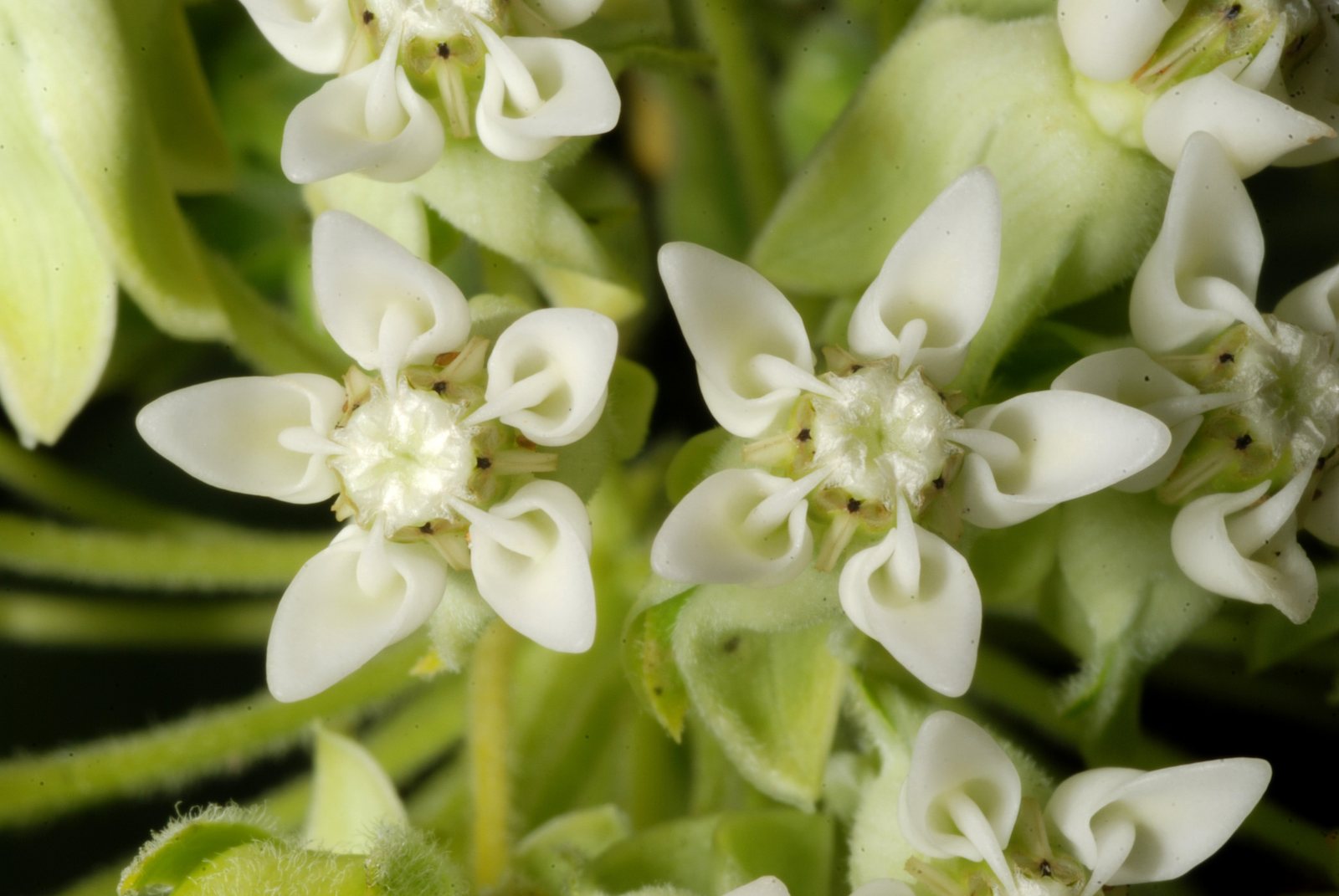
Has more conspicuously star-shaped flowers with long, pointed pink hoods and generally woollier, grey-green foliage; common milkweed flowers look rounder and more compact.
Swamp milkweed (Asclepias incarnata)
Has much narrower leaves, more branching stems and flatter clusters of pink flowers; it favours moist ground and does not form the same extensive running colonies.
Hemp dogbane (Apocynum cannabinum)
Also has opposite leaves and milky sap, but usually branches more freely and bears tiny whitish flowers followed by long, slender paired pods rather than broad, warty milkweed pods.
The name
Asclepias honours Asclepius, the Greek god of medicine, while syriaca means 'of Syria', reflecting an early mistaken association with that region rather than the plant's North American origin.
Propagation. Where legally permitted, sow fresh seed outdoors in autumn, or give seed about 4-6 weeks of cold, moist stratification before spring sowing. Transplant seedlings while small to avoid disturbing their developing roots.
Checked against open data
- Accepted botanical name
- Asclepias syriaca
- In the US and Canada
- Native in Canada and the lower 48 states.
- Native range
- Arkansas, Connecticut, Delaware, District of Columbia, Illinois, Indiana, Iowa, Kansas, Kentucky, Maine, Manitoba and Maryland.
- Measured
- Soil pH 7.5 to 8. Average height 106 cm.
Sources: GBIF (CC BY 4.0), USDA PLANTS and Trefle (CC BY 4.0). The care and design notes are LandscapeGPT's own.
See it in your own yard.
Upload a photo of your yard and see it redesigned with plants that suit your climate, each checked against your zone.