Cranberry
Vaccinium macrocarpon. Family Ericaceae. Shrub.
Also called American cranberry, Large cranberry.
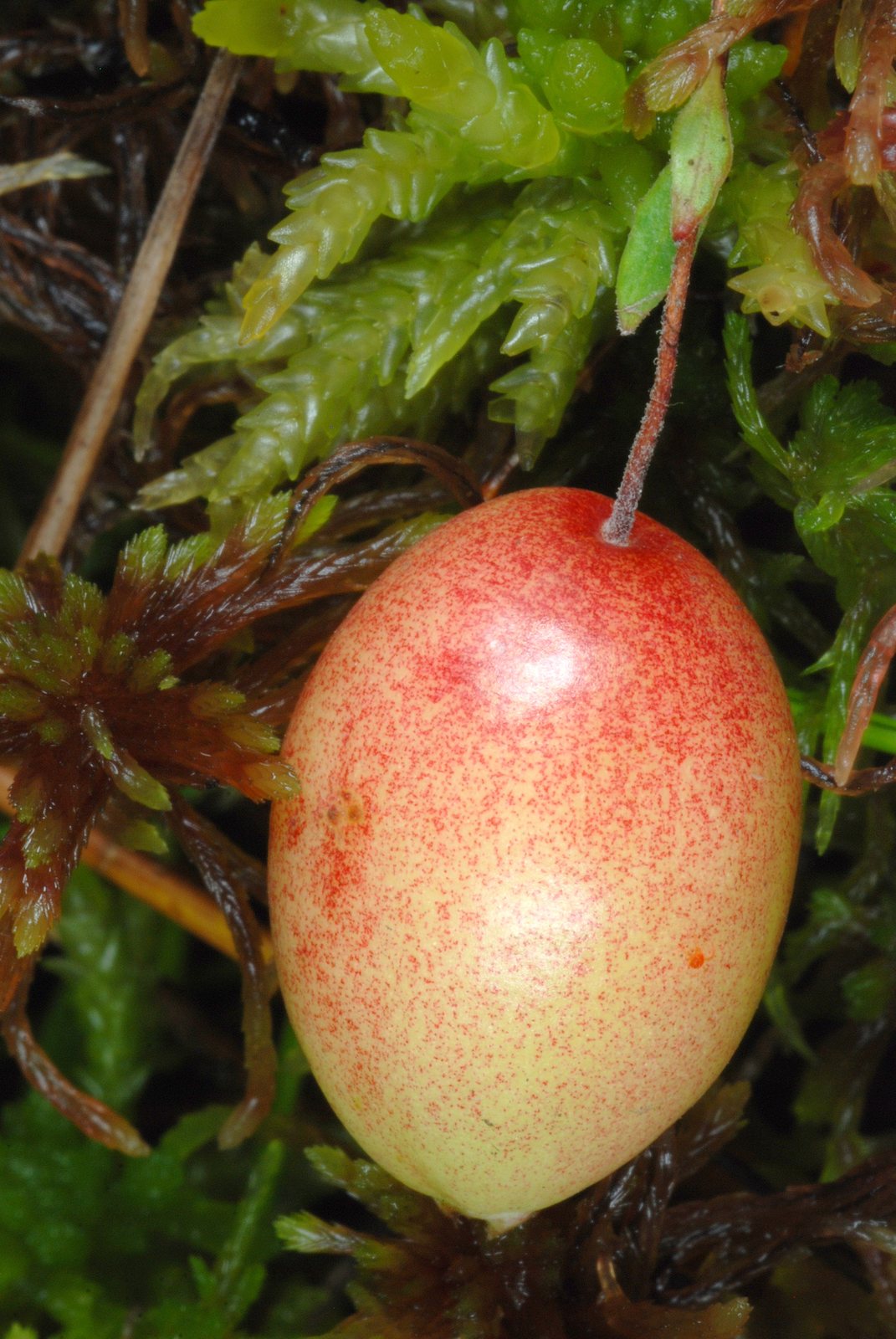
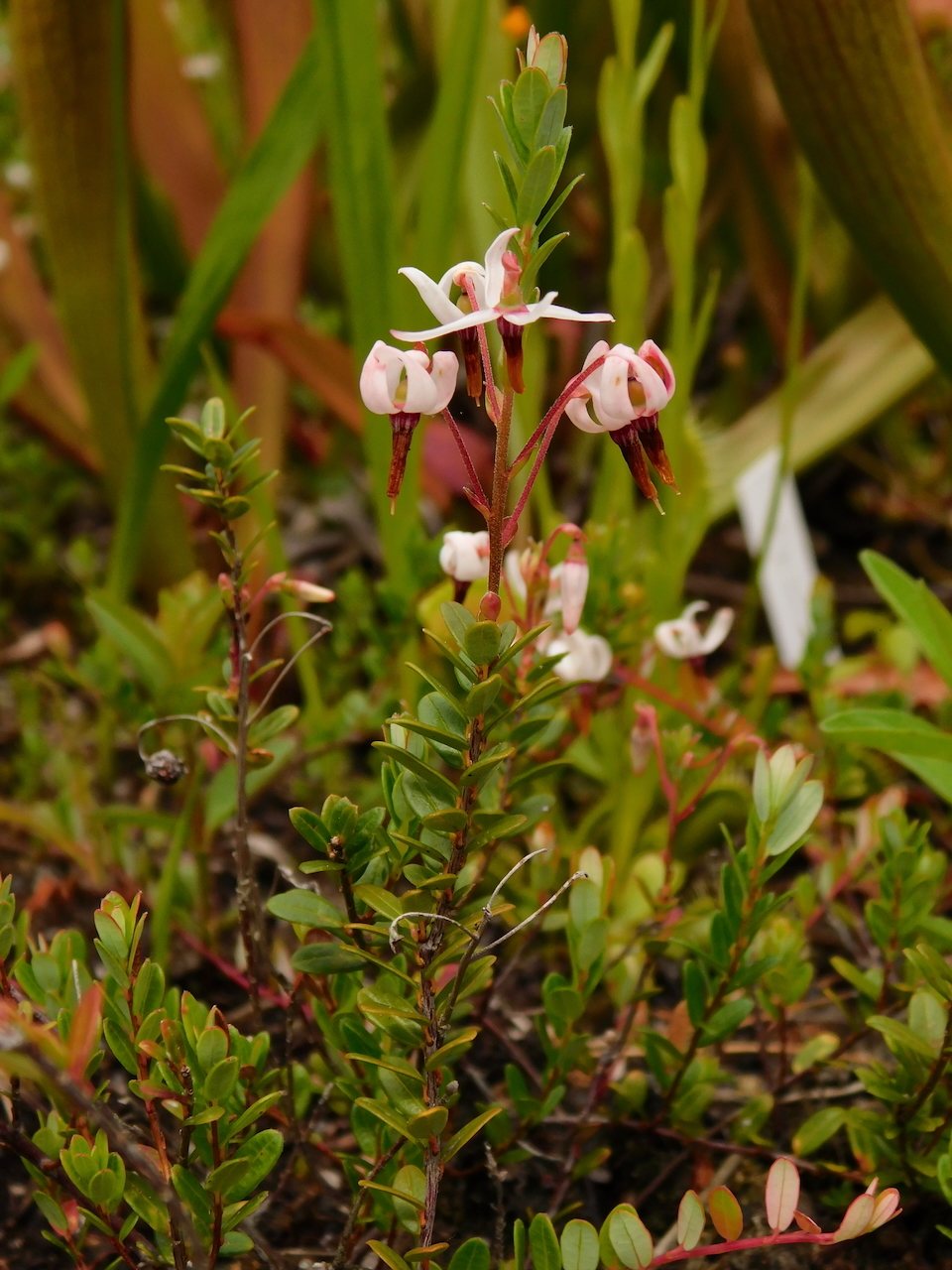
Cranberry is a low, spreading evergreen shrub with fine trailing stems, small pink flowers and tart red berries used in sauces, preserves and baking. It makes an edible groundcover in a sunny, acidic bed that stays consistently moist, and crops best where winters are cold and summers are relatively cool. You do not need to flood it to grow or harvest the fruit.
At a glance
- Sun
- Full sun for the best crop; tolerates light shade but produces fewer berries.
- Water
- Keep the shallow root zone consistently moist, preferably with rainwater where tap water is alkaline. Avoid prolonged stagnant water around the roots.
- Soil
- Strongly acidic, moisture-retentive soil with good aeration; aim for pH 4.0-5.5. Use an acidic raised bed or a wide container of ericaceous compost if your garden soil is unsuitable.
- Height
- 0.25-0.5 ft (0.08-0.15 m)
- Spread
- 2-4 ft (0.6-1.2 m), eventually wider where trailing stems root
- Flowers
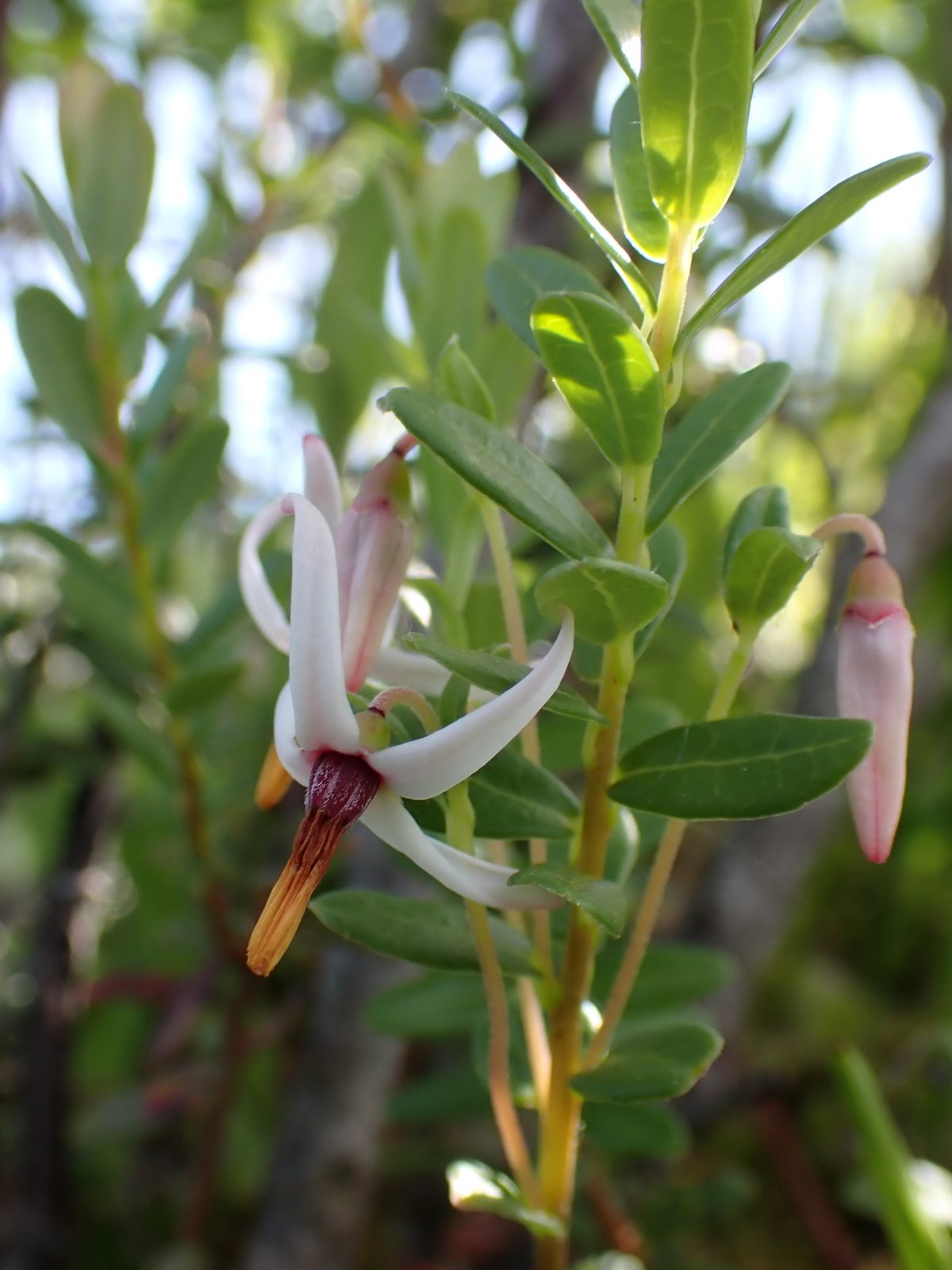
- Late spring to early summer; small pale pink flowers with swept-back petals.
- Foliage
- Evergreen. Small, leathery, dark green leaves with pale undersides; often turn bronze or purplish in winter.
- Growth
- Slow to moderate; runners gradually form a dense mat.
- Care needed
- Medium
The year at a glance
- Pollinators
- Cold hardy
- Wildlife
- Low allergen
- Edible
| J | F | M | A | M | J | J | A | S | O | N | D | |
|---|---|---|---|---|---|---|---|---|---|---|---|---|
| Flowers | ||||||||||||
| Fruit | ||||||||||||
| Plant |
Northern hemisphere months. In Australia, shift them by six.
- Difficulty
- Moderate
- Toughness
- Fairly tough
Will it suit your garden?
Pick your zone, country, light and whether you have pets.
Full sun is 6 or more hours of direct sun a day, part shade 3 to 6 hours, shade under 3.
How it grows
Planting day
0.4 ft (0.12 m)
full size
About 7 years to full size.
From a typical nursery size, at an average rate for this kind of plant. A rule of thumb, not a forecast.
Good to know
- Cats and dogs
- Safe
- Native to
- the US and Canada
- In the garden
- Spreads vigorously: plan to contain it.
- Growth rate
- Slow
Care
Jobs through the year
- WaterMar–May, Sep–Oct, every 7 days
- Check established plants and water if rainfall is insufficient; maintain moist, acidic soil without stagnant water.
- WaterJun–Aug, every 3 days
- Check shallow roots and water before they dry; young plants and containers need more frequent checks.
- WaterJan–Feb, Nov–Dec, every 14 days
- Check moisture in dry weather and water only if needed when soil is unfrozen; monitor containers especially.
- FeedMar–Apr
- Feed sparingly with acid-loving plant fertiliser only if growth is weak.
- MulchApr
- Apply a light layer of fine pine bark around new plants without burying upright shoots.
- PruneFeb–Mar
- Remove dead stems and thin excessive runners, retaining short fruiting uprights.
- ProtectMay–Jun
- Cover flowers during forecast frosts and remove fleece by day for pollinators.
- HarvestSep–Nov, every 7 days
- Hand-pick firm, mature-coloured berries; cut samples open to check for brown seeds.
- ProtectJan–Feb, Nov–Dec
- Shelter containers from drying winds and repeated freeze-thaw cycles.
- Water before the shallow roots dry out, especially while flowers and berries are developing.
- Use rainwater if your tap water is hard; check soil pH if new leaves turn yellow.
- Feed sparingly in spring with a fertilizer for acid-loving plants; excess nitrogen encourages runners at the expense of fruit.
- Apply a light mulch of fine pine bark around new plants, keeping upright shoots uncovered.
- Protect open flowers from late frost with horticultural fleece, removing it during the day so insects can visit.
Pruning. In late winter or early spring, remove dead stems and lightly thin congested, long runners. Keep the short upright shoots, which carry the flowers and fruit; avoid shearing the whole mat.
Harvest
Pick berries by hand in autumn when they are firm and have developed the mature colour typical of the variety, usually deep red; cut a few open to check that the seeds are brown. Colour alone is not a perfect guide, and ripe cranberries remain very tart. Expect the first worthwhile crop about 3-4 years after planting rooted plants.
Through the year
- Late winter
- Remove dead stems and thin excessive runners without cutting away the short fruiting uprights.
- Spring
- Plant rooted plants in a prepared acidic bed or wide container, and water them in thoroughly.
- Spring
- Apply a light feed only if growth is weak; check moisture and soil acidity.
- Late spring
- Protect flowers during forecast frosts and leave them accessible to pollinating insects by day.
- Summer
- Keep the root zone moist and inspect developing berries for caterpillar damage.
- Autumn
- Harvest ripe berries by hand and remove damaged or rotten fruit.
- Winter
- Check containers for drying out and shelter them from drying winds and repeated freeze-thaw cycles.
In the garden
- Use as an edible groundcover beneath widely spaced blueberries, keeping it out of deep shade.
- Plant along the moist, acidic margin of a bog garden, above any permanently standing water.
- Grow in a broad, shallow container near a path where the flowers and berries can be seen.
- Combine with moisture-loving heaths for a low evergreen carpet with contrasting foliage and flowers.
Garden styles it suits: Bog garden, Edible landscape, Homestead, New England, Wildlife garden and Small-space.
Plant it with: Highbush blueberry, Lingonberry, Bog rosemary and Cross-leaved heath.
Wildlife: Flowers provide pollen and nectar for bees, including bumblebees. Birds and small mammals eat the berries, and the evergreen mat provides low cover.
Problems to watch for
- Yellow leaves with greener veins usually indicate insufficient acidity or alkaline irrigation water: test the soil, switch to rainwater and correct the growing medium.
- Root rot and dieback can develop in stagnant, poorly aerated soil: improve drainage while maintaining moisture, and remove badly affected plants.
- Cranberry fruitworm caterpillars damage berries in parts of North America: remove infested fruit promptly and clear fallen berries after harvest.
- Poor fruit set can follow flower frost, shade or limited pollinator activity: protect flowers on frosty nights, provide more sun and avoid insecticides during bloom.
Safety
Not known to be toxic to people, cats, dogs or horses. The berries are edible, although large quantities can cause digestive upset, particularly in pets; leaves and stems are not normally eaten.
Easily confused with
Small cranberry (Vaccinium oxycoccos)
Usually has smaller leaves with more strongly rolled-under edges and smaller berries; cranberry has larger, more oblong leaves.
Lingonberry (Vaccinium vitis-idaea)
Forms more upright shoots with broader leaves and clusters of bell-shaped flowers, rather than cranberry's trailing stems and swept-back flower petals.
American highbush cranberry (Viburnum opulus var. americanum)
An upright deciduous shrub with maple-like leaves, flat clusters of white flowers and bunches of red fruit; it is not a true cranberry.
The name
The species name macrocarpon means 'large-fruited', distinguishing it from smaller-fruited cranberries.
Propagation. Lift and replant rooted sections of runners in spring, or root stem cuttings in a moist, acidic medium. Seed-grown plants are variable and take longer to crop; use vegetative propagation to keep a named variety true to type.
Checked against open data
- Accepted botanical name
- Vaccinium macrocarpon
- In the US and Canada
- Native in Canada, the lower 48 states and St. Pierre and Miquelon.
- Native range
- Connecticut, Delaware, District of Columbia, Illinois, Indiana, Maine, Maryland, Masachusettes, Michigan, Minnesota, New Brunswick and New Hampshire.
- Measured
- Average height 60 cm.
Sources: GBIF (CC BY 4.0), USDA PLANTS and Trefle (CC BY 4.0). The care and design notes are LandscapeGPT's own.
See it in your own yard.
Upload a photo of your yard and see it redesigned with plants that suit your climate, each checked against your zone.