Damson
Prunus domestica subsp. insititia. Family Rosaceae. Tree.
Also called Damson plum, Prunus insititia.
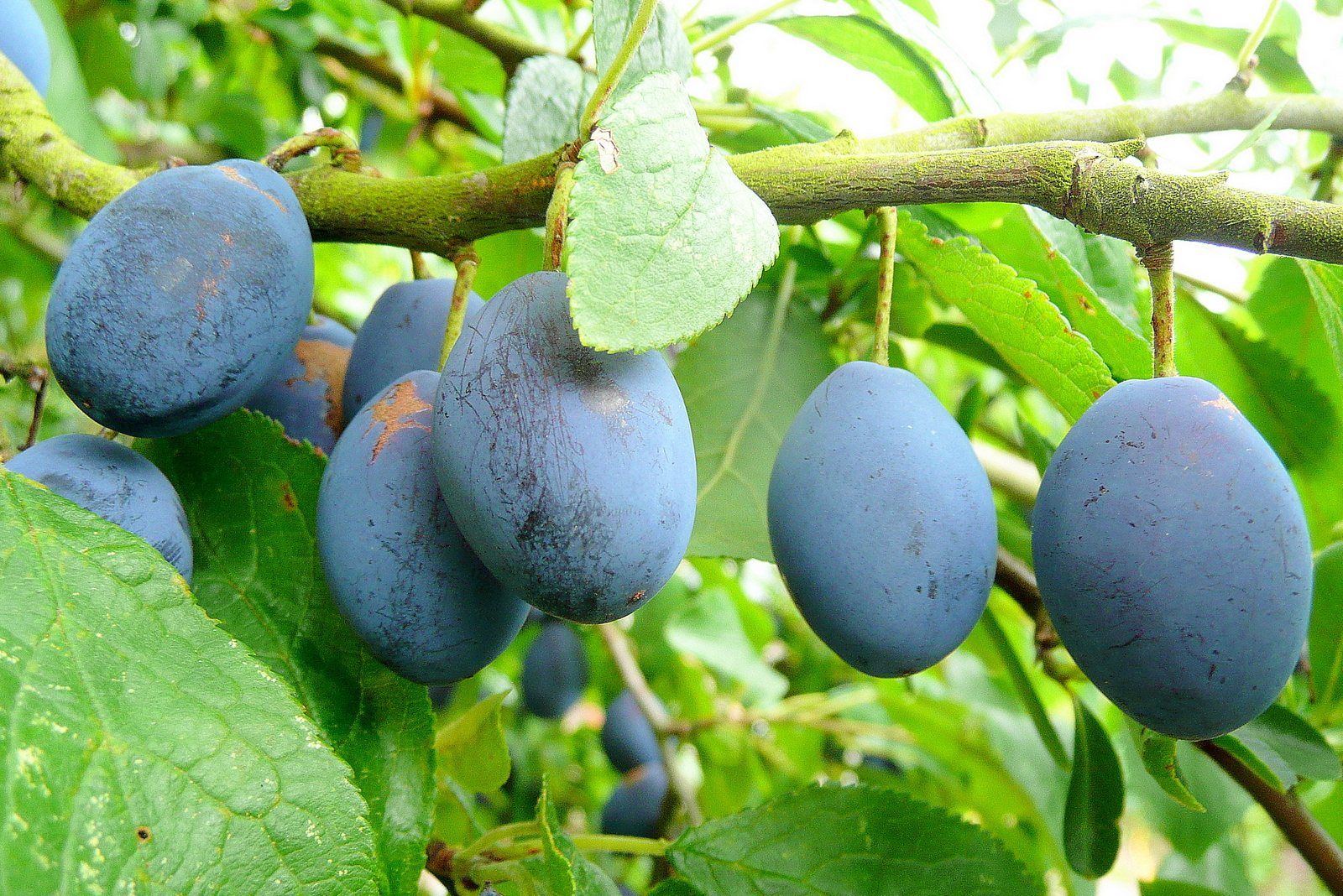
Damson is a deciduous plum tree grown for small, usually blue-black fruits with firm, tart flesh, especially useful for jam, preserves and cooking. It also provides white spring blossom and can suit a small orchard or edible hedge, although its eventual size depends strongly on the rootstock. Most varieties are self-fertile, but check the named variety before buying.
At a glance
- Sun
- Full sun gives the best crops; tolerates light partial shade. Choose a sheltered position outside frost pockets.
- Water
- Water deeply during dry weather for the first two growing seasons and while fruit is swelling. Established trees tolerate short dry spells but crop poorly under prolonged drought.
- Soil
- Fertile, moisture-retentive, well-drained soil, ideally near neutral. Tolerates clay if it does not remain waterlogged; suitability for chalky or wet soils depends partly on the rootstock.
- Height
- 15-25 ft (4.5-7.5 m) on vigorous rootstocks; smaller on dwarfing rootstocks
- Spread
- 12-20 ft (3.7-6 m) on vigorous rootstocks; smaller on dwarfing rootstocks
- Flowers
- White flowers in early to mid-spring, before or as the leaves open.
- Foliage
- Oval, finely toothed green leaves, sometimes turning yellow in autumn.
- Growth
- Moderate
- Care needed
- Medium
The year at a glance
- Pollinators
- Wildlife
- Low allergen
- Edible
| J | F | M | A | M | J | J | A | S | O | N | D | |
|---|---|---|---|---|---|---|---|---|---|---|---|---|
| Flowers | ||||||||||||
| Fruit | ||||||||||||
| Plant |
Northern hemisphere months. In Australia, shift them by six.
- Difficulty
- Moderate
- Toughness
- Fairly tough
Will it suit your garden?
Pick your zone, country, light and whether you have pets.
Full sun is 6 or more hours of direct sun a day, part shade 3 to 6 hours, shade under 3.
How it grows
Planting day
7 ft (2 m)
After 1 year
7 ft (2.2 m)
After 2 years
8 ft (2.4 m)
After 3 years
9 ft (2.6 m)
After 5 years
10 ft (3 m)
About 20 years to full size.
From a typical nursery size, at an average rate for this kind of plant. A rule of thumb, not a forecast.
Good to know
- Cats and dogs
- Toxic
- Growth rate
- Moderate
Care
Jobs through the year
- WaterApr–May, Oct, every 14 days
- Water established trees deeply during dry spells; water young trees more regularly for two seasons.
- WaterJun–Sep, every 7 days
- Water deeply when soil is drying, especially while fruit swells; skip when rainfall is adequate.
- MulchFeb–Mar
- Renew organic mulch over a grass-free root area, leaving the trunk clear.
- FeedMar
- Feed modestly only if growth is weak; avoid heavy nitrogen applications.
- ProtectMar–Apr
- Cover accessible blossom during forecast frost, removing covers by day for pollinators.
- PruneApr–May
- Train young branches as growth starts, making cuts only in dry weather.
- PruneJun–Aug
- Lightly prune established trees in dry weather; remove damaged, diseased or crossing wood and suckers.
- ProtectJun–Jul
- Support heavily laden branches before the crop bends or breaks them.
- HarvestAug–Sep
- Pick fully coloured, slightly softened fruit that lifts off easily; remove rotting fruit.
- ProtectFeb, Nov
- Check stakes, ties and browsing guards, ensuring nothing constricts the trunk.
- Choose a rootstock suited to your available space and soil; allow room for the mature crown.
- Plant with the graft union above soil level and stake young trees if the site or rootstock requires support.
- Keep a grass-free circle around young trees and apply organic mulch annually, leaving a gap around the trunk.
- Water deeply during establishment and dry spells rather than giving frequent shallow watering.
- Feed modestly in spring if growth is weak; avoid heavy nitrogen feeding that encourages leafy growth instead of fruit.
- Remove root suckers promptly, especially shoots arising below the graft.
Pruning. Train young trees in spring as growth begins, then prune established trees lightly in summer during dry weather to reduce silver leaf and bacterial canker risk. Remove dead, damaged and crossing branches, retaining an open crown; avoid routine winter pruning.
Harvest
Pick damsons in late summer or early autumn when they have developed their full colour, soften slightly and detach with a gentle lift; taste a few because ripe fruit remains tart. Harvest in several passes and handle gently to avoid bruising. Grafted trees usually give their first worthwhile crop about 3-5 years after planting, though vigorous rootstocks and poor growing conditions can delay this.
Through the year
- Late autumn
- Plant dormant bare-root trees where soil is workable and not waterlogged; stake and protect trunks from browsing animals.
- Late winter
- Check ties and guards, clear grass from around the trunk and renew mulch without covering the bark.
- Spring
- Feed lightly if needed, train young branches and protect blossom from forecast frost where practical.
- Early summer
- Water during dry spells, remove root suckers and support branches if a heavy crop threatens to bend or break them.
- Summer
- Prune established trees lightly in dry weather and remove diseased shoots.
- Late summer to early autumn
- Harvest ripe fruit regularly and remove rotting or mummified fruit from the tree and ground.
In the garden
- Use as a small orchard tree with other compatible fruit trees, leaving access for picking and pruning.
- Plant in an informal edible hedge where suckering growth can be managed.
- Make it a spring-flowering focal point in a cottage garden, with low planting beyond the clear trunk circle.
- Include in a food forest as a fruiting canopy tree, allowing enough sunlight for reliable cropping.
Garden styles it suits: Cottage garden, English country, Backyard orchard, Edible landscape, Food forest and Native hedgerow.
Plant it with: Chives, Yarrow, Nasturtiums and White clover.
Wildlife: Spring flowers provide pollen and nectar for bees and other insects. Birds eat ripe fruit, and mature trees provide shelter and nesting sites.
Problems to watch for
- Brown rot: remove rotting and mummified fruit promptly, clear fallen fruit and prune for airflow.
- Silver leaf and bacterial canker: prune only in suitable dry spring or summer weather, remove affected wood and clean tools between cuts.
- Plum moth: larvae tunnel into fruit; remove affected and fallen fruit, and use pheromone traps to monitor activity where this pest occurs.
- Poor fruit set: avoid frost pockets, check the variety's pollination needs and choose a locally suitable variety with enough winter chill; the warmest parts of zone 9 may be unsuitable.
Safety
Leaves, stems and the kernels inside the stones contain cyanogenic compounds and can cause serious poisoning in people, cats, dogs and horses if eaten; wilted foliage is a particular concern for grazing animals. Ripe fruit flesh is edible, but remove the stones, which also pose choking and intestinal-blockage risks to pets.
Easily confused with
Bullace (Prunus domestica subsp. insititia)
Usually has rounder fruit, while damsons are typically oval. Both belong to the same variable group, so fruit shape alone does not always settle identification.
Blackthorn or sloe (Prunus spinosa)
Usually forms a densely thorny shrub with much smaller, rounder, intensely astringent fruit; its white flowers normally open before the leaves.
Cherry plum (Prunus cerasifera)
Usually flowers earlier and bears rounder red, yellow or purple fruit, often ripening earlier than damsons.
The name
The name damson comes from the older name 'damascene plum', meaning a plum associated with Damascus.
Propagation. Named varieties are usually propagated by budding or grafting onto a suitable plum rootstock. Seedlings vary and do not reliably reproduce the parent; suckers from grafted trees may belong to the rootstock rather than the damson variety.
Checked against open data
- Accepted botanical name
- Prunus domestica insititia
Sources: GBIF (CC BY 4.0). The care and design notes are LandscapeGPT's own.
See it in your own yard.
Upload a photo of your yard and see it redesigned with plants that suit your climate, each checked against your zone.