Date palm
Phoenix dactylifera. Family Arecaceae. Tree.
Also called True date palm, Edible date palm.
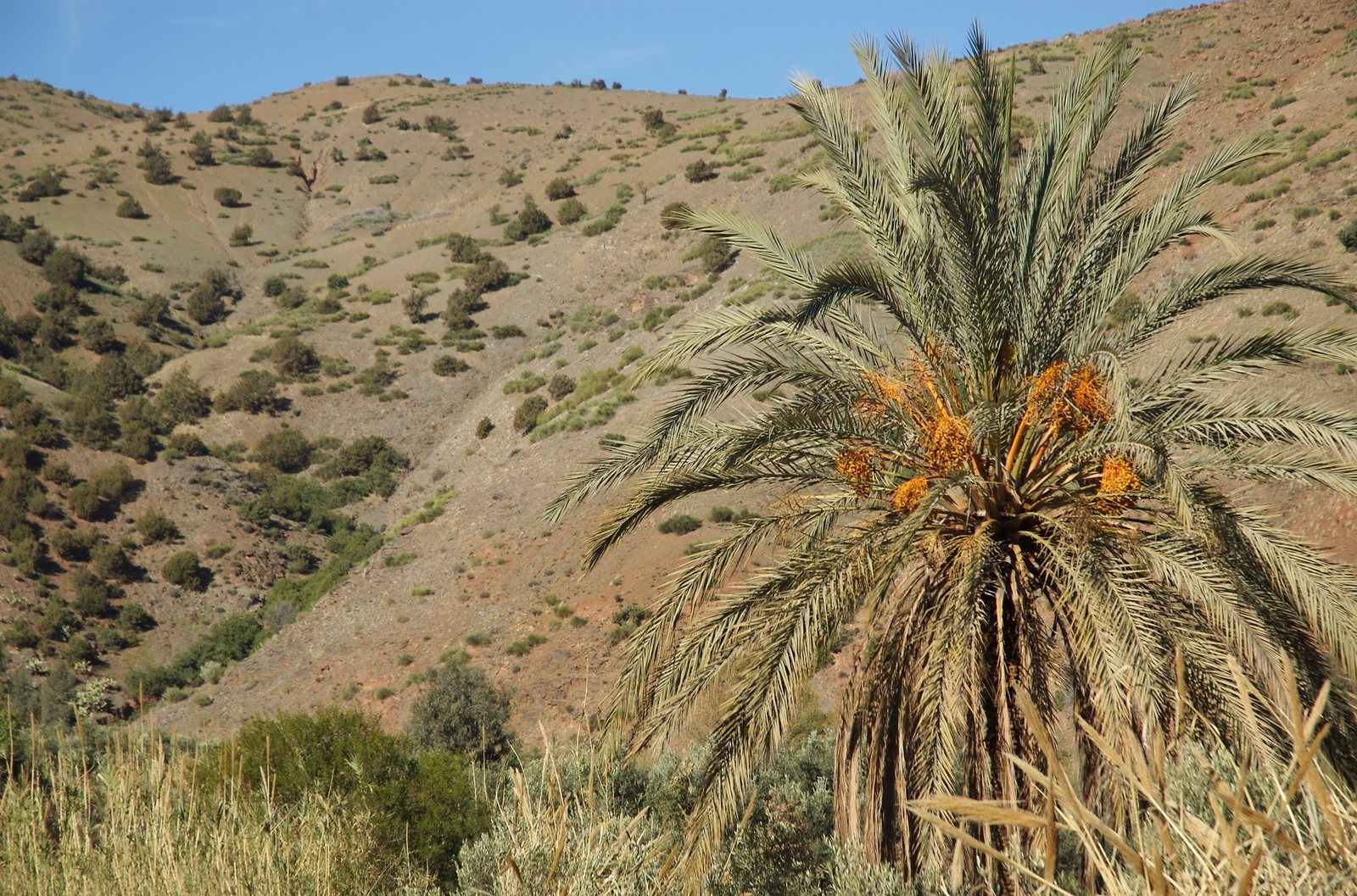
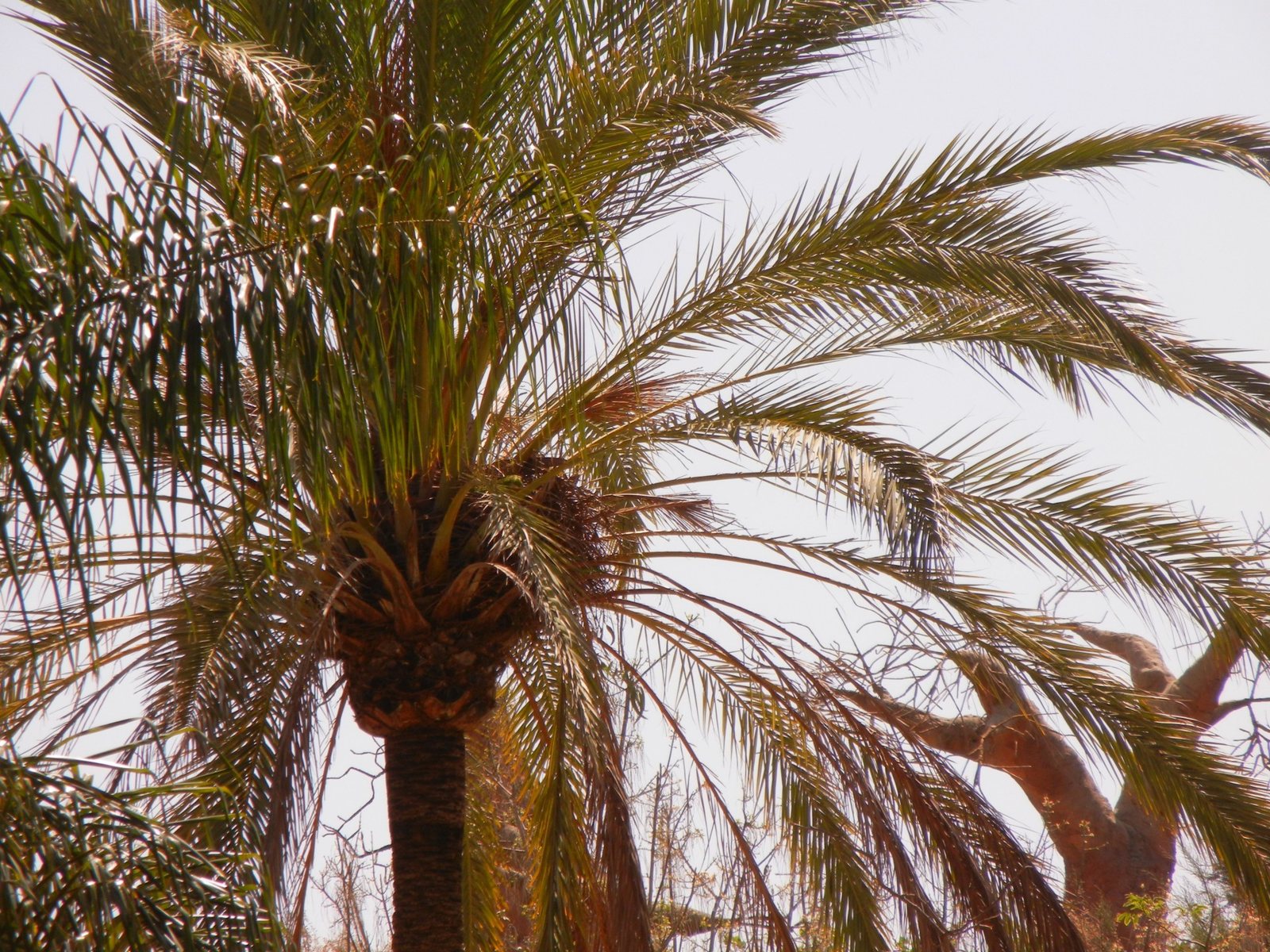
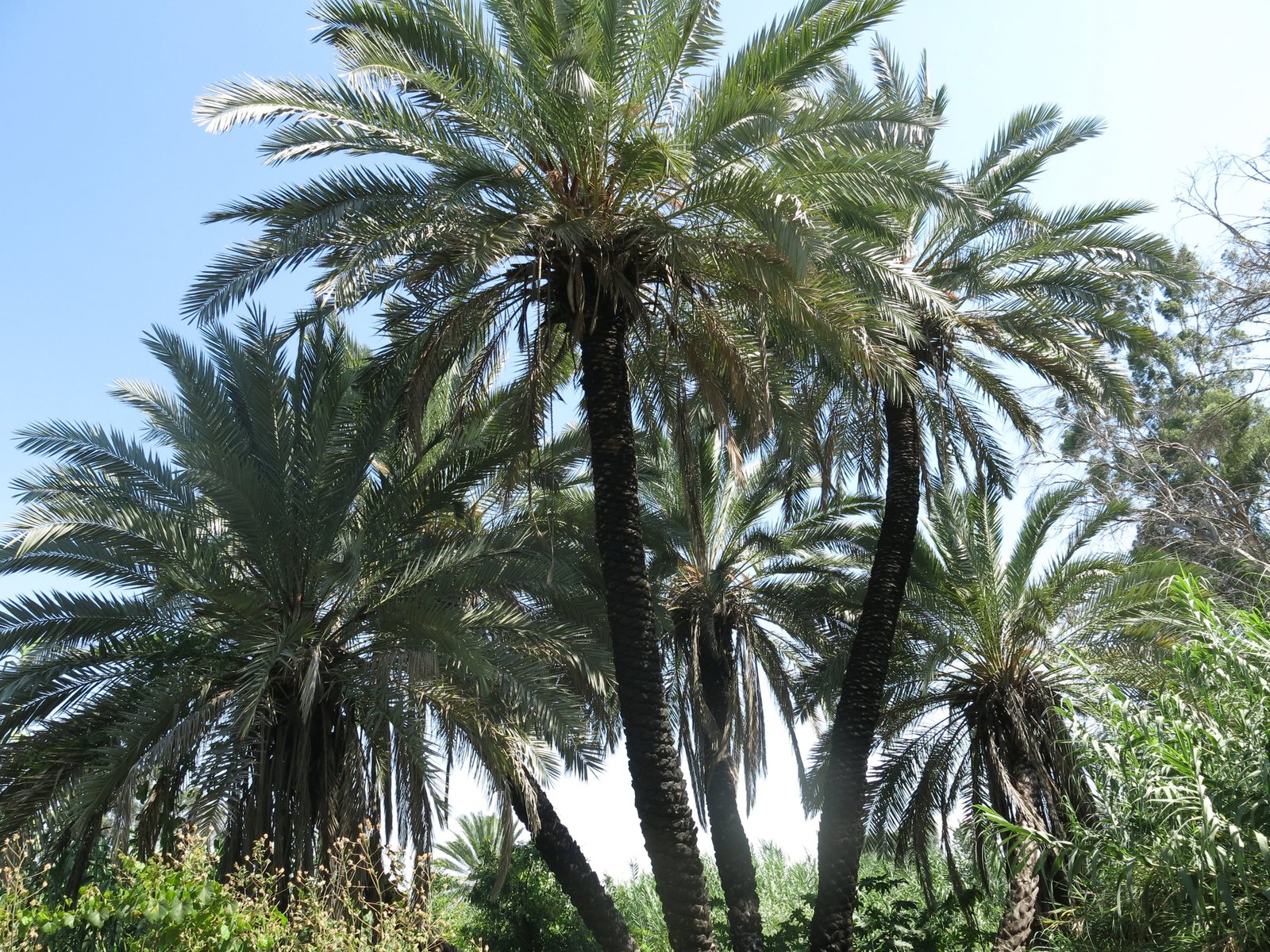
Date palm is a large evergreen palm grown for its tall trunk, arching grey-green fronds and edible dates. It suits spacious, sunny gardens in warm climates; good fruit needs a female palm, pollen from a male and a long, hot, mostly dry ripening season. In the UK and most of Canada, grow young plants in containers with frost-free winter shelter rather than expecting a permanent outdoor tree.
At a glance
- Sun
- Full sun; fruit production needs prolonged summer heat.
- Water
- Water deeply while establishing. Established palms tolerate drought, but regular deep watering supports better growth and fruit; avoid constantly wet soil.
- Soil
- Deep, well-drained sandy or loamy soil; tolerates alkaline conditions and some salinity, but not waterlogging.
- Height
- 50-80 ft (15-24 m)
- Spread
- 20-40 ft (6-12 m)
- Flowers
- Small cream to pale yellow flowers in branching clusters, usually in spring; male and female flowers grow on separate plants.
- Foliage
- Evergreen. Long, arching, feather-shaped grey-green to blue-green fronds with stiff leaflets; the lowest leaflets form sharp spines near the leaf stalk base.
- Growth
- Slow to moderate, faster with sustained heat and adequate water.
- Care needed
- Medium
The year at a glance
- Drought tolerant
- Heat tolerant
- Wildlife
| J | F | M | A | M | J | J | A | S | O | N | D | |
|---|---|---|---|---|---|---|---|---|---|---|---|---|
| Flowers | ||||||||||||
| Plant |
Northern hemisphere months. In Australia, shift them by six.
- Difficulty
- Hard
- Toughness
- Needs looking after
Will it suit your garden?
Pick your zone, country, light and whether you have pets.
Full sun is 6 or more hours of direct sun a day, part shade 3 to 6 hours, shade under 3.
How it grows
Planting day
8 ft (2.3 m)
After 1 year
10 ft (3.2 m)
After 2 years
13 ft (4.1 m)
After 3 years
16 ft (4.9 m)
After 5 years
22 ft (6.6 m)
About 20 years to full size.
From a typical nursery size, at an average rate for this kind of plant. A rule of thumb, not a forecast.
Good to know
- Cats and dogs
- Safe
- Invasive in
- Australia
- In the garden
- Spreads vigorously: plan to contain it.
- Growth rate
- Moderate
Care
Jobs through the year
- ProtectSep–Oct
- Not reliably hardy in zone 6–7 or the UK: grow in a movable container and bring into bright, frost-free shelter.
- ProtectMay–Jun
- Acclimatize gradually to outdoor sun after frost risk passes; outdoor planting is unsuitable here.
- WaterApr–May, Sep–Oct, every 10 days
- For container culture here, water deeply once the surface dries; keep water out of the crown.
- WaterJun–Aug, every 7 days
- Check container moisture and soak when the surface dries; small pots may need water more often.
- WaterJan–Mar, Nov–Dec, every 21 days
- Under cool frost-free cover, water sparingly without letting the root ball dry completely.
- FeedMay–Aug, every 30 days
- Use palm fertilizer containing magnesium and micronutrients at its labelled container rate.
- PruneMay–Jun
- Remove only dead, broken or fully brown fronds; wear heavy gloves and eye protection around spines.
- Plant in warm weather where the full crown can develop clear of buildings, overhead wires and busy paths.
- Water the root zone deeply, then let the surface soil dry; keep irrigation away from the crown.
- Apply a palm fertiliser containing magnesium and micronutrients during active growth, following local guidance and label rates.
- Mulch the root zone lightly, leaving the trunk base uncovered.
- For fruit, use a named female propagated from an offshoot or tissue culture and arrange compatible male pollen; seed-grown palms have unpredictable sex and fruit quality.
- Keep container plants in very bright light and move them under frost-free cover before cold weather.
Pruning. In late spring or early summer, remove only dead, broken or fully brown fronds and unwanted flower or fruit stalks; leave healthy green fronds intact. Wear eye protection and heavy gloves around the spines, and use a qualified arborist for tall palms.
Through the year
- Spring
- Check for winter damage and resume feeding once active growth begins.
- Spring
- If growing fruit, hand-pollinate receptive female flowers with male pollen; flowering time varies with climate.
- Late spring
- Plant or repot when the soil is warm, keeping the palm at its previous planting depth.
- Summer
- Water deeply during dry spells and inspect the crown and fronds for pests.
- Late summer to autumn
- Harvest dates as they reach the ripeness appropriate to the variety; remove fallen fruit.
- Autumn
- Move container plants into bright, frost-free shelter in cool climates.
- Winter
- Keep sheltered container plants on the dry side without letting the root ball dry out completely.
In the garden
- Use as a tall focal point in a spacious gravel garden with low, drought-tolerant planting.
- Plant in widely spaced rows along a broad drive or avenue for a formal rhythm.
- Combine with agaves, aloes and ornamental grasses for contrasting leaf shapes in hot, dry gardens.
- Use young container specimens on sunny terraces where winter shelter is available.
- Include fruiting females in a warm-climate edible landscape, with room for harvesting and fallen fruit.
Garden styles it suits: Architectural minimal, Modern Mediterranean, Desert modern, Moroccan, Desert / xeriscape and Edible landscape.
Plant it with: Agave, Aloe, Red yucca, Rosemary, Lavender and Deer grass.
Wildlife: Flowers attract insects, and ripe or fallen dates feed birds and mammals. Remove unwanted fruit where it attracts rodents or encourages seedlings.
Problems to watch for
- Root or crown rot: improve drainage, avoid frequent shallow watering and keep water out of the crown; severely rotted palms may need removal.
- Potassium or magnesium deficiency: older fronds develop spotting or yellow bands; use a balanced palm fertiliser rather than removing affected green fronds or applying isolated nutrients indiscriminately.
- Palm weevils: larvae tunnel inside the trunk or crown, causing holes, oozing or collapse; seek prompt local advice because treatment and reporting requirements vary by region.
- Cold injury: fronds brown and the growing point may be damaged after hard freezes; protect small specimens and choose a warmer site rather than relying on repeated winter recovery.
Safety
Phoenix dactylifera is not known to be toxic to cats, dogs, horses or people, and ripe date flesh is edible. Hard pits can cause choking or intestinal blockage if swallowed, and the sharp leaf-base spines can cause serious puncture wounds.
Where it spreads. Naturalised date palms can spread aggressively along waterways and around springs in arid central Australia, particularly in the Northern Territory. Avoid planting near natural watercourses there and remove volunteer seedlings.
Easily confused with
Canary Island date palm (Phoenix canariensis)
Usually has a much thicker trunk and a denser crown of deeper green fronds; its small fruits have little edible flesh.
Silver date palm (Phoenix sylvestris)
Often has a solitary trunk and a dense crown of shorter, silvery fronds; true date palm commonly produces basal offshoots. Hybrids can make identification difficult.
Pygmy date palm (Phoenix roebelenii)
Much smaller, with a slender trunk and shorter, softer-looking green fronds; it does not develop the massive crown of a mature true date palm.
The name
The epithet dactylifera means 'finger-bearing', referring to the elongated fruits, and the common name date also traces to the Greek word for finger.
Propagation. Commercial fruiting varieties are propagated from basal offshoots or by specialist tissue culture. Seeds germinate in warmth but do not reproduce the parent variety, and seedlings may be male or female; separating large offshoots is best left to experienced growers.
Checked against open data
- Accepted botanical name
- Phoenix dactylifera
- In the US and Canada
- Introduced in Hawaii, the lower 48 states and Pacific Basin.
- Native range
- Gulf States, Iran, Iraq, Oman, Pakistan and Saudi Arabia.
- Measured
- Average height 3000 cm.
Sources: GBIF (CC BY 4.0), USDA PLANTS and Trefle (CC BY 4.0). The care and design notes are LandscapeGPT's own.
See it in your own yard.
Upload a photo of your yard and see it redesigned with plants that suit your climate, each checked against your zone.