English oak
Quercus robur. Family Fagaceae. Tree.
Also called Pedunculate oak, Common oak.
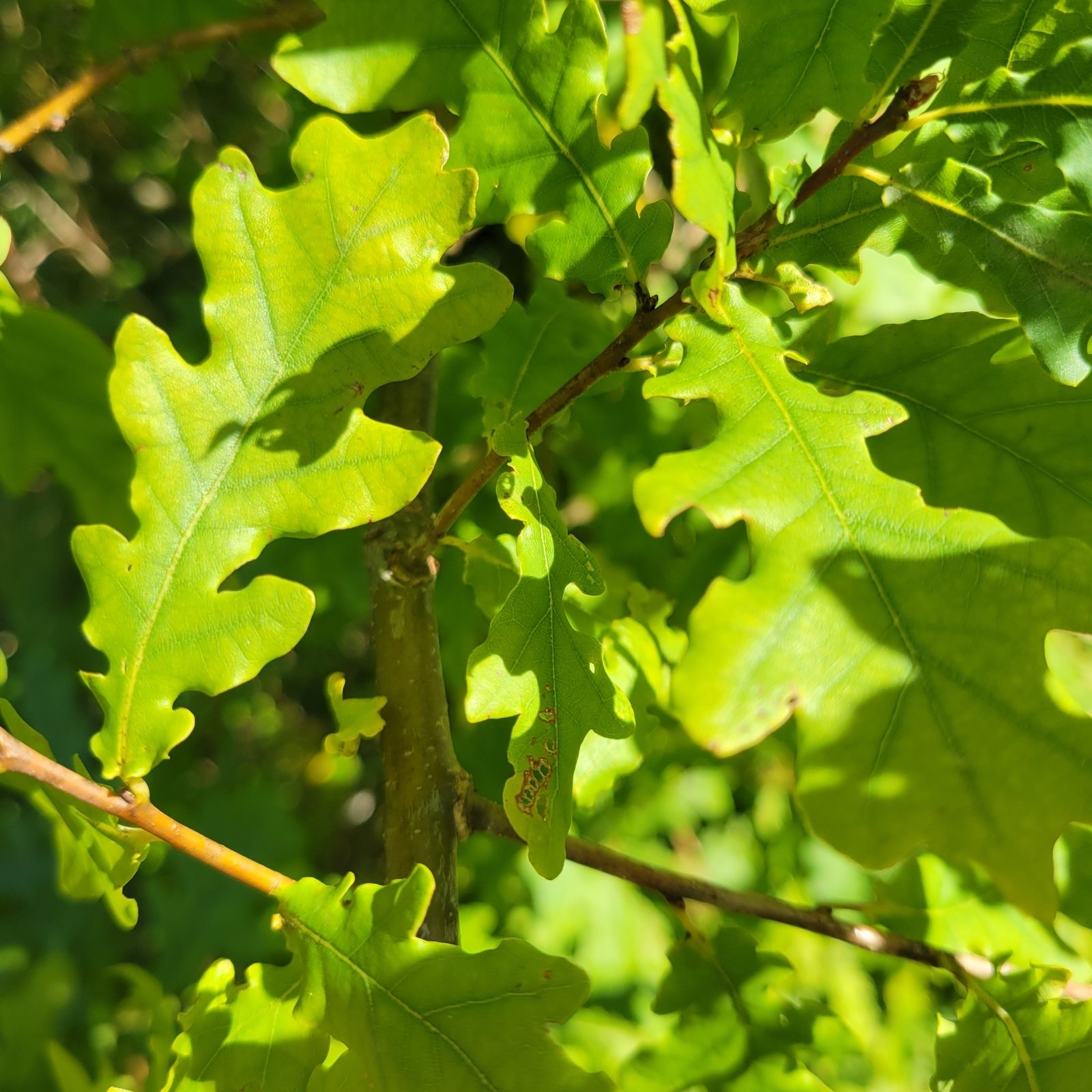
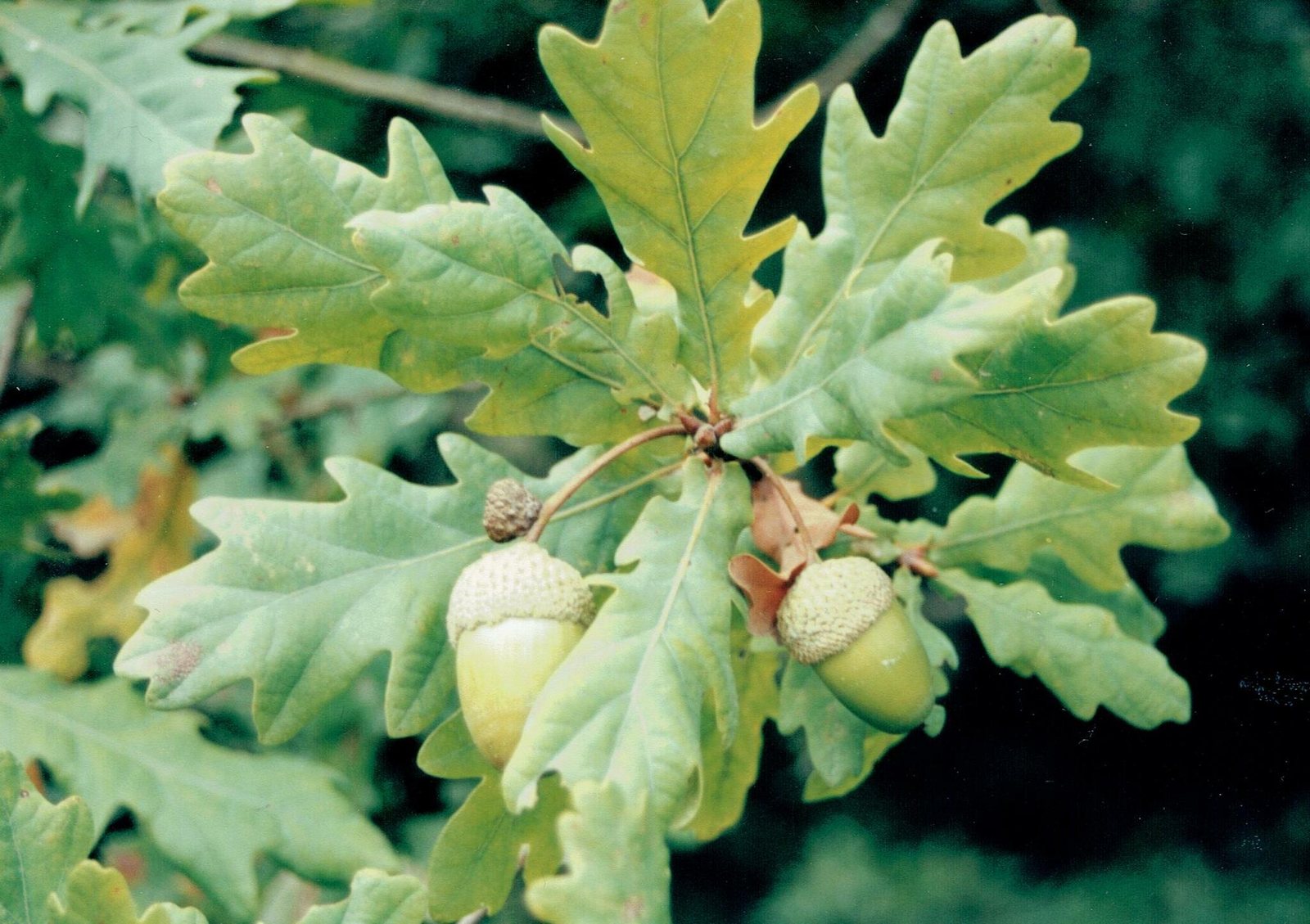
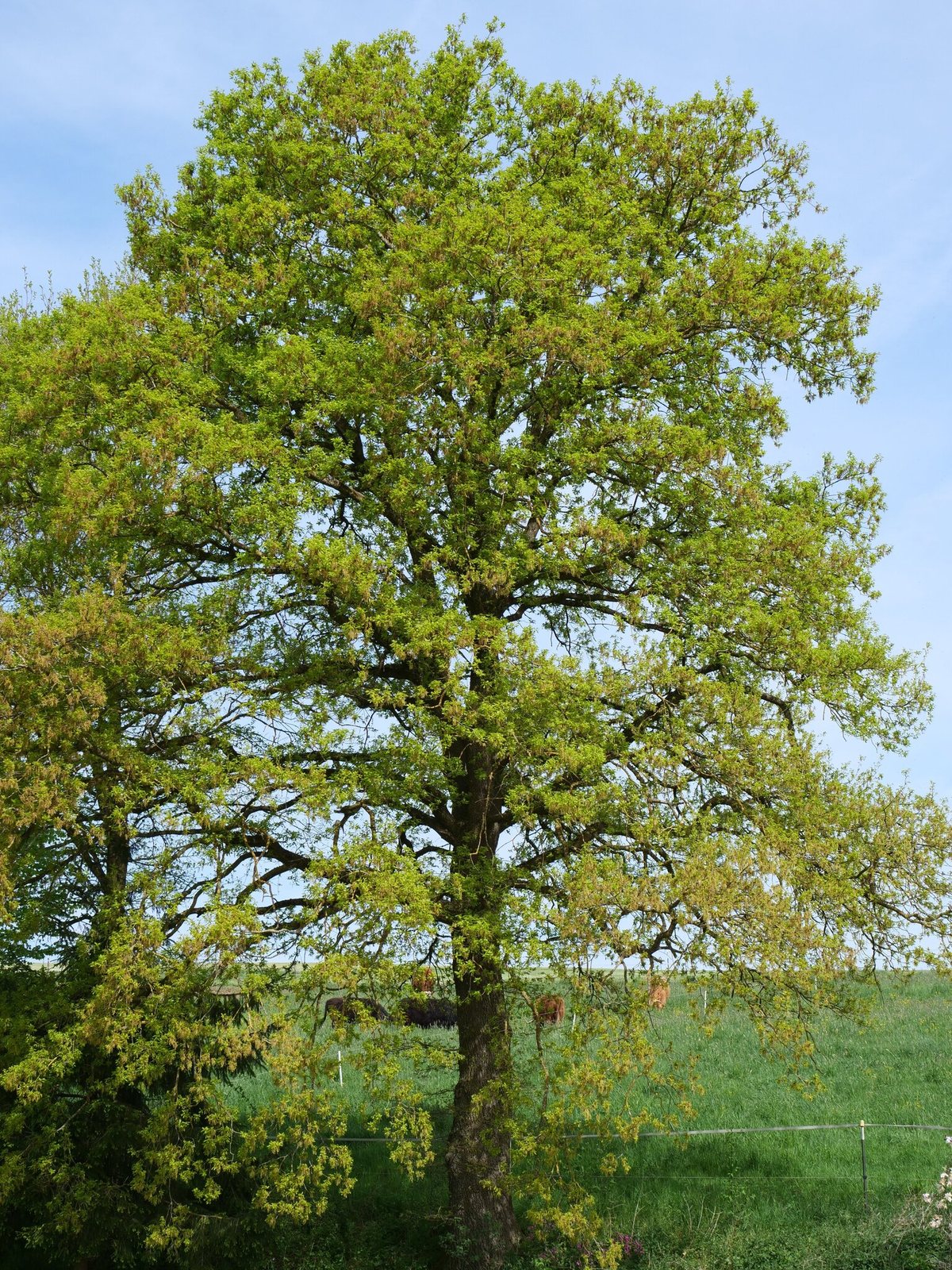
English oak is a large, long-lived deciduous tree with a broad crown, deeply lobed leaves and stalked acorns. Grow it for lasting shade, a strong winter outline and wildlife habitat, but allow room for its mature canopy and roots: it is not a small-garden tree.
At a glance
- Sun
- Full sun; young trees tolerate light shade.
- Water
- Water regularly while establishing. Established trees tolerate some drought, but prolonged heat and dry soil can cause stress and dieback.
- Soil
- Deep loam or clay that retains moisture but drains reasonably well; tolerates acidic, neutral and alkaline soils and occasional flooding. Avoid shallow, severely compacted or permanently waterlogged ground.
- Height
- 40-70 ft (12-21 m), sometimes taller
- Spread
- 40-70 ft (12-21 m)
- Flowers
- Spring, as leaves emerge: inconspicuous yellow-green male catkins and tiny reddish female flowers.
- Foliage
- Green, rounded-lobed leaves with very short stalks and small ear-like lobes at the base; usually yellow-brown to brown in autumn.
- Growth
- Moderate when young, slowing with age.
- Care needed
- Medium
The year at a glance
- Wildlife
| J | F | M | A | M | J | J | A | S | O | N | D | |
|---|---|---|---|---|---|---|---|---|---|---|---|---|
| Flowers | ||||||||||||
| Fruit | ||||||||||||
| Plant |
Northern hemisphere months. In Australia, shift them by six.
- Difficulty
- Moderate
- Toughness
- Very tough
Will it suit your garden?
Pick your zone, country, light and whether you have pets.
Full sun is 6 or more hours of direct sun a day, part shade 3 to 6 hours, shade under 3.
How it grows
Planting day
7 ft (2 m)
After 1 year
8 ft (2.6 m)
After 2 years
10 ft (3.1 m)
After 3 years
12 ft (3.7 m)
After 5 years
16 ft (4.8 m)
About 26 years to full size.
From a typical nursery size, at an average rate for this kind of plant. A rule of thumb, not a forecast.
Good to know
- Cats and dogs
- Toxic
- Native to
- the UK
- Invasive in
- Australia
- Growth rate
- Slow
Care
Jobs through the year
- WaterApr–May, Sep–Oct, every 21 days
- Water established trees only in prolonged dry weather; young trees need more for two to three years.
- WaterJun–Aug, every 14 days
- During prolonged drought, soak a broad root area slowly rather than wetting only the trunk base.
- MulchMar–Apr
- Refresh a broad grass-free mulch ring around young trees, keeping the root flare exposed.
- PruneJan–Feb
- Train young trees without topping; use an arborist for large limbs and follow local oak-wilt restrictions.
- ProtectMar, Oct
- Check young-tree ties, remove unnecessary stakes and protect roots from compaction.
- Plant with the root flare at soil level, well away from buildings, drains and overhead wires.
- Water deeply during dry spells for the first two or three growing seasons; check soil moisture before watering again.
- Keep a broad, grass-free mulch ring around young trees, leaving the trunk clear.
- Stake only if needed for stability, using flexible ties; remove supports once roots hold the tree securely.
- Do not feed routinely; protect the root area from excavation, paving and soil compaction.
Pruning. Prune young trees in midwinter to develop a sound framework, removing damaged, crossing or competing branches without topping the tree. Use a qualified arborist for large limbs, and follow local oak-wilt pruning restrictions in affected parts of North America.
Through the year
- Autumn
- Collect freshly fallen, sound acorns for immediate sowing; protect them from rodents.
- Late autumn
- Plant while dormant where soil is workable; in very cold regions, wait until early spring.
- Winter
- Check young trees for structural faults and arrange any necessary pruning.
- Spring
- Refresh mulch, check ties and remove grass competing around young trees.
- Summer
- Water establishing trees deeply during dry periods and watch for premature browning or wilting.
- Autumn
- Remove unwanted oak seedlings and keep fallen acorns away from livestock.
In the garden
- Plant as a specimen in a large lawn, with space for its wide, spreading crown.
- Use in parkland or estate planting to create long views and a lasting landscape framework.
- Combine with native shrubs and woodland-edge plants in a spacious wildlife garden.
- Use widely spaced groups to give large rural gardens shade and a woodland character.
Garden styles it suits: English country, Traditional, Grand estate, Woodland, Wildlife garden and English manor.
Plant it with: Hawthorn, Hazel, Holly, Primroses, Wood anemones and Male fern.
Wildlife: In its native UK and European range, it supports a particularly rich community of caterpillars and other insects, which feed birds and bats. Acorns feed birds and mammals, and old trees provide cavities and decaying-wood habitat. Its value to specialist native insects is generally lower outside its native range.
Problems to watch for
- Powdery mildew: white coating on leaves, especially young growth. Usually needs no treatment on established trees; reduce drought stress and maintain airflow.
- Aphids: sticky honeydew may drip onto paving or parked cars. Encourage natural predators; avoid routine spraying of large trees.
- Oak wilt in affected parts of North America: sudden wilting and browning can be fatal. Seek prompt professional diagnosis, follow local pruning restrictions and do not move infected firewood.
- Root stress and decay: compaction, buried root flares and persistently saturated soil can cause thinning foliage and dieback. Correct drainage or planting problems where feasible and have declining trees assessed.
Safety
Acorns, young leaves and buds contain tannins and can poison horses, dogs and other animals if eaten in quantity; horses are particularly at risk. Cats should also be kept from eating them, although poisoning is less commonly reported. Raw acorns and leaves are not safe food for people; substantial ingestion can cause digestive upset and potentially kidney damage. Acorns also pose a choking or intestinal-blockage risk to pets.
Where it spreads. Can escape cultivation and naturalise in southeastern Australia, including parts of Victoria, where it is treated as an environmental weed in some areas. Remove self-sown seedlings near bushland and check local planting guidance.
Easily confused with
Sessile oak (Quercus petraea)
Usually has longer leaf stalks, leaf bases without prominent ear-like lobes, and acorns attached directly to the twig or on very short stalks. English oak has very short leaf stalks and acorns on long stalks;
Turkey oak (Quercus cerris)
Has conspicuously bristly, shaggy acorn cups and more pointed leaf lobes. English oak has rounded lobes and cups covered with short, close-fitting scales.
White oak (Quercus alba)
Usually has leaves with more evenly tapered bases and longer stalks, plus pale, scaly mature bark. English oak typically has ear-like leaf bases and acorns borne on conspicuously long stalks.
The name
Quercus is the Latin name for oak, robur refers to oak or strength, and 'pedunculate' describes the long stalks carrying the acorns.
Propagation. Sow fresh acorns in autumn in deep pots or a protected seedbed, guarding against mice and squirrels. Do not let acorns dry out, and plant seedlings out while young to avoid disturbing their developing taproots.
Checked against open data
- Accepted botanical name
- Quercus robur
- In the US and Canada
- Introduced in Canada and the lower 48 states.
- Native range
- Albania, Austria, Baltic States, Belarus, Belgium, Bulgaria, Central European Rus, Corse, Czechoslovakia, Denmark, East European Russia and Finland.
- Measured
- Soil pH 5.5 to 6.5. Average height 1970 cm.
Sources: GBIF (CC BY 4.0), USDA PLANTS and Trefle (CC BY 4.0). The care and design notes are LandscapeGPT's own.
See it in your own yard.
Upload a photo of your yard and see it redesigned with plants that suit your climate, each checked against your zone.