Firebush
Hamelia patens. Family Rubiaceae. Shrub.
Also called Scarlet bush, Hummingbird bush.
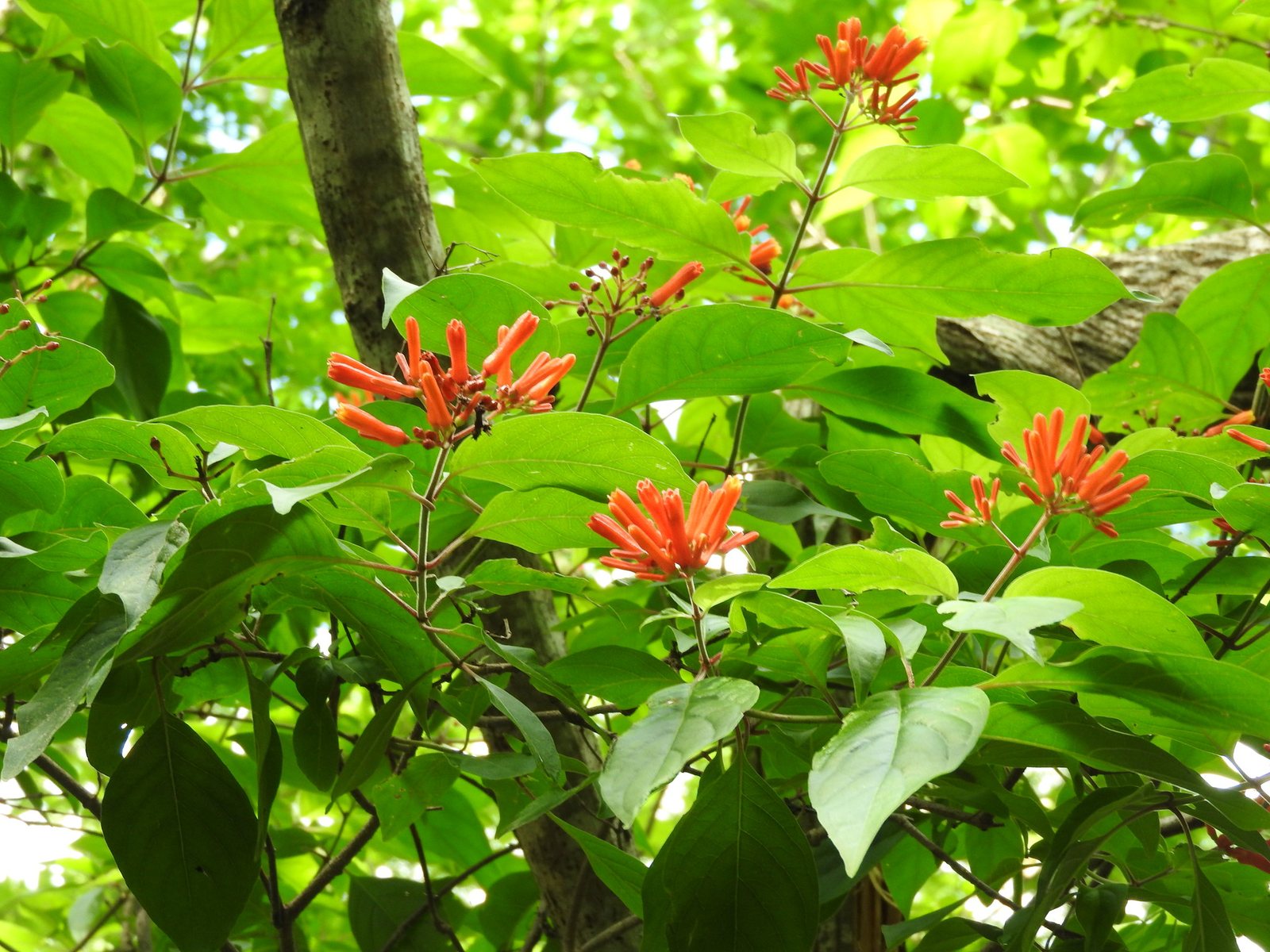
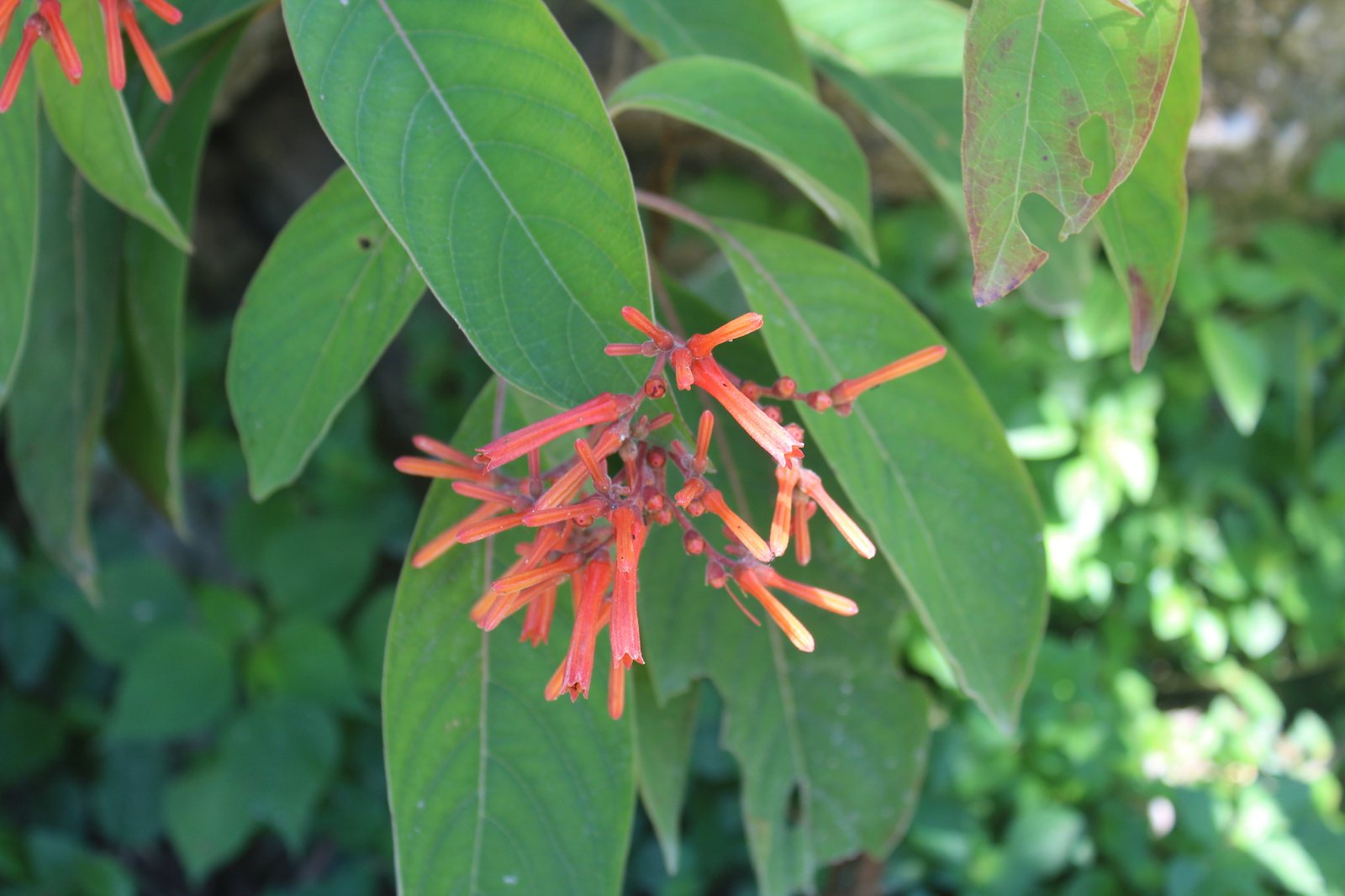
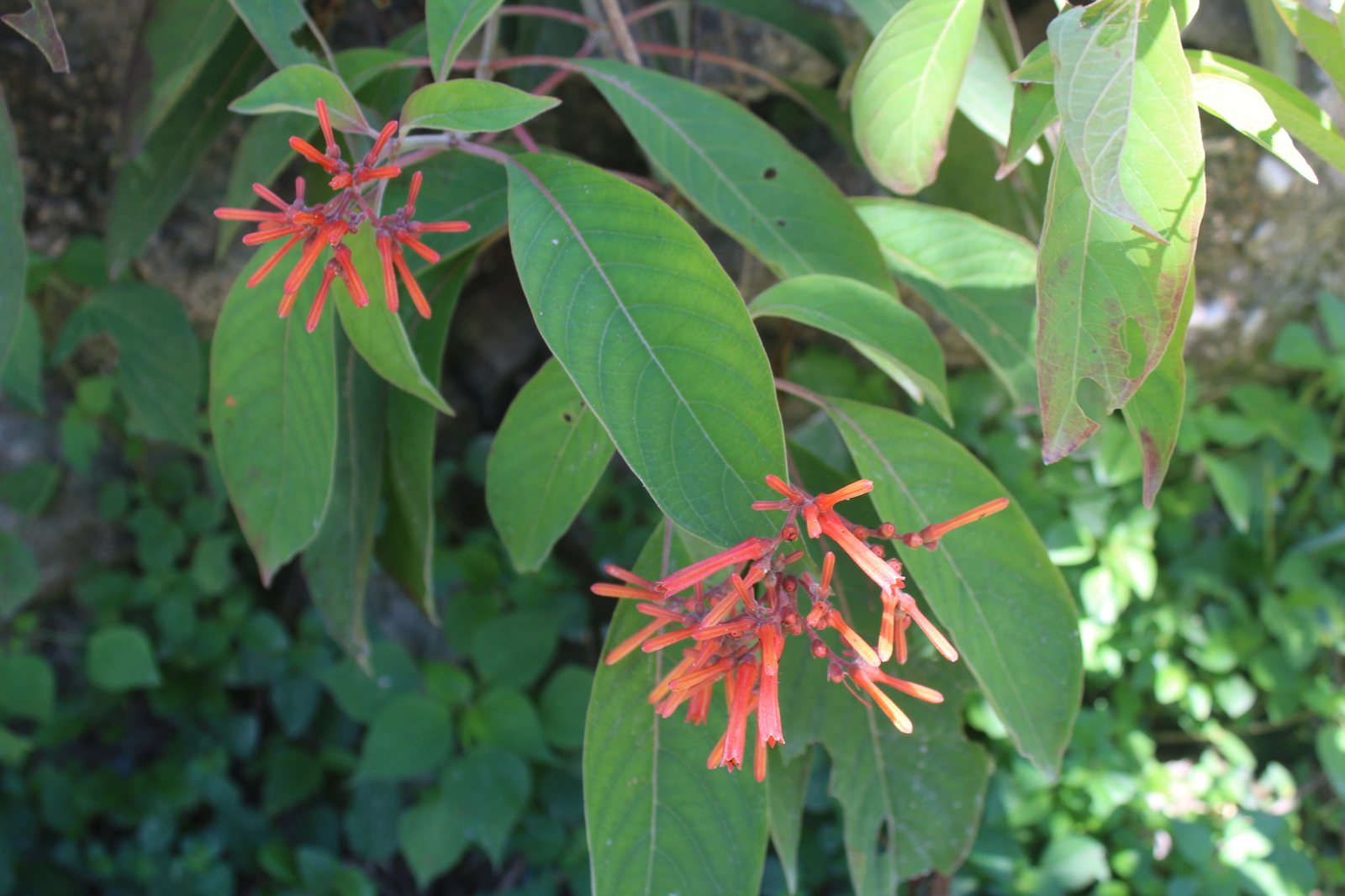
Firebush is a fast-growing tropical American shrub with clusters of narrow orange-red flowers that attract hummingbirds and butterflies. It flowers for months in warm weather and stays evergreen where winters are frost-free. In colder parts of the United States, the United Kingdom, Canada and Australia, grow it as a summer annual or overwinter it in a frost-free place.
At a glance
- Sun
- Full sun to partial shade; flowering is heaviest in full sun.
- Water
- Water regularly while establishing, then during prolonged dry spells. Established plants tolerate some drought; containers need more frequent watering.
- Soil
- Well-drained sandy, loamy or rocky soil; tolerates a range of soil pH but dislikes persistent waterlogging.
- Height
- 6-12 ft (1.8-3.7 m) in frost-free gardens; usually smaller where frost kills the stems
- Spread
- 5-8 ft (1.5-2.4 m)
- Flowers
- Orange to red tubular flowers from late spring through autumn; potentially year-round in frost-free tropical conditions.
- Foliage
- Evergreen. Green, oval to lance-shaped leaves, often arranged in whorls of three, with reddish stalks and young stems. Leaves may turn red before falling in cool weather.
- Growth
- Fast in warm weather.
- Care needed
- Low
The year at a glance
- Pollinators
- Drought tolerant
- Heat tolerant
- Wildlife
- Low allergen
| J | F | M | A | M | J | J | A | S | O | N | D | |
|---|---|---|---|---|---|---|---|---|---|---|---|---|
| Flowers | ||||||||||||
| Fruit | ||||||||||||
| Plant |
Northern hemisphere months. In Australia, shift them by six.
- Difficulty
- Moderate
- Toughness
- Fairly tough
Will it suit your garden?
Pick your zone, country, light and whether you have pets.
Full sun is 6 or more hours of direct sun a day, part shade 3 to 6 hours, shade under 3.
How it grows
Planting day
1.6 ft (0.5 m)
After 1 year
4 ft (1.2 m)
After 2 years
6 ft (1.9 m)
After 3 years
8 ft (2.6 m)
After 5 years
9 ft (2.8 m)
full size
About 3 years to full size.
From a typical nursery size, at an average rate for this kind of plant. A rule of thumb, not a forecast.
Good to know
- Cats and dogs
- Safe
- Native to
- the US
- Growth rate
- Fast
Care
Jobs through the year
- WaterApr–May, Sep–Oct, every 14 days
- Water established ground plants if dry; young plants and containers need more frequent checks.
- WaterJun–Aug, every 10 days
- Water established plants deeply during dry spells, allowing the surface to dry between waterings.
- WaterJan–Mar, Nov–Dec, every 21 days
- Check sheltered pots and water sparingly without letting the root ball dry completely.
- FeedApr–May
- Feed lightly once in spring only if growth is weak; avoid excess nitrogen.
- PruneApr–May
- Once growth starts, remove dead stems and shorten overlong branches; avoid frequent shearing.
- MulchMay
- Apply a light root-zone mulch, keeping it clear of stems.
- ProtectSep–Oct
- Not winter-hardy locally; bring container plants into bright, frost-free shelter before frost.
- ProtectMay–Jun
- Gradually return sheltered plants outdoors after frost risk passes and soil warms.
- Plant after frost danger has passed, allowing room for a broad, branching shrub.
- Water deeply when the root zone begins to dry during the first growing season.
- Apply a light mulch over the roots, keeping it clear of the stems.
- Feed lightly in spring only if growth is weak; excessive nitrogen encourages leaves rather than flowers.
- Move container plants under bright, frost-free cover before the first frost.
Pruning. In spring, once new growth shows what survived winter, remove dead stems and shorten overlong branches. Avoid frequent shearing, which removes flowering growth; occasional tip-pruning gives a fuller plant.
Through the year
- Spring
- Wait for new growth before cutting away frost-damaged stems.
- Late spring
- Plant outdoors after frost danger has passed and the soil has warmed.
- Early summer
- Take softwood cuttings from healthy, nonflowering shoots.
- Summer
- Water new plants during dry spells and check container compost frequently.
- Autumn
- Move pots into frost-free shelter before cold nights arrive.
- Winter
- Keep sheltered plants in bright light and water sparingly without letting the root ball dry completely.
In the garden
- Use as a loose flowering hedge or screen in frost-free gardens, leaving it unsheared for flowers and berries.
- Place behind salvias and other low flowering perennials in a warm-coloured border.
- Grow in a large patio container where butterflies and visiting hummingbirds can be watched closely.
- Combine with bold foliage plants in tropical-style planting for a long season of orange-red colour.
Garden styles it suits: Tropical, Modern tropical, Wildlife garden, Pollinator garden, Hot border and Florida subtropical.
Plant it with: Scarlet sage, Blue porterweed, Pentas, Canna and Muhly grass.
Wildlife: Tubular flowers provide nectar for hummingbirds in the Americas and attract butterflies and other nectar-feeding insects. Birds eat the small berries, which ripen from green through red to black.
Problems to watch for
- Frost damage: leaves and stems can die back even where roots survive. Protect the root zone with mulch and delay pruning until spring growth appears.
- Root rot in wet soil: improve drainage or move the plant to a raised bed; do not keep the soil constantly saturated.
- Aphids or whiteflies: inspect soft shoots and leaf undersides, wash off small infestations and use insecticidal soap if needed, following the label.
- Sparse flowering in shade: move container plants to more sun or choose a sunnier planting position; avoid excessive nitrogen feeding.
Safety
Not known to be toxic to people, cats, dogs or horses, but reliable species-specific safety information is limited, especially for livestock. No particular part is established as poisonous; do not assume that leaves or berries are suitable food for people or pets.
Easily confused with
Jungle geranium (Ixora coccinea)
Ixora has dense, rounded flower heads with conspicuous four-lobed flowers and usually glossy, opposite leaves. Firebush has looser clusters of slender tubes and often three leaves at each node.
Egyptian starcluster (Pentas lanceolata)
Pentas has broad heads of clearly star-shaped, five-pointed flowers and usually opposite leaves. Firebush flowers remain narrow tubes with only small lobes at their tips.
The name
Hamelia honours the French botanist Henri-Louis Duhamel du Monceau, patens means spreading, and firebush refers to the fiery flower colour.
Propagation. Take softwood or semi-ripe cuttings during warm weather and root them in a moist, free-draining medium. Seed from ripe berries can also be sown warm; seedlings may vary.
Checked against open data
- Accepted botanical name
- Hamelia patens
- In the US and Canada
- Native in the lower 48 states, Navassa Island, Puerto Rico and US Virgin Islands.
- Native range
- Argentina Northeast, Argentina Northwest, Bahamas, Belize, Bolivia, Brazil North, Brazil Northeast, Brazil South, Brazil Southeast, Brazil West-Central, Colombia and Costa Rica.
- Measured
- Average height 535 cm.
Sources: GBIF (CC BY 4.0), USDA PLANTS and Trefle (CC BY 4.0). The care and design notes are LandscapeGPT's own.
See it in your own yard.
Upload a photo of your yard and see it redesigned with plants that suit your climate, each checked against your zone.