Firethorn
Pyracantha coccinea. Family Rosaceae. Shrub.
Also called Scarlet firethorn.
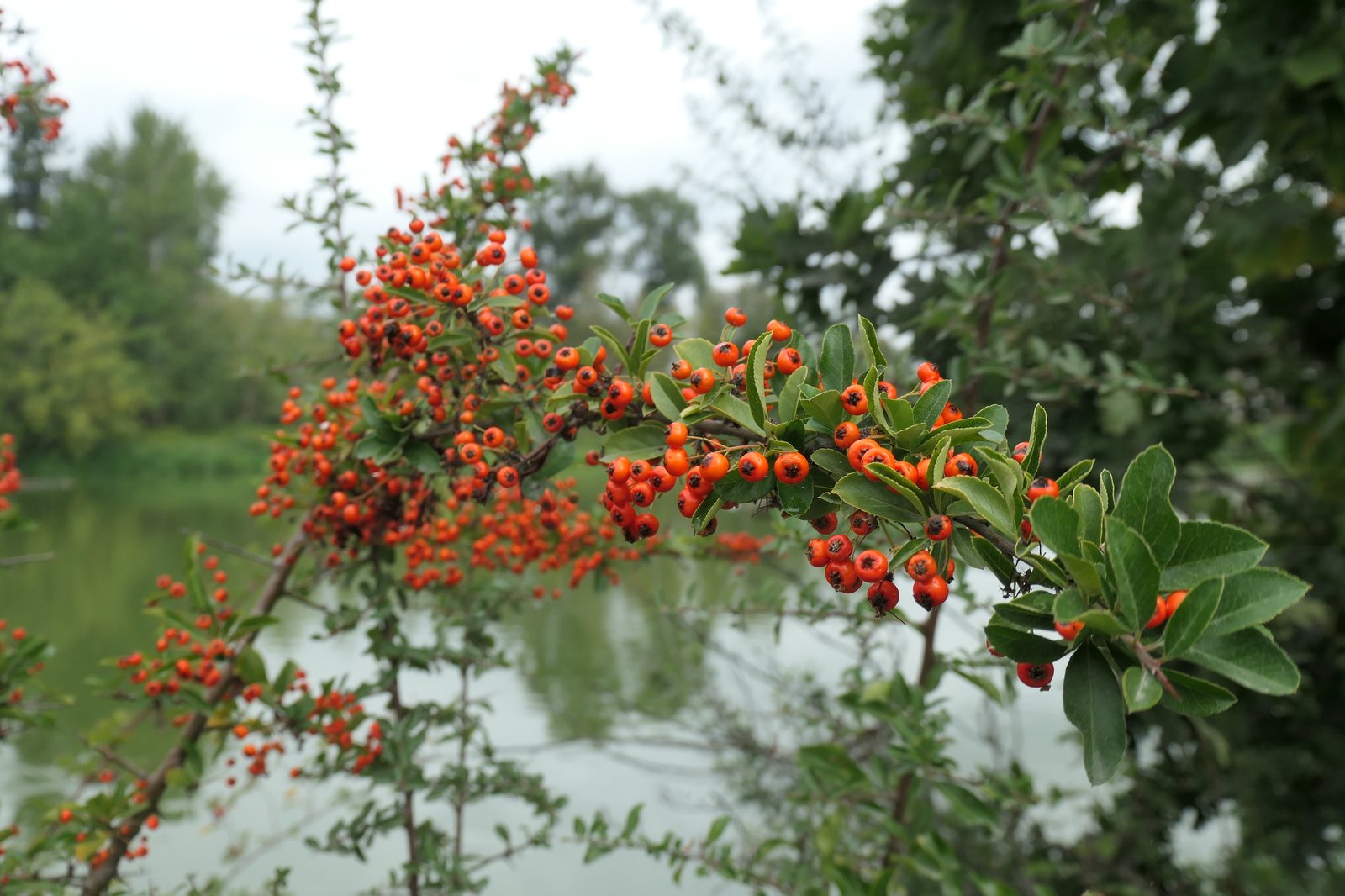
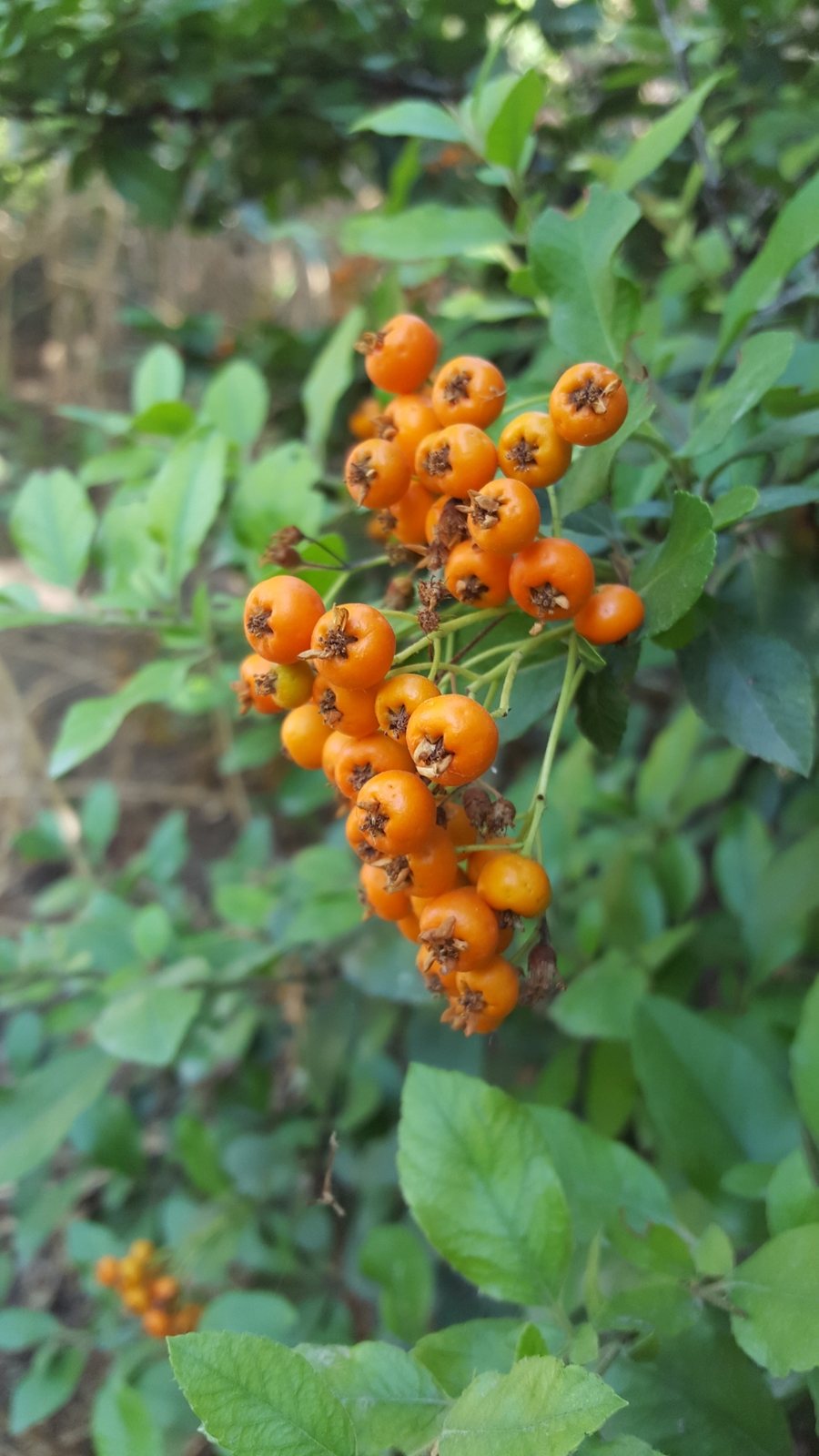
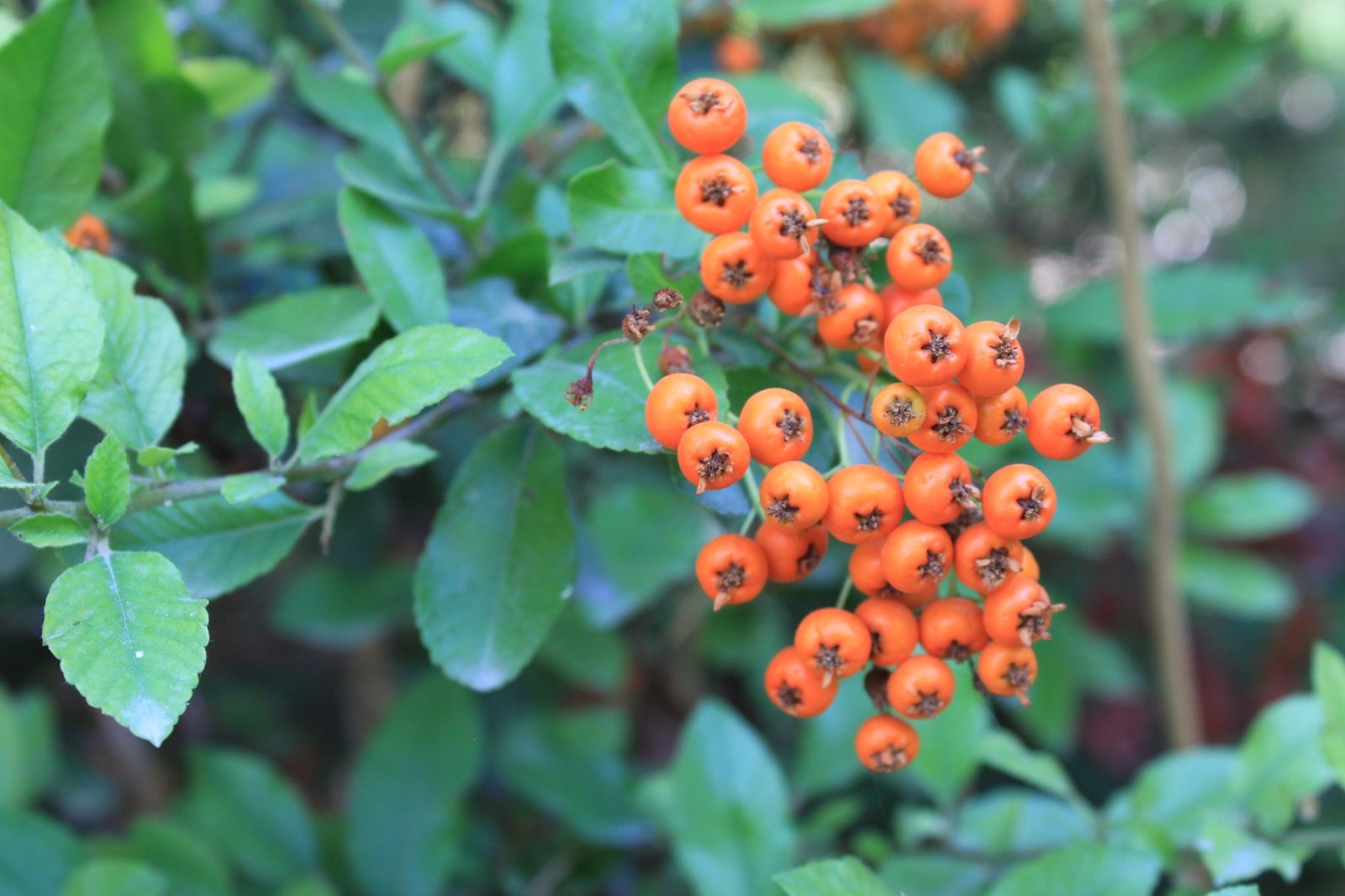
Firethorn is a dense, thorny shrub grown for its white spring flowers and clusters of orange-red fruit that often persist into winter. It makes a useful security hedge or wall-trained shrub, but needs room and careful pruning to preserve its fruiting branches. It is evergreen in mild climates and may lose much of its foliage in cold winters.
At a glance
- Sun
- Full sun to partial shade; flowering and fruiting are strongest in full sun.
- Water
- Water regularly during the first growing season. Once established, water during prolonged drought, especially beside walls where rain may not reach the roots.
- Soil
- Most well-drained soils, including clay, loam and sandy soil; tolerates acidic to alkaline conditions. Avoid waterlogged ground.
- Height
- 6-12 ft (1.8-3.7 m)
- Spread
- 6-12 ft (1.8-3.7 m)
- Flowers
- Clusters of small, creamy-white flowers in late spring to early summer.
- Foliage
- Small, glossy, dark green leaves on stiff branches armed with sharp thorns; evergreen to semi-evergreen depending on winter conditions.
- Growth
- Moderate to fast once established.
- Care needed
- Medium
The year at a glance
- Pollinators
- Deer resistant
- Drought tolerant
- Heat tolerant
- Wildlife
- Low allergen
| J | F | M | A | M | J | J | A | S | O | N | D | |
|---|---|---|---|---|---|---|---|---|---|---|---|---|
| Flowers | ||||||||||||
| Fruit | ||||||||||||
| Plant |
Northern hemisphere months. In Australia, shift them by six.
- Difficulty
- Moderate
- Toughness
- Very tough
Will it suit your garden?
Pick your zone, country, light and whether you have pets.
Full sun is 6 or more hours of direct sun a day, part shade 3 to 6 hours, shade under 3.
How it grows
Planting day
1.6 ft (0.5 m)
After 1 year
3 ft (1.1 m)
After 2 years
5 ft (1.6 m)
After 3 years
7 ft (2.2 m)
After 5 years
9 ft (2.8 m)
full size
About 4 years to full size.
From a typical nursery size, at an average rate for this kind of plant. A rule of thumb, not a forecast.
Good to know
- Cats and dogs
- Mildly toxic: may upset a stomach
- Native to
- Canada
- Invasive in
- the US and Australia
- Growth rate
- Fast
Care
Jobs through the year
- WaterApr–May, Sep–Oct, every 14 days
- Water established ground plants only in dry weather; young plants and wall-trained shrubs may need more.
- WaterJun–Aug, every 14 days
- Soak established roots during prolonged drought, checking especially carefully beside rain-sheltering walls.
- FeedMar–Apr
- Feed lightly only if growth is weak; avoid high-nitrogen feeding.
- MulchMar–Apr
- Apply 5–8 cm of organic mulch, keeping it away from main stems.
- PruneMar–Apr
- Remove dead, damaged or crowded branches while retaining older flowering wood; wear thorn-proof protection.
- PruneJun–Jul
- Shorten unwanted new shoots after flowering, preserving fruit clusters and avoiding active bird nests.
- ProtectFeb
- Check wall-training supports and loosen tight ties before spring growth.
- Water deeply during dry spells for the first growing season rather than giving frequent shallow drinks.
- Apply 2-3 in (5-8 cm) of organic mulch, keeping it clear of the main stems.
- Feed lightly in spring only if growth is weak; excessive nitrogen encourages leafy growth at the expense of flowers.
- For wall training, install sturdy wires or a trellis and tie in branches; firethorn does not cling by itself.
- Wear thick gloves, long sleeves and eye protection when handling thorny branches.
Pruning. In spring, remove dead, damaged or crowded branches, avoiding heavy cuts into older flowering wood. After flowering, shorten new side shoots without cutting off developing fruit clusters; check for active bird nests before pruning.
Through the year
- Late winter
- Check wall supports and ties, and loosen any ties that are cutting into stems.
- Spring
- Plant when the ground is workable, water thoroughly and mulch around the root area.
- Spring
- Remove winter-damaged growth and inspect new shoots for aphids or sudden blackening.
- Early summer
- After flowering, trim unwanted new shoots while retaining fruit clusters and checking for nesting birds.
- Summer
- Water young plants during dry weather and tie new framework branches to supports.
- Autumn
- Remove unwanted seedlings and assess whether fruit-bearing branches are encroaching on paths.
In the garden
- Train branches across a sunny wall or fence to display the flowers and fruit without taking up a deep border.
- Use as a dense boundary or security hedge, set well back from paths and play areas.
- Combine with ornamental grasses and autumn-flowering perennials so the fruit provides a strong late-season accent.
- Grow as a loose wildlife screen with other flowering and fruiting shrubs where its thorny branches have room to develop.
Garden styles it suits: Traditional, English country, Cottage garden, Wildlife garden, Native hedgerow and Winter interest.
Plant it with: Lavender, Catmint, Hardy geranium, Feather reed grass, Michaelmas daisy and Shrub roses.
Wildlife: Flowers provide nectar and pollen for insects, and birds eat the fruit in autumn and winter. Dense, thorny branches offer shelter and nesting sites, although birds can also spread the seeds into nearby natural areas.
Problems to watch for
- Fire blight: flowers and shoots suddenly blacken, often with hooked shoot tips. Cut back into healthy wood in dry weather, disinfect tools between cuts and avoid heavy nitrogen feeding.
- Pyracantha scab: dark leaf spots, leaf fall and blackened or cracked fruit. Collect fallen leaves, thin crowded growth and choose a scab-resistant cultivar when replacing badly affected plants.
- Aphids: clusters on soft shoots can curl leaves and leave sticky honeydew. Wash off small colonies with water and encourage ladybirds and other predators.
- Poor fruiting: deep shade, repeated hedge clipping or frost-damaged flowers can leave little fruit. Provide more sun where possible and prune selectively rather than shearing off flowering wood.
Safety
Not known to be toxic to cats, dogs or horses. Fruit can cause stomach upset if eaten in quantity; for people, it should not be treated as an edible crop, and the seeds contain cyanogenic compounds. Sharp thorns are a significant puncture hazard for people and animals.
Where it spreads. Bird-spread seedlings can establish beyond gardens. It is an environmental weed in parts of southeastern Australia, including New South Wales, Victoria and South Australia, and is invasive in parts of California. Check local guidance before planting near bushland or other natural areas.
Easily confused with
Cotoneaster (Cotoneaster spp.)
Many have similar small leaves, white flowers and red fruit, but cotoneasters lack firethorn's stout thorns.
Narrow-leaved firethorn (Pyracantha angustifolia)
Usually has much narrower leaves with pale, felted undersides and yellow to orange fruit; scarlet firethorn has broader leaves with mostly hairless undersides.
Common hawthorn (Crataegus monogyna)
Also has thorns, white flowers and red fruit, but its leaves are distinctly lobed and deciduous, and it commonly develops into a small tree.
The name
Pyracantha comes from Greek words meaning fire and thorn, referring to the bright fruit and thorny branches, while coccinea means scarlet.
Propagation. Take semi-ripe cuttings in late summer. Seed can be sown after cold stratification, but seedlings vary and do not reliably retain a named cultivar's characteristics.
Checked against open data
- Accepted botanical name
- Pyracantha coccinea
- In the US and Canada
- Native in Canada. Introduced in the lower 48 states.
- Native range
- Albania, Bulgaria, France, Greece, Iran, Italy, Krym, Lebanon-Syria, North Caucasus, Spain, Switzerland and Transcaucasus.
- Measured
- Soil pH 5.8 to 8. Average height 222 cm.
Sources: GBIF (CC BY 4.0), USDA PLANTS and Trefle (CC BY 4.0). The care and design notes are LandscapeGPT's own.
See it in your own yard.
Upload a photo of your yard and see it redesigned with plants that suit your climate, each checked against your zone.