Fishtail palm
Caryota mitis. Family Arecaceae. Tree.
Also called Clustering fishtail palm, Burmese fishtail palm.
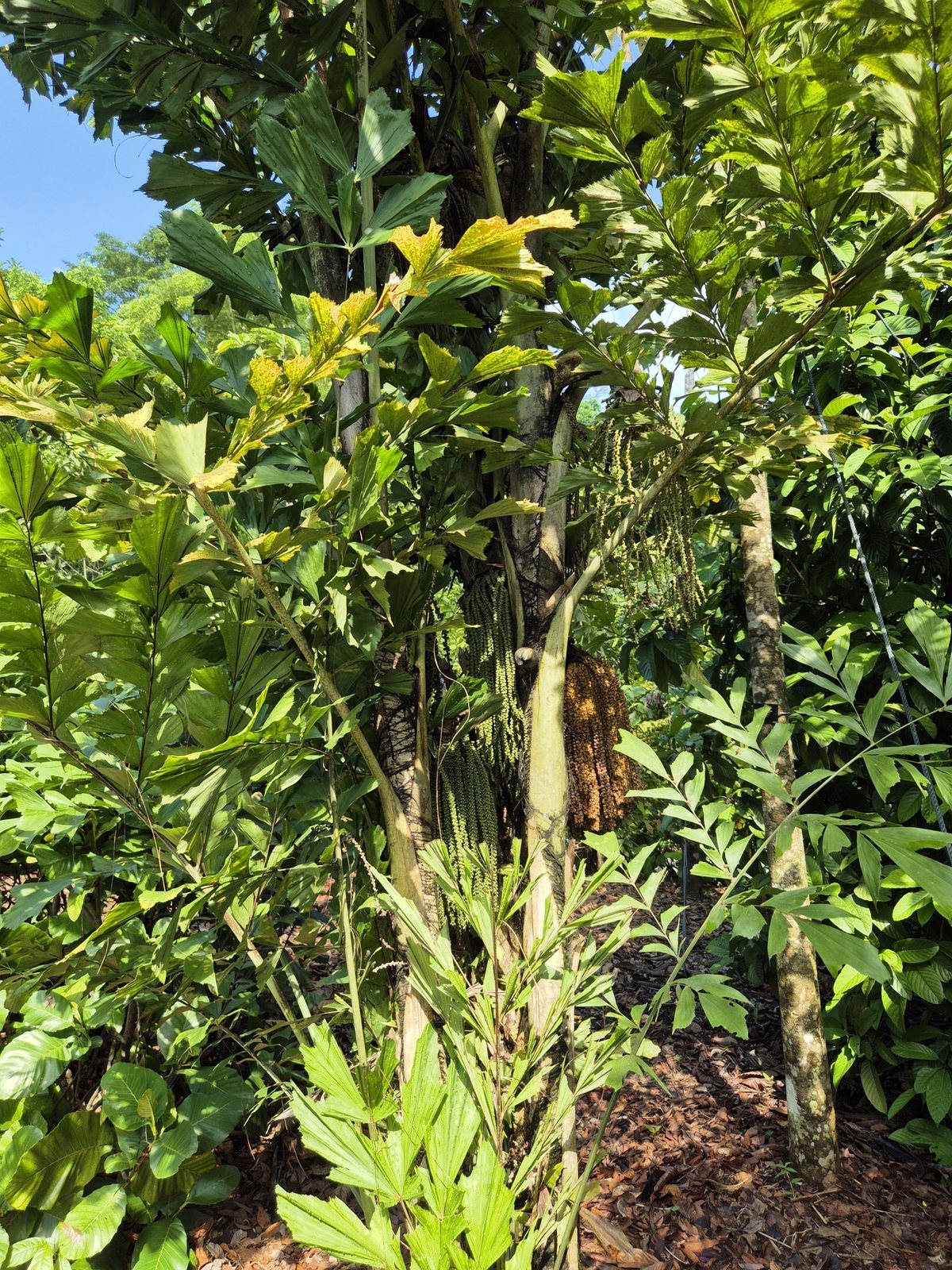
Fishtail palm is a clumping tropical palm grown for its tall, cane-like stems and ragged leaflets shaped like fish tails. It makes a leafy screen in frost-free gardens or a large container specimen under glass elsewhere. Each stem dies after flowering and fruiting, but younger shoots keep the clump growing.
At a glance
- Sun
- Partial shade to full sun; give young plants shelter from strong afternoon sun and introduce indoor-grown plants to outdoor light gradually.
- Water
- Keep evenly moist during active growth, allowing the soil surface to dry slightly between waterings. Water less in cool weather, but do not let the root ball dry out completely.
- Soil
- Moisture-retentive, well-drained soil enriched with organic matter; use a free-draining container compost for potted plants.
- Height
- 20-30 ft (6-9 m) outdoors; usually smaller in containers
- Spread
- 10-15 ft (3-4.6 m)
- Flowers
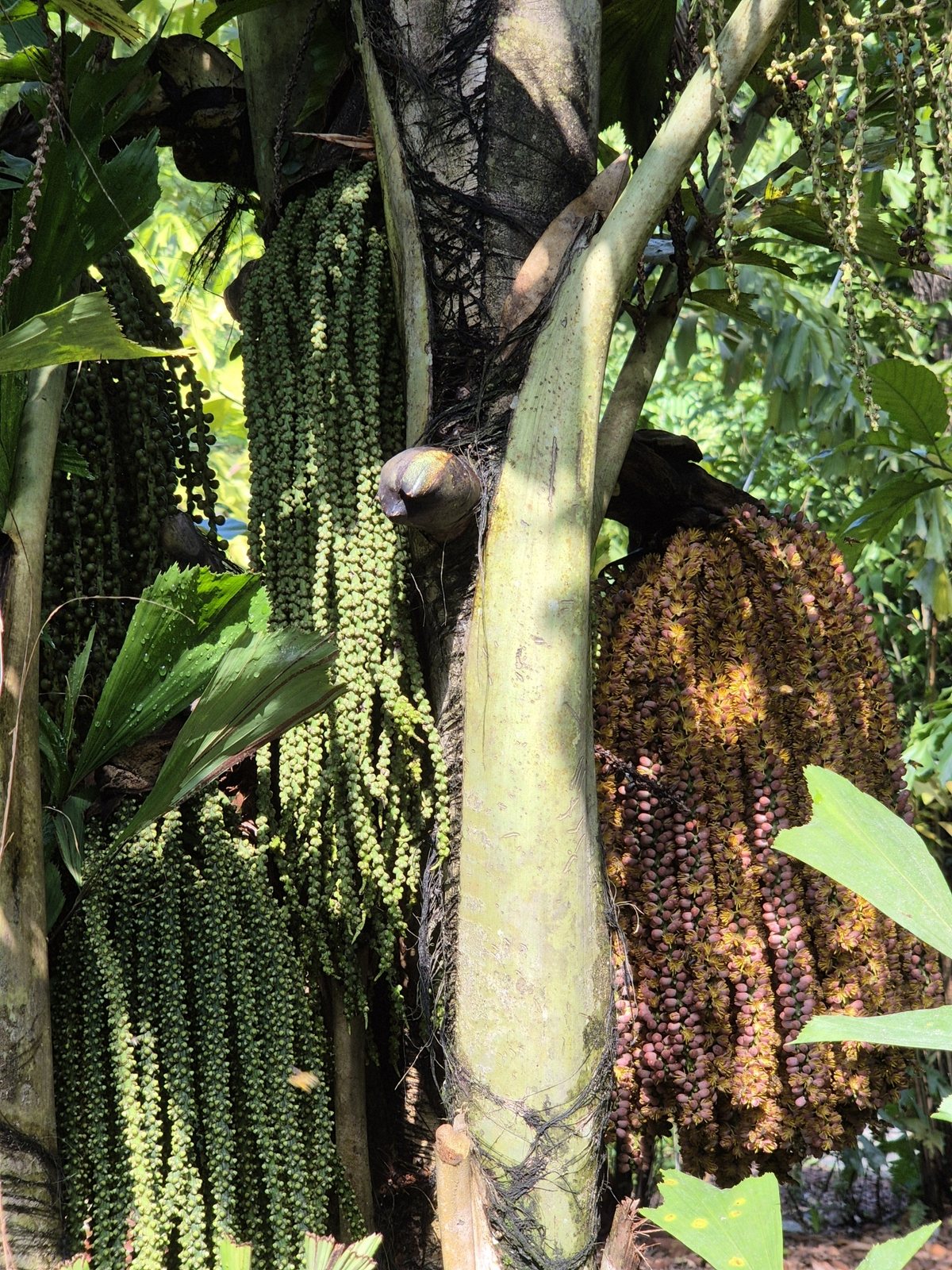
- Mature stems produce hanging clusters of small cream flowers, followed by reddish to dark purple fruit. Flowering is not reliably seasonal in tropical conditions.
- Foliage
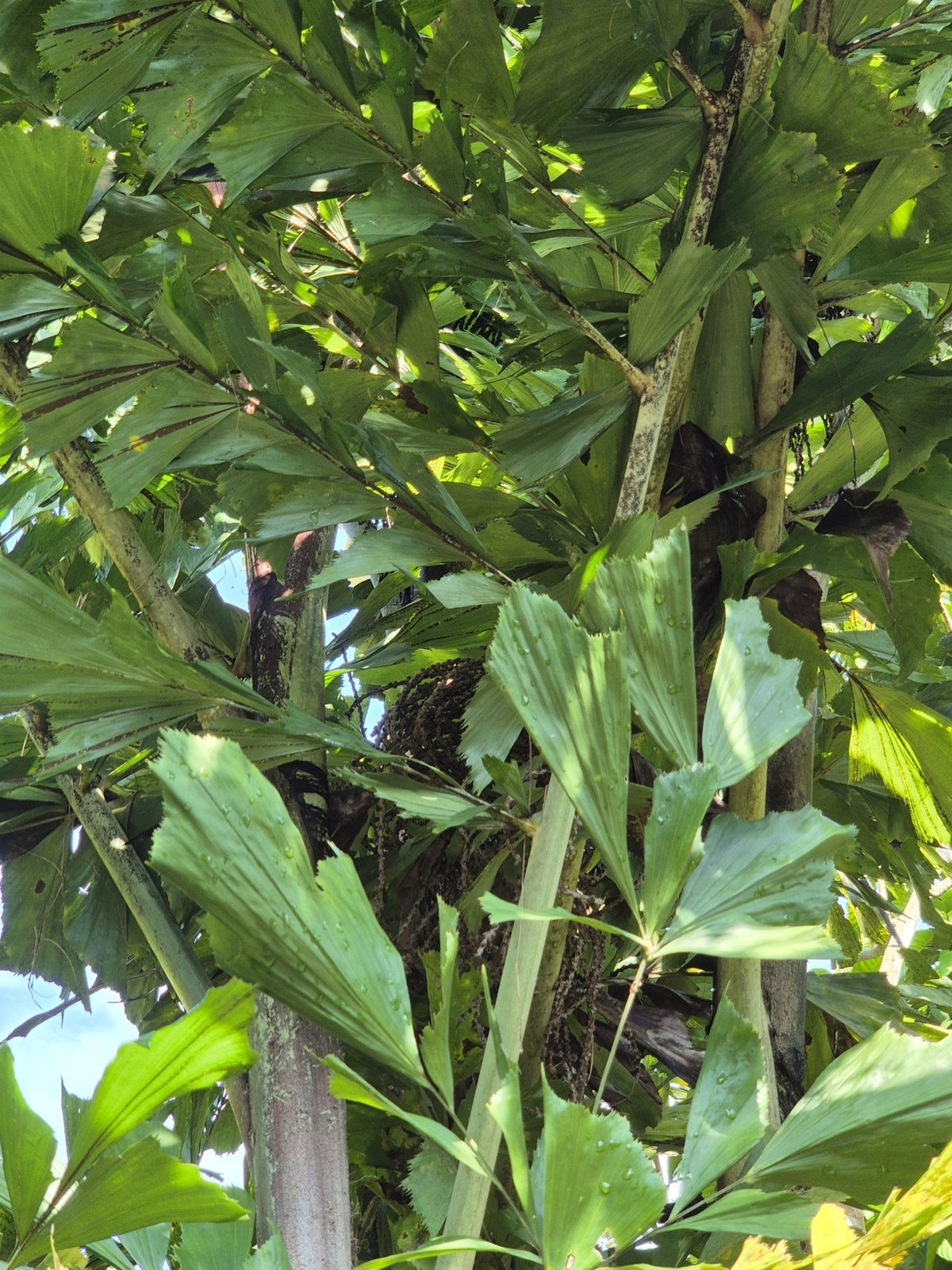
- Large, arching, twice-divided evergreen leaves with broad, wedge-shaped leaflets and jagged tips.
- Growth
- Moderate to fast in warm, humid conditions
- Care needed
- Medium
The year at a glance
- Pollinators
- Heat tolerant
- Wildlife
| J | F | M | A | M | J | J | A | S | O | N | D | |
|---|---|---|---|---|---|---|---|---|---|---|---|---|
| Flowers | ||||||||||||
| Fruit | ||||||||||||
| Plant |
Northern hemisphere months. In Australia, shift them by six.
- Difficulty
- Moderate
- Toughness
- Fairly tough
Will it suit your garden?
Pick your zone, country, light and whether you have pets.
Full sun is 6 or more hours of direct sun a day, part shade 3 to 6 hours, shade under 3.
How it grows
Planting day
7 ft (2 m)
After 1 year
8 ft (2.3 m)
After 2 years
9 ft (2.7 m)
After 3 years
10 ft (3 m)
After 5 years
12 ft (3.7 m)
About 16 years to full size.
From a typical nursery size, at an average rate for this kind of plant. A rule of thumb, not a forecast.
Good to know
- Cats and dogs
- Toxic
- Invasive in
- the US
- In the garden
- Spreads vigorously: plan to contain it.
- Growth rate
- Fast
Care
Jobs through the year
- WaterJun–Aug, every 4 days
- Grow in a pot in this climate; check moisture and water when the surface dries slightly, draining fully.
- WaterMar–May, Sep–Oct, every 7 days
- Check pots weekly; keep the root ball lightly moist without saturating it.
- WaterJan–Feb, Nov–Dec, every 14 days
- Check sheltered pots fortnightly and water sooner if needed to prevent complete drying.
- FeedApr–Aug, every 30 days
- Apply liquid palm fertiliser with magnesium and trace elements at the labelled container rate.
- PruneJan–Dec
- Remove dead fronds and stems that die after fruiting; wear gloves and eye protection around irritating fruit or sap.
- ProtectJan–May, Sep–Dec
- Keep in bright, warm, frost-free shelter; flowering and fruiting are rare in pots and not reliably seasonal.
- ProtectJun–Aug
- Acclimatise summer pots gradually to outdoor light and shelter from drying winds.
- Water deeply during warm, dry spells without leaving the roots waterlogged.
- Feed outdoor plants during the growing season with a palm fertiliser containing magnesium and trace elements, following the label.
- Apply a 2-3 in (5-8 cm) organic mulch, keeping it clear of the stems.
- Shelter from cold, drying winds and protect container plants from frost.
- Keep indoor plants in bright, filtered light, away from heating vents, and check regularly for mites.
Pruning. Remove fully brown leaves as needed, without cutting into green stems or removing healthy green fronds. Cut a stem down at its base once it has finished fruiting and died; wear gloves and eye protection when handling fruit or sap.
Through the year
- Spring
- Repot container plants if root-bound, or refresh the surface compost on large specimens.
- Spring
- Begin feeding as active growth resumes and renew mulch around outdoor clumps.
- Summer
- Water regularly during dry weather and inspect leaf undersides for spider mites and scale.
- Autumn
- Move container plants into a bright, frost-free space before nights become cold.
- Winter
- Reduce watering in cool conditions, while keeping the root ball slightly moist.
- Year-round
- Remove dead fronds and spent stems; collect fallen fruit with gloves where children or pets could reach it.
In the garden
- Plant as a tall, informal screen in a sheltered, frost-free garden.
- Use a single clump as a foliage focal point beside broad-leaved tropical plants.
- Grow in a large container in a bright conservatory or spacious indoor courtyard.
- Underplant with shade-tolerant ferns and cast iron plants for a layered green planting.
Garden styles it suits: Modern tropical, Tropical, Luxury resort, Architectural minimal, Modern courtyard and Balinese.
Plant it with: Bird's nest fern, Cast iron plant, Shell ginger, Philodendron and Bromeliads.
Wildlife: Flowers attract insects, and birds may eat the fruit and disperse the seeds. Do not encourage fruiting where the palm can escape into nearby natural areas.
Problems to watch for
- Spider mites cause pale, speckled leaves, especially indoors: rinse leaf undersides and use an insecticidal soap labelled for the pest if needed.
- Scale insects and mealybugs cause sticky deposits and weak growth: isolate affected container plants and treat with a suitable horticultural oil or insecticidal soap.
- Yellowing or spotted older fronds can indicate nutrient deficiency: use a complete palm fertiliser rather than repeatedly removing affected green leaves.
- Cold or waterlogged soil can cause browning and root decline: improve drainage, reduce watering in cool weather and move pots to frost-free shelter.
Safety
The fruit pulp contains irritating calcium oxalate crystals and is harmful to people, cats and dogs if chewed or swallowed, causing mouth pain, swelling and digestive upset. Handling fruit or sap can cause marked skin and eye irritation. Horse-specific toxicity information is limited, so keep fruit and prunings away from grazing animals; seek urgent help for breathing or swallowing difficulties.
Where it spreads. Invasive in parts of southern Florida, where bird-dispersed seedlings can establish in natural vegetation. Avoid planting near natural areas there and remove seedlings promptly.
Easily confused with
Solitary fishtail palm (Caryota urens)
Has one trunk rather than a suckering clump and generally becomes much taller; the whole plant dies after its flowering cycle.
Giant fishtail palm (Caryota gigas)
Forms a single massive trunk with much larger, broadly spreading leaves, rather than the multiple slender stems of Caryota mitis.
The name
The common name refers to the jagged, fish-tail-shaped leaflets, while the Latin mitis means soft or mild.
Propagation. Grow from fresh seed in warm, consistently moist conditions; remove the irritating fruit pulp while wearing gloves. Established clumps can sometimes be divided by separating a well-rooted sucker, although poorly rooted divisions often fail.
Checked against open data
- Accepted botanical name
- Caryota mitis
- In the US and Canada
- Introduced in the lower 48 states and Pacific Basin.
- Native range
- Andaman Is., Bangladesh, Borneo, Cambodia, China Southeast, Hainan, Jawa, Laos, Lesser Sunda Is., Malaya, Myanmar and Nicobar Is..
- Measured
- Average height 1000 cm.
Sources: GBIF (CC BY 4.0), USDA PLANTS and Trefle (CC BY 4.0). The care and design notes are LandscapeGPT's own.
See it in your own yard.
Upload a photo of your yard and see it redesigned with plants that suit your climate, each checked against your zone.