Flame vine
Pyrostegia venusta. Family Bignoniaceae. Climber.
Also called Orange trumpet vine, Flame flower, Golden shower vine.
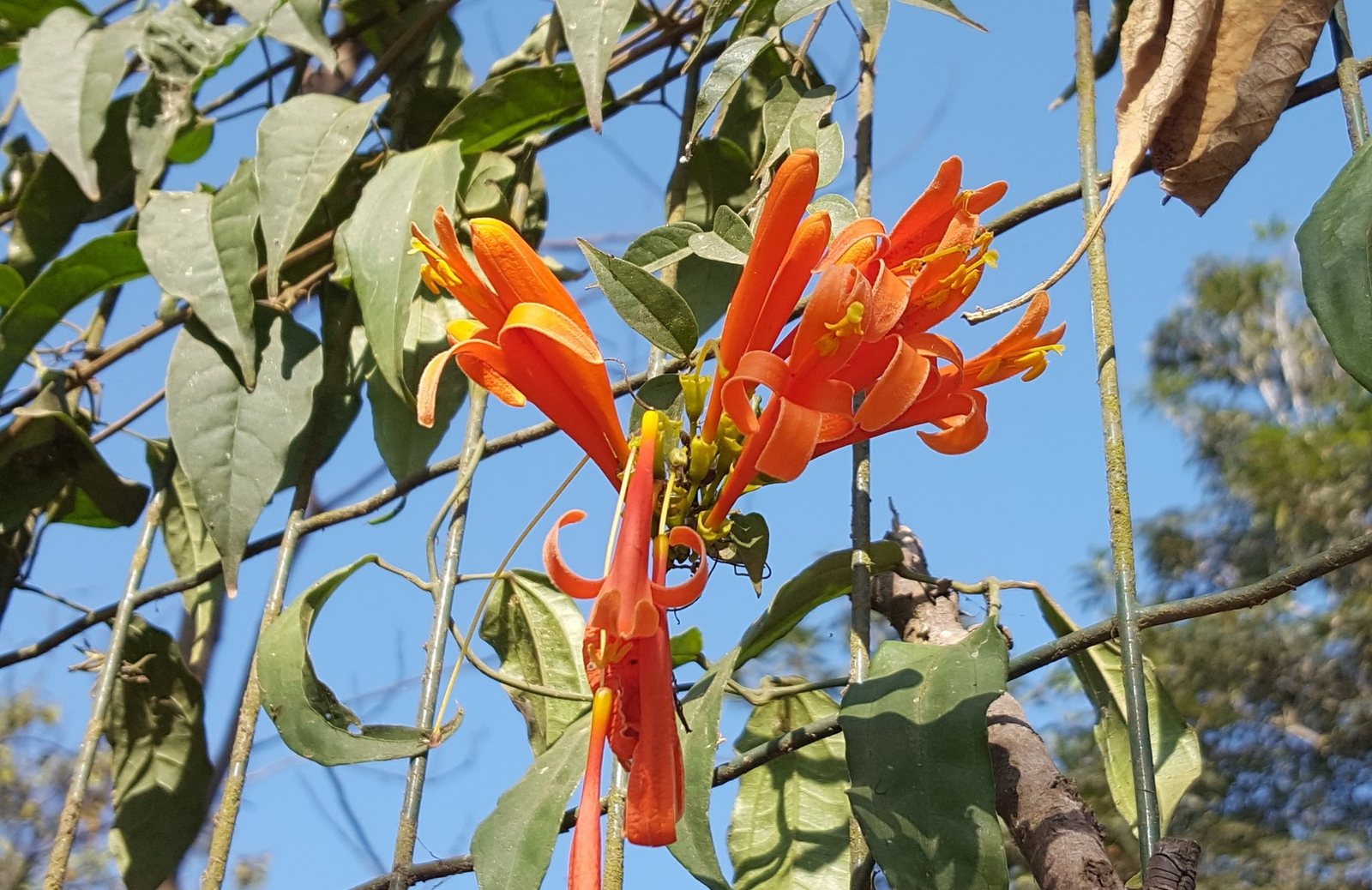
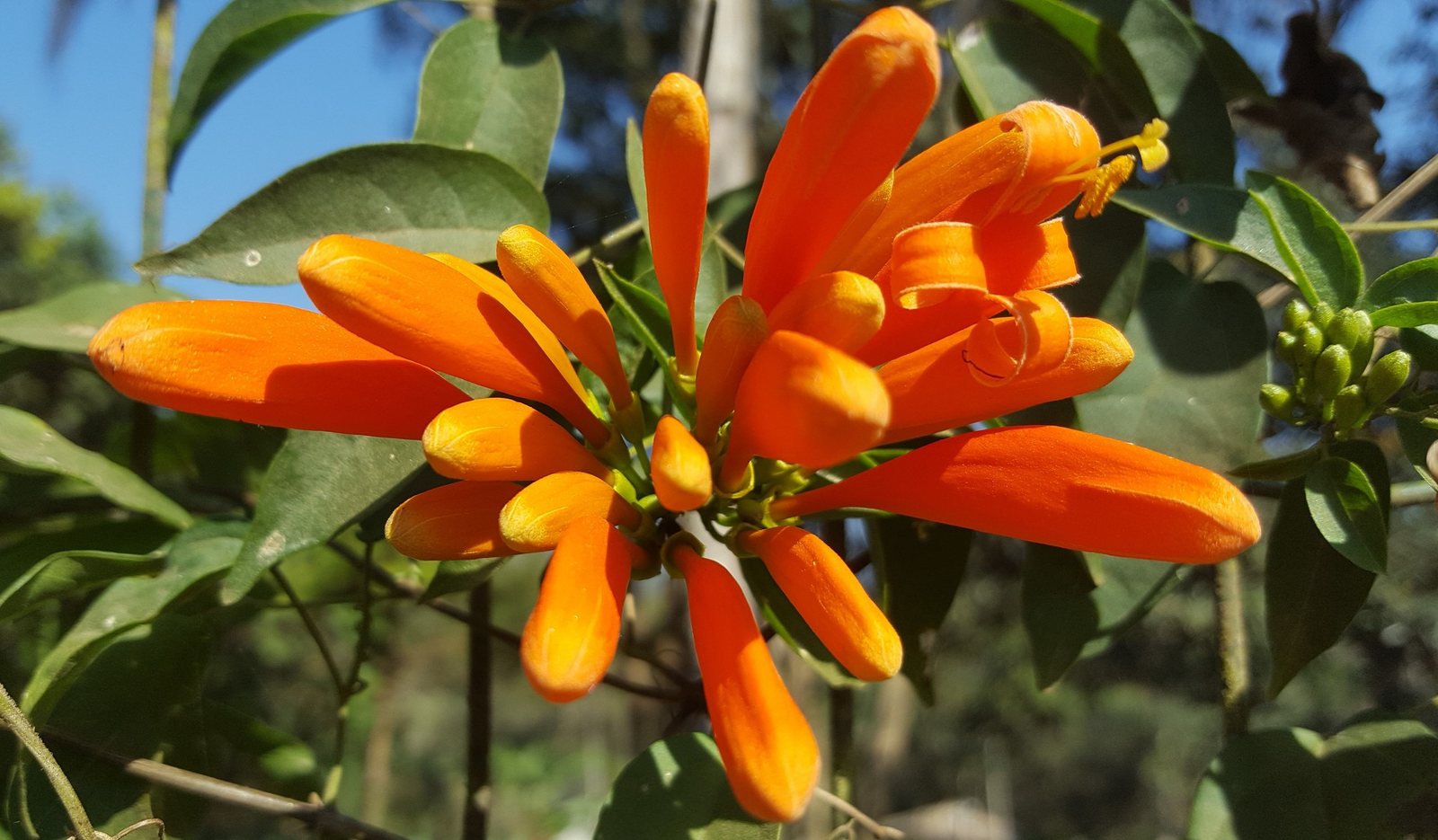
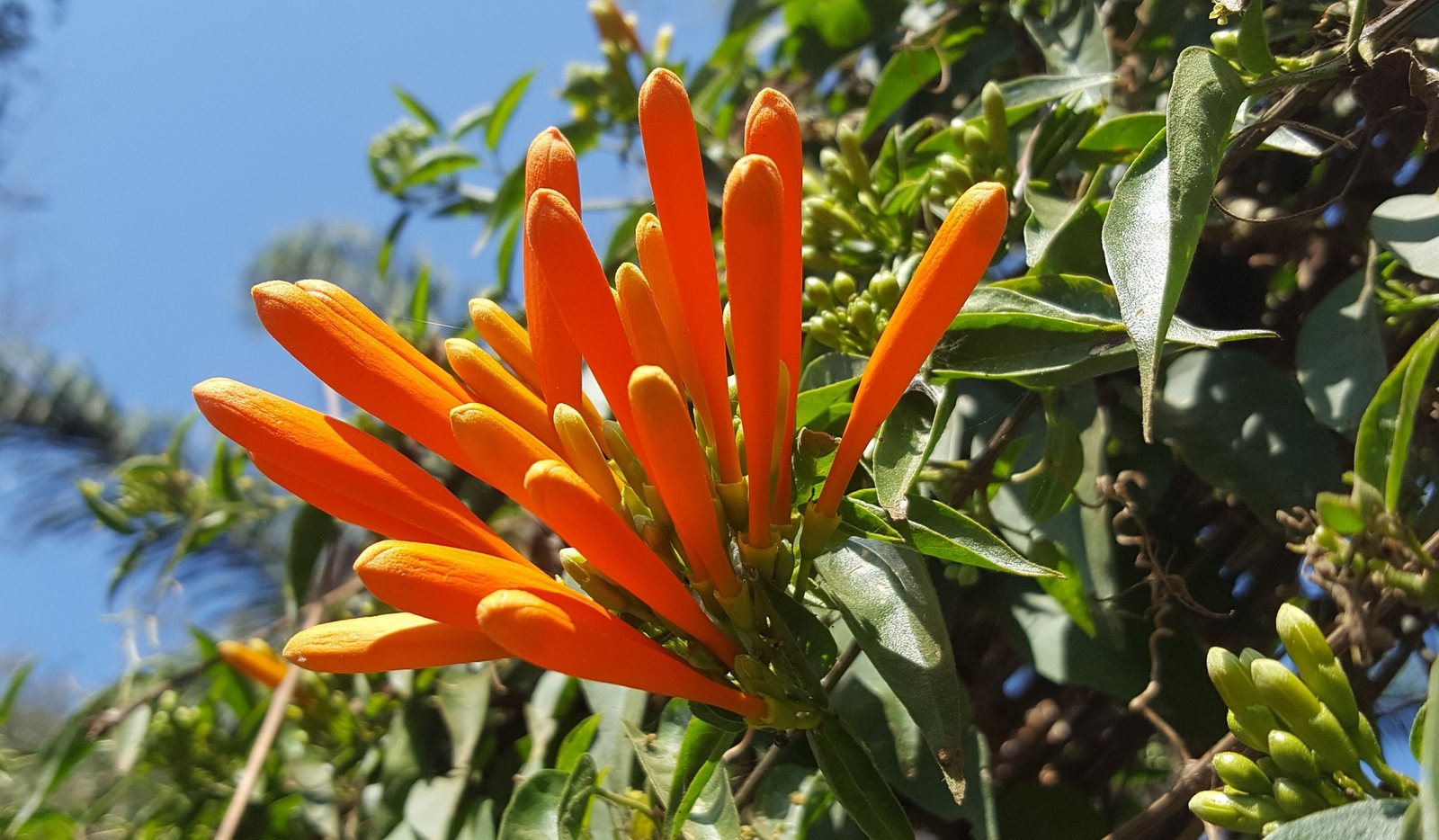
Flame vine is a vigorous, woody climber grown for dense clusters of orange tubular flowers, usually from winter into spring. It needs a warm, largely frost-free position and a substantial support; in the United Kingdom and most of Canada, grow it in a heated conservatory or greenhouse rather than outdoors year-round.
At a glance
- Sun
- Full sun gives the heaviest flowering; tolerates light partial shade.
- Water
- Water regularly while establishing. Established plants tolerate short dry spells, but need occasional deep watering during prolonged drought.
- Soil
- Well-drained soil, from sandy loam to loam; avoid sites that remain waterlogged.
- Height
- 20-40 ft (6-12 m), potentially longer in frost-free climates
- Spread
- 10-20 ft (3-6 m), depending on support and pruning
- Flowers
- Dense clusters of bright orange tubular flowers, mainly in winter and early spring; timing varies with climate.
- Foliage
- Evergreen. Glossy green leaves usually have two or three oval leaflets, with a branching tendril often replacing the terminal leaflet.
- Growth
- Fast
- Care needed
- High
The year at a glance
- Pollinators
- Heat tolerant
- Wildlife
- Low allergen
| J | F | M | A | M | J | J | A | S | O | N | D | |
|---|---|---|---|---|---|---|---|---|---|---|---|---|
| Flowers | ||||||||||||
| Plant |
Northern hemisphere months. In Australia, shift them by six.
- Difficulty
- Hard
- Toughness
- Fairly tough
Will it suit your garden?
Pick your zone, country, light and whether you have pets.
Full sun is 6 or more hours of direct sun a day, part shade 3 to 6 hours, shade under 3.
How it grows
Planting day
2 ft (0.6 m)
After 1 year
3 ft (1.1 m)
After 2 years
5 ft (1.5 m)
After 3 years
6 ft (1.8 m)
full size
About 3 years to full size.
From a typical nursery size, at an average rate for this kind of plant. A rule of thumb, not a forecast.
Good to know
- Cats and dogs
- Safe
- Invasive in
- Australia
- In the garden
- Spreads vigorously: plan to contain it.
- Growth rate
- Fast
Care
Jobs through the year
- WaterApr–May, Sep–Oct, every 14 days
- Water established roots if dry; young plants and containers need more frequent watering.
- WaterJun–Aug, every 14 days
- Give established plants a deep soak during prolonged drought; check containers more often.
- WaterJan–Mar, Nov–Dec, every 14 days
- Under glass, water sparingly when the surface dries; flowering plants may need more.
- FeedApr–May
- Apply a modest balanced feed only if growth is weak.
- MulchMay
- Apply 5–8 cm of organic mulch, keeping stems clear.
- PruneMar–Apr
- Immediately after flowering, shorten flowered shoots and remove tangled or unwanted stems.
- PruneMay–Aug, every 21 days
- Remove escaping or ground-rooting shoots; avoid routine autumn pruning.
- ProtectJan–Apr, Sep–Dec
- Keep under bright, frost-free glass through cold weather; winter flowering needs sufficient warmth.
- Install a strong pergola, trellis or wire framework before planting; keep stems away from gutters and roof tiles.
- Water deeply through the first growing season, allowing the soil surface to dry between waterings.
- Apply a modest amount of balanced fertilizer in spring if growth is weak; avoid heavy nitrogen feeding.
- Spread 2-3 in (5-8 cm) of organic mulch over the root area, keeping it clear of the stems.
- Tie young shoots to supports and remove stems that trail onto soil or neighbouring plants.
- In cold climates, grow under glass with frost protection and reduce watering during cool weather.
Pruning. Prune immediately after flowering, shortening flowered shoots and removing dead, tangled or unwanted stems. Avoid routine autumn pruning, which can remove growth carrying the next flower display.
Through the year
- Spring
- Plant after frost risk has passed, or move container plants outside once nights are reliably warm.
- After flowering
- Prune to fit the support and remove shoots spreading into surrounding plants.
- Late spring
- Refresh mulch and feed lightly if needed.
- Summer
- Train new shoots, water during prolonged dry spells and check for stems rooting where they touch soil.
- Autumn
- Bring container plants under cover before frost and check that supports can carry the mature vine.
- Winter
- Enjoy flowering in warm climates; keep greenhouse plants bright, frost-free and less frequently watered.
In the garden
- Train over a substantial pergola where flower clusters can hang freely.
- Cover a sturdy boundary trellis for evergreen screening in frost-free gardens.
- Grow against a sunny wall on stand-off wires for a strong winter colour display.
- Combine with bold foliage plants in a large tropical courtyard, keeping their crowns clear of its stems.
Garden styles it suits: Tropical, Modern tropical, Mediterranean, Winter interest, Hot border and Modern courtyard.
Plant it with: Bird of paradise, Agapanthus, Society garlic, Aloe and Lomandra.
Wildlife: Flowers provide nectar for hummingbirds where present and are visited by other nectar-feeding birds and insects. Dense growth can provide shelter for birds.
Problems to watch for
- Poor flowering: provide more sun, reduce nitrogen feeding and prune only after flowering.
- Frost damage: protect young plants and overwinter containers under glass; remove damaged stems after frost risk passes.
- Waterlogged roots: improve drainage or relocate the plant rather than continuing to water wet soil.
- Uncontrolled growth: inspect regularly, cut back escaping shoots and lift stems before they root into surrounding soil.
Safety
Not known to be toxic to people, cats, dogs or horses, but reliable species-specific safety information is limited. No particular part is established as poisonous; do not treat the flowers, leaves or seeds as edible.
Where it spreads. Naturalised and regarded as an environmental weed in parts of Queensland and New South Wales, Australia. It can smother surrounding vegetation and spread through stems rooting where they touch the ground; check local guidance before planting near bushland.
Easily confused with
Cape honeysuckle (Tecomaria capensis)
Has pinnate leaves with several small, toothed leaflets and a scrambling shrub habit rather than climbing by branching tendrils.
Trumpet creeper (Campsis radicans)
Is deciduous, climbs with aerial rootlets and has leaves with many toothed leaflets; its broader trumpet flowers appear mainly in summer.
Orange trumpet vine (Campsis grandiflora)
Has large, flared orange trumpets and pinnate leaves with toothed leaflets, rather than flame vine's narrow flower tubes and two or three leaflets.
The name
The common name refers to the flame-orange flower clusters, while the Latin venusta means beautiful or charming.
Propagation. Take semi-ripe stem cuttings in summer with warmth and humidity, or layer a low shoot and detach it after roots form. Keep cuttings and unwanted rooted stems out of garden waste dumped near natural areas.
Checked against open data
- Accepted botanical name
- Pyrostegia venusta
- In the US and Canada
- Introduced in the lower 48 states and Puerto Rico.
- Native range
- Argentina Northeast, Bolivia, Brazil North, Brazil Northeast, Brazil South, Brazil Southeast, Brazil West-Central, Colombia, Costa Rica, Ecuador, El Salvador and Guatemala.
Sources: GBIF (CC BY 4.0), USDA PLANTS and Trefle (CC BY 4.0). The care and design notes are LandscapeGPT's own.
See it in your own yard.
Upload a photo of your yard and see it redesigned with plants that suit your climate, each checked against your zone.