German chamomile
Matricaria chamomilla. Family Asteraceae. Annual.
Also called Wild chamomile, Scented mayweed, Matricaria recutita.
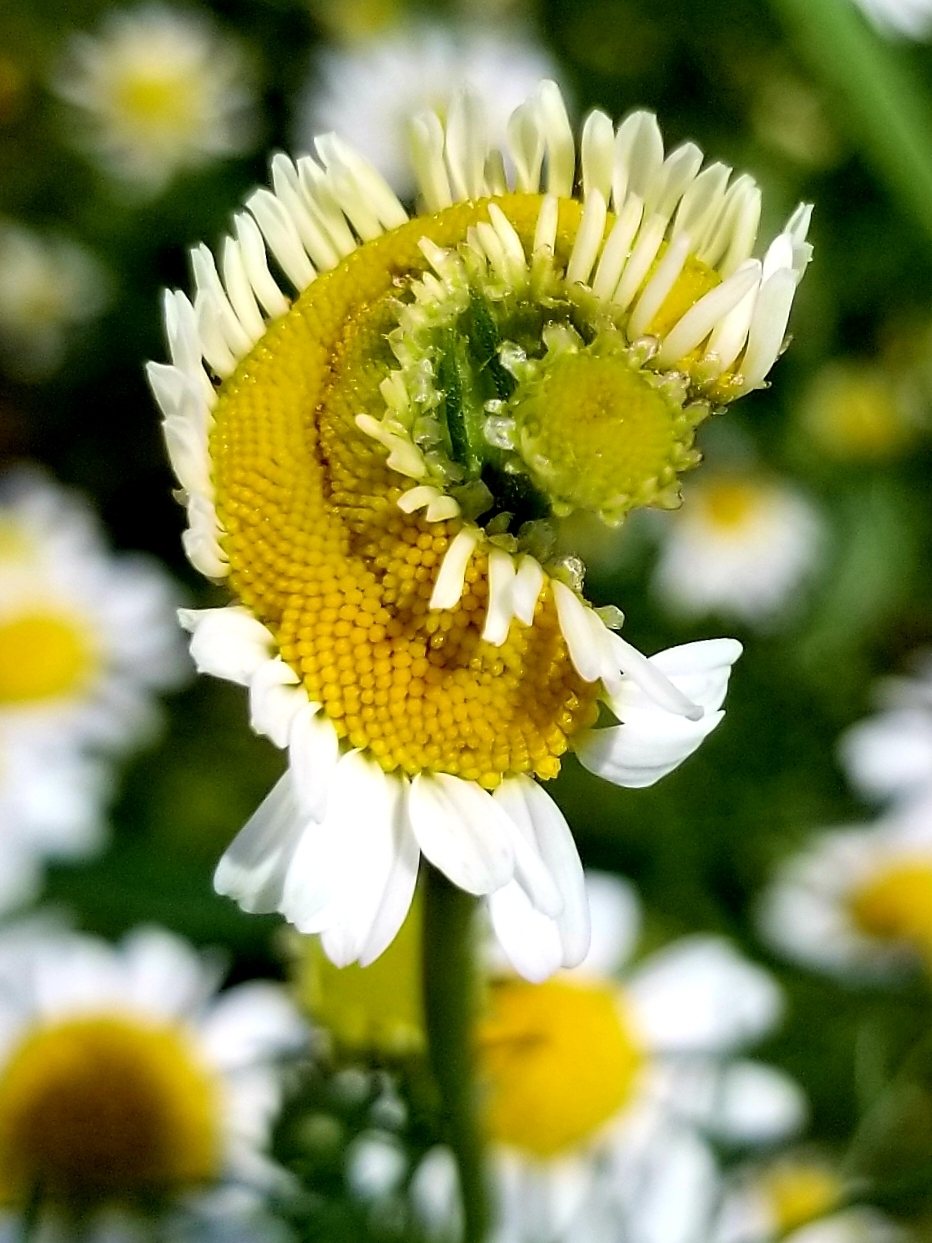
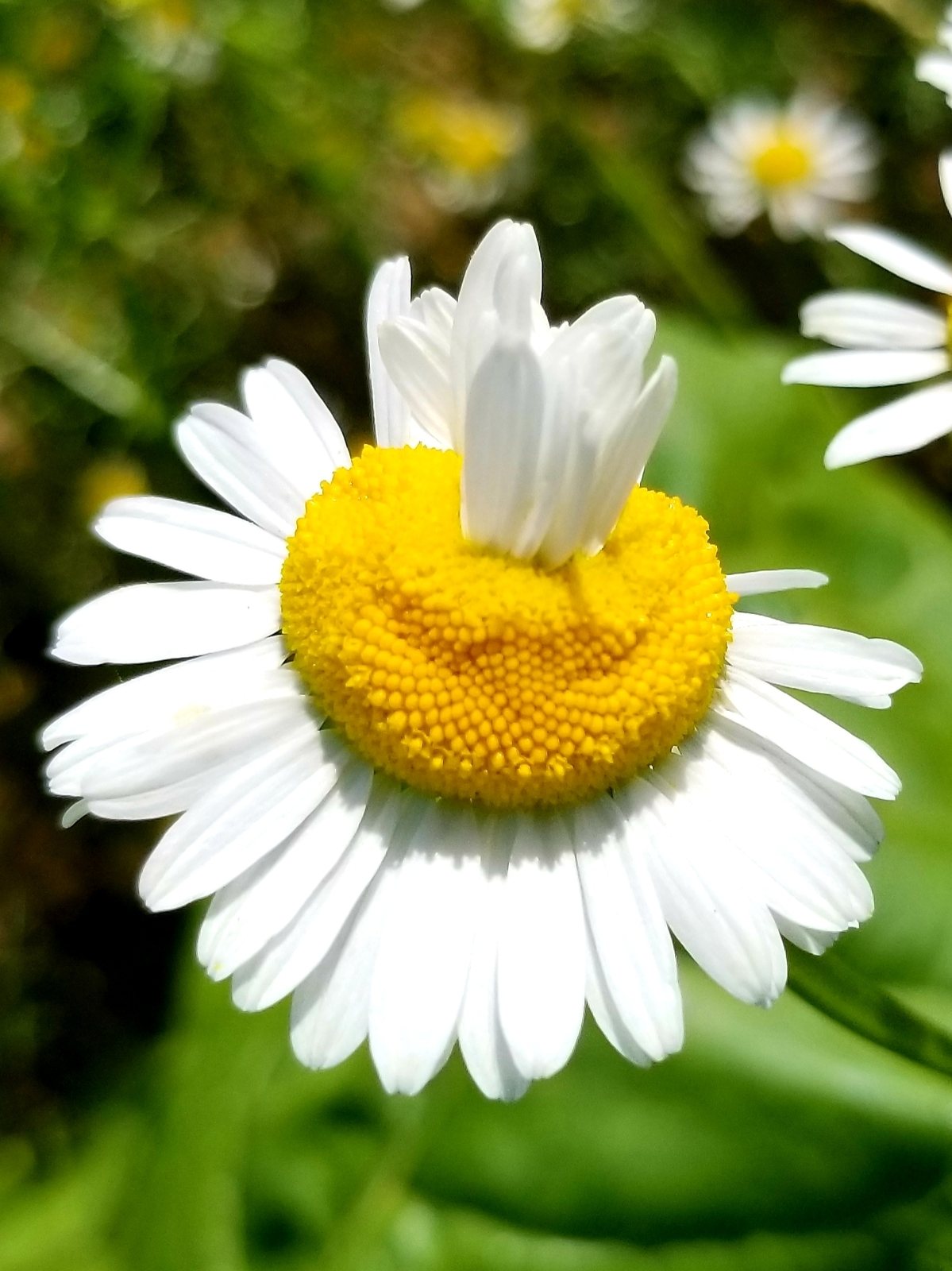
German chamomile is grown as an annual for its finely divided, apple-scented foliage and small, white-and-yellow daisy flowers. Gardeners grow it for herbal tea, visiting insects and a light, informal effect among herbs and vegetables; it often self-seeds.
At a glance
- Sun
- Full sun; light afternoon shade is useful in hot climates.
- Water
- Moderate while establishing; then water during prolonged dry spells. Avoid persistently wet soil.
- Soil
- Well-drained sandy or loamy soil, preferably of modest fertility; tolerates a fairly wide pH range.
- Height
- 1-2 ft (0.3-0.6 m)
- Spread
- 0.5-1 ft (0.15-0.3 m)
- Flowers
- Late spring through summer, sometimes into early autumn; white ray petals surround raised yellow centres.
- Foliage
- Soft green, finely divided, feathery leaves with an apple-like scent when crushed.
- Growth
- Fast; flowers in its first growing season.
- Care needed
- Low
The year at a glance
- Pollinators
- Drought tolerant
- Fragrant
- Edible
| J | F | M | A | M | J | J | A | S | O | N | D | |
|---|---|---|---|---|---|---|---|---|---|---|---|---|
| Flowers | ||||||||||||
| Fruit | ||||||||||||
| Plant |
Northern hemisphere months. In Australia, shift them by six.
- Difficulty
- Easy
- Toughness
- Fairly tough
Will it suit your garden?
Pick your zone, country, light and whether you have pets.
Full sun is 6 or more hours of direct sun a day, part shade 3 to 6 hours, shade under 3.
How it grows
Planting day
0.5 ft (0.15 m)
After 1 year
1.5 ft (0.45 m)
full size
Full size in one season.
From a typical nursery size, at an average rate for this kind of plant. A rule of thumb, not a forecast.
Good to know
- Cats and dogs
- Safe
- In the garden
- Spreads vigorously: plan to contain it.
- Growth rate
- Fast
Care
Jobs through the year
- WaterMar–May, every 14 days
- Water established plants only when dry; keep newly sown seedbeds consistently moist.
- WaterJun–Sep, every 7 days
- Water at soil level during prolonged dry spells; skip when rainfall is sufficient.
- HarvestMay–Sep
- Pick fully open flower heads after dew dries, before centres brown; dry promptly in shade.
- DeadheadJun–Sep, every 7 days
- Remove unharvested spent flowers to prolong bloom, leaving some only if seedlings are wanted.
- PruneSep–Oct
- Pull up exhausted plants before seeds ripen if self-sowing is unwanted.
- Keep the seedbed evenly moist until seedlings are established.
- Thin seedlings to about 0.5-1 ft (0.15-0.3 m) apart for airflow and sturdy growth.
- Water at soil level during dry spells rather than repeatedly wetting the foliage.
- Avoid rich manure and heavy feeding, which encourage floppy growth.
- Pick open flower heads regularly, leaving some to ripen only if you want seedlings.
Pruning. During flowering, snip off open flower heads or lightly trim spent blooms to encourage more flowers. Pull up exhausted plants before their seeds ripen if you do not want them spreading.
Harvest
Pick the flower heads when fully open, with white petals held flat or just starting to turn down and yellow centres that have not browned. Harvest on dry mornings after the dew has dried, pinching or snipping off heads with little stem attached; repeat every few days. German chamomile is an annual that flowers in its first year, usually from late spring through summer, sometimes into autumn in mild climates.
Through the year
- Early spring
- Surface-sow seed outdoors where plants are to grow once the soil is workable; press it in without burying it deeply.
- Mid-spring
- Thin crowded seedlings and keep young plants watered during dry weather.
- Late spring
- Make a second small sowing if you want a longer flowering season.
- Summer
- Harvest fully open flower heads on dry days and dry them promptly in a shaded, airy place.
- Late summer
- Leave a few flower heads to set seed, or remove fading plants to prevent self-sowing.
- Autumn
- Clear exhausted plants and remove unwanted seedlings; in mild climates, autumn-sown seedlings may overwinter.
In the garden
- Weave through herb beds with parsley and chives for contrasting foliage and accessible flower harvesting.
- Plant in loose groups near the front of cottage borders, where the fine foliage softens heavier plants.
- Use between vegetable crops as a short-lived flowering plant for hoverflies and other beneficial insects.
- Grow in a sunny container with good drainage near a kitchen door for regular picking.
Garden styles it suits: Cottage garden, Potager (kitchen garden), Herb parterre, Pollinator garden, Sensory garden and Edible landscape.
Plant it with: Calendula, Borage, Chives, Parsley, Lettuce and Sweet alyssum.
Wildlife: The open flowers provide pollen and nectar for small bees, hoverflies and other insects. Avoid spraying flowers while insects are visiting.
Problems to watch for
- Aphids on soft shoots: wash off small colonies with water and encourage hoverflies and ladybirds.
- Powdery mildew in crowded or stressed plants: thin seedlings, improve airflow and water the soil during drought.
- Root rot in waterlogged soil: improve drainage or grow in a free-draining container; discard badly affected plants.
- Flopping in rich soil or shade: move future sowings into more sun and stop nitrogen-rich feeding.
Safety
German chamomile is not known to be toxic to people in normal culinary amounts, but flowers and foliage can cause allergic reactions, especially in people sensitive to ragweed and other daisy-family plants. It is not known to be poisonous to cats, dogs or horses, although species-specific safety information is limited; do not offer large amounts or concentrated essential oil. Do not assume that toxicity information for Roman chamomile applies to this species.
Easily confused with
Roman chamomile (Chamaemelum nobile)
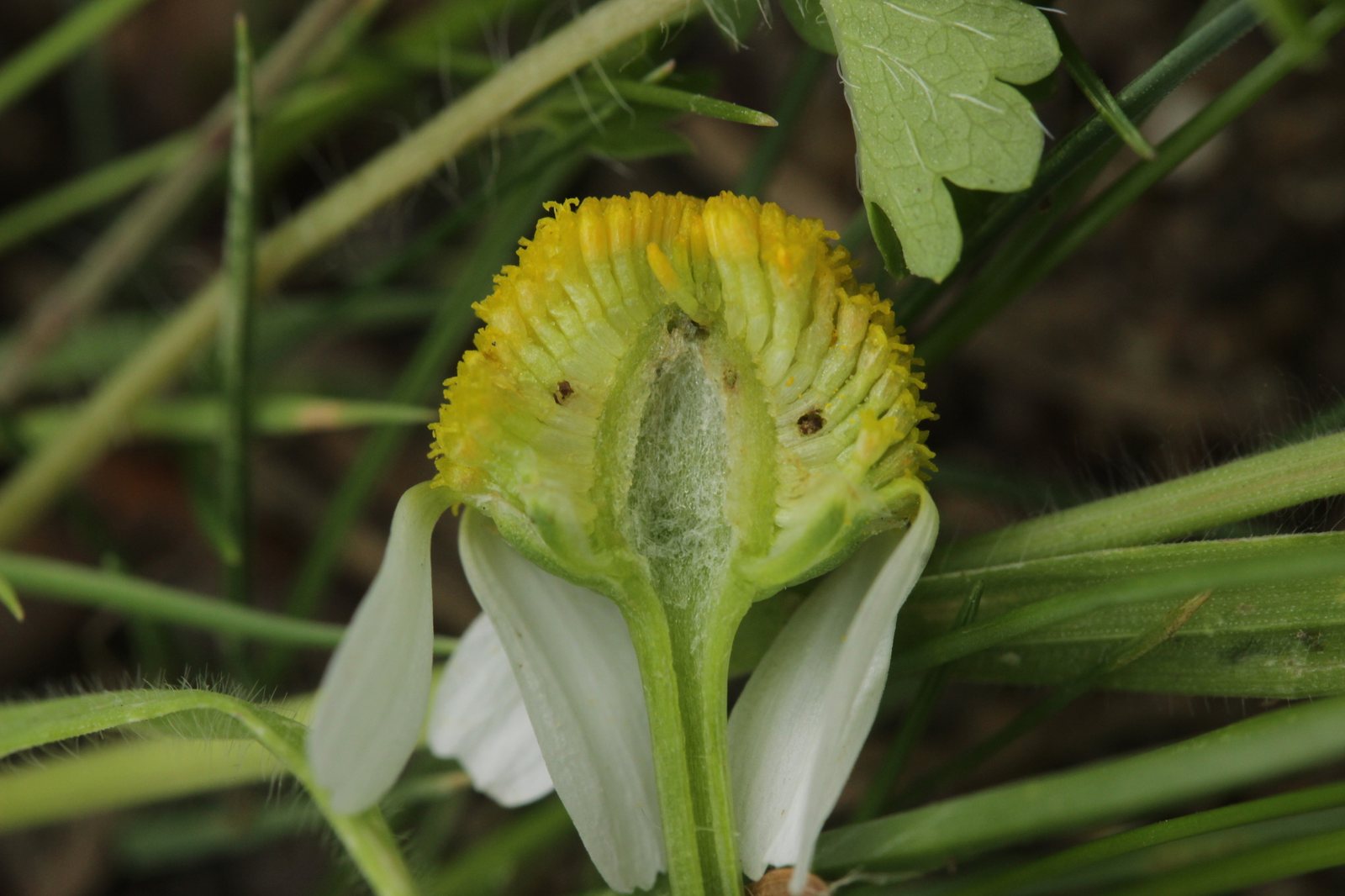
A low, creeping perennial rather than an upright annual; its flower receptacle is solid, while German chamomile's raised yellow receptacle is hollow when cut lengthways.
Scentless mayweed (Tripleurospermum inodorum)
Usually has larger flower heads and little or no chamomile scent; its flower receptacle is solid rather than hollow.
Pineapple weed (Matricaria discoidea)
Has small, yellow-green, cone-shaped flower heads without white ray petals and a pineapple-like scent when crushed.
The name
Chamomile comes from Greek words meaning 'ground apple', referring to the plant's apple-like scent.
Propagation. Grow from seed, usually sown directly outdoors in spring. Seeds need light for good germination, so press them onto the surface and keep moist. It also self-seeds readily; autumn sowing is possible where winters are mild.
Checked against open data
- Accepted botanical name
- Matricaria chamomilla
- Native range
- Afghanistan, Albania, Algeria, Altay, Austria, Azores, Belarus, Belgium, Bulgaria, Buryatiya, Canary Is. and Central European Rus.
- Measured
- Soil pH 5 to 5.5. Average height 40 cm.
Sources: GBIF (CC BY 4.0) and Trefle (CC BY 4.0). The care and design notes are LandscapeGPT's own.
See it in your own yard.
Upload a photo of your yard and see it redesigned with plants that suit your climate, each checked against your zone.