Golden currant
Ribes aureum. Family Grossulariaceae. Shrub.
Also called Golden flowering currant.
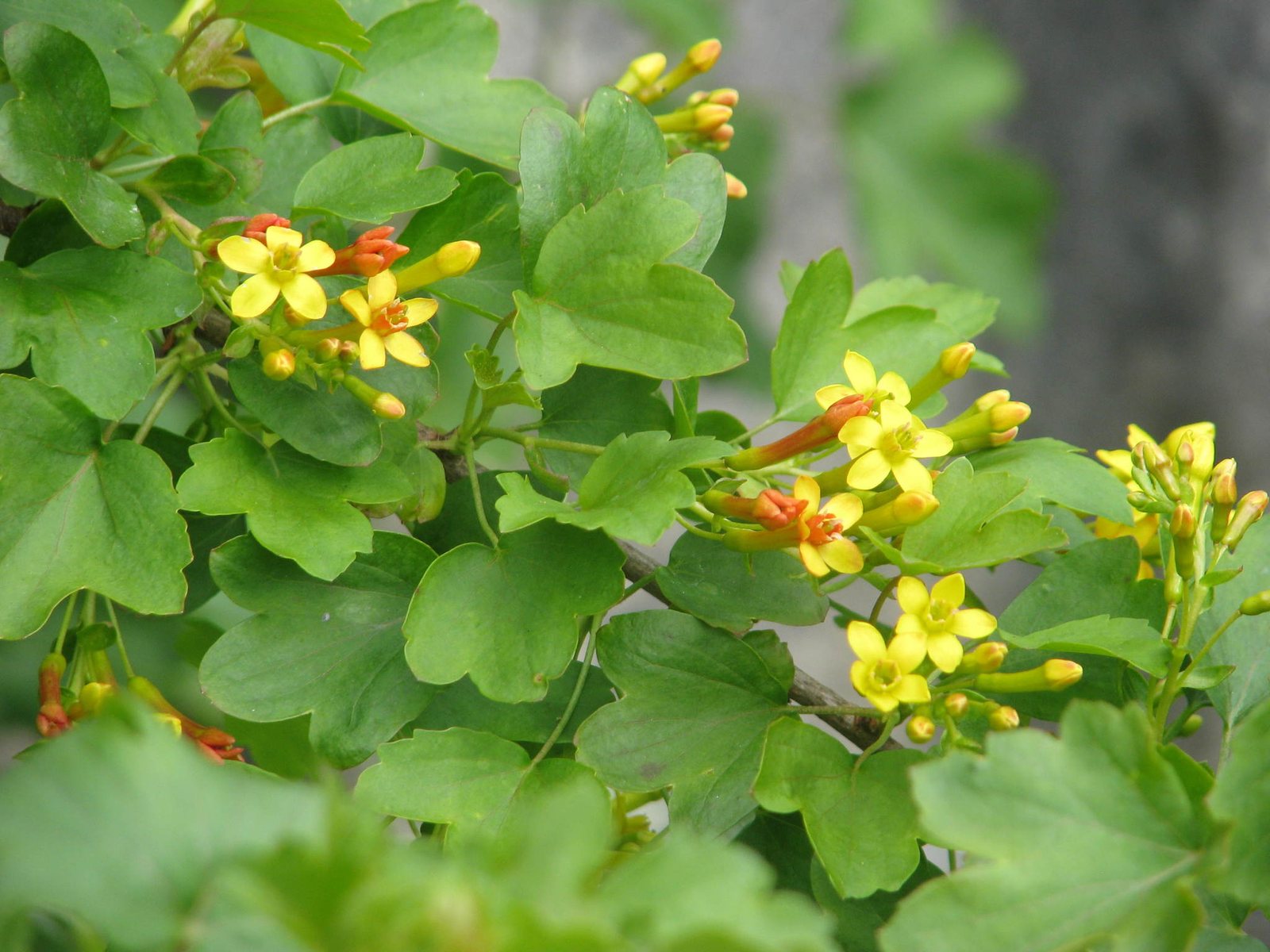
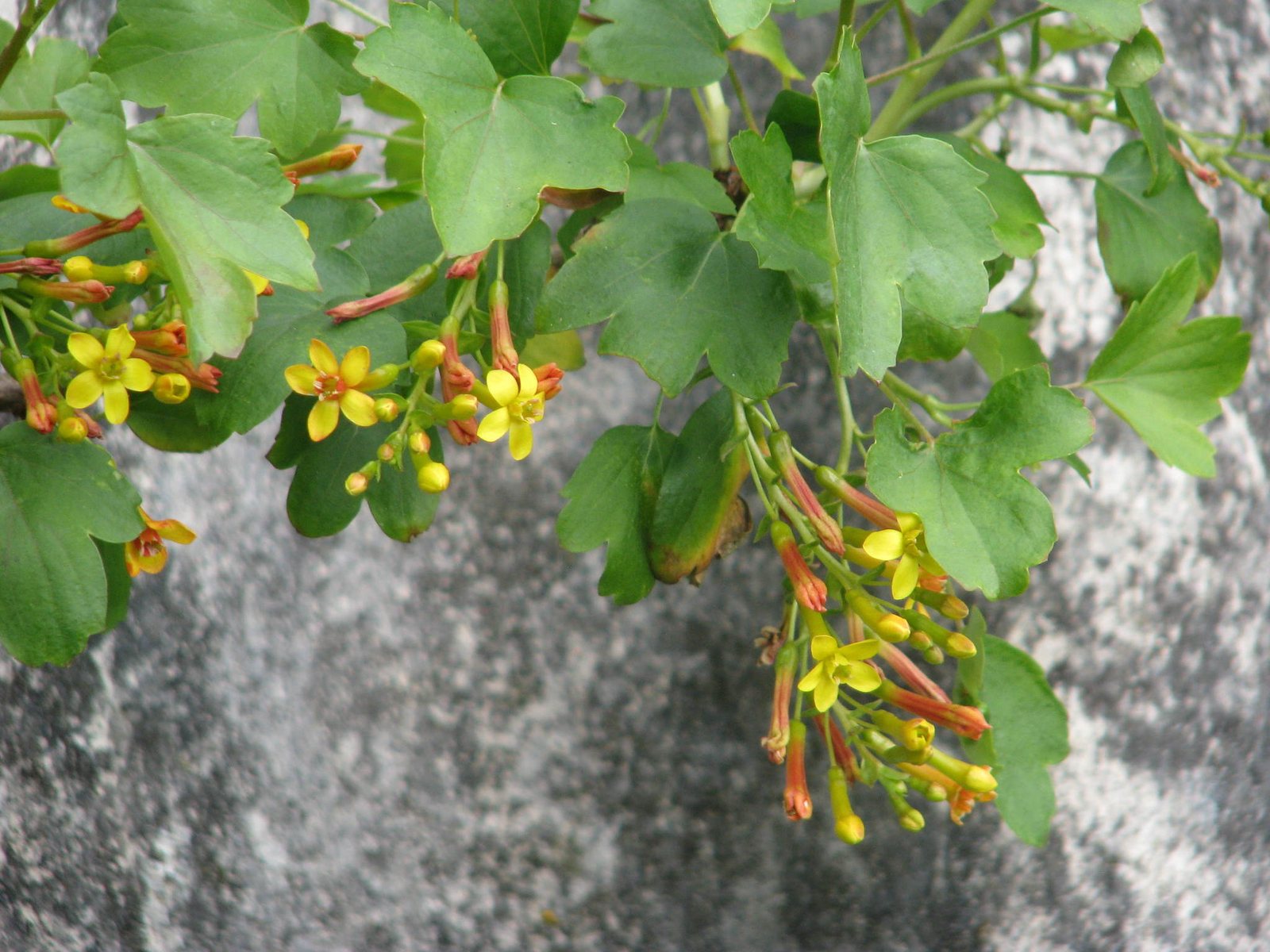
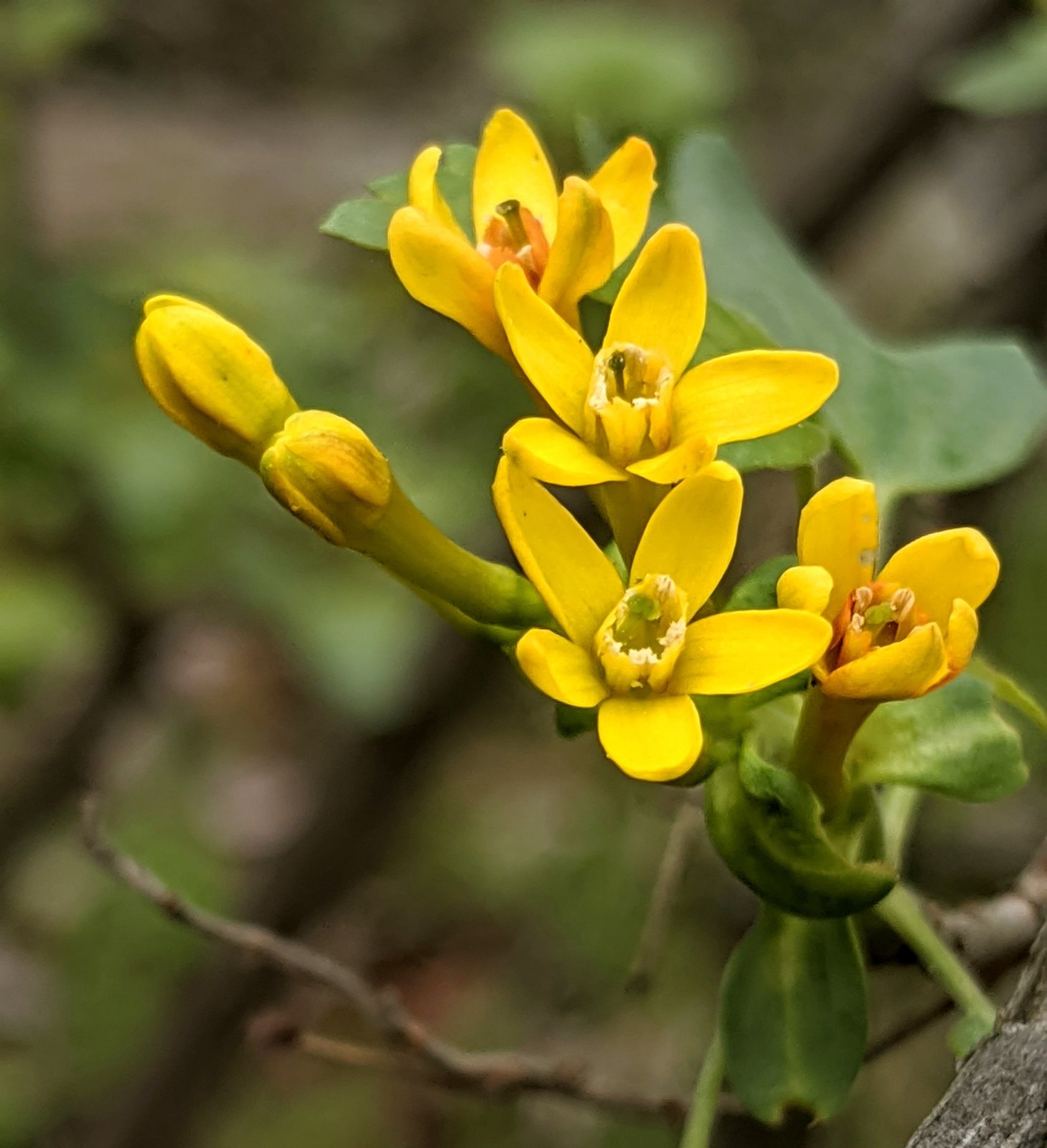
Golden currant is a deciduous North American shrub grown for its fragrant yellow spring flowers, edible berries and yellow to reddish autumn foliage. It tolerates dry conditions once established, but fruits best with sunshine and some summer moisture; suckering stems can gradually form a thicket.
At a glance
- Sun
- Full sun to partial shade; flowering and fruiting are usually best in full sun.
- Water
- Water regularly during establishment, then during prolonged dry spells. Keep the soil evenly moist while fruit develops, without waterlogging it.
- Soil
- Well-drained sandy, loamy or clay soil; tolerates a broad range of soil pH and relatively poor ground.
- Height
- 6-10 ft (1.8-3 m)
- Spread
- 6-10 ft (1.8-3 m), potentially wider through suckering
- Flowers
- Spring; clusters of fragrant golden-yellow tubular flowers, sometimes with orange-red centres.
- Foliage
- Small, three-lobed green leaves turn yellow, orange or reddish in autumn.
- Growth
- Moderate
- Care needed
- Low
The year at a glance
- Pollinators
- Drought tolerant
- Cold hardy
- Wildlife
- Low allergen
- Fragrant
- Edible
| J | F | M | A | M | J | J | A | S | O | N | D | |
|---|---|---|---|---|---|---|---|---|---|---|---|---|
| Flowers | ||||||||||||
| Fruit | ||||||||||||
| Plant |
Northern hemisphere months. In Australia, shift them by six.
- Difficulty
- Easy
- Toughness
- Very tough
Will it suit your garden?
Pick your zone, country, light and whether you have pets.
Full sun is 6 or more hours of direct sun a day, part shade 3 to 6 hours, shade under 3.
How it grows
Planting day
1.6 ft (0.5 m)
After 1 year
2.9 ft (0.88 m)
After 2 years
4 ft (1.3 m)
After 3 years
5 ft (1.6 m)
After 5 years
8 ft (2.4 m)
full size
About 5 years to full size.
From a typical nursery size, at an average rate for this kind of plant. A rule of thumb, not a forecast.
Good to know
- Cats and dogs
- Safe
- Native to
- the US and Canada
- In the garden
- Spreads vigorously: plan to contain it.
- Growth rate
- Moderate
Care
Jobs through the year
- WaterApr–May, Sep–Oct, every 14 days
- Water established shrubs deeply if soil is dry; water more often for the first two growing seasons.
- WaterJun–Aug, every 7 days
- Water during dry weather, keeping soil evenly moist while berries develop; account for rain.
- MulchMar–Apr
- Maintain 5–8 cm of organic mulch, clear of the stems.
- FeedMar–Apr
- Top-dress lightly with compost; avoid heavy nitrogen feeding.
- PruneFeb–Mar
- Remove dead or damaged stems and unwanted suckers; leave healthy flowering wood.
- PruneAug–Sep
- After harvest, remove crossing stems and up to one-third of the oldest stems at ground level.
- HarvestJun–Aug
- Pick fully coloured, soft berries that detach easily.
- Water deeply during dry weather for the first two growing seasons.
- Spread a 2-3 in (5-8 cm) layer of organic mulch, keeping it clear of the stems.
- Apply compost in spring; avoid heavy nitrogen feeding, which encourages leafy growth at the expense of flowers.
- Remove unwanted suckers at their point of origin if you need to contain the shrub.
- For better fruit set, plant two genetically different plants rather than two cuttings of the same plant.
- Before planting in the United States, check local Ribes restrictions related to white pine blister rust.
Pruning. Prune just after flowering if flowers are your priority, or after harvest if you want berries. Remove dead or crossing stems and cut up to one-third of the oldest stems to ground level, retaining younger growth for future crops.
Harvest
Pick berries in summer when fully coloured, soft and easily detached; ripe fruit may be yellow, amber, reddish or black depending on the plant. Expect the first worthwhile crop about 2-3 years after planting a young nursery shrub, with yields varying according to pollination and growing conditions.
Through the year
- Autumn
- Plant while the soil is workable, water thoroughly and mulch; in very cold regions, plant in spring instead.
- Late winter
- Remove dead or damaged stems and check for unwanted suckers.
- Early spring
- Top up mulch and add a light dressing of compost if growth was weak.
- Spring
- Enjoy the flowers and leave them accessible to pollinating insects; prune afterwards only if fruit is not a priority.
- Summer
- Water during prolonged drought and pick fully ripe berries before birds take them.
- Late summer
- After harvest, thin old stems if needed and remove suckers outside the intended planting area.
In the garden
- Plant in an informal mixed hedge with other flowering and fruiting shrubs for seasonal interest and wildlife cover.
- Use near a path or seating area where the spring flower fragrance is easy to notice.
- Combine with ornamental grasses and drought-tolerant perennials in a sunny, naturalistic border.
- Include in an edible landscape or food forest, allowing space for harvesting and sucker removal.
Garden styles it suits: Wildlife garden, Pollinator garden, Native hedgerow, Edible landscape, Sensory garden and Low-maintenance.
Plant it with: Serviceberry, Red-twig dogwood, Yarrow, Prairie dropseed, Purple coneflower and Wild bergamot.
Wildlife: Spring flowers feed bees and other pollinating insects. Birds and small mammals eat the berries, and established thickets provide shelter.
Problems to watch for
- Aphids can curl young leaves: dislodge them with water and encourage ladybirds and other predators.
- Currant sawfly larvae may strip foliage: inspect leaf undersides and hand-pick larvae promptly.
- Powdery mildew can coat leaves in crowded or stressed plants: improve airflow, avoid excessive nitrogen and water during drought.
- White pine blister rust is a regional concern because Ribes can act as an alternate host: follow local planting restrictions and seek local advice where susceptible five-needle pines grow.
Safety
Not known to be toxic to people, cats, dogs or horses. Ripe berries are edible; leaves and stems are not normally eaten and should not be treated as food.
Easily confused with
Clove currant (Ribes odoratum)
Very similar, with strongly clove-scented yellow flowers and usually black fruit; its leaves and young shoots are generally hairier. It is also treated as Ribes aureum var. villosum, so nursery labels may overlap.
Flowering currant (Ribes sanguineum)
Usually has pink or red flower clusters rather than yellow, larger leaves and blue-black berries with a waxy bloom.
European gooseberry (Ribes uva-crispa)
Usually has conspicuous spines at the stem nodes and larger berries borne singly or in small groups; golden currant is spineless and carries berries in clusters.
The name
The Latin aureum means golden, referring to the yellow flowers that also give golden currant its common name.
Propagation. Take hardwood cuttings during dormancy or lift rooted suckers while dormant. Seed needs cold stratification, and seedlings can differ in fruit colour, flavour and productivity.
Checked against open data
- Accepted botanical name
- Ribes aureum
- In the US and Canada
- Native in Canada and the lower 48 states. Introduced in Canada.
- Native range
- Alberta, Arizona, Arkansas, California, Colorado, Idaho, Iowa, Kansas, Michigan, Minnesota, Missouri and Montana.
- Measured
- Soil pH 6 to 8. Average height 225 cm.
Sources: GBIF (CC BY 4.0), USDA PLANTS and Trefle (CC BY 4.0). The care and design notes are LandscapeGPT's own.
See it in your own yard.
Upload a photo of your yard and see it redesigned with plants that suit your climate, each checked against your zone.