Goldmoss stonecrop
Sedum acre. Family Crassulaceae. Groundcover.
Also called Biting stonecrop, Mossy stonecrop, Gold moss.
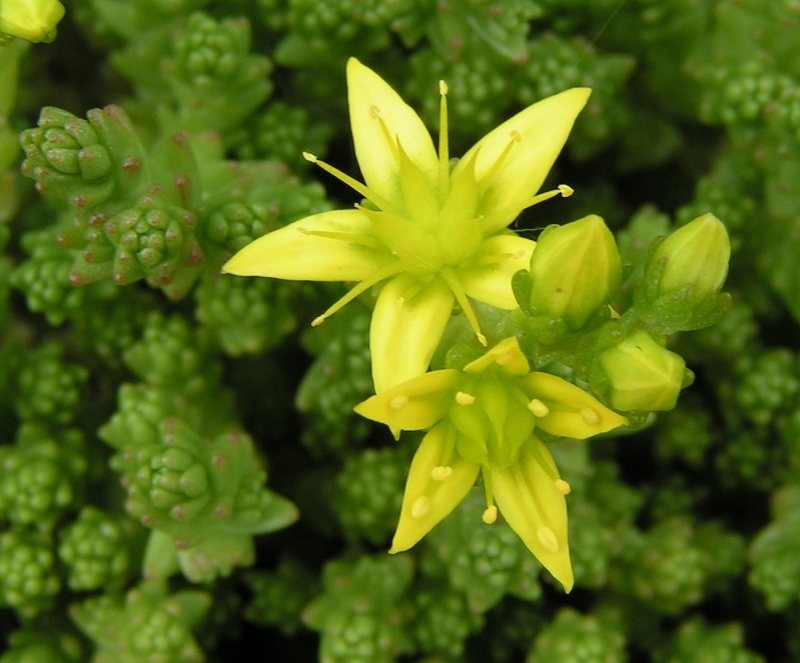
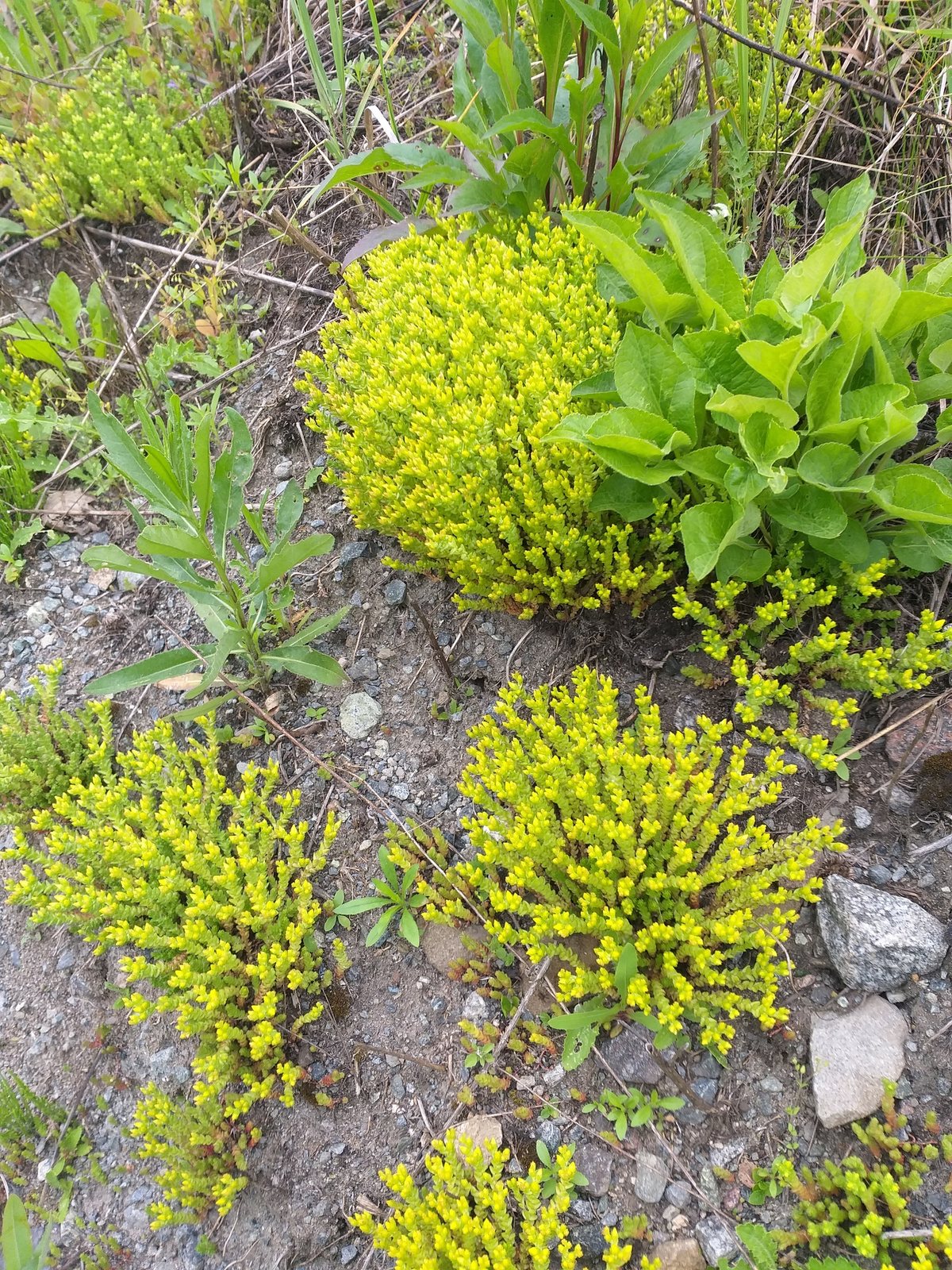
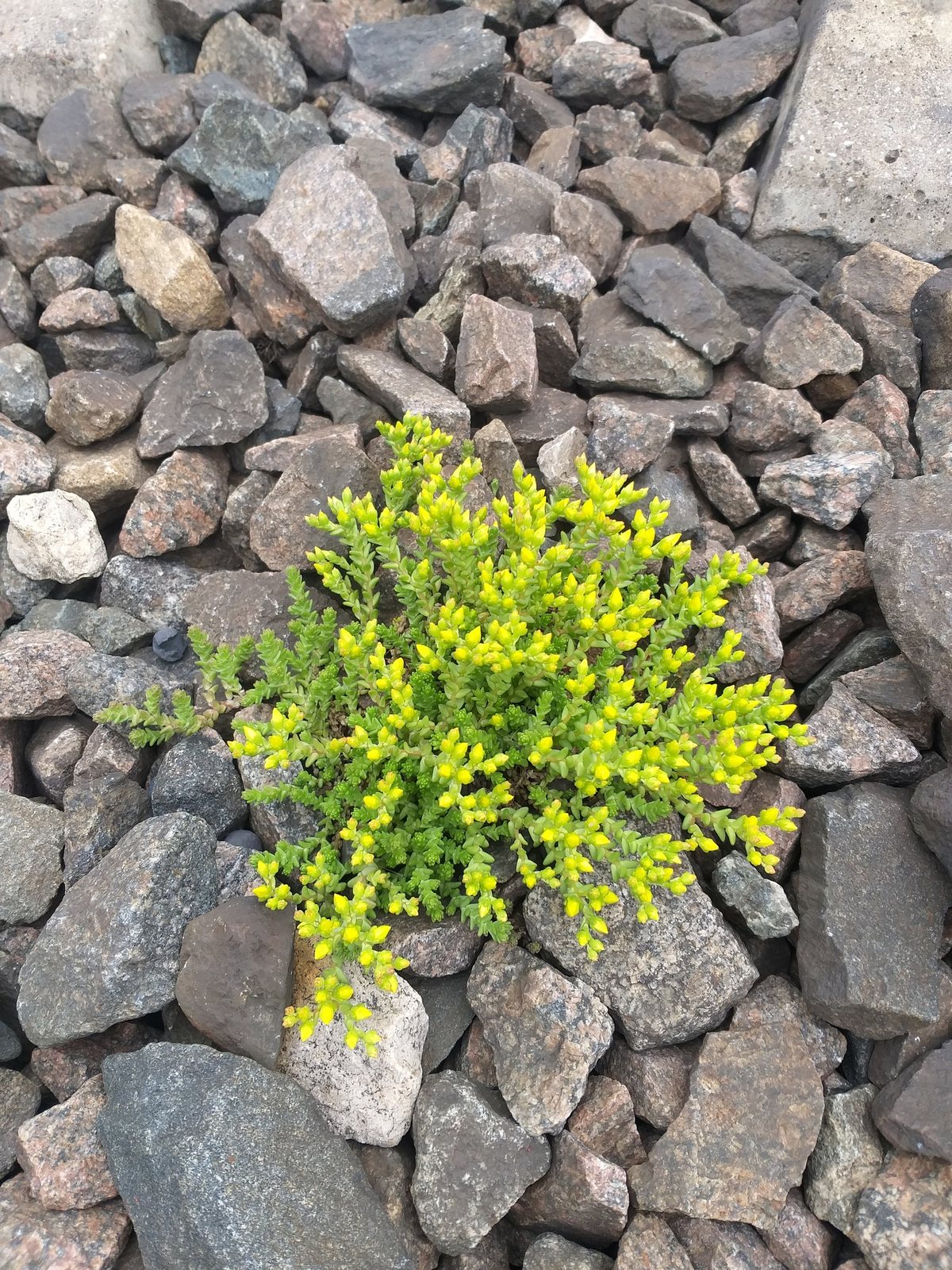
Goldmoss stonecrop is a low, mat-forming succulent perennial with tiny fleshy leaves and bright yellow, star-shaped flowers. Gardeners grow it over gravel, rocks and shallow soil where drainage is sharp, but its spreading stems can overwhelm smaller rock-garden plants.
At a glance
- Sun
- Full sun; tolerates light shade but grows more loosely and flowers less.
- Water
- Low once established. Water new plants during dry spells; established mats usually need extra water only during prolonged drought.
- Soil
- Lean, sandy or gritty soil with excellent drainage. Tolerates shallow, stony soil and a broad range of soil pH; struggles in wet clay.
- Height
- 0.25-0.5 ft (0.08-0.15 m), including flowers
- Spread
- 1-2 ft (0.3-0.6 m), spreading farther over time
- Flowers
- Late spring to early summer; masses of small, bright yellow, star-shaped flowers.
- Foliage
- Evergreen. Tiny, plump green leaves packed around creeping stems; foliage may turn bronze or reddish in cold or dry conditions.
- Growth
- Fast in suitable soil; creeping stems root where they touch the ground.
- Care needed
- Low
The year at a glance
- Pollinators
- Deer resistant
- Drought tolerant
- Cold hardy
- Heat tolerant
- Low allergen
| J | F | M | A | M | J | J | A | S | O | N | D | |
|---|---|---|---|---|---|---|---|---|---|---|---|---|
| Flowers | ||||||||||||
| Plant |
Northern hemisphere months. In Australia, shift them by six.
- Difficulty
- Easy
- Toughness
- Very tough
Will it suit your garden?
Pick your zone, country, light and whether you have pets.
Full sun is 6 or more hours of direct sun a day, part shade 3 to 6 hours, shade under 3.
How it grows
Planting day
0.1 ft (0.03 m)
After 1 year
0.3 ft (0.08 m)
After 2 years
0.4 ft (0.12 m)
full size
About 2 years to full size.
From a typical nursery size, at an average rate for this kind of plant. A rule of thumb, not a forecast.
Good to know
- Cats and dogs
- Mildly toxic: may upset a stomach
- Native to
- the UK
- Invasive in
- the US and Canada
- In the garden
- Spreads vigorously: plan to contain it.
- Growth rate
- Fast
Care
Jobs through the year
- WaterApr–May, Sep–Oct, every 21 days
- Established ground mats need water only in prolonged drought; water new pieces lightly until rooted.
- WaterJun–Aug, every 14 days
- Water established ground mats only during prolonged drought, letting soil dry completely between waterings.
- MulchApr
- Use a thin gravel dressing around stems; avoid moisture-retaining organic mulch.
- PruneMar–Apr
- Remove dead or rotting patches and clear leaves trapped in the mat.
- PruneMay–Sep, every 30 days
- Lift spreading edges that crowd neighbours and collect fragments before they root.
- DeadheadJun–Jul
- Optionally trim spent flower stems lightly for a tidier mat.
- DivideApr–May
- Divide only crowded or thinning mats; replant healthy rooted sections in gritty soil.
- ProtectJan–Feb, Oct–Dec
- Clear fallen leaves and keep drainage open to prevent winter rot.
- Plant in freely draining ground; use a gritty potting mix in containers with drainage holes.
- Water newly planted pieces until rooted, then let the soil dry between waterings.
- Avoid routine feeding: rich soil encourages loose growth that can rot.
- Use gravel rather than moisture-holding organic mulch around the stems.
- Pull back spreading edges before they root among smaller plants; remove loose fragments.
- Divide crowded mats in spring if the centres become thin.
Pruning. After flowering, lightly trim off spent flower stems if you want a tidier mat. Cut back or lift unwanted growth whenever it crosses its allotted space, removing fragments that could root.
Through the year
- Early spring
- Remove dead or rotting patches and clear fallen leaves from the mat.
- Spring
- Plant or divide rooted pieces in gritty soil, watering lightly while they establish.
- Late spring
- Weed carefully between mats before weeds become tangled in the stems.
- Summer
- Trim spent flowers if needed and remove stems spreading into neighbouring plants.
- Autumn
- Clear fallen leaves and check that containers and planting pockets drain freely.
- Winter
- Keep container plants out of standing water; avoid watering frozen or already wet soil.
In the garden
- Use between rocks in a sunny rock garden for a low green carpet and a brief yellow flower display.
- Let it trail over a dry stone wall where rooted stems can occupy small soil pockets.
- Plant in shallow troughs with compact houseleeks, keeping its spreading edges away from slower plants.
- Use as a low edging beside gravel paths or paving that receives little foot traffic.
Garden styles it suits: Alpine rock garden, Dry gravel garden, Desert / xeriscape, Low-maintenance, Modern courtyard and Cottage garden.
Plant it with: Houseleeks, Creeping thyme, Maiden pink, Rock rose and Blue fescue.
Wildlife: Open flowers provide nectar and pollen for bees and other small pollinating insects. The low mat offers little cover for larger wildlife.
Problems to watch for
- Root and stem rot in wet soil: improve drainage or move healthy pieces to a gritty raised bed or container.
- Loose, sparse growth in shade: move to a sunnier position and avoid feeding.
- Aggressive spread into nearby plants: lift rooted edges regularly and collect every loose stem fragment.
- Vine weevil larvae in containers: inspect roots when plants wilt or detach, remove larvae and use an appropriate biological control where available.
Safety
Leaves and stems are mildly toxic to people, cats and dogs if eaten, potentially causing mouth irritation, vomiting or diarrhoea. Sap can irritate skin. Reliable horse-specific toxicity information is limited, so keep it out of grazing areas; it should not be treated as an edible stonecrop.
Where it spreads. Can spread aggressively in rocky and sandy habitats in the northeastern and Great Lakes United States and southern Canada, including Ontario, where escaped plants can compete with native rock-outcrop vegetation. It is native to the UK but can still overwhelm small garden plants. Avoid planting beside natural rock outcrops in regions where it is introduced.
Easily confused with
Tasteless stonecrop (Sedum sexangulare)
Its slender leaves usually form six clear spiral rows around the stems; goldmoss has shorter, broader, more tightly overlapping leaves. Both have yellow flowers; do not taste them to identify them.
White stonecrop (Sedum album)
Has longer, rounded, sausage-shaped leaves and white rather than yellow flowers.
Reflexed stonecrop (Petrosedum rupestre)
Usually grows taller, with narrow, pointed, often blue-grey leaves resembling miniature conifer needles; goldmoss has short, plump green leaves.
The name
The Latin acre means sharp or acrid, referring to the plant's biting sap, while goldmoss describes its moss-like carpet covered in yellow flowers.
Propagation. Divide rooted mats in spring or take short stem cuttings in spring or summer. Set pieces on gritty soil with the stem bases in contact with the surface and water sparingly until rooted; even small fragments can establish.
Checked against open data
- Accepted botanical name
- Sedum acre
- In the US and Canada
- Introduced in Canada, Greenland and the lower 48 states.
- Native range
- Albania, Algeria, Austria, Baltic States, Belarus, Belgium, Bulgaria, Central European Rus, Czechoslovakia, Denmark, East Aegean Is. and East European Russia.
- Measured
- Soil pH 6.5 to 7. Average height 7 cm.
Sources: GBIF (CC BY 4.0), USDA PLANTS and Trefle (CC BY 4.0). The care and design notes are LandscapeGPT's own.
See it in your own yard.
Upload a photo of your yard and see it redesigned with plants that suit your climate, each checked against your zone.