Gum rock rose
Cistus ladanifer. Family Cistaceae. Shrub.
Also called Gum cistus, Labdanum, Spotted rock rose.
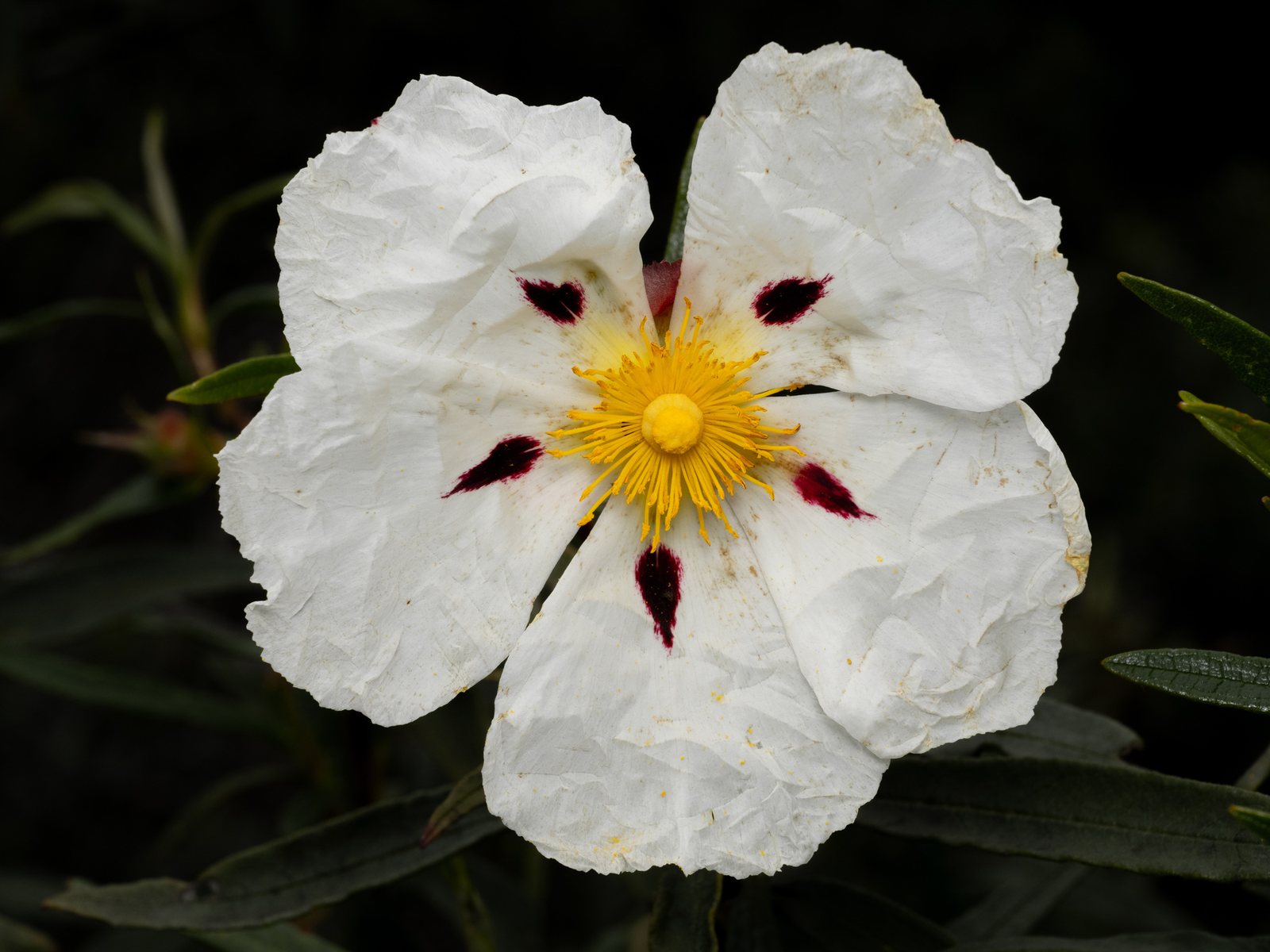
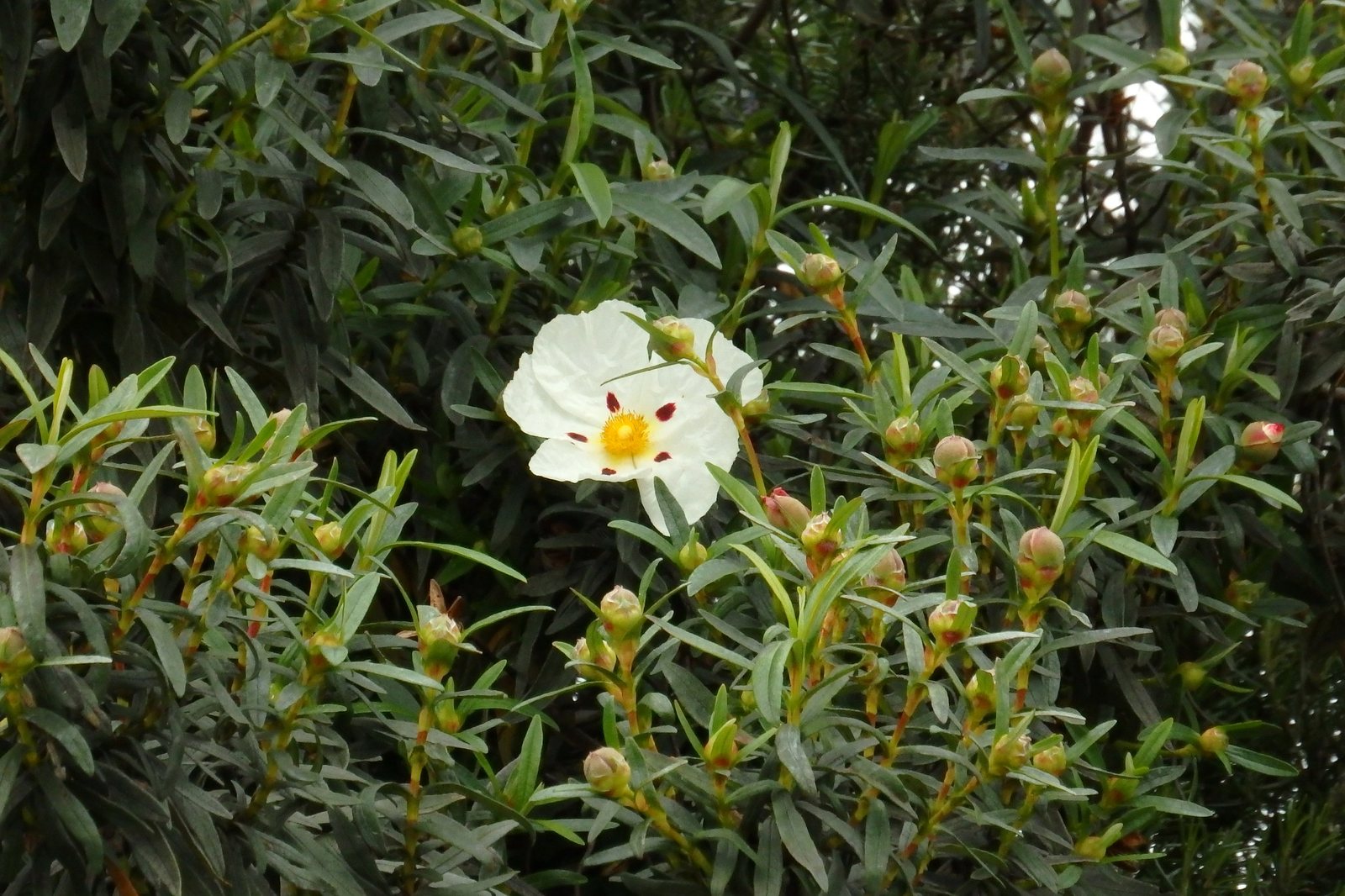
Gum rock rose is an evergreen Mediterranean shrub grown for its large, crumpled white flowers, often marked with dark maroon blotches, and its aromatic, resinous leaves. It suits sunny, dry gardens with sharply drained soil, but struggles in wet winters and is not reliably hardy in most of Canada or colder inland districts.
At a glance
- Sun
- Full sun, preferably in a warm position sheltered from cold winds.
- Water
- Water regularly during the first growing season, allowing the soil to dry between waterings. Once established, water only during prolonged drought.
- Soil
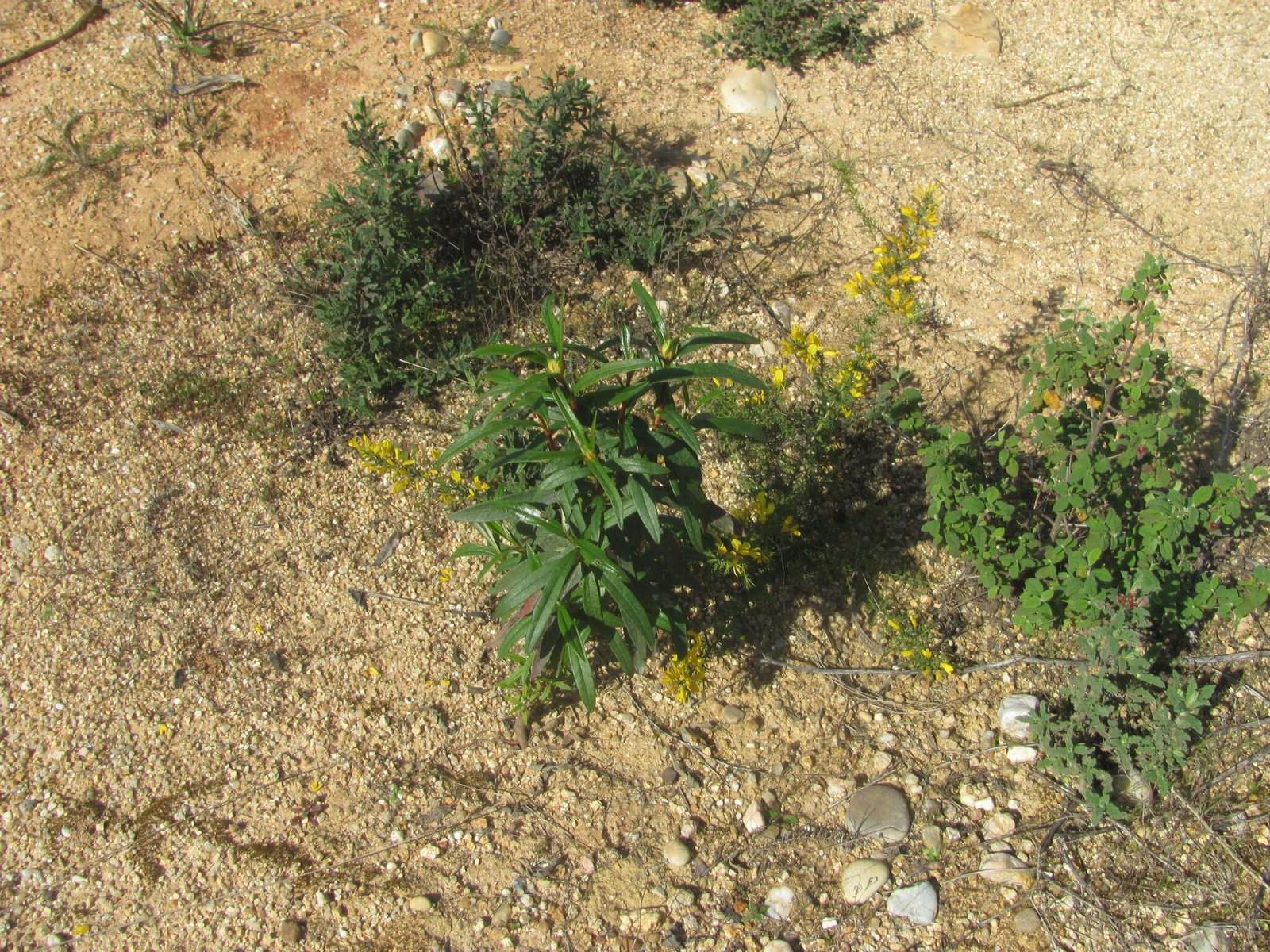
- Lean, sharply drained sandy, gravelly or stony soil; preferably acidic to neutral. Avoid waterlogged ground and rich, heavily fertilised beds.
- Height
- 5-8 ft (1.5-2.4 m)
- Spread
- 4-8 ft (1.2-2.4 m)
- Flowers
- Late spring to early summer; large white flowers with yellow stamens, often with a dark maroon blotch at the base of each petal. Each flower lasts one day, but more open over several weeks.
- Foliage
- Evergreen. Narrow, dark green leaves with pale, hairy undersides; sticky with aromatic resin, especially in warm weather.
- Growth
- Fast in a warm, sunny position; relatively short-lived compared with many evergreen shrubs.
- Care needed
- Low
The year at a glance
- Pollinators
- Deer resistant
- Drought tolerant
- Heat tolerant
- Wildlife
- Low allergen
- Fragrant
| J | F | M | A | M | J | J | A | S | O | N | D | |
|---|---|---|---|---|---|---|---|---|---|---|---|---|
| Flowers | ||||||||||||
| Plant |
Northern hemisphere months. In Australia, shift them by six.
- Difficulty
- Moderate
- Toughness
- Fairly tough
Will it suit your garden?
Pick your zone, country, light and whether you have pets.
Full sun is 6 or more hours of direct sun a day, part shade 3 to 6 hours, shade under 3.
How it grows
Planting day
1.6 ft (0.5 m)
After 1 year
3 ft (0.95 m)
After 2 years
5 ft (1.4 m)
After 3 years
6 ft (1.8 m)
After 5 years
6 ft (2 m)
full size
About 3 years to full size.
From a typical nursery size, at an average rate for this kind of plant. A rule of thumb, not a forecast.
Good to know
- Cats and dogs
- Safe
- Invasive in
- Australia
- Growth rate
- Fast
Care
Jobs through the year
- WaterApr–May, Sep, every 28 days
- Established ground plants need water only in prolonged drought; water new plants more regularly.
- WaterJun–Aug, every 21 days
- Water established plants deeply only during prolonged drought, letting soil dry thoroughly.
- MulchApr–May
- Apply a thin gravel mulch, keeping it clear of stem bases.
- PruneJun–Jul
- Lightly trim leafy shoots after flowering; never cut into bare old wood.
- ProtectOct–Nov
- Not reliably hardy locally; shelter pots frost-free or protect a very sheltered, freely drained planting.
- ProtectJan–Feb, Dec, every 14 days
- Keep drainage clear and protect from severe frost and persistent winter wet.
- Plant while young in its permanent position; established plants dislike root disturbance.
- Water deeply during establishment, then let the soil dry before watering again.
- Avoid routine feeding or manure; rich soil encourages soft, sprawling growth.
- Use a thin gravel mulch, keeping it clear of the stem bases.
- In colder gardens, choose a sheltered slope or raised bed that drains freely through winter.
Pruning. Lightly trim leafy shoots just after flowering to keep the shrub compact. Do not cut into bare old wood, as it rarely regrows well.
Through the year
- Spring
- Plant after severe frosts have passed in cooler climates, keeping the root ball intact.
- Late spring
- Check new plants for dry root balls and water deeply when needed.
- Early summer
- Lightly trim after flowering without cutting below leafy growth.
- Summer
- Take semi-ripe cuttings from healthy, non-flowering shoots.
- Autumn
- Plant in mild, dry-winter districts; remove unwanted seedlings where the plant escapes cultivation.
- Winter
- Keep drainage channels clear and avoid watering already damp soil.
In the garden
- Use as a loose evergreen anchor in a sunny gravel garden with lavender and santolina.
- Plant on a dry bank where its rounded outline and white flowers soften stones and retaining walls.
- Combine with rosemary and smaller rock roses in a Mediterranean-style border.
- Place beside a sunny terrace where its resinous scent can be noticed without sticky foliage brushing against people.
Garden styles it suits: Mediterranean, Modern Mediterranean, Dry gravel garden, Desert / xeriscape, Sensory garden and White garden.
Plant it with: Lavender, Rosemary, Santolina, Jerusalem sage, Thyme and Bearded iris.
Wildlife: The pollen-rich flowers attract bees and other visiting insects. Dense evergreen growth provides shelter for small garden animals.
Problems to watch for
- Root rot in wet soil: improve drainage before planting and avoid frequent irrigation; replace badly affected plants.
- Frost damage: use a sheltered position and trim dead tips in spring once new growth shows what survived.
- Leggy growth or bare centres: trim lightly after flowering each year; replace old shrubs rather than cutting hard into bare wood.
- Poor establishment after transplanting: start with a young container-grown plant and avoid moving it once established.
Safety
Not known to be toxic to people, cats, dogs or horses; no part is recognised as a common poisoning hazard. It is not a food plant, and the sticky resin may irritate sensitive skin.
Where it spreads. It can self-seed beyond gardens and is recorded as an environmental weed in parts of southern Australia, including Western Australia and South Australia. Check local weed guidance before planting near bushland.
Easily confused with
Purple rock rose (Cistus × purpureus)
Usually has pink-purple flowers with dark basal blotches, rather than white flowers.
Sage-leaved rock rose (Cistus salviifolius)
Has smaller white flowers without dark basal blotches and shorter, broader, wrinkled leaves that are not strongly resinous.
Grey-leaved rock rose (Cistus albidus)
Has soft, grey, felted leaves and pink flowers, rather than sticky dark green leaves and white flowers.
The name
The species name ladanifer means 'bearing labdanum', referring to the fragrant resin that also gives gum rock rose its common name.
Propagation. Take semi-ripe cuttings in summer and root them in a gritty, free-draining medium. Seed can also be sown in spring, but seedlings may vary, especially where other rock roses grow nearby.
Checked against open data
- Accepted botanical name
- Cistus ladanifer
- In the US and Canada
- Introduced in the lower 48 states.
- Native range
- Algeria, France, Morocco, Portugal and Spain.
- Measured
- Average height 152 cm.
Sources: GBIF (CC BY 4.0), USDA PLANTS and Trefle (CC BY 4.0). The care and design notes are LandscapeGPT's own.
See it in your own yard.
Upload a photo of your yard and see it redesigned with plants that suit your climate, each checked against your zone.