Hairpin banksia
Banksia spinulosa. Family Proteaceae. Shrub.
Also called Hair-pin banksia, Golden banksia.
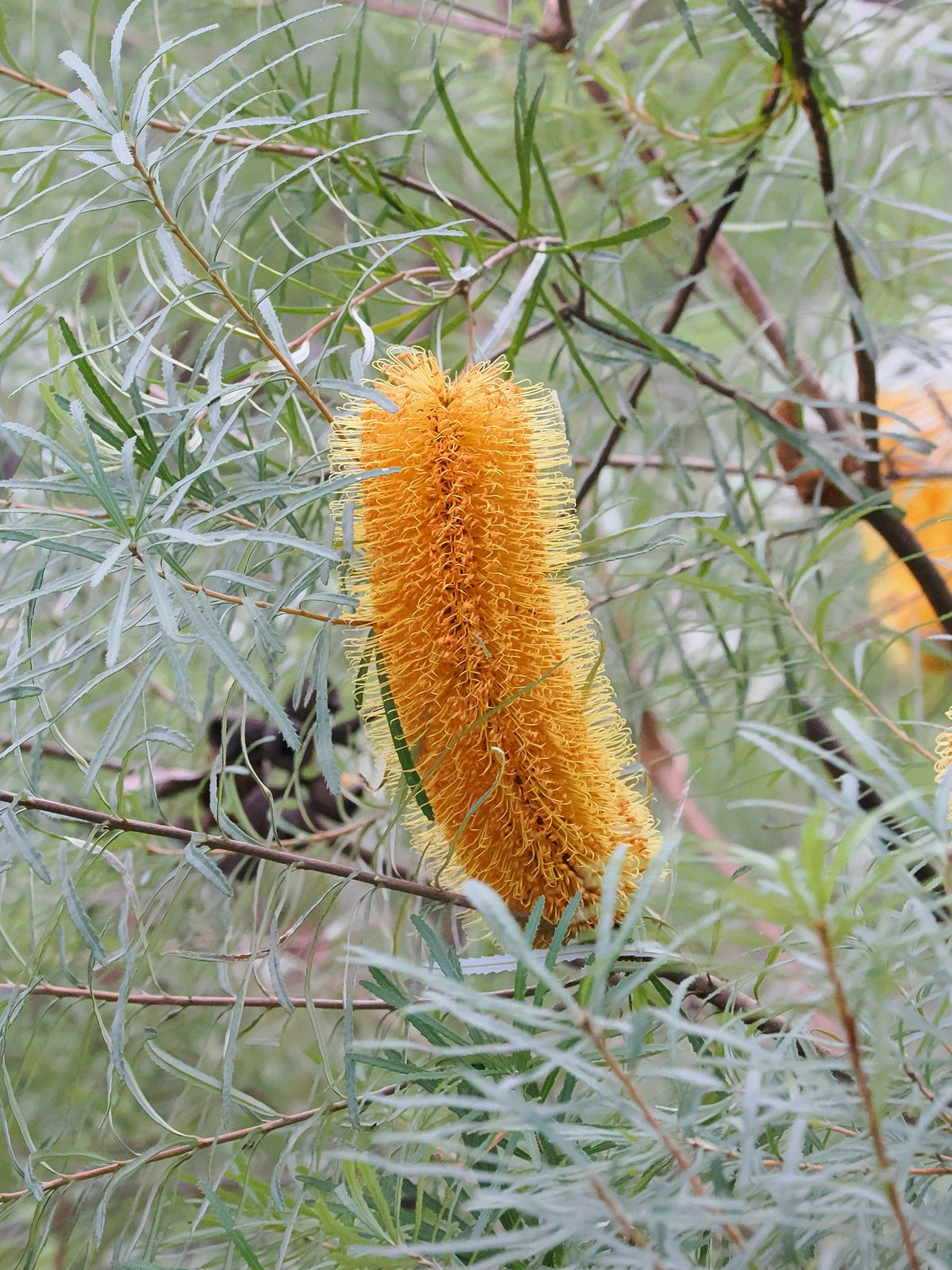
Hairpin banksia is an evergreen shrub from eastern Australia, grown for its cylindrical golden flower spikes and contrasting hooked styles. It attracts nectar-feeding birds and suits sunny, well-drained gardens with mild winters; in colder regions, grow a compact selection in a container that can be sheltered from frost.
At a glance
- Sun
- Full sun for best flowering; tolerates light partial shade.
- Water
- Water regularly while establishing, then during extended dry spells. Allow the soil surface to dry between waterings; avoid permanently wet roots.
- Soil
- Well-drained, acidic to neutral sandy soil or sandy loam, low in phosphorus. Avoid chalky ground and heavy, waterlogged clay.
- Height
- 3-10 ft (0.9-3 m), depending on form; some wild forms grow taller.
- Spread
- 3-8 ft (0.9-2.4 m)
- Flowers
- Mainly autumn through winter, sometimes continuing into spring; golden-yellow to orange cylindrical spikes with red, maroon or nearly black hooked styles.
- Foliage
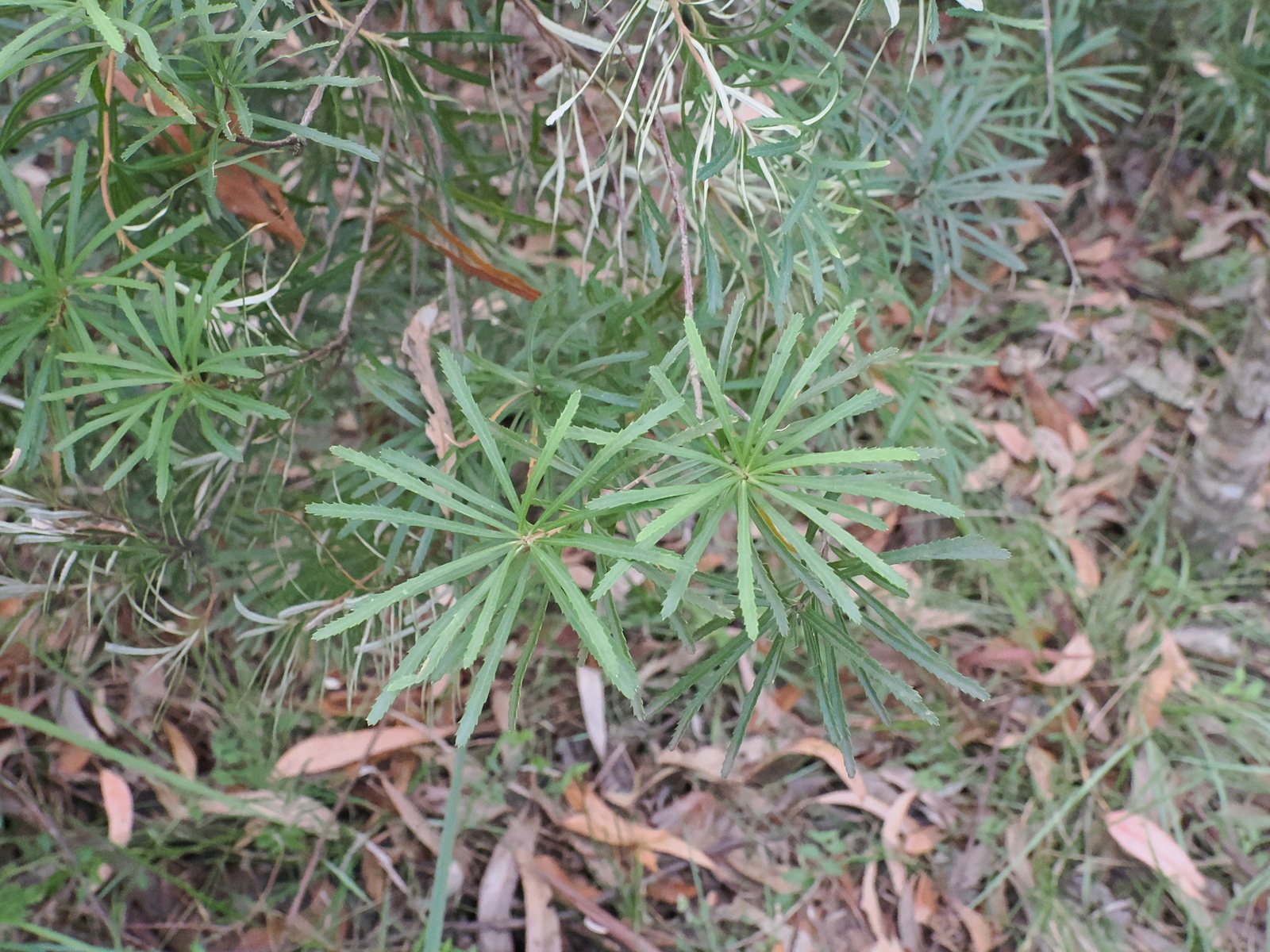
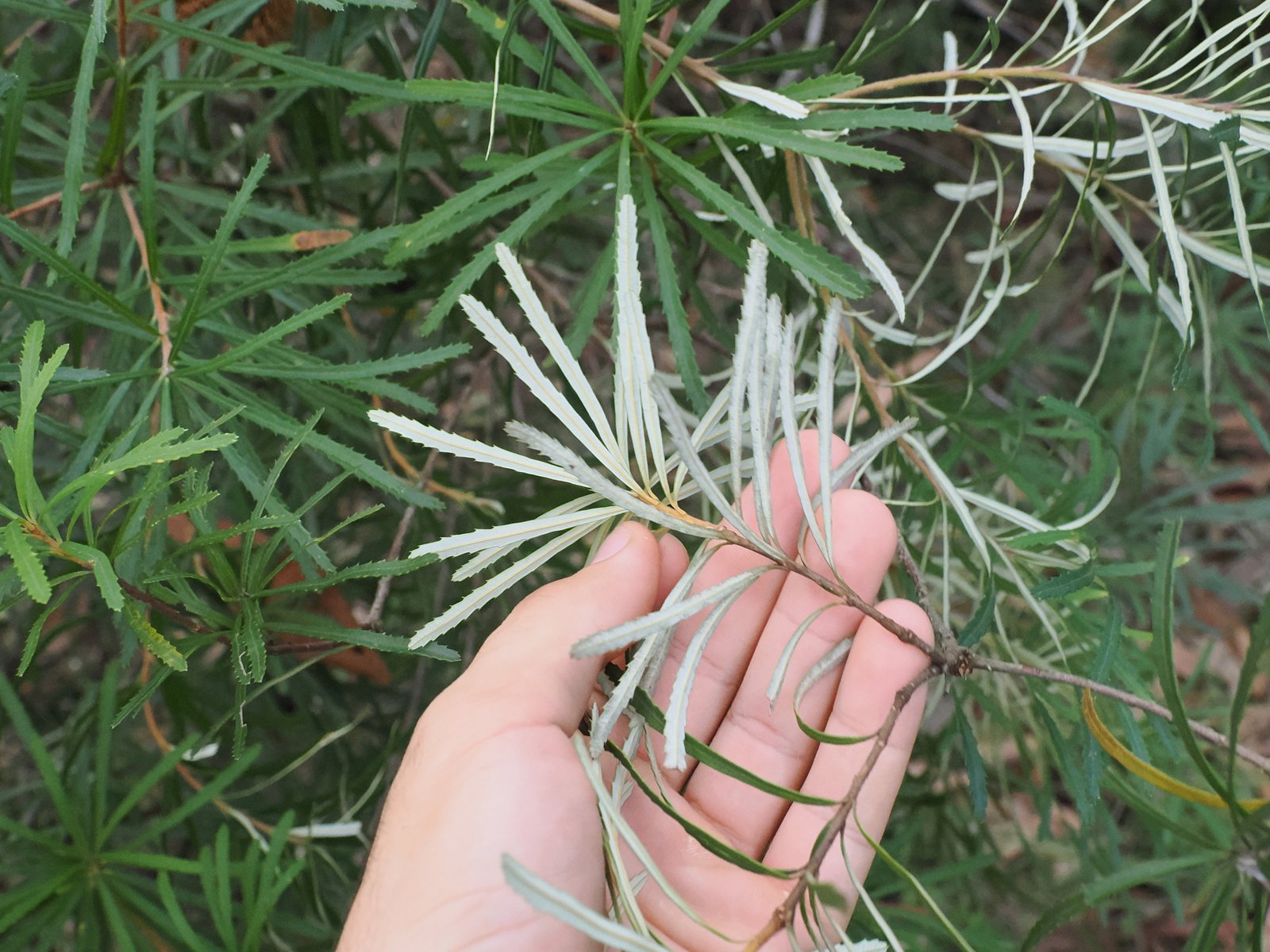
- Evergreen. Narrow, leathery green leaves with pale undersides, rolled edges and small teeth, often concentrated towards the tips.
- Growth
- Slow to moderate.
- Care needed
- Low
The year at a glance
- Pollinators
- Drought tolerant
- Heat tolerant
- Wildlife
- Low allergen
| J | F | M | A | M | J | J | A | S | O | N | D | |
|---|---|---|---|---|---|---|---|---|---|---|---|---|
| Flowers | ||||||||||||
| Fruit | ||||||||||||
| Plant |
Northern hemisphere months. In Australia, shift them by six.
- Difficulty
- Hard
- Toughness
- Needs looking after
Will it suit your garden?
Pick your zone, country, light and whether you have pets.
Full sun is 6 or more hours of direct sun a day, part shade 3 to 6 hours, shade under 3.
How it grows
Planting day
1.6 ft (0.5 m)
After 1 year
2.4 ft (0.72 m)
After 2 years
3 ft (0.95 m)
After 3 years
4 ft (1.2 m)
After 5 years
5 ft (1.6 m)
About 7 years to full size.
From a typical nursery size, at an average rate for this kind of plant. A rule of thumb, not a forecast.
Good to know
- Cats and dogs
- Safe
- Native to
- Australia
- Growth rate
- Slow
Care
Jobs through the year
- WaterApr–May, Sep–Oct, every 14 days
- For established ground plants in mild sites, water only if dry; new plants and pots need more.
- WaterJun–Aug, every 14 days
- Water established ground plants deeply during extended drought; check containers more often.
- WaterJan–Mar, Nov–Dec, every 14 days
- Water frost-free sheltered containers when the surface dries; avoid saturated roots.
- FeedApr–May
- Feed only if needed with a low-phosphorus fertiliser labelled for banksias.
- MulchApr–May
- Refresh light coarse mulch clear of stems without disturbing shallow roots.
- PruneApr–May
- After flowering, lightly trim leafy shoots and retain some spent spikes for woody cones.
- ProtectJan–Apr, Oct–Dec
- Grow in containers in zones 6–7 and overwinter in bright, frost-free shelter.
- Water deeply through the first growing season, allowing excess water to drain away.
- Use only a low-phosphorus fertiliser labelled suitable for banksias or phosphorus-sensitive Australian native plants; avoid rich manure.
- Spread a light layer of coarse mulch over the root zone, keeping it clear of the stems.
- Keep digging and cultivation around established roots to a minimum.
- In containers, use a free-draining native-plant potting mix and shelter the pot from prolonged freezing.
Pruning. After flowering, shorten leafy shoots lightly to encourage branching, leaving any flower spikes you want to develop into seed cones. Avoid cutting into bare old wood unless you know your particular form can regenerate from a woody basal swelling.
Through the year
- Spring
- In frost-prone regions, plant after the risk of hard frost has passed and water deeply.
- Spring
- Refresh mulch and, only if needed, apply a light dressing of low-phosphorus native-plant fertiliser.
- Summer
- Check new plants and containers regularly; water deeply during dry weather without keeping the roots saturated.
- Autumn
- In mild-winter climates, plant while the soil is still warm and reliable rain is returning.
- Winter
- Protect container plants from prolonged frost and keep drainage holes clear.
- After flowering
- Lightly trim leafy growth if shaping is needed, retaining some spent spikes for seed and wildlife.
In the garden
- Use as an evergreen feature shrub in a sunny Australian-native border.
- Combine with fine-leaved grasses and kangaroo paws for contrasting foliage and flower shapes.
- Plant in an open wildlife garden where nectar-feeding birds can reach the flower spikes.
- Use a named compact selection in a large, freely draining container beside a sunny patio.
Garden styles it suits: Australian native, Wildlife garden, Coastal, Dry gravel garden, Architectural minimal and Low-maintenance.
Plant it with: Kangaroo paw, Lomandra, Grevillea, Geraldton wax and Woolly bush.
Wildlife: Nectar-rich flowers attract honeyeaters and other nectar-feeding birds in Australia, as well as bees and other insects. Mature woody cones provide seed for some seed-eating birds, including cockatoos.
Problems to watch for
- Phytophthora root rot can cause wilting and dieback in poorly drained soil. Improve drainage before planting, avoid overwatering and remove badly affected plants; there is no reliable home cure.
- Phosphorus toxicity can cause yellowing, scorched leaf tips and decline. Stop unsuitable fertilisers and use only products labelled for phosphorus-sensitive native plants.
- Scale insects may produce sticky honeydew and sooty mould. Check stems and leaf undersides, remove small infestations by hand and use a labelled horticultural oil if necessary.
- Hard frost can scorch foliage and kill young growth. Choose a sheltered position and cover young plants during brief cold spells, or move containers under cover.
Safety
Not known to be toxic to people, cats, dogs or horses. Species-specific toxicity information is limited, so do not treat the leaves, flowers or seeds as food.
Easily confused with
Heath-leaved banksia (Banksia ericifolia)
Has much smaller, crowded, heath-like leaves with mostly smooth margins; hairpin banksia has longer leaves with small teeth, especially towards their tips.
Swamp banksia (Banksia robur)
Has very broad, prominently veined leaves with coarse teeth, rather than the narrow leaves of hairpin banksia.
The name
Banksia honours botanist Joseph Banks, spinulosa refers to the small spines or teeth on the leaves, and hairpin describes the hooked flower styles.
Propagation. Sow seed extracted from mature woody cones into a freely draining seed mix; smoke treatment is not normally necessary. Propagate named selections from cuttings to preserve their characteristics, although rooting can be slow and unreliable.
Checked against open data
- Accepted botanical name
- Banksia spinulosa
- Native range
- New South Wales and Queensland.
- Measured
- Average height 200 cm.
Sources: GBIF (CC BY 4.0) and Trefle (CC BY 4.0). The care and design notes are LandscapeGPT's own.
See it in your own yard.
Upload a photo of your yard and see it redesigned with plants that suit your climate, each checked against your zone.