Hardy yellow ice plant
Delosperma nubigenum. Family Aizoaceae. Succulent.
Also called Yellow ice plant, Cloud-loving ice plant.
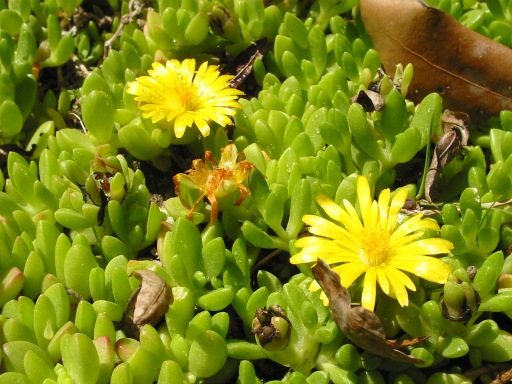
Hardy yellow ice plant is a low, spreading South African succulent grown for its bright yellow, daisy-like flowers and dense mats of fleshy leaves. It suits sunny rock gardens, gravel beds and shallow containers, provided water drains away quickly, especially in winter.
At a glance
- Sun
- Full sun; light afternoon shade can help in very hot climates, but too much shade reduces flowering.
- Water
- Low once established. Water during establishment and prolonged dry spells, then let the soil dry between waterings; avoid persistent winter moisture.
- Soil
- Lean, sandy or gravelly soil with excellent drainage. Avoid heavy clay unless planting in a raised, freely draining bed.
- Height
- 0.15-0.3 ft (0.05-0.1 m)
- Spread
- 1-2 ft (0.3-0.6 m)
- Flowers
- Bright yellow, daisy-like flowers in late spring to early summer; flowers open best in sunshine.
- Foliage
- Evergreen. Small, fleshy green leaves packed along trailing stems; often bronze or reddish in cold weather.
- Growth
- Moderate; rooting stems gradually form a broad mat.
- Care needed
- Low
The year at a glance
- Pollinators
- Deer resistant
- Drought tolerant
- Heat tolerant
- Low allergen
| J | F | M | A | M | J | J | A | S | O | N | D | |
|---|---|---|---|---|---|---|---|---|---|---|---|---|
| Flowers | ||||||||||||
| Plant |
Northern hemisphere months. In Australia, shift them by six.
- Difficulty
- Moderate
- Toughness
- Fairly tough
Will it suit your garden?
Pick your zone, country, light and whether you have pets.
Full sun is 6 or more hours of direct sun a day, part shade 3 to 6 hours, shade under 3.
How it grows
Planting day
0.2 ft (0.08 m)
full size
About 6 years to full size.
From a typical nursery size, at an average rate for this kind of plant. A rule of thumb, not a forecast.
Good to know
- Cats and dogs
- Safe
- Growth rate
- Moderate
Care
Jobs through the year
- WaterApr–May, Sep, every 21 days
- Water established mats only during prolonged drought; water new plants when soil dries.
- WaterJun–Aug, every 14 days
- Water only during prolonged dry spells, letting the root zone dry between soakings.
- PruneApr
- Snip out dead or winter-damaged stems once healthy growth is visible.
- PruneJun–Jul
- Lightly trim encroaching edges after flowering.
- DivideApr–May
- Divide established mats only if renewal or additional plants are needed.
- MulchApr
- Apply a thin gravel mulch to keep damp soil away from leaves and crowns.
- ProtectJan–Mar, Oct–Dec
- Remove damp debris and maintain sharp drainage; shelter containers from prolonged rain.
- Plant with the crown at soil level in a sunny, sharply drained position.
- Water new plants when the root zone dries; reduce watering once they are established.
- Use a thin gravel mulch to keep damp soil away from the leaves and crowns.
- Avoid rich compost and routine feeding; excessive fertility encourages soft growth.
- Keep fallen leaves and other damp debris off the mat over winter.
Pruning. In spring, snip out dead or winter-damaged stems once healthy growth is visible. After flowering, trim spreading edges lightly if they are encroaching on nearby plants.
Through the year
- Spring
- Remove dead stems and check that winter moisture has not rotted the crown.
- Mid-spring
- Plant into warming, freely draining soil; divide established mats if needed.
- Late spring
- Enjoy the main flower display and keep taller neighbours from shading the mat.
- Summer
- Water during prolonged drought and take short, non-flowering stem cuttings.
- Autumn
- Clear fallen leaves and check drainage before wetter weather arrives.
- Winter
- Keep containers out of standing water and shelter them from prolonged rain where winters are wet.
In the garden
- Plant between rocks on a sunny slope, where its low mat softens stone edges.
- Use along the front of a gravel bed with compact sedums and other small drought-tolerant plants.
- Let it trail over a low retaining wall without burying the crown in damp soil.
- Grow in shallow, frost-resistant containers with generous drainage holes and a gritty potting mix.
Garden styles it suits: Alpine rock garden, Dry gravel garden, Desert / xeriscape, Low-maintenance, Small-space and Mountain lodge.
Plant it with: Creeping thyme, Moss phlox, Hens and chicks, Stonecrop, Sea thrift and Dwarf bearded iris.
Wildlife: The open flowers attract bees and other small pollinating insects.
Problems to watch for
- Root and crown rot in wet soil: improve drainage, reduce watering and replace badly rotted plants with healthy cuttings.
- Winter dieback in cold, wet conditions: plant on a raised slope or in a sheltered gravel bed and keep damp debris off the foliage.
- Sparse flowering and loose growth in shade: move to a sunnier position and avoid heavy feeding.
- Mealybugs, especially on sheltered container plants: inspect leaf joints and remove small infestations with a cotton swab; isolate affected pots.
Safety
Not known to be toxic to people, cats, dogs or horses. Species-specific safety information is limited, so do not treat the leaves, stems or flowers as edible.
Easily confused with
Cooper's ice plant (Delosperma cooperi)
Usually has purple-pink flowers, longer narrow leaves and a longer summer flowering season; hardy yellow ice plant has shorter leaves and a concentrated yellow spring display.
Basutoland ice plant (Delosperma basuticum)
Also forms low mats with yellow flowers, but its leaves tend to be more pointed. The two can be difficult to distinguish without reliable labels.
Hottentot fig (Carpobrotus edulis)
A much larger coastal succulent with long, thick, distinctly three-sided leaves and much larger flowers; it is invasive in several coastal regions.
The name
The species name nubigenum means 'cloud-born', referring to its high-mountain habitat, while 'ice plant' refers to the glistening surface cells characteristic of these succulents.
Propagation. Divide rooted sections in spring, keeping roots attached to each piece. Alternatively, take short non-flowering stem cuttings in late spring or summer, let the cut ends dry briefly, then insert into a gritty, barely moist propagation mix.
Checked against open data
- Accepted botanical name
- Delosperma nubigenum
- Native range
- Free State and Lesotho.
Sources: GBIF (CC BY 4.0) and Trefle (CC BY 4.0). The care and design notes are LandscapeGPT's own.
See it in your own yard.
Upload a photo of your yard and see it redesigned with plants that suit your climate, each checked against your zone.