Hong Kong orchid tree
Bauhinia × blakeana. Family Fabaceae. Tree.
Also called Hong Kong bauhinia.
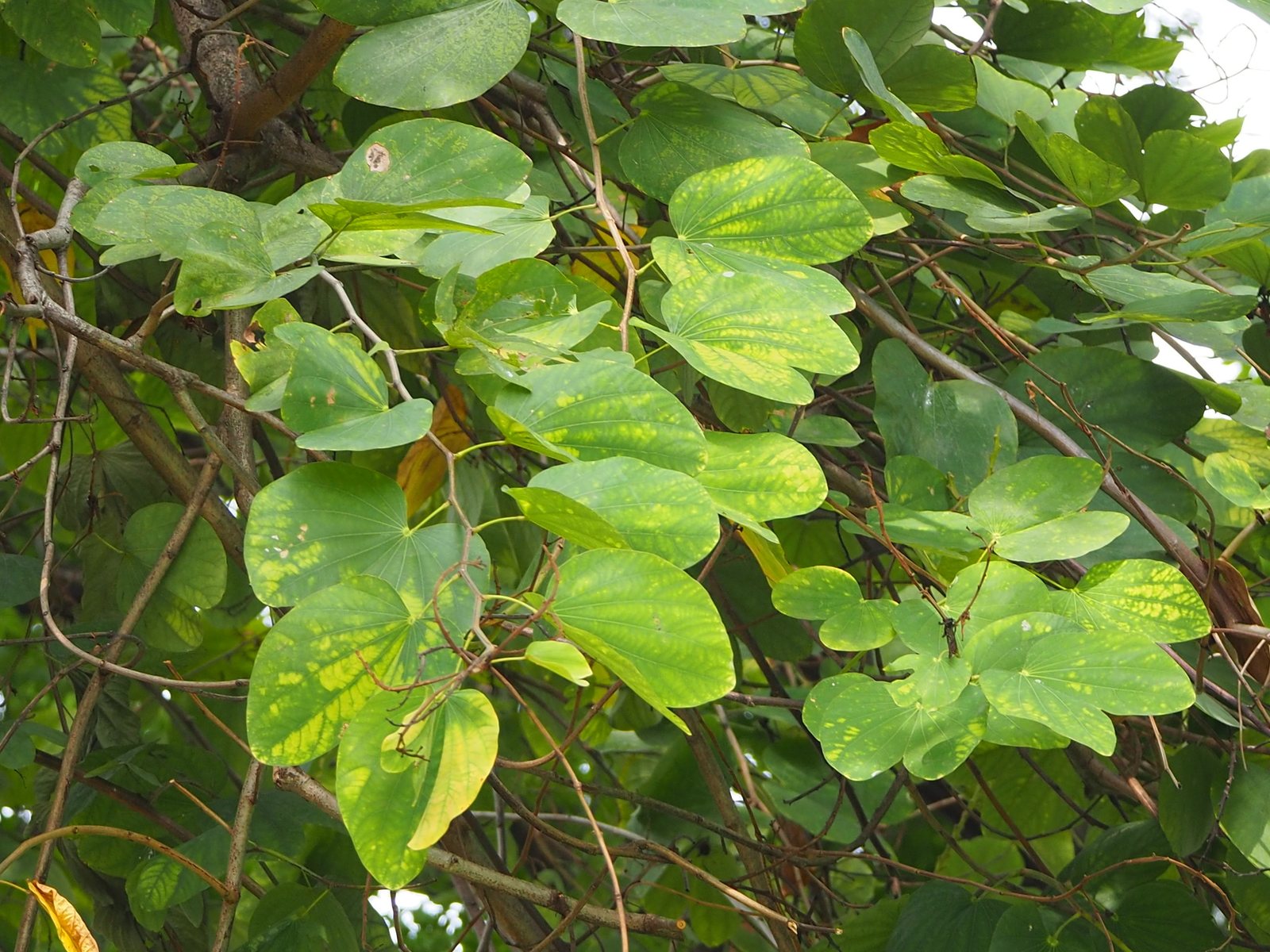
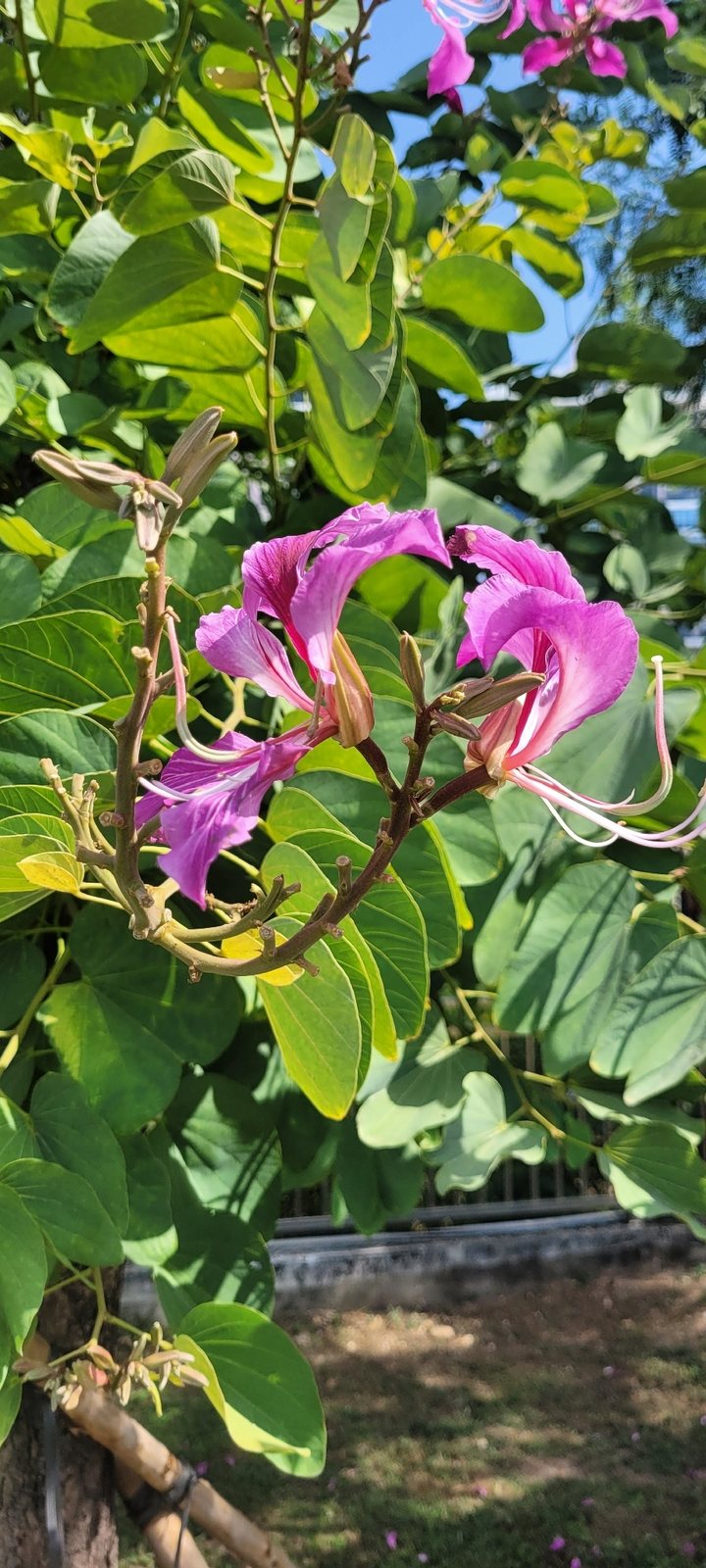
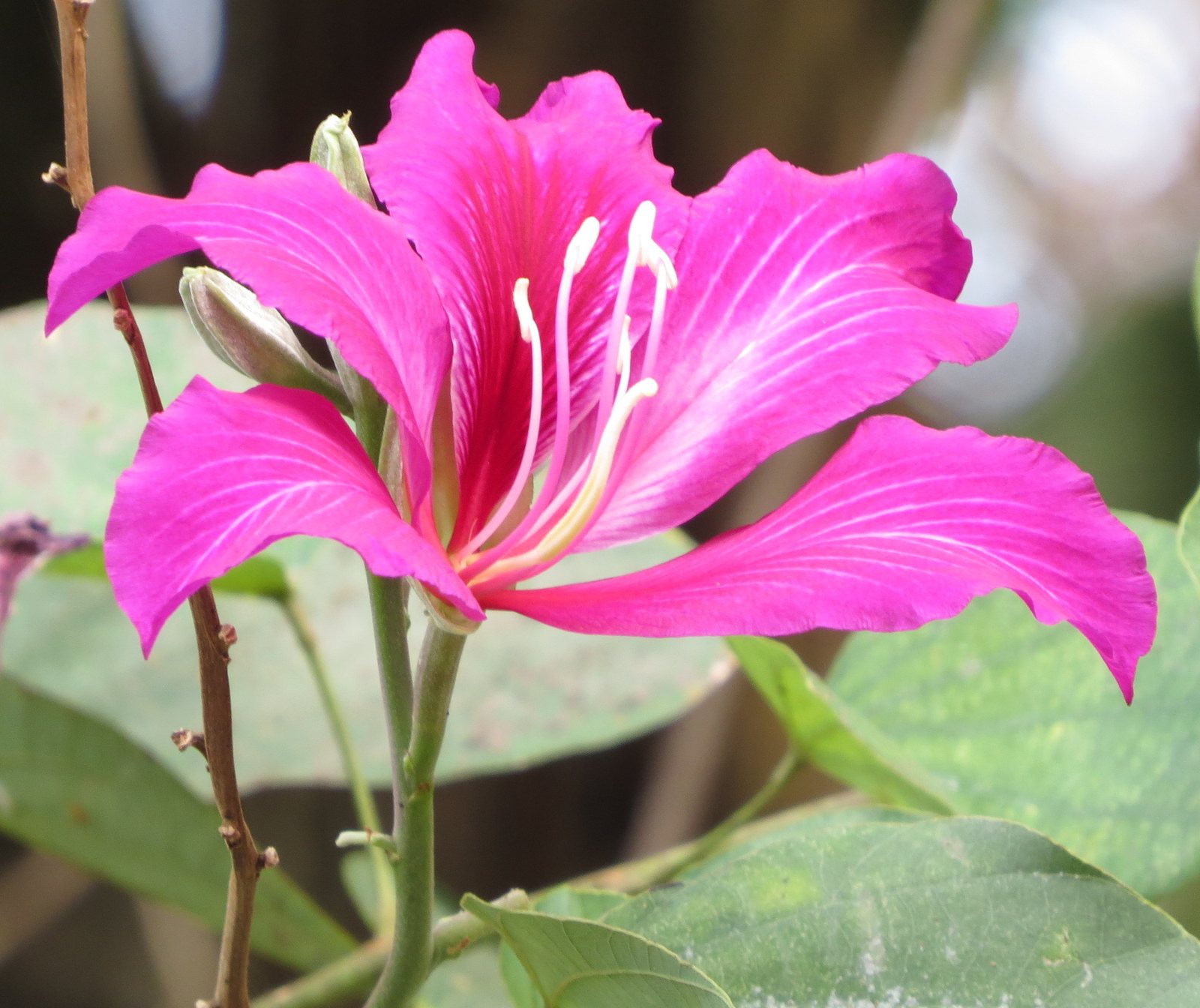
A spreading tropical tree grown for large, fragrant, magenta-purple flowers and distinctive two-lobed leaves. This sterile hybrid flowers through much of the cooler season without producing the long seed pods of many other orchid trees. It suits frost-free and very mild gardens; in the United Kingdom and most of Canada, it needs a large heated conservatory.
At a glance
- Sun
- Full sun for the best flowering; tolerates light partial shade.
- Water
- Water regularly while establishing, then deeply during prolonged dry weather. Established trees tolerate some drought but flower and retain foliage better with occasional irrigation.
- Soil
- Well-drained soil, from sandy loam to clay loam; avoid ground that remains waterlogged.
- Height
- 20-40 ft (6-12 m)
- Spread
- 20-35 ft (6-10.7 m)
- Flowers
- Large magenta-purple flowers, often with pale markings, from late autumn through spring in warm climates; timing varies with local conditions.
- Foliage
- Large, rounded green leaves divided into two lobes like a butterfly's wings. Evergreen in consistently warm conditions, but may briefly lose leaves during cool or dry weather.
- Growth
- Fast in warm conditions.
- Care needed
- Medium
The year at a glance
- Pollinators
- Drought tolerant
- Heat tolerant
- Wildlife
- Low allergen
| J | F | M | A | M | J | J | A | S | O | N | D | |
|---|---|---|---|---|---|---|---|---|---|---|---|---|
| Flowers | ||||||||||||
| Plant |
Northern hemisphere months. In Australia, shift them by six.
- Difficulty
- Hard
- Toughness
- Fairly tough
Will it suit your garden?
Pick your zone, country, light and whether you have pets.
Full sun is 6 or more hours of direct sun a day, part shade 3 to 6 hours, shade under 3.
How it grows
Planting day
7 ft (2 m)
After 1 year
8 ft (2.5 m)
After 2 years
10 ft (3.1 m)
After 3 years
12 ft (3.6 m)
After 5 years
15 ft (4.7 m)
About 13 years to full size.
From a typical nursery size, at an average rate for this kind of plant. A rule of thumb, not a forecast.
Good to know
- Cats and dogs
- Safe
- Growth rate
- Fast
Care
Jobs through the year
- WaterApr–May, Sep–Oct, every 14 days
- Check established trees and water when dry; trees in their first two years and pots need more frequent checks.
- WaterJun–Aug, every 14 days
- Soak the established root zone during prolonged drought; check containers much more often.
- WaterJan–Mar, Nov–Dec, every 14 days
- Check sheltered containers and water when surface mix dries; do not keep roots saturated.
- FeedApr–May
- Feed lightly if growth is weak; avoid excessive nitrogen.
- MulchMay–Jun
- Renew 5–8 cm of organic mulch over roots, keeping the trunk clear.
- PruneMay
- After flowering, remove weak or crossing branches and train a strong framework; never top.
- ProtectJan–May, Sep–Dec
- Cannot overwinter outdoors locally; requires a large movable container and spacious bright frost-free shelter.
- Plant where the mature canopy has room to spread, sheltered from strong winds and frost pockets.
- Water deeply through the first two growing seasons, allowing the soil surface to dry between waterings.
- Spread 2-3 in (5-8 cm) of mulch over the root area, keeping it clear of the trunk.
- Feed lightly in spring if growth is weak; avoid heavy nitrogen feeding that encourages leafy growth at the expense of flowers.
- Protect young trees during brief frosts; foliage and young shoots can be damaged near freezing.
Pruning. After the main flowering period, remove dead, crossing or poorly attached branches and shorten overly long shoots selectively. Train young trees to a strong framework with well-spaced branches; avoid topping mature trees.
Through the year
- Spring
- Plant once frost risk has passed and the soil is warming.
- Late spring
- After flowering, prune lightly and check young trees for competing leaders or weak branch unions.
- Early summer
- Renew mulch and check that irrigation wets the expanding root area.
- Summer
- Water during prolonged drought, especially while the tree is young.
- Autumn
- Avoid heavy feeding and pruning as the main flowering season approaches.
- Winter
- Protect young trees from forecast frost and reduce watering when growth slows.
In the garden
- Use as a specimen tree in a sheltered lawn, where its broad canopy and winter flowers can be seen clearly.
- Place beside a patio for light shade, allowing space for spreading branches and fallen flowers.
- Combine with evergreen shrubs and bold-leaved subtropical plants for a layered, warm-climate garden.
- Train a young tree over a generous courtyard, keeping the main branches above paths and seating.
Garden styles it suits: Tropical, Modern tropical, Luxury resort, Modern courtyard, Winter interest and Chinese scholar garden.
Plant it with: Clivia, Lilyturf, Bird of paradise, Agapanthus and Cast-iron plant.
Wildlife: Flowers provide nectar and pollen for visiting insects and, where present, nectar-feeding birds. Its broad canopy also offers shelter for small birds.
Problems to watch for
- Frost damage: plant in a warm, sheltered position and cover small trees during brief cold spells; wait until spring growth begins before removing damaged wood.
- Weak branch unions and wind breakage: train a sound framework while young and have large defective limbs assessed by a qualified arborist.
- Scale insects or aphids: inspect shoots and leaf undersides; treat small infestations with horticultural oil or insecticidal soap according to the label.
- Root decline in wet soil: improve drainage before planting and avoid frequent watering of already damp ground.
Safety
Not known to be toxic to people, cats, dogs or horses, but species-specific safety information is limited. No particular part is established as poisonous; do not treat the leaves or flowers as food or livestock fodder.
Easily confused with
Purple orchid tree (Bauhinia purpurea)
Usually flowers mainly in autumn, with narrower, more separated petals, and produces long, flat seed pods.
Orchid tree (Bauhinia variegata)
Usually flowers in late winter or spring, often on nearly bare branches; flowers are commonly paler pink, purple or white, and are followed by long seed pods.
The name
Bauhinia honours the botanist brothers Johann and Gaspard Bauhin, while blakeana honours Sir Henry Blake, a former governor of Hong Kong, where the original tree was found.
Propagation. Normally propagated by grafting or air layering; cuttings can be difficult to root. This sterile hybrid does not normally produce viable seed, so seed sold under its name is unlikely to be true Hong Kong orchid tree.
Checked against open data
- Accepted botanical name
- Bauhinia blakeana
Sources: GBIF (CC BY 4.0). The care and design notes are LandscapeGPT's own.
See it in your own yard.
Upload a photo of your yard and see it redesigned with plants that suit your climate, each checked against your zone.