Indian pink
Spigelia marilandica. Family Loganiaceae. Perennial.
Also called Woodland pinkroot, Pinkroot.
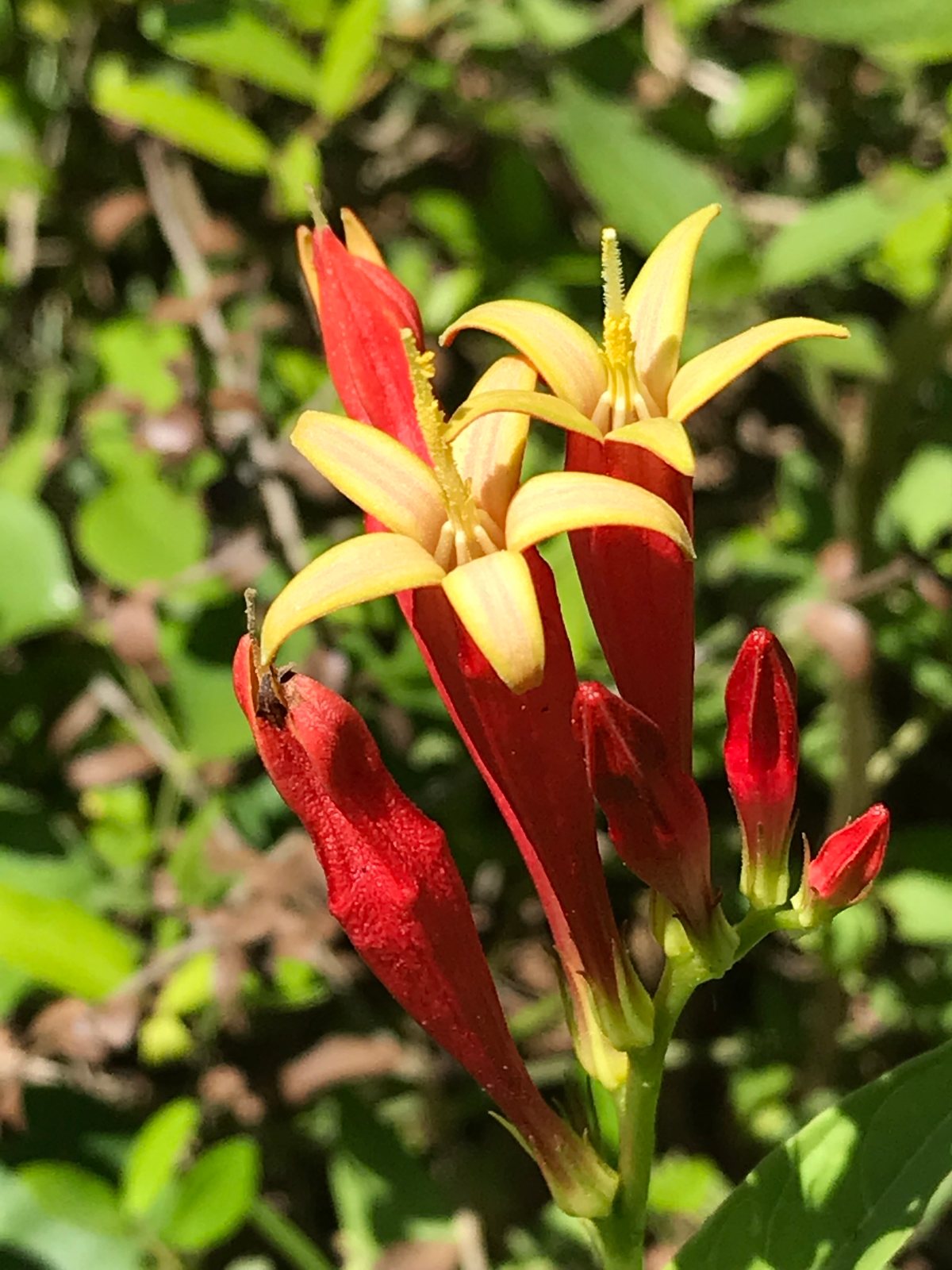
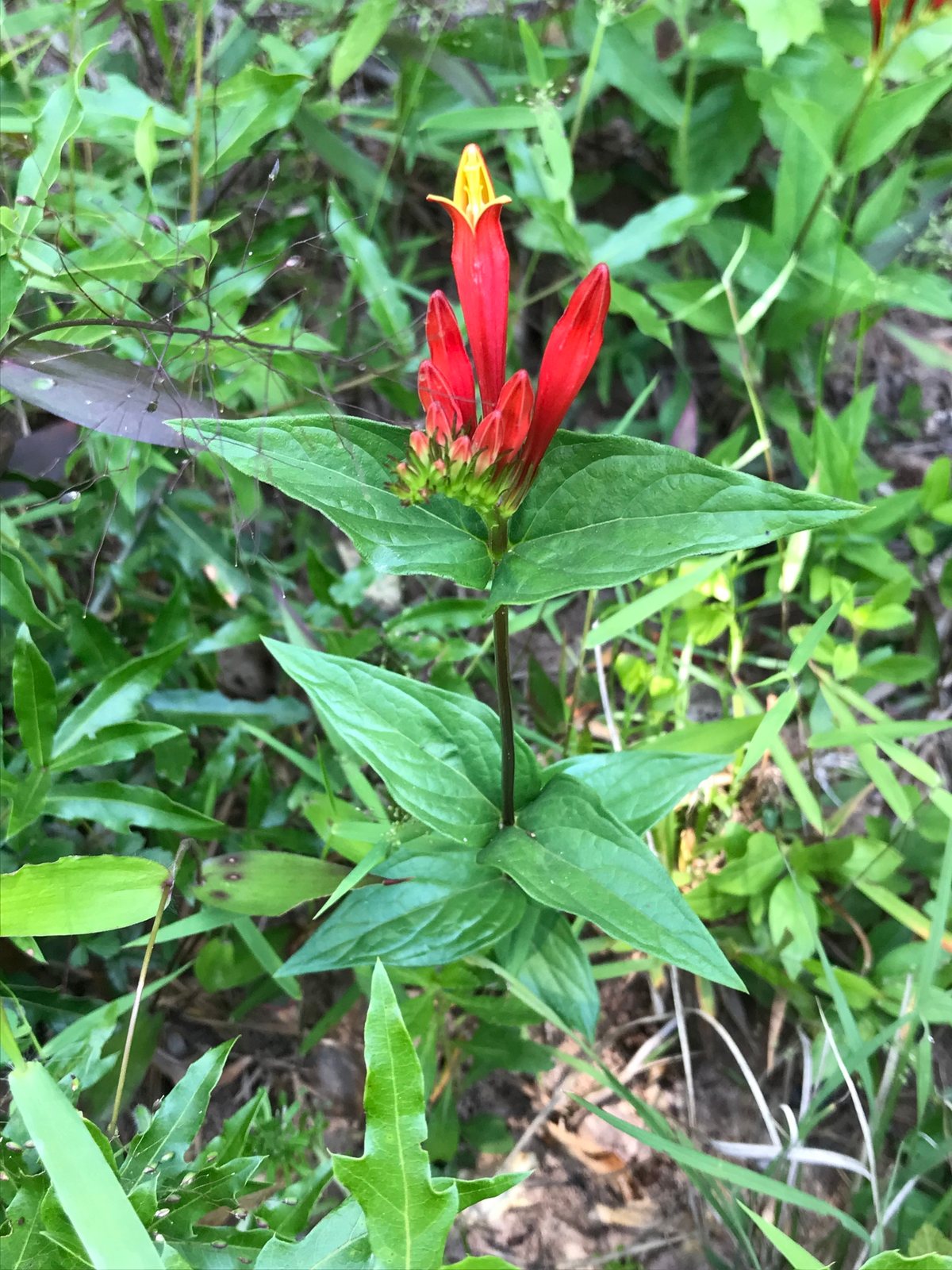
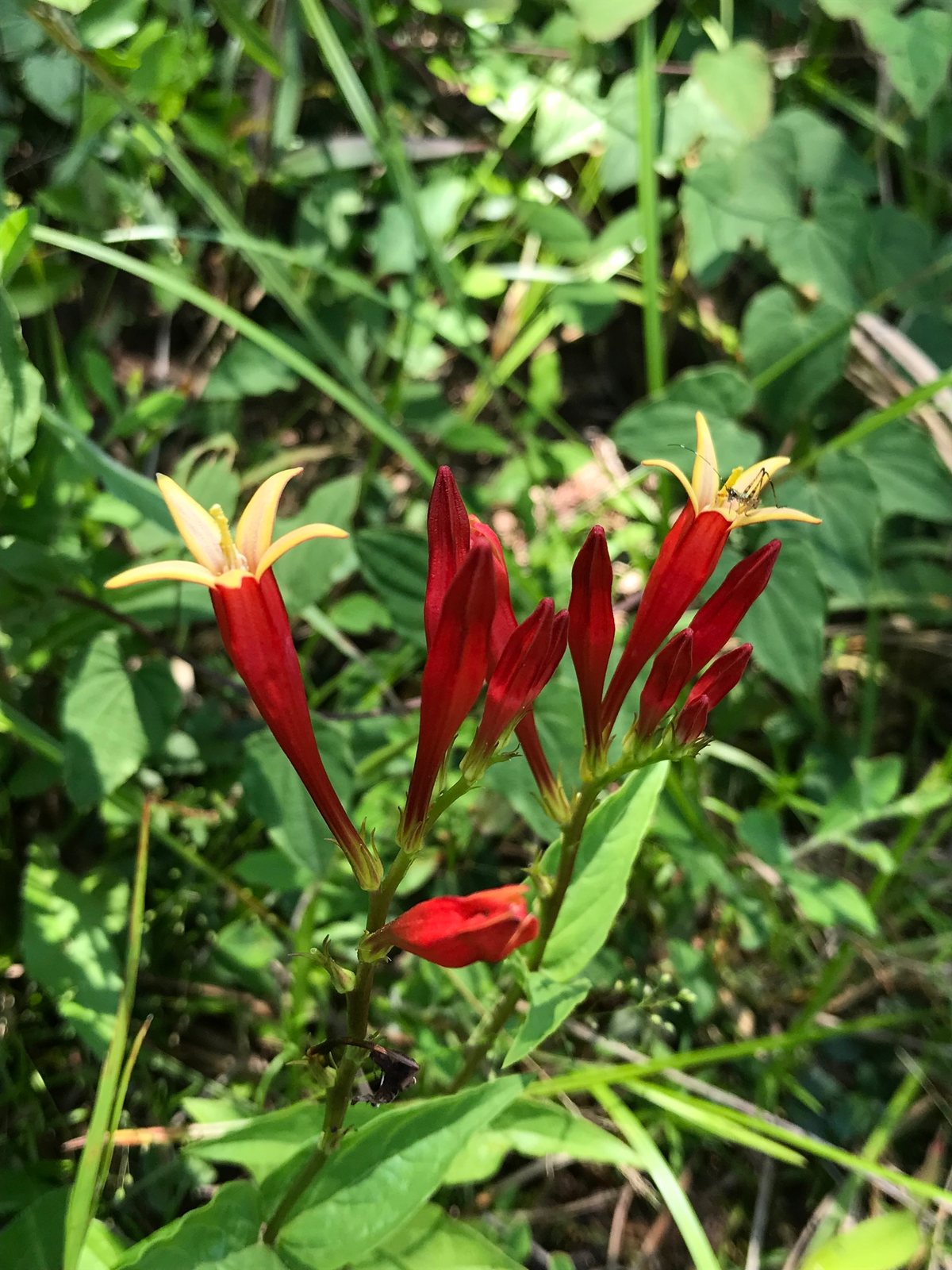
Indian pink is a clump-forming perennial native to the southeastern and south-central United States. Gardeners grow it for upright clusters of red tubular flowers with yellow, star-shaped tips, bringing strong colour to lightly shaded borders and woodland edges.
At a glance
- Sun
- Partial shade, ideally with morning sun. Tolerates deeper shade with fewer flowers, or more sun where the soil stays moist.
- Water
- Keep evenly moist during establishment and dry spells; established plants tolerate brief dry periods but flower best without prolonged drought.
- Soil
- Humus-rich, moist but well-drained soil; slightly acidic to neutral soil is ideal. Avoid waterlogged ground.
- Height
- 1-2 ft (0.3-0.6 m)
- Spread
- 1-2 ft (0.3-0.6 m)
- Flowers
- Late spring to early summer; scarlet-red tubes open into yellow, five-pointed stars. A smaller repeat flush is possible.
- Foliage
- Opposite pairs of pointed, oval, deep-green leaves on upright stems; dies back in winter.
- Growth
- Slow to moderate; young plants may take several seasons to form substantial clumps.
- Care needed
- Low
The year at a glance
- Pollinators
- Deer resistant
- Heat tolerant
- Low allergen
| J | F | M | A | M | J | J | A | S | O | N | D | |
|---|---|---|---|---|---|---|---|---|---|---|---|---|
| Flowers | ||||||||||||
| Plant |
Northern hemisphere months. In Australia, shift them by six.
- Difficulty
- Easy
- Toughness
- Fairly tough
Will it suit your garden?
Pick your zone, country, light and whether you have pets.
Full sun is 6 or more hours of direct sun a day, part shade 3 to 6 hours, shade under 3.
How it grows
Planting day
1 ft (0.3 m)
After 1 year
1.1 ft (0.34 m)
After 2 years
1.2 ft (0.38 m)
After 3 years
1.4 ft (0.42 m)
After 5 years
1.5 ft (0.45 m)
full size
About 4 years to full size.
From a typical nursery size, at an average rate for this kind of plant. A rule of thumb, not a forecast.
Good to know
- Cats and dogs
- Toxic
- Native to
- the US
- Growth rate
- Slow
Care
Jobs through the year
- WaterApr–May, Sep–Oct, every 14 days
- Water established clumps if soil is drying; newly planted clumps need more frequent watering.
- WaterJun–Aug, every 7 days
- Water deeply during dry weather to keep soil evenly moist, not saturated.
- PruneFeb–Mar
- Cut dead stems to ground level before new shoots develop.
- MulchMar–Apr
- Top-dress with thin compost and leaf mould, keeping the crown clear.
- DeadheadJun–Jul, every 14 days
- Remove faded flower clusters to encourage a possible repeat flush.
- ProtectOct–Nov
- Mark dormant crowns to prevent accidental digging and leave light leaf cover around them.
- Water deeply after planting and during prolonged dry weather, rather than giving frequent light sprinkles.
- Apply a thin layer of compost in spring; avoid heavy feeding.
- Mulch with leaf mould or shredded leaves to conserve moisture, keeping mulch clear of the crown.
- Leave established clumps undisturbed unless they need dividing or moving.
- Mark the planting spot before winter so dormant crowns are not accidentally dug up.
Pruning. Remove spent flower clusters after the main display to encourage possible repeat flowering. Cut dead stems to ground level in late winter or early spring before new shoots develop.
Through the year
- Early spring
- Remove dead stems and top-dress around the crown with compost.
- Spring
- Plant or carefully divide clumps as growth starts, then water thoroughly.
- Late spring
- Check soil moisture as flower stems develop and renew the leaf mulch if needed.
- Early summer
- Remove faded flower clusters unless you want seed.
- Summer
- Water during extended dry spells, especially in sunnier positions.
- Autumn
- Mark dormant clumps and leave a light covering of fallen leaves around them.
In the garden
- Plant small groups along a woodland edge where the red-and-yellow flowers stand out against green foliage.
- Use near the front of a partially shaded border with ferns and sedges for contrasting leaf shapes.
- Combine with foamflower and woodland phlox for a succession of spring and early-summer flowers.
- Place beside a shaded path where the small, detailed flowers can be seen at close range.
Garden styles it suits: Woodland, Wildlife garden, Pollinator garden, Cottage garden, Southern and Traditional.
Plant it with: Foamflower, Woodland phlox, Christmas fern, Solomon's seal, Wild ginger and Pennsylvania sedge.
Wildlife: The tubular flowers attract hummingbirds in North America and may be visited by butterflies. Hummingbirds do not occur naturally in the United Kingdom or Australia.
Problems to watch for
- Slugs and snails may damage emerging shoots: inspect at dusk, remove pests and use an approved iron-phosphate bait if needed.
- Yellowing, wilting or crown rot in wet soil: improve drainage or move the plant to a raised position; do not keep the crown saturated.
- Poor flowering in deep shade: move to brighter filtered light or a position with morning sun.
- Scorched leaves or early dormancy during drought: water deeply and mulch; provide afternoon shade in hot climates.
Safety
All parts are poisonous if eaten, particularly the roots. Keep away from children and prevent cats, dogs and horses from eating it; species-specific veterinary information is limited, but ingestion should be treated as potentially serious. Seek medical or veterinary advice promptly after suspected ingestion.
Easily confused with
West Indian pinkroot (Spigelia anthelmia)
An annual with small, pale pink to whitish flowers, rather than the conspicuous red tubes and yellow star-shaped tips of Indian pink.
The name
Spigelia honours the botanist and anatomist Adriaan van den Spiegel, while marilandica means 'of Maryland'.
Propagation. Divide established clumps carefully in early spring, keeping substantial roots on each division; plants can be slow to recover. Seed is best sown fresh, and germination can be slow and irregular, sometimes requiring a period of winter cold.
Checked against open data
- Accepted botanical name
- Spigelia marilandica
- In the US and Canada
- Native in the lower 48 states.
- Native range
- Alabama, Arkansas, Florida, Georgia, Illinois, Indiana, Kentucky, Louisiana, Mississippi, Missouri, North Carolina and Oklahoma.
Sources: GBIF (CC BY 4.0), USDA PLANTS and Trefle (CC BY 4.0). The care and design notes are LandscapeGPT's own.
See it in your own yard.
Upload a photo of your yard and see it redesigned with plants that suit your climate, each checked against your zone.