Japanese banana
Musa basjoo. Family Musaceae. Perennial.
Also called Hardy banana, Japanese fibre banana.
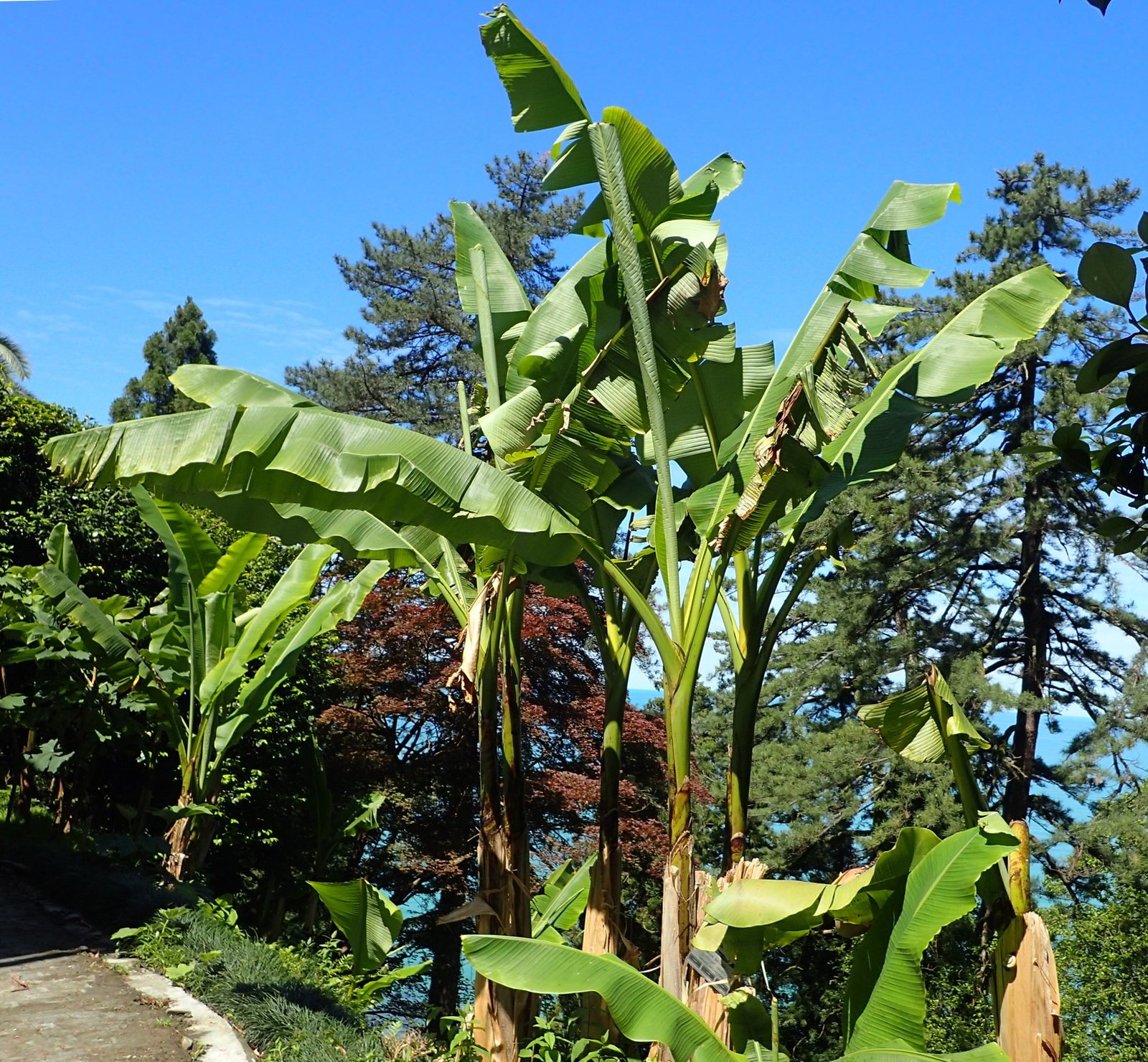
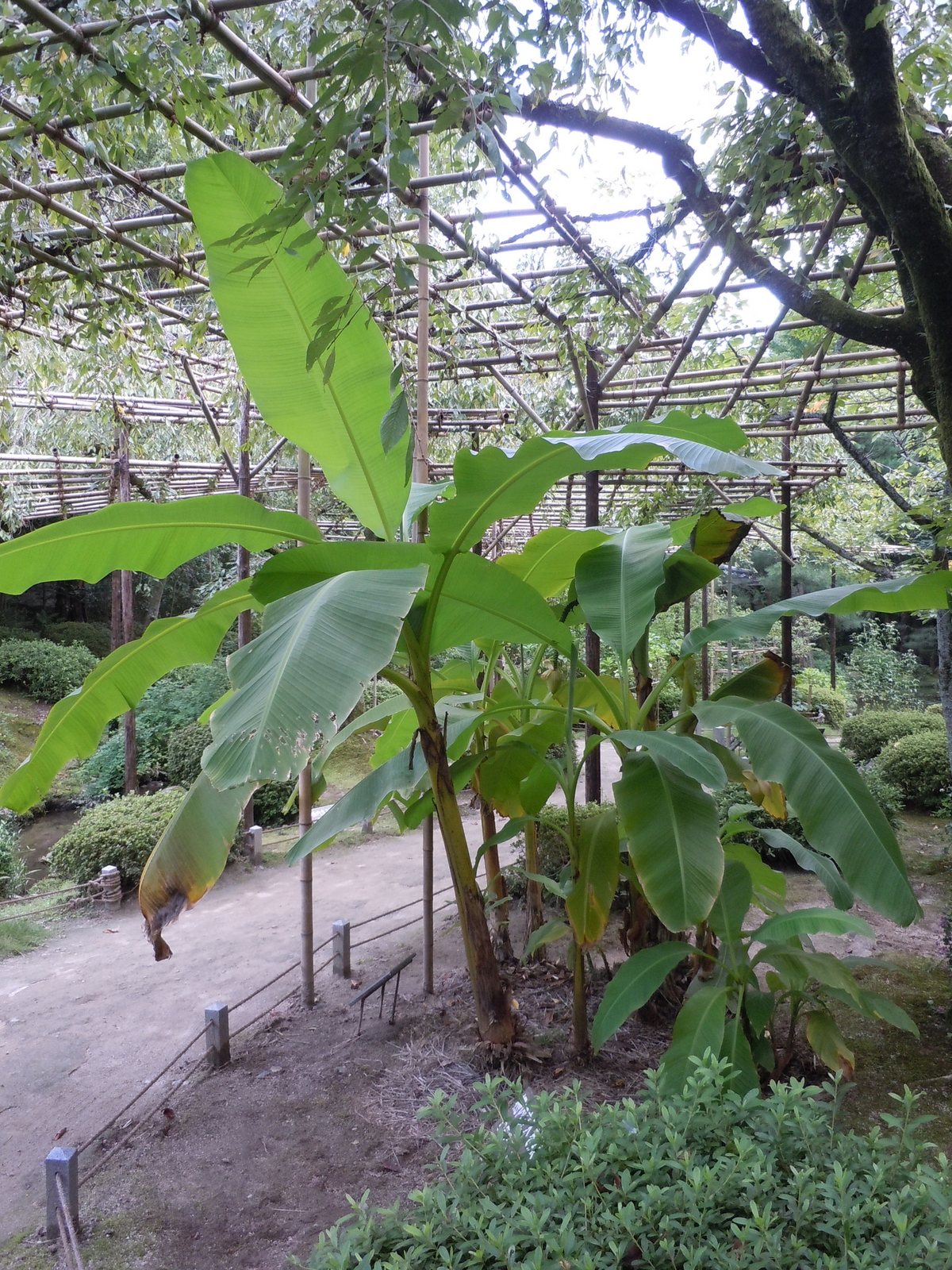
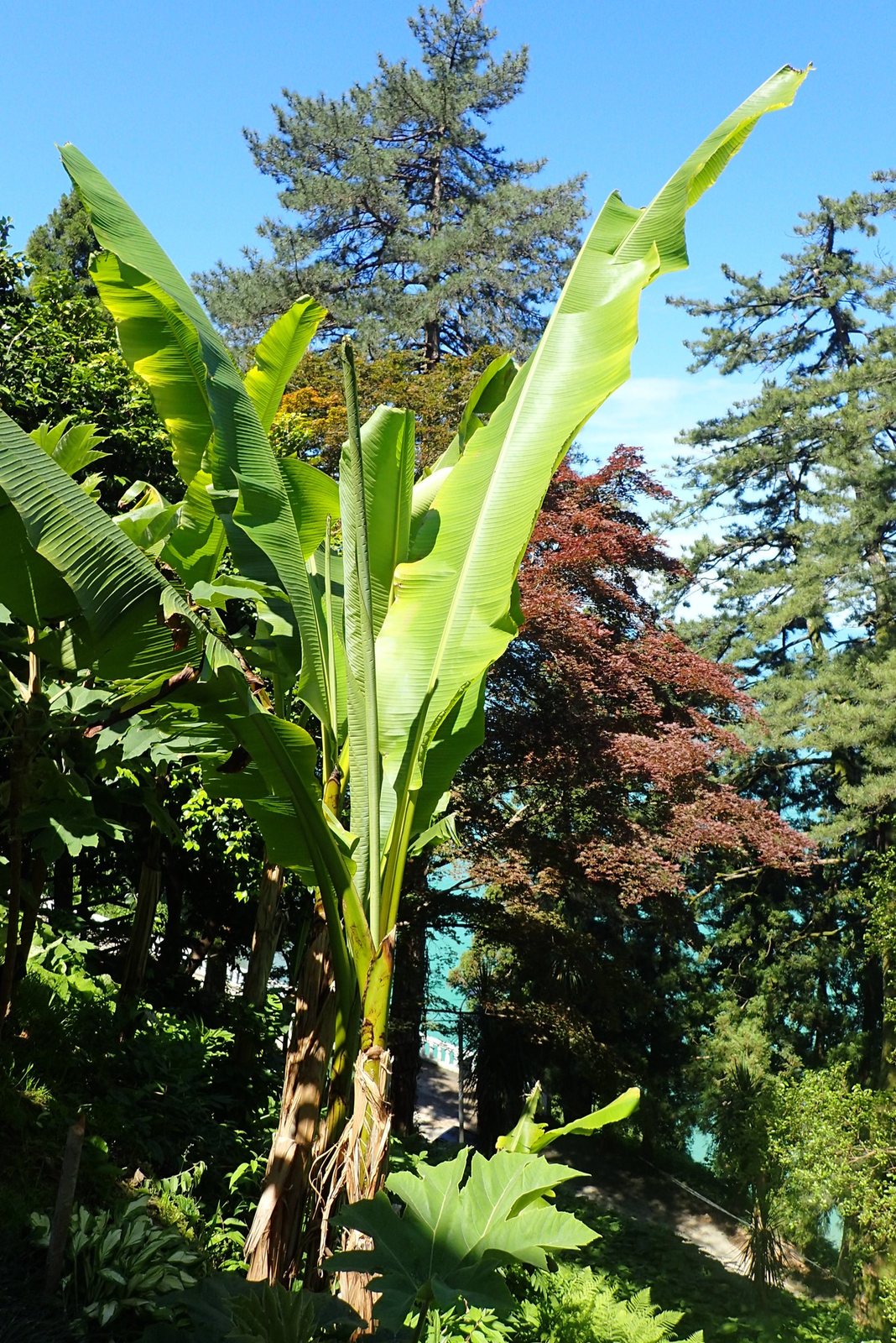
Japanese banana (Musa basjoo) is a large, clump-forming perennial grown for its broad leaves and tropical appearance, not for edible bananas. Its underground rhizomes can survive cold winters with protection, but frost kills the leaves and may kill the leafy trunks back to ground level. Give it a sheltered position, generous watering and room for new shoots.
At a glance
- Sun
- Full sun to partial shade; shelter from strong winds, which shred the leaves. Some afternoon shade helps in very hot climates.
- Water
- Keep evenly moist during active growth, watering deeply during dry weather. Reduce watering when dormant and avoid waterlogged soil in winter.
- Soil
- Deep, fertile, moisture-retentive soil with good drainage; improve poor soil with compost before planting.
- Height
- 6-15 ft (1.8-4.6 m), depending on summer warmth and how much stem survives winter
- Spread
- 6-10 ft (1.8-3 m) as an established clump; wider if suckers are left unchecked
- Flowers
- Mature stems may produce hanging flowers with cream-yellow blooms beneath reddish-brown bracts in summer. Flowering is uncommon where stems are killed back each winter; any small fruits are seedy and not useful for eating.
- Foliage
- Large, bright green, paddle-shaped leaves, often 4-6 ft (1.2-1.8 m) long. Wind commonly splits them along the veins.
- Growth
- Fast in warm weather with ample water and nutrients
- Care needed
- Medium
The year at a glance
- Heat tolerant
- Wildlife
- Low allergen
| J | F | M | A | M | J | J | A | S | O | N | D | |
|---|---|---|---|---|---|---|---|---|---|---|---|---|
| Flowers | ||||||||||||
| Fruit | ||||||||||||
| Plant |
Northern hemisphere months. In Australia, shift them by six.
- Difficulty
- Moderate
- Toughness
- Fairly tough
Will it suit your garden?
Pick your zone, country, light and whether you have pets.
Full sun is 6 or more hours of direct sun a day, part shade 3 to 6 hours, shade under 3.
How it grows
Planting day
1.3 ft (0.38 m)
After 1 year
6 ft (1.8 m)
After 2 years
10 ft (3.2 m)
full size
About 2 years to full size.
From a typical nursery size, at an average rate for this kind of plant. A rule of thumb, not a forecast.
Good to know
- Cats and dogs
- Safe
- In the garden
- Spreads vigorously: plan to contain it.
- Growth rate
- Fast
Care
Jobs through the year
- WaterMay, Sep, every 7 days
- Water established clumps deeply if the surface is drying; young plants need more frequent checks.
- WaterJun–Aug, every 3 days
- Keep soil evenly moist, adjusting for rain; large clumps may need water more often in heat.
- FeedMay–Aug, every 28 days
- Apply balanced fertilizer at the label rate during active growth.
- MulchMay
- Spread compost or well-rotted manure around the clump, clear of stem bases.
- DivideMay–Jun
- Divide established clumps or remove unwanted suckers as strong growth begins.
- PruneApr–May
- Cut dead or rotten stem tissue back to firm growth after severe frosts pass.
- PruneOct–Nov
- Remove frost-collapsed leaves but retain firm stems if protecting them.
- ProtectOct–Nov
- After frost, insulate roots deeply with dry mulch; protect standing stems to improve the chance of flowering.
- ProtectJan–Mar, Dec, every 14 days
- Check winter insulation stays secure and drains freely; keep containers frost-free.
- ProtectApr–May
- Remove insulation gradually as severe frost risk passes, retaining cover for late frosts.
- Water deeply whenever the upper soil begins to dry during warm weather; large clumps use substantial water.
- Apply a balanced fertiliser in spring and feed through summer according to the product label; stop as growth slows in autumn.
- Mulch with compost or well-rotted manure to conserve moisture, keeping it away from the bases of the stems.
- In cold climates, cover the root area with a deep, loose layer of dry mulch after frost; keep winter drainage clear.
- Remove unwanted suckers in spring to limit the clump, and plant away from exposed, windy corners.
- Protect containers from freezing: roots in pots are less cold-hardy than roots in the ground.
Pruning. Remove broken or fully dead leaves during the growing season, cutting the leaf stalk close to the trunk without gouging it. After frost, remove collapsed foliage; leave firm stems if protecting them for winter, and cut dead or rotten stem tissue back to sound growth in spring.
Through the year
- Spring
- Gradually remove winter protection as severe frost risk passes, keeping material handy for late cold spells.
- Late spring
- Plant after frost risk has passed and the soil has warmed; divide established clumps as active growth begins.
- Late spring
- Apply balanced fertiliser and renew the moisture-conserving mulch.
- Summer
- Water deeply during dry spells, feed regularly and check leaf undersides for mites.
- Autumn
- Stop feeding as growth slows and prepare winter protection before hard frosts.
- Late autumn
- After frost blackens the leaves, remove collapsed foliage and insulate the root area; protect standing stems if you want to retain height.
- Winter
- Check that protection remains secure and that water is not collecting around the crown.
In the garden
- Use as a tall foliage focal point in a sheltered courtyard, leaving room for its spreading leaves.
- Plant behind cannas and elephant ears for a layered tropical border.
- Set against a plain wall or fence where the large leaves make a strong architectural outline.
- Use beside a pond, above the waterlogged margin, for bold foliage reflected in the water.
Garden styles it suits: Modern tropical, Tropical, Architectural minimal, Modern courtyard, Luxury resort and Green on green.
Plant it with: Cannas, Elephant ears, Japanese aralia, Hostas, Japanese forest grass and Crocosmia.
Wildlife: Offers cover for small garden animals, but has limited value as a food plant for native insects in these regions. Flowers may attract insects where the climate allows it to bloom.
Problems to watch for
- Wind-torn leaves: choose a sheltered site; existing splits will not heal, but healthy plants continue producing new leaves.
- Winter crown or rhizome rot: improve drainage, avoid wet winter wrapping and remove soft, rotten tissue in spring.
- Spider mites, especially under cover: check for fine webbing and stippled leaves, rinse leaf undersides and use an insecticidal soap labelled for the plant if needed.
- Brown leaf edges or stalled summer growth: check soil moisture first, water deeply and feed only while the plant is actively growing.
Safety
Not known to be toxic to cats, dogs, horses or people. No parts are recognised as poisonous, but the small, seedy fruits are not a useful eating banana, and chewing plant material can cause digestive upset.
Easily confused with
Abyssinian banana (Ensete ventricosum)
Usually forms one stout trunk rather than a freely suckering clump and is much less cold-hardy. The commonly grown 'Maurelii' has conspicuous burgundy-red foliage.
Darjeeling banana (Musa sikkimensis)
Often has reddish leaf undersides and maroon markings, especially when young; Japanese banana usually has plain green leaves. Colour varies, so an unmarked plant may need a reliable nursery label for identification.
The name
The common name reflects its long cultivation in Japan, and basjoo comes from bashō, the Japanese name for a banana plant.
Propagation. Divide suckers in late spring or early summer when growth is active. Choose a shoot with its own roots, cut it away with a portion of rhizome, and keep it warm and evenly moist while it establishes.
Checked against open data
- Accepted botanical name
- Musa basjoo
- Native range
- China South-Central and China Southeast.
Sources: GBIF (CC BY 4.0) and Trefle (CC BY 4.0). The care and design notes are LandscapeGPT's own.
See it in your own yard.
Upload a photo of your yard and see it redesigned with plants that suit your climate, each checked against your zone.