Kentucky coffeetree
Gymnocladus dioicus. Family Fabaceae. Tree.
Also called Kentucky coffee tree, American coffee tree.
A large deciduous tree native to central and eastern North America, Kentucky coffeetree has enormous, finely divided leaves and an open crown of stout branches. Gardeners grow it for light summer shade, yellow autumn foliage and a striking winter outline; it needs room and leafs out noticeably late in spring.
At a glance
- Sun
- Full sun; tolerates light shade but develops a better crown in an open position.
- Water
- Water regularly while establishing; established trees tolerate drought but grow better with occasional deep watering during prolonged dry weather.
- Soil
- Deep, well-drained soil is best. Tolerates clay, alkaline soil and urban conditions, but avoid persistently waterlogged ground.
- Height
- 60-80 ft (18-24 m)
- Spread
- 40-55 ft (12-17 m)
- Flowers
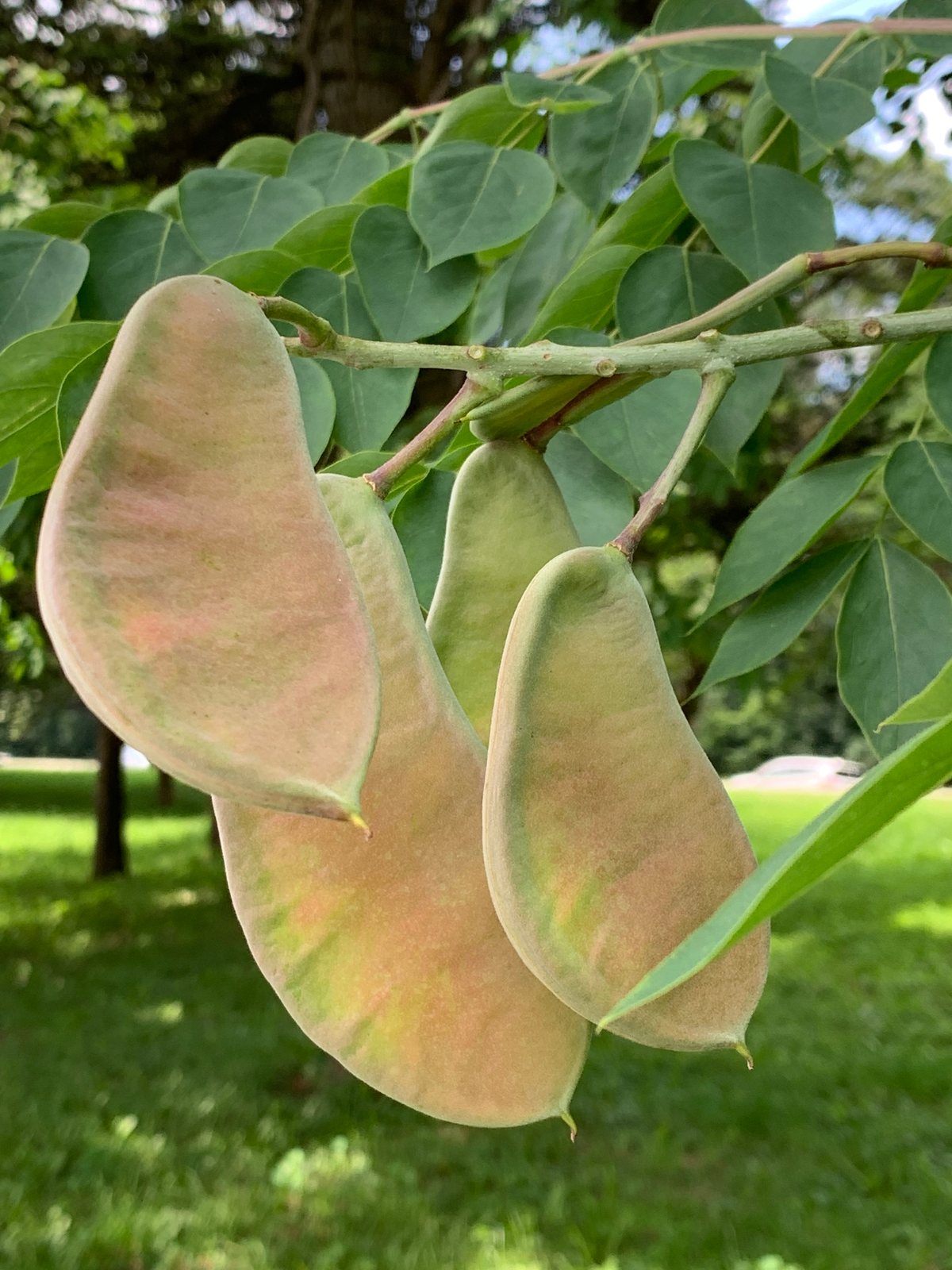
- Small greenish-white flowers in late spring to early summer; male and female flowers are usually on separate trees. Pollinated female trees develop thick brown pods.
- Foliage
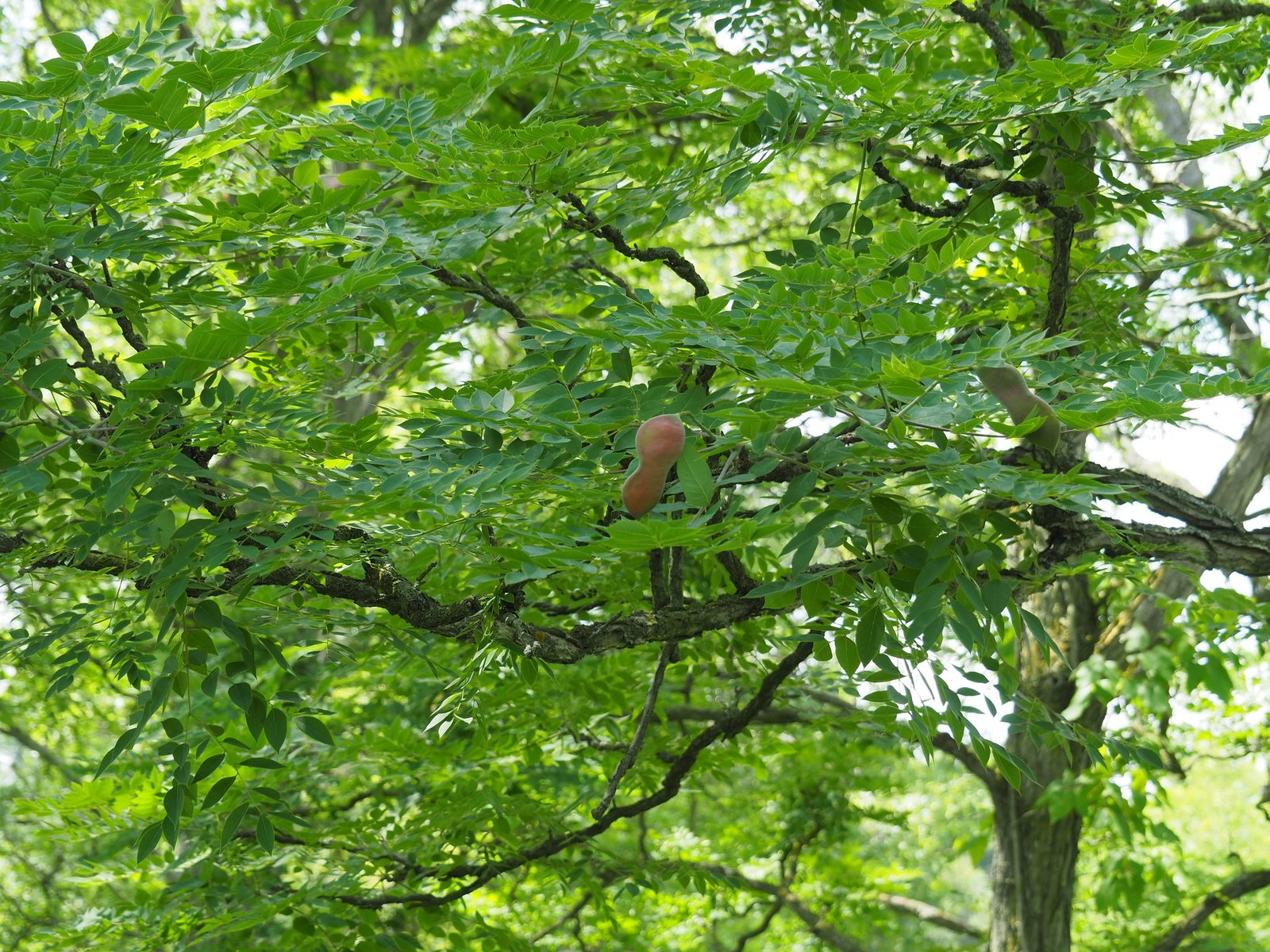
- Very large, twice-divided leaves with many blue-green leaflets; turns yellow in autumn. Leaves emerge late and often fall relatively early.
- Growth
- Slow to moderate, often faster once established in deep soil with adequate moisture.
- Care needed
- Low
The year at a glance
- Pollinators
- Deer resistant
- Drought tolerant
- Cold hardy
- Disease resistant
- Wildlife
- Low allergen
| J | F | M | A | M | J | J | A | S | O | N | D | |
|---|---|---|---|---|---|---|---|---|---|---|---|---|
| Flowers | ||||||||||||
| Fruit | ||||||||||||
| Plant |
Northern hemisphere months. In Australia, shift them by six.
- Difficulty
- Easy
- Toughness
- Very tough
Will it suit your garden?
Pick your zone, country, light and whether you have pets.
Full sun is 6 or more hours of direct sun a day, part shade 3 to 6 hours, shade under 3.
How it grows
Planting day
8 ft (2.5 m)
After 1 year
11 ft (3.4 m)
After 2 years
14 ft (4.4 m)
After 3 years
17 ft (5.3 m)
After 5 years
23 ft (7.1 m)
About 20 years to full size.
From a typical nursery size, at an average rate for this kind of plant. A rule of thumb, not a forecast.
Good to know
- Cats and dogs
- Toxic
- Native to
- the US and Canada
- Growth rate
- Moderate
Care
Jobs through the year
- WaterApr–May, Sep–Oct, every 21 days
- Water established trees only during prolonged dry spells; water young trees regularly for two to three years.
- WaterJun–Aug, every 14 days
- Deep-water established trees during prolonged drought; young trees need more frequent watering.
- MulchApr–May
- Maintain 5–8 cm of organic mulch over the root area, leaving the trunk clear.
- PruneFeb–Mar
- Train a central leader on young trees and remove damaged or crossing branches; use an arborist for large limbs.
- PruneMay–Sep, every 30 days
- Remove unwanted root suckers at their origin without disturbing surrounding roots.
- ProtectJan–Apr, Sep–Dec, every 7 days
- On pod-bearing female trees, collect fallen pods and seeds to prevent ingestion by children or animals.
- Plant where the mature crown and roots have ample space, away from overhead wires.
- Water deeply through dry spells during the first two or three growing seasons.
- Maintain a 2-3 in (5-8 cm) layer of organic mulch over the root area, keeping it clear of the trunk.
- Do not feed routinely; use a soil test if growth is poor before adding fertilizer.
- Choose a named male selection from a reliable nursery if you want to avoid seedpods.
- Remove unwanted root suckers promptly and collect fallen pods where children or animals could reach them.
Pruning. Prune in late winter while dormant, removing dead, damaged or crossing branches and establishing a strong central leader while the tree is young. Avoid topping; have an arborist assess large limbs.
Through the year
- Late winter
- Prune young trees for sound structure and check established trees for damaged branches.
- Spring
- Plant while dormant or before hot weather, provided the soil is workable; water thoroughly.
- Late spring
- Refresh mulch and check soil moisture. Allow for naturally late leaf emergence before assuming the tree has died.
- Summer
- Deep-water young trees during dry spells and remove unwanted suckers.
- Autumn
- Collect fallen pods where they pose an ingestion hazard; shred healthy leaves for compost or mulch.
- Late autumn
- Plant dormant trees in mild areas with well-drained soil; in very cold regions, wait until spring.
In the garden
- Use as a specimen in a large lawn where its broad crown and winter branches can be seen clearly.
- Plant above meadow-style grasses and perennials for light, shifting summer shade.
- Use a male selection as a shade tree beside a broad terrace, allowing generous rooting space.
- Include in spacious parkland or estate planting with other large deciduous trees.
Garden styles it suits: Architectural minimal, Grand estate, Midwest prairie, Native meadow, Low-maintenance and Winter interest.
Plant it with: Switchgrass, Little bluestem, Wild indigo, Purple coneflower, Wild geranium and Pennsylvania sedge.
Wildlife: Flowers provide nectar and pollen for visiting insects. The crown offers perching and nesting space, but the hard seeds are not a dependable food source for most garden wildlife.
Problems to watch for
- Persistent wet soil can cause root decline: improve drainage before planting or choose a better-drained site.
- Poor branch structure can develop if young trees are neglected: train a central leader and remove competing leaders while cuts are small.
- Root suckers may appear, particularly after root disturbance: cut them at their point of origin and avoid damaging nearby roots.
- Large leaves, stalks and pods can create substantial litter: place away from pools and narrow paths, and choose a male selection where pods would be troublesome.
Safety
Toxic to people, dogs, cats and horses if eaten. Raw seeds and pod pulp are especially hazardous; leaves and other parts should also be treated as poisonous. Ingestion can cause serious poisoning, so keep pods away from children, pets and livestock and seek urgent medical or veterinary advice after suspected ingestion. Do not use the seeds to make a homemade coffee substitute.
Easily confused with
Honey locust (Gleditsia triacanthos)
Has much smaller leaflets, finer twigs and long, relatively thin pods; wild forms often carry large branched thorns. Kentucky coffeetree is thornless, with stout twigs and short, thick pods.
Black locust (Robinia pseudoacacia)
Has once-divided leaves, hanging clusters of white pea-shaped flowers and thin pods; young shoots often have paired spines. Kentucky coffeetree has twice-divided leaves and inconspicuous greenish-white flowers.
Tree of heaven (Ailanthus altissima)
Has once-divided leaves with gland-bearing teeth near each leaflet base, an unpleasant smell when crushed and clusters of winged seeds rather than thick pods.
The name
Gymnocladus means 'naked branch', referring to its bare-looking shoots, dioicus refers to male and female flowers usually occurring on separate trees, and coffeetree recalls the historical use of roasted seeds as a coffee substitute.
Propagation. Raise from seed after carefully nicking or filing the very hard seed coat without damaging the embryo, then soaking before sowing. Keep seeds away from children and animals. Seedlings vary and their sex is not apparent until flowering; named selections are generally propagated by grafting.
Checked against open data
- Accepted botanical name
- Gymnocladus dioicus
- In the US and Canada
- Native in Canada and the lower 48 states.
- Native range
- Alabama, Arkansas, Connecticut, Illinois, Indiana, Kentucky, Maryland, Masachusettes, Michigan, Minnesota, Mississippi and New York.
- Measured
- Soil pH 6 to 8. Average height 2150 cm.
Sources: GBIF (CC BY 4.0), USDA PLANTS and Trefle (CC BY 4.0). The care and design notes are LandscapeGPT's own.
See it in your own yard.
Upload a photo of your yard and see it redesigned with plants that suit your climate, each checked against your zone.