Labrador tea
Rhododendron groenlandicum. Family Ericaceae. Shrub.
Also called Bog Labrador tea, Ledum groenlandicum.
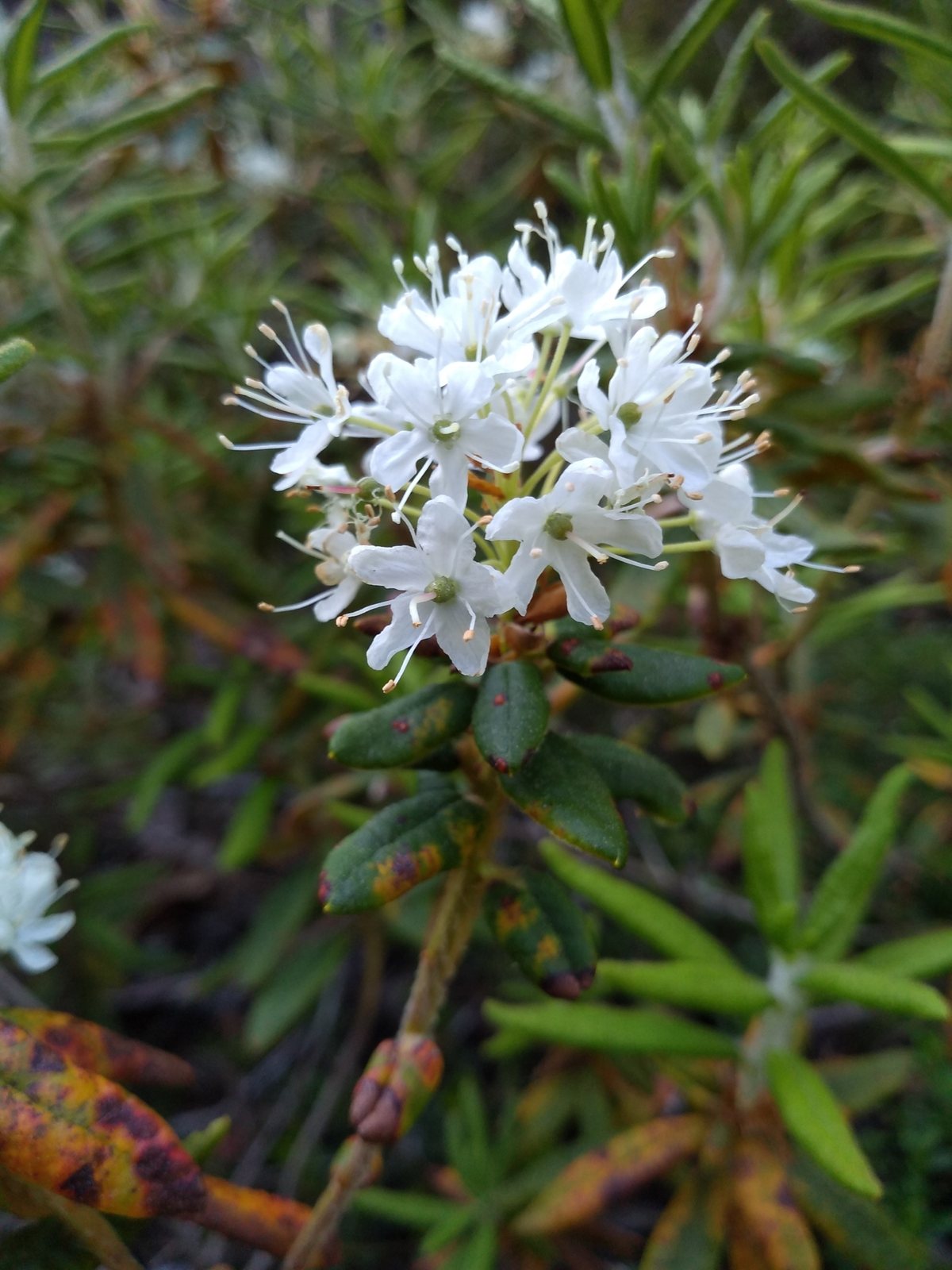
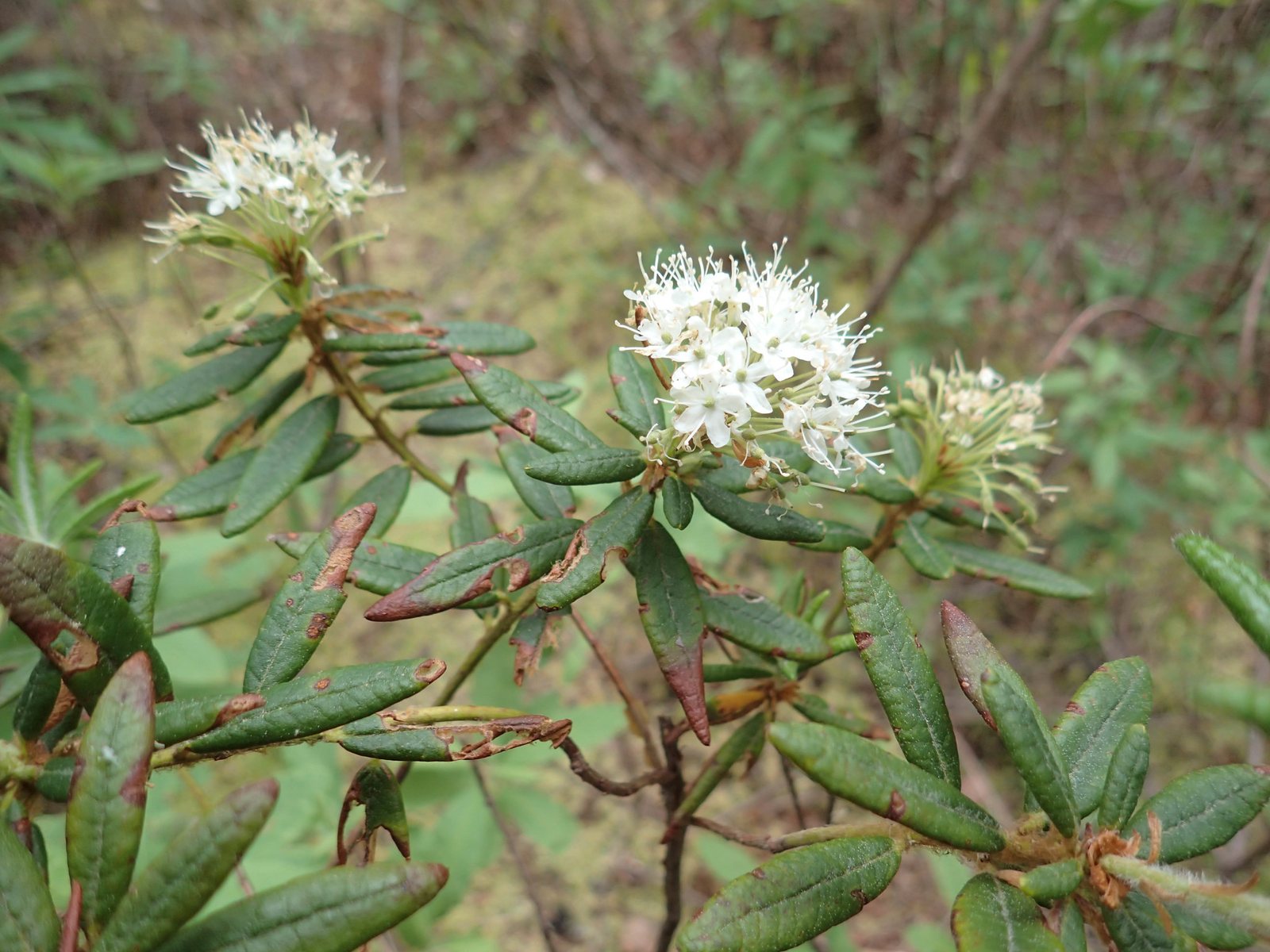
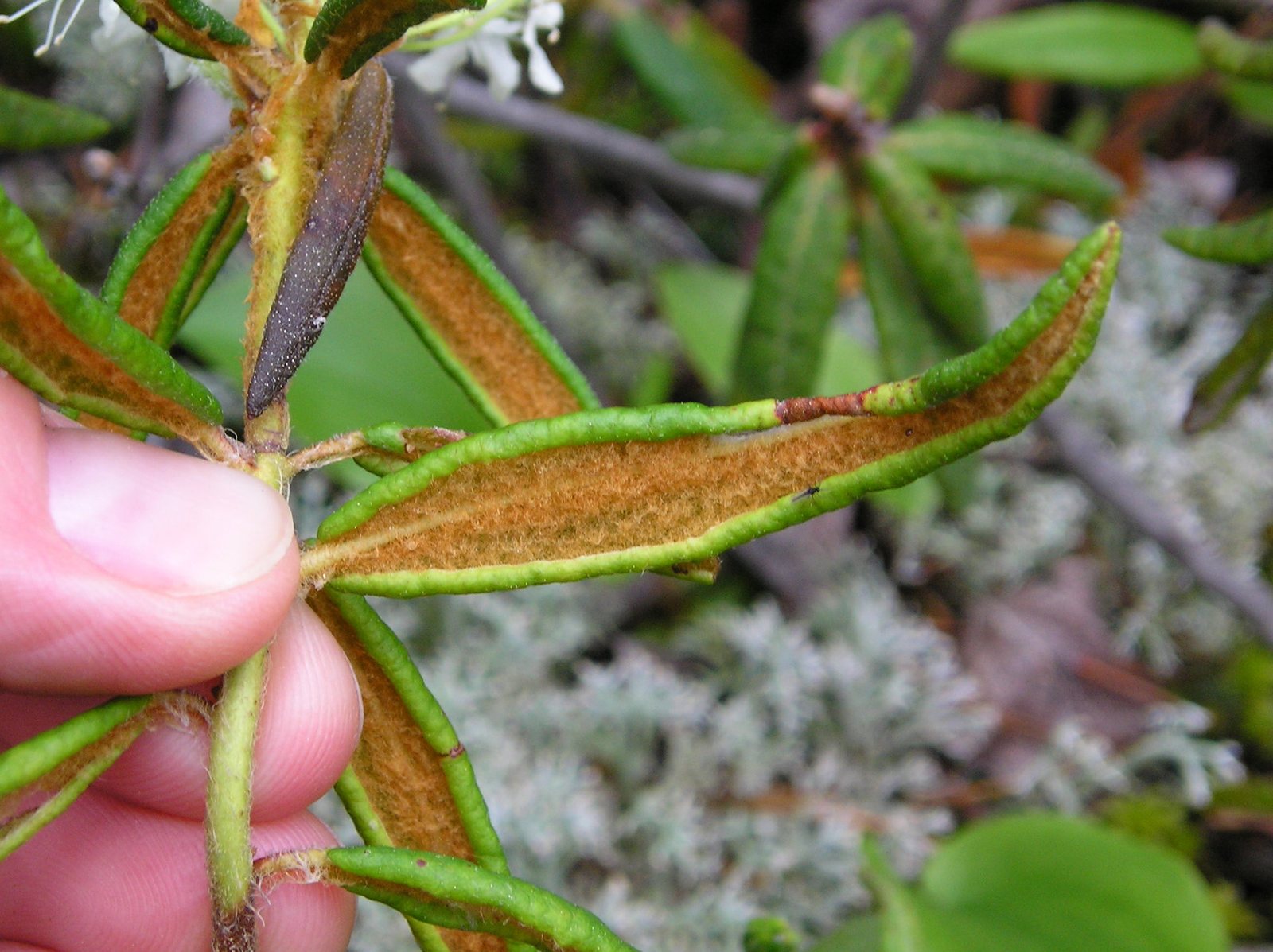
Labrador tea is a small evergreen shrub native to northern North America and Greenland, with white flower clusters and leathery leaves backed by rusty felt. Grow it for its flowers, unusual foliage and value in cool, acidic bog or woodland gardens; it struggles in hot, dry conditions.
At a glance
- Sun
- Full sun to partial shade; light afternoon shade is helpful near the warmer end of its range.
- Water
- Keep consistently moist to wet. Do not allow the shallow roots to dry out.
- Soil
- Strongly acidic, humus-rich soil, ideally around pH 4.0-5.5. Suits boggy ground and moist, peaty woodland soil; unsuitable for chalk or limestone soils.
- Height
- 2-4 ft (0.6-1.2 m)
- Spread
- 2-4 ft (0.6-1.2 m), gradually wider through underground stems
- Flowers
- Late spring to early summer; rounded clusters of small white flowers.
- Foliage
- Evergreen. Aromatic, narrow, leathery dark green leaves with rolled-under edges; mature leaf undersides are covered in rusty-brown felt.
- Growth
- Slow
- Care needed
- Medium
The year at a glance
- Pollinators
- Cold hardy
- Wildlife
- Low allergen
- Fragrant
| J | F | M | A | M | J | J | A | S | O | N | D | |
|---|---|---|---|---|---|---|---|---|---|---|---|---|
| Flowers | ||||||||||||
| Plant |
Northern hemisphere months. In Australia, shift them by six.
- Difficulty
- Moderate
- Toughness
- Needs looking after
Will it suit your garden?
Pick your zone, country, light and whether you have pets.
Full sun is 6 or more hours of direct sun a day, part shade 3 to 6 hours, shade under 3.
How it grows
Planting day
1.6 ft (0.5 m)
After 1 year
1.8 ft (0.55 m)
After 2 years
2 ft (0.6 m)
After 3 years
2.1 ft (0.65 m)
After 5 years
2.5 ft (0.75 m)
About 8 years to full size.
From a typical nursery size, at an average rate for this kind of plant. A rule of thumb, not a forecast.
Good to know
- Cats and dogs
- Toxic
- Native to
- the US and Canada
- Growth rate
- Slow
Care
Jobs through the year
- WaterMar–May, Sep–Oct, every 7 days
- Check established shrubs and water as needed to keep roots consistently moist; use rainwater if tap water is alkaline.
- WaterJun–Aug, every 3 days
- Check moisture and water before shallow roots dry out; young plants may need daily checks in hot weather.
- MulchMar–Apr
- Refresh leaf mould or fine pine bark mulch, keeping it clear of stems.
- PruneMar–Apr
- Remove winter-damaged or dead stems once living growth is distinguishable.
- PruneJun
- If needed, lightly shorten wayward shoots immediately after flowering; avoid hard pruning.
- FeedApr
- Only if growth is weak and soil acidity is suitable, apply a light dose of ericaceous fertiliser.
- ProtectJun–Aug
- Provide light afternoon shade during hot spells, especially near the warmer edge of its range.
- Plant in spring in cold districts, keeping the root ball at its original soil level.
- Water during dry spells, using rainwater if your tap water is alkaline.
- Mulch with leaf mould or fine pine bark, keeping mulch away from the stems.
- Avoid routine feeding; use a light application of ericaceous fertiliser only if growth is weak and soil acidity is suitable.
- Keep cultivation away from its shallow roots and remove weeds by hand.
Pruning. Little pruning is needed. Remove dead or damaged stems in spring, and lightly shorten wayward shoots immediately after flowering rather than cutting hard into old wood.
Through the year
- Early spring
- Check for winter damage and remove dead stems once healthy growth is distinguishable.
- Spring
- Plant new shrubs and refresh the organic mulch without burying the crown.
- Late spring
- Check soil moisture as temperatures rise, especially around newly planted shrubs.
- Early summer
- After flowering, lightly trim only if shaping is needed.
- Summer
- Water during dry weather and watch for leaf yellowing or heat stress.
- Autumn
- Layer a low, flexible branch into moist acidic soil to produce another plant.
In the garden
- Plant in an acidic bog garden with sedges and other moisture-loving shrubs.
- Use along a cool woodland edge with ferns and mosses for year-round texture.
- Group beside a pond in acidic soil, above the permanently submerged margin.
- Combine with other northern native shrubs in a naturalistic North American garden.
Garden styles it suits: Bog garden, Woodland, Wildlife garden, Pollinator garden, Moss and fern garden and Rewilded.
Plant it with: Leatherleaf, Bog rosemary, Small cranberry, Bog laurel, Cinnamon fern and Tussock sedge.
Wildlife: Flowers provide nectar and pollen for bees and other visiting insects. Dense evergreen growth offers low cover for small animals.
Problems to watch for
- Yellow leaves with greener veins can indicate alkaline soil or water: test the soil, use rainwater and move the plant to a suitable acidic bed if necessary.
- Brown leaf edges and dieback can follow drought or excessive heat: keep the root zone moist, mulch and provide light afternoon shade.
- Root rot can occur in warm, stagnant conditions: avoid compacted planting holes and improve water movement without letting the soil dry out.
- Lace bugs may cause pale stippling and dark specks beneath leaves: inspect leaf undersides and treat young infestations with insecticidal soap labelled for rhododendrons.
Safety
Treat all parts, including leaves and flowers, as toxic to people, cats, dogs and horses if eaten. Poisoning can cause vomiting, weakness and potentially serious heart or nervous-system effects. Although traditionally used for tea, it is not a safe everyday culinary herb; do not make homemade tea from garden plants.
Easily confused with
Marsh Labrador tea (Rhododendron tomentosum)
Its leaves are generally much narrower, often almost linear, with more tightly rolled edges. Both species have white flower clusters and felted leaf undersides, so check several mature leaves.
Bog rosemary (Andromeda polifolia)
Bog rosemary has pink or white urn-shaped flowers rather than open white flowers in rounded clusters. Its leaf undersides are pale or whitish, without Labrador tea's rusty felt.
The name
The common name refers to its traditional use as a tea in Labrador, while groenlandicum means 'of Greenland'.
Propagation. Layer low branches into moist acidic soil and separate them once well rooted. Seed can also be surface-sown on a moist, acidic medium and kept cool and bright; seedlings develop slowly.
Checked against open data
- Accepted botanical name
- Rhododendron groenlandicum
- In the US and Canada
- Native in Alaska, Canada, Greenland, the lower 48 states and St. Pierre and Miquelon.
- Native range
- Alberta, Alaska, British Columbia, Connecticut, Greenland, Idaho, Labrador, Maine, Manitoba, Masachusettes, Michigan and Minnesota.
- Measured
- Soil pH 4.5 to 7.5. Average height 20 cm.
Sources: GBIF (CC BY 4.0), USDA PLANTS and Trefle (CC BY 4.0). The care and design notes are LandscapeGPT's own.
See it in your own yard.
Upload a photo of your yard and see it redesigned with plants that suit your climate, each checked against your zone.