Leatherleaf viburnum
Viburnum rhytidophyllum. Family Viburnaceae. Shrub.
Also called Wrinkled viburnum.
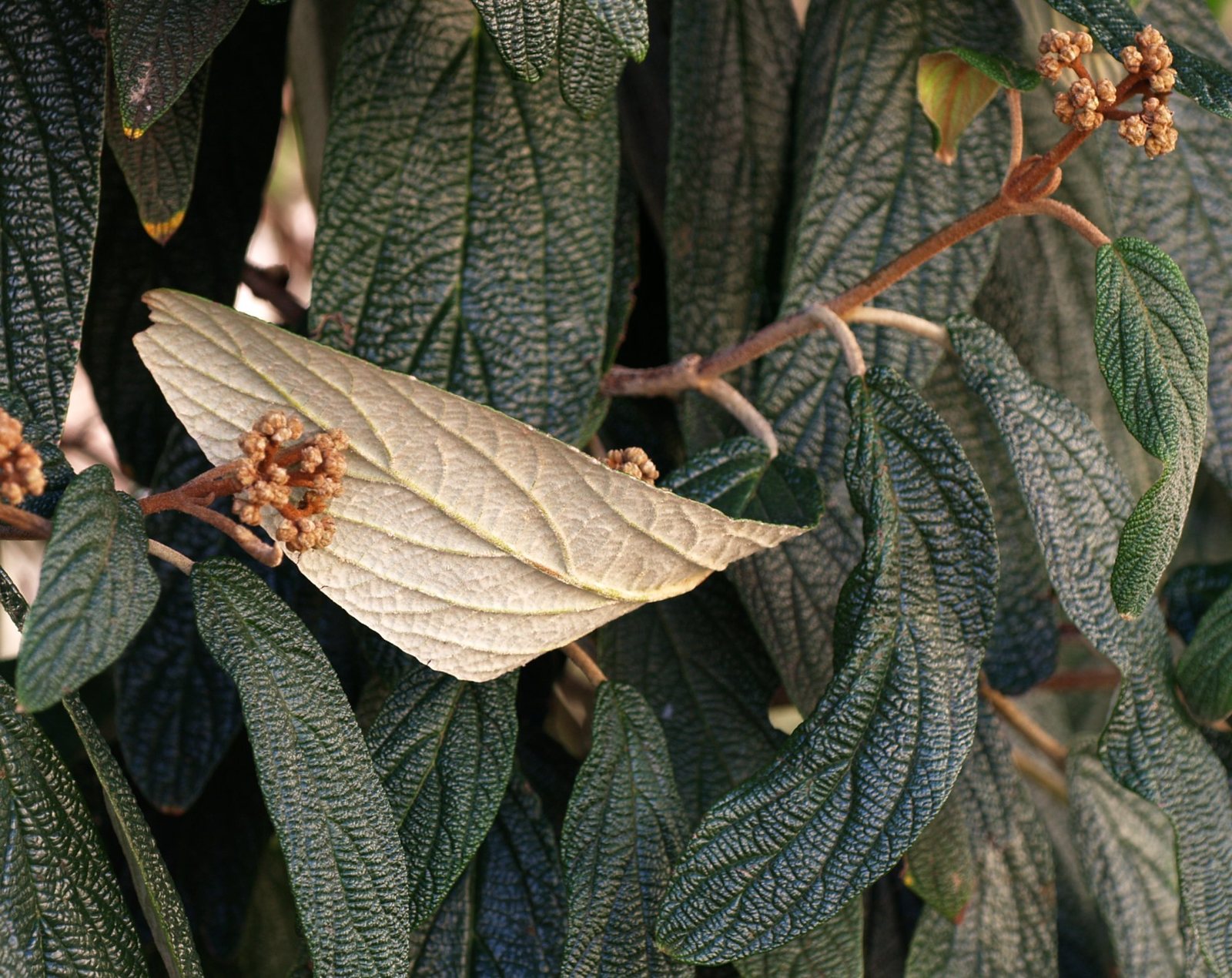
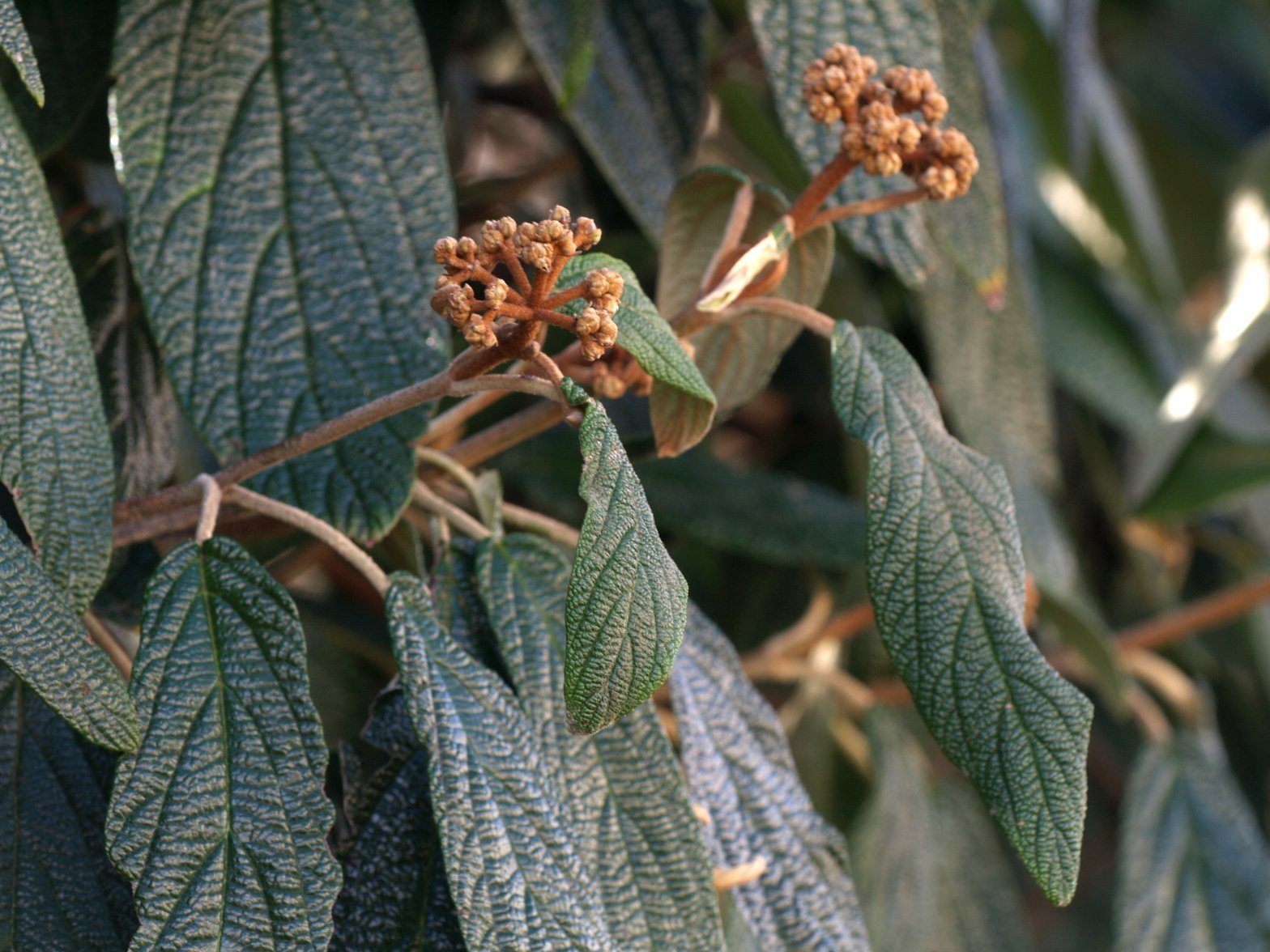
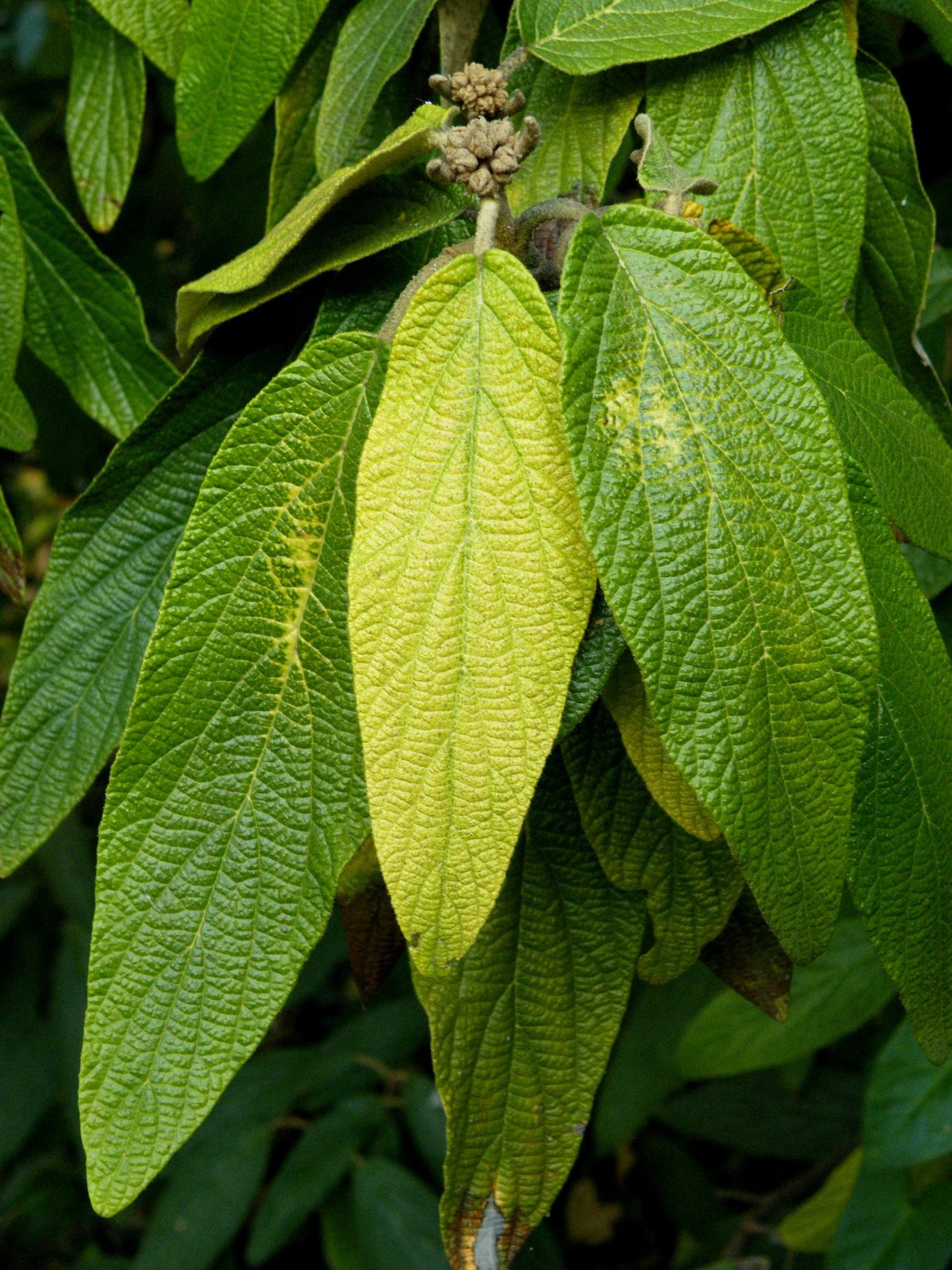
Leatherleaf viburnum is a large evergreen shrub grown for its deeply wrinkled leaves, creamy-white spring flowers and dense screening growth. Red fruits ripen to black and attract birds; in cold or exposed gardens, the foliage may become damaged or partly deciduous.
At a glance
- Sun
- Full sun to partial shade; light woodland shade is suitable, but heavy shade reduces flowering.
- Water
- Water regularly while establishing. Once established, water during prolonged dry spells; avoid persistently saturated ground.
- Soil
- Moist but well-drained soil, including clay that drains adequately; tolerates acidic, neutral and alkaline conditions.
- Height
- 10-15 ft (3-4.5 m)
- Spread
- 10-15 ft (3-4.5 m)
- Flowers
- Late spring to early summer; broad, flattened clusters of creamy-white flowers.
- Foliage
- Evergreen. Large, leathery, dark green leaves with deeply impressed veins and densely felted, pale undersides. Leaves often hang down or curl in cold weather.
- Growth
- Moderate
- Care needed
- Low
The year at a glance
- Pollinators
- Deer resistant
- Wildlife
- Low allergen
| J | F | M | A | M | J | J | A | S | O | N | D | |
|---|---|---|---|---|---|---|---|---|---|---|---|---|
| Flowers | ||||||||||||
| Fruit | ||||||||||||
| Plant |
Northern hemisphere months. In Australia, shift them by six.
- Difficulty
- Easy
- Toughness
- Fairly tough
Will it suit your garden?
Pick your zone, country, light and whether you have pets.
Full sun is 6 or more hours of direct sun a day, part shade 3 to 6 hours, shade under 3.
How it grows
Planting day
1.6 ft (0.5 m)
After 1 year
4 ft (1.2 m)
After 2 years
6 ft (1.8 m)
After 3 years
8 ft (2.5 m)
After 5 years
12 ft (3.8 m)
full size
About 5 years to full size.
From a typical nursery size, at an average rate for this kind of plant. A rule of thumb, not a forecast.
Good to know
- Cats and dogs
- Safe
- Invasive in
- the US
- Growth rate
- Moderate
Care
Jobs through the year
- WaterApr–May, Sep–Oct, every 14 days
- Water established shrubs if the root zone is dry; check young plants more often for two years.
- WaterJun–Aug, every 7 days
- Water deeply during prolonged dry spells, avoiding persistently saturated soil.
- WaterJan–Mar, Nov–Dec, every 21 days
- Water during dry winter spells only when the soil is dry and unfrozen.
- FeedMar–Apr
- Feed lightly only if growth is weak or soil is poor; avoid heavy nitrogen applications.
- MulchMar, Oct
- Maintain 5–8 cm of organic mulch over the root zone, clear of the stems.
- PruneJun
- After flowering, selectively thin or shorten branches; wear gloves, sleeves and eye protection against irritating leaf hairs.
- ProtectApr–May, every 7 days
- Inspect foliage for viburnum beetle larvae and remove them before extensive feeding occurs.
- ProtectJan–Feb, Nov–Dec
- Shelter exposed shrubs from drying winter winds; temporarily curled leaves need not be dead.
- ProtectSep–Oct
- Remove unwanted seedlings, especially beneath nearby bird perches.
- Plant where the mature shrub can spread without repeated clipping, sheltered from drying winter winds.
- Water deeply during dry weather for the first two growing seasons.
- Apply 2-3 in (5-8 cm) of organic mulch over the root area, keeping it clear of the stems.
- Feed lightly in spring only if growth is weak or the soil is poor; avoid heavy nitrogen feeding.
- Wear gloves, long sleeves and eye protection when handling or pruning; hairs from the leaves can irritate skin and eyes.
Pruning. Prune just after flowering, removing damaged branches and shortening selected shoots rather than shearing the whole shrub. To renovate an overgrown plant, remove up to one-third of the oldest stems at ground level each year, accepting fewer fruits that season.
Through the year
- Spring
- Plant when the soil is workable, water thoroughly and mulch the root area.
- Early spring
- Check for winter damage and remove dead wood once new growth makes the damage clear.
- Late spring
- After flowering, prune only where shaping or thinning is necessary.
- Summer
- Water young shrubs during dry spells and check leaf undersides for pests.
- Late summer
- Take semi-ripe cuttings from healthy, non-flowering shoots.
- Autumn
- Look for seedlings beneath the shrub and nearby bird perches; remove unwanted plants before they establish.
- Winter
- Check exposed plants after severe weather; do not assume temporarily drooping or curled leaves are dead.
In the garden
- Use as a broad, informal evergreen screen where there is room for its full width.
- Plant behind deciduous shrubs to provide a dark, year-round backdrop.
- Place at a woodland edge with ferns and shade-tolerant perennials for contrasting leaf textures.
- Use as a large specimen in a spacious border, away from narrow paths where its hairy leaves would be brushed frequently.
Garden styles it suits: Woodland, Traditional, Grand estate, Green on green, Winter interest and Low-maintenance.
Plant it with: Japanese aucuba, Oakleaf hydrangea, Hellebores, Hostas, Epimediums and Soft shield fern.
Wildlife: Flowers provide food for visiting insects, birds eat the ripe fruits, and the dense branches offer shelter. In regions where it escapes cultivation, choose a locally native shrub instead.
Problems to watch for
- Winter scorch: cold wind and frozen soil can brown the leaves; choose a sheltered site, mulch and water before freezing weather if the soil is dry.
- Viburnum beetle: larvae and adults can skeletonise foliage where this pest occurs; inspect in spring, remove larvae and prune out egg-bearing twig tips during dormancy.
- Leaf spots: remove badly affected fallen leaves, improve airflow and water at soil level rather than wetting the foliage.
- Poor fruiting: deep shade, pruning after flowering or inadequate cross-pollination can reduce berries; provide more light and a genetically different leatherleaf viburnum flowering at the same time.
Safety
Not known to be toxic to people, cats, dogs or horses. The fruits are not intended for eating, and ingestion may cause stomach upset; the hairs on leaves and young stems can irritate skin, eyes and airways.
Where it spreads. Escapes cultivation through bird-dispersed seed in parts of the eastern United States and is listed as invasive in Virginia. Check local invasive-plant guidance before planting near woodland or other natural areas.
Easily confused with
Wayfaring tree (Viburnum lantana)
A deciduous shrub with broader, more oval leaves that are less leathery; leatherleaf viburnum has longer, narrower, more deeply wrinkled leaves.
David viburnum (Viburnum davidii)
Much lower-growing, with three conspicuous lengthwise leaf veins and metallic blue fruit rather than fruit that ripens from red to black.
The name
The epithet rhytidophyllum means 'wrinkled-leaved', while leatherleaf describes the thick, tough texture of the foliage.
Propagation. Take semi-ripe cuttings in summer and root them in a moist, free-draining medium under cover. Seed propagation is slow and germination can require successive warm and cold periods.
Checked against open data
- Accepted botanical name
- Viburnum rhytidophyllum
- In the US and Canada
- Introduced in the lower 48 states.
- Native range
- China North-Central and China South-Central.
- Measured
- Average height 400 cm.
Sources: GBIF (CC BY 4.0), USDA PLANTS and Trefle (CC BY 4.0). The care and design notes are LandscapeGPT's own.
See it in your own yard.
Upload a photo of your yard and see it redesigned with plants that suit your climate, each checked against your zone.