Loquat
Eriobotrya japonica. Family Rosaceae. Tree.
Also called Japanese medlar, Japanese plum.
Loquat is a broad-leaved evergreen tree grown for its bold foliage, fragrant autumn flowers and yellow to orange fruit that ripens in spring or early summer. Native to China, it fruits best where winters are mild: established trees tolerate more cold than their flowers and young fruit, so outdoor trees in cooler gardens may remain mainly ornamental.
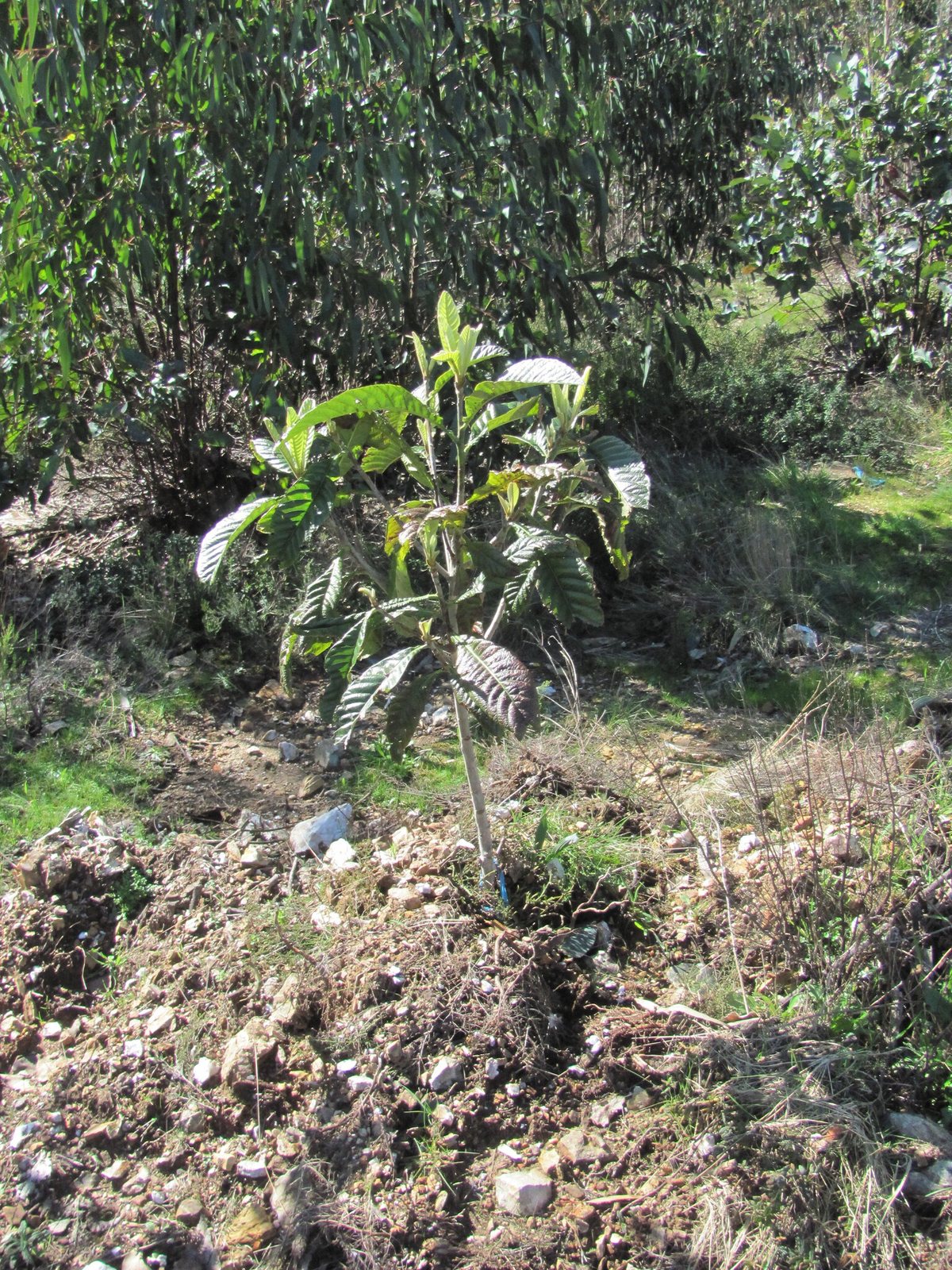
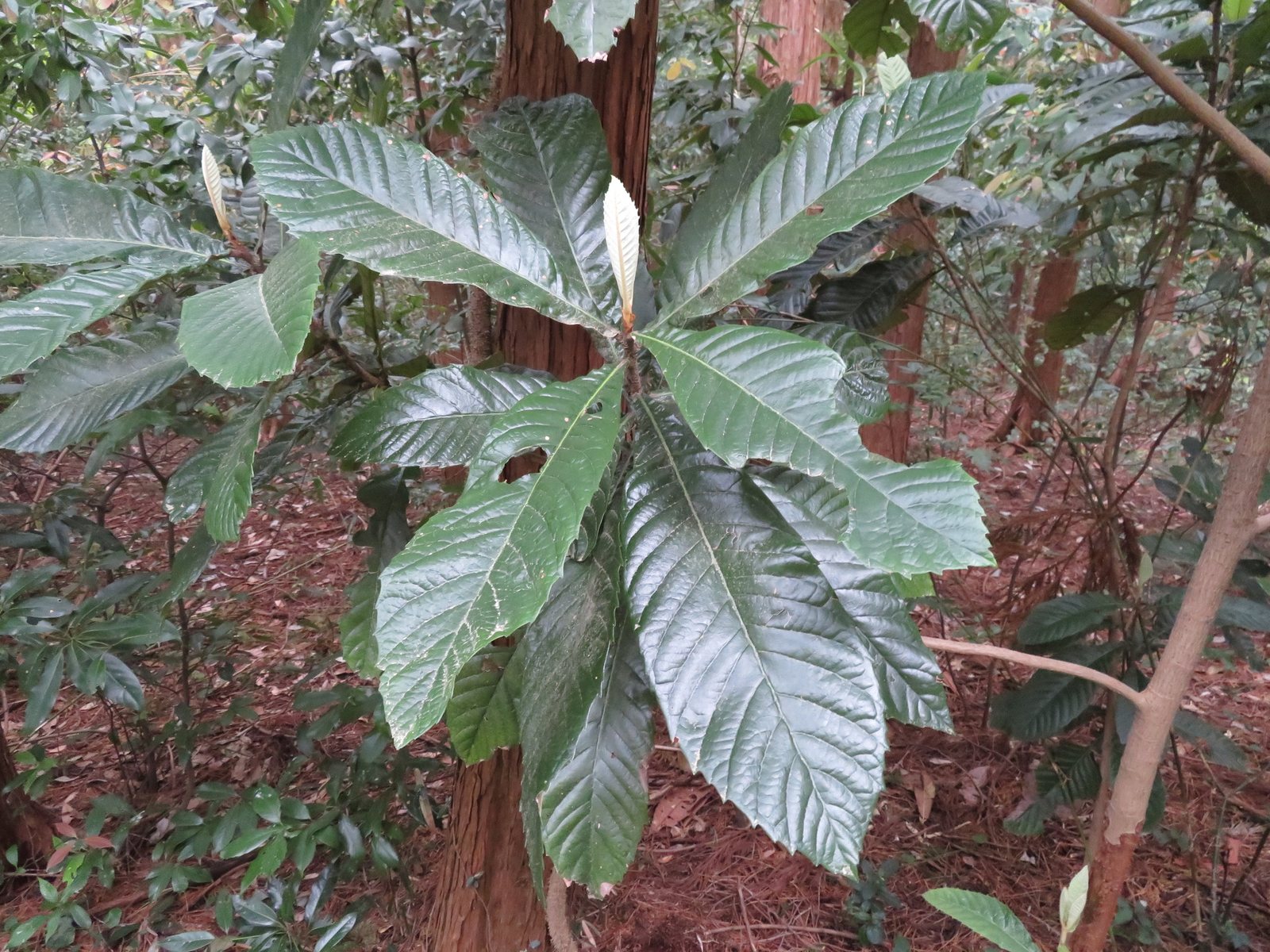
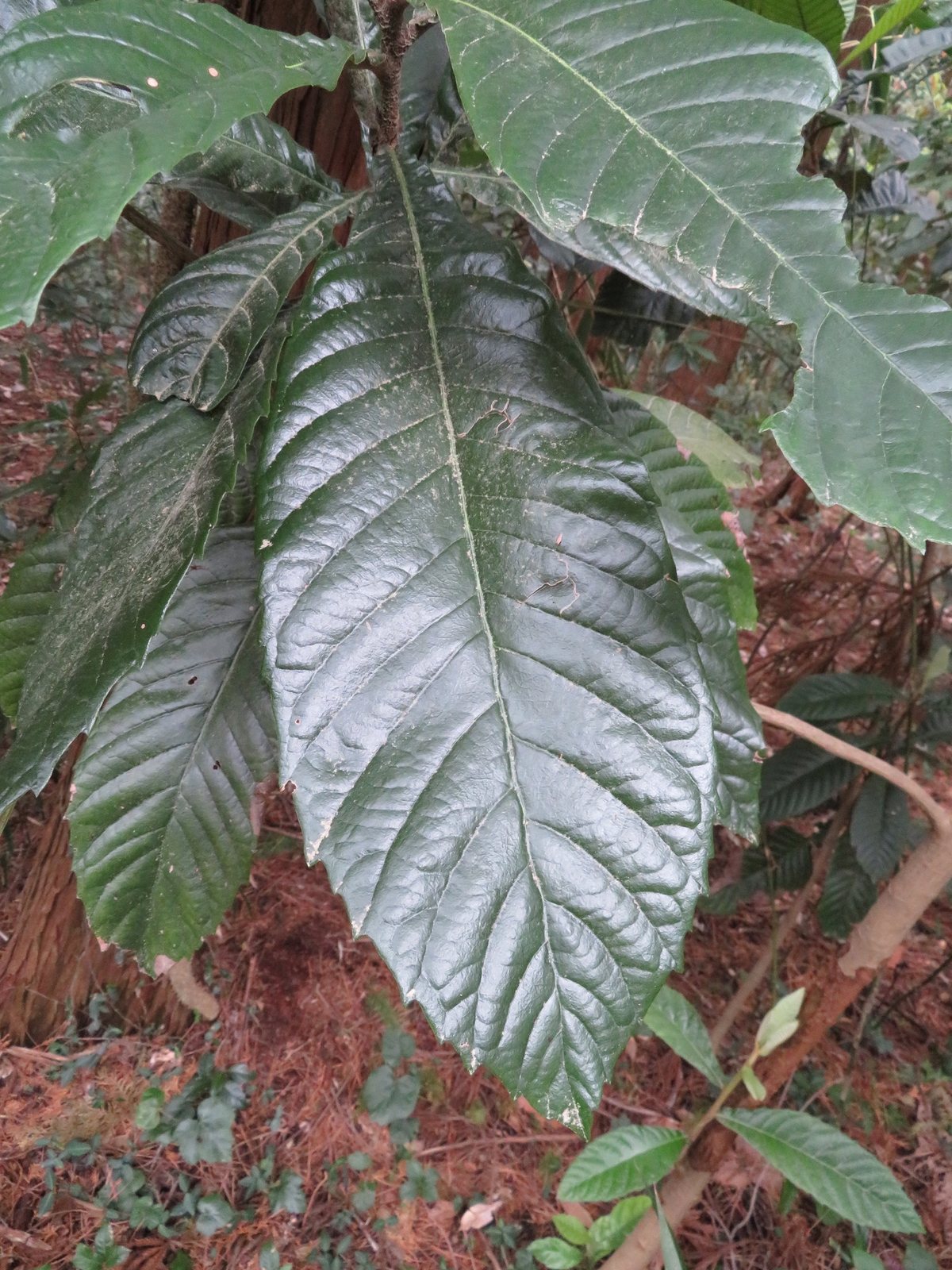
At a glance
- Sun
- Full sun for the best flowering and fruiting; tolerates partial shade.
- Water
- Water regularly during establishment. Established trees tolerate some drought, but need deep watering during prolonged dry weather, especially while fruit is developing.
- Soil
- Well-drained soil, preferably moderately fertile and slightly acidic to neutral. Avoid waterlogged ground; strongly alkaline soil can cause yellowing leaves.
- Height
- 15-30 ft (4.6-9.1 m)
- Spread
- 15-25 ft (4.6-7.6 m)
- Flowers
- Fragrant white to cream flowers in woolly clusters from autumn into early winter.
- Foliage
- Evergreen. Large, leathery, dark green leaves with strongly marked veins, toothed edges and pale, felted undersides.
- Growth
- Moderate; faster in warm conditions with adequate moisture.
- Care needed
- Medium
The year at a glance
- Pollinators
- Drought tolerant
- Heat tolerant
- Wildlife
- Low allergen
- Fragrant
- Edible
| J | F | M | A | M | J | J | A | S | O | N | D | |
|---|---|---|---|---|---|---|---|---|---|---|---|---|
| Flowers | ||||||||||||
| Fruit | ||||||||||||
| Plant |
Northern hemisphere months. In Australia, shift them by six.
- Difficulty
- Hard
- Toughness
- Needs looking after
Will it suit your garden?
Pick your zone, country, light and whether you have pets.
Full sun is 6 or more hours of direct sun a day, part shade 3 to 6 hours, shade under 3.
How it grows
Planting day
7 ft (2 m)
After 1 year
8 ft (2.3 m)
After 2 years
9 ft (2.6 m)
After 3 years
10 ft (2.9 m)
After 5 years
12 ft (3.5 m)
About 16 years to full size.
From a typical nursery size, at an average rate for this kind of plant. A rule of thumb, not a forecast.
Good to know
- Cats and dogs
- Toxic
- Invasive in
- the US and Australia
- Growth rate
- Fast
Care
Jobs through the year
- WaterMar–May, Sep–Oct, every 14 days
- Deep-water established in-ground trees if dry; young and container-grown trees need more.
- WaterJun–Aug, every 7 days
- Water in-ground trees deeply during dry spells, especially when fruiting; check containers more often.
- MulchApr–May
- Apply 5–8 cm of organic mulch over the roots, keeping it away from the trunk.
- FeedApr–May
- Feed lightly only if growth is weak; avoid heavy nitrogen feeding.
- PruneJun–Jul
- Prune lightly after harvest, removing crowded wood; avoid autumn cuts that remove flowers.
- ProtectJan–Apr, Oct–Dec
- Not reliably hardy in zones 6–7: overwinter in a bright frost-free space; protect winter flowers.
- HarvestMay–Jul, every 7 days
- Protected crops may ripen now; clip fully coloured, slightly soft fruit, as it will not sweeten after picking.
- Plant in a sheltered position away from cold winds and frost pockets; allow room for the broad crown.
- Water deeply during dry spells for the first two growing seasons, letting the soil surface dry between waterings.
- Spread 2-3 in (5-8 cm) of organic mulch over the root area, keeping it clear of the trunk.
- Feed lightly in spring if growth is weak; avoid heavy nitrogen feeding, which encourages leaves at the expense of flowers.
- For fruit, choose a named grafted cultivar suited to your climate; some crop better with a second compatible cultivar nearby.
- In climates colder than its outdoor range, grow it in a large container and overwinter in a bright, frost-free position.
Pruning. Prune lightly just after harvest in late spring or early summer, removing dead, crossing or crowded branches and shortening selected shoots to keep fruit within reach. Avoid routine autumn pruning, which removes flower clusters.
Harvest
Pick fruit when fully yellow to orange, slightly soft and sweet; clip it off with a short stalk, as loquats do not sweeten after picking. Harvest is usually March–June in mild US regions and August–November in Australia; in the UK and Canada, outdoor crops are unreliable because frost damages the winter flowers, while protected fruit generally ripens in late spring or summer.
Through the year
- Spring
- Plant when severe frost has passed, refresh mulch and feed lightly if needed.
- Spring to early summer
- Harvest fruit when fully coloured and slightly soft; it does not sweeten properly after early picking.
- Early summer
- After harvest, thin crowded branches and reduce height selectively if necessary.
- Summer
- Deep-water young trees and container plants during dry weather; check for scale insects.
- Autumn
- Leave flowering shoot tips intact and check that the root area drains freely before wetter weather.
- Winter
- Cover the flowering canopy of small trees with horticultural fleece during forecast frosts, and keep container-grown trees protected from hard freezing.
In the garden
- Use as a small specimen tree in a sheltered lawn or courtyard, where its large leaves provide year-round structure.
- Plant against a sunny, sheltered wall in cooler gardens to improve warmth and reduce wind exposure.
- Combine with rosemary, lavender and other sun-loving plants in a well-drained Mediterranean-style garden, keeping their crowns outside the regularly watered root basin.
- Include in a warm-climate edible landscape with citrus and feijoa, allowing access beneath the canopy for harvesting.
Garden styles it suits: Architectural minimal, Modern courtyard, Mediterranean, Edible landscape, Food forest and Japanese.
Plant it with: Rosemary, Lavender, Feijoa, Satsuma mandarin and Lilyturf.
Wildlife: Flowers provide nectar and pollen for bees and other insects during a season when fewer plants are flowering. Birds and mammals eat the fruit and can disperse the seeds; use wildlife-safe exclusion netting if protecting a crop.
Problems to watch for
- Frost-damaged flowers and poor fruit set: choose a warm, sheltered site and protect small flowering trees during frosts; foliage survival does not guarantee a crop.
- Fire blight: blackened flowers and hooked, dying shoots need prompt removal in dry weather, cutting well below visible damage and disinfecting tools between cuts; avoid excessive nitrogen.
- Scale insects and sooty mould: inspect leaf undersides and stems, manage ants and treat young scale with a horticultural oil labelled for edible trees.
- Fruit fly in affected regions, especially parts of Australia: use local monitoring advice, protect fruit with suitable exclusion bags or netting and promptly collect fallen fruit.
Safety
Seeds and leaves contain cyanogenic compounds and should not be eaten by people, cats, dogs or horses; chewing or crushing them can release cyanide, and substantial ingestion can cause serious poisoning. The ripe flesh is not known to be toxic to these species, but remove all seeds before offering fruit; the large seeds also present a choking or obstruction risk.
Where it spreads. Naturalised and locally invasive in parts of eastern Australia, including coastal Queensland and New South Wales, and in Hawaii and South Africa. Birds spread the seeds into bushland and forest margins; check local guidance and remove unwanted seedlings.
Easily confused with
Medlar (Mespilus germanica)
Medlar is deciduous, flowers in spring and bears brown fruit with a conspicuous open, star-shaped end; loquat is evergreen and has yellow to orange spring fruit.
Japanese aralia (Fatsia japonica)
Japanese aralia has deeply lobed, hand-shaped leaves and small black berries; loquat has undivided, toothed leaves and larger yellow to orange fruit.
Southern magnolia (Magnolia grandiflora)
Southern magnolia has smooth-edged leaves and very large individual white flowers; loquat has toothed, strongly veined leaves and clusters of small flowers.
The name
Eriobotrya comes from Greek words meaning wool and bunch of grapes, referring to the woolly flower clusters, while japonica means Japanese despite the species being native to China.
Propagation. Sow fresh, cleaned seeds promptly; seedlings vary and may take many years to fruit. Grafting or budding a known cultivar onto suitable rootstock preserves fruit quality and usually produces a bearing tree sooner.
Checked against open data
- Accepted botanical name
- Rhaphiolepis bibas Eriobotrya japonica is an older name for Rhaphiolepis bibas.
Sources: GBIF (CC BY 4.0). The care and design notes are LandscapeGPT's own.
See it in your own yard.
Upload a photo of your yard and see it redesigned with plants that suit your climate, each checked against your zone.