Manuka
Leptospermum scoparium. Family Myrtaceae. Shrub.
Also called Mānuka, New Zealand tea tree, Broom tea tree.
Manuka is an evergreen shrub or small tree native to New Zealand and southeastern Australia, grown for its fine foliage, peeling bark and abundant small flowers. It suits mild coastal gardens and sheltered borders; in colder areas, grow it in a container that can be moved into a bright, frost-free shelter.
At a glance
- Sun
- Full sun gives the best flowering; light partial shade is tolerated.
- Water
- Water regularly while establishing. Established plants tolerate short dry spells, but prolonged drought and completely dry container compost can cause dieback.
- Soil
- Well-drained, acidic to neutral soil; avoid chalky soil and stagnant winter wet.
- Height
- 6-16 ft (1.8-5 m), occasionally taller in favourable conditions
- Spread
- 6-10 ft (1.8-3 m)
- Flowers
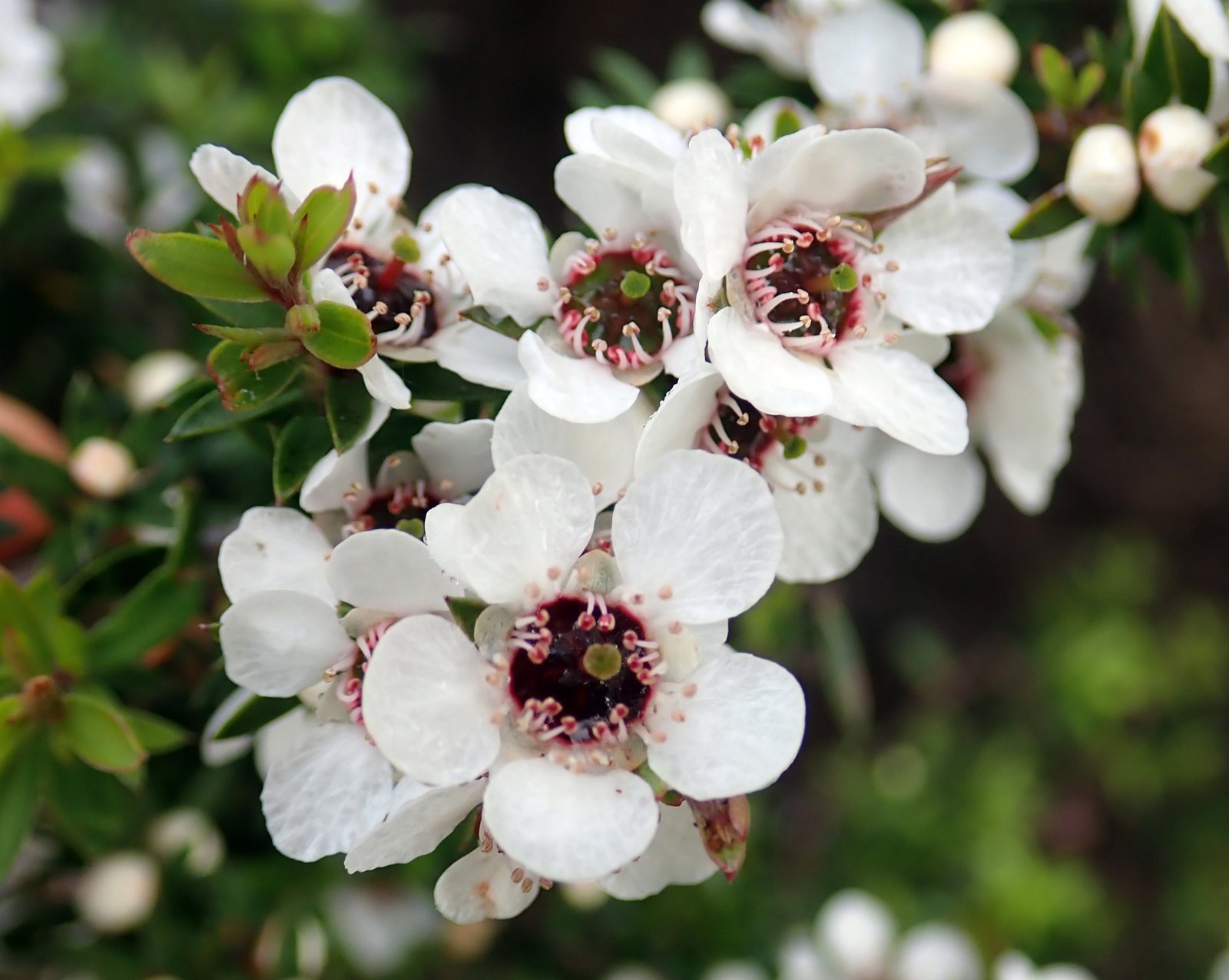
- Usually late spring to early summer; some plants flower earlier or over a longer period in mild climates. The species has white, occasionally pink flowers; garden cultivars also have pink or red, single or double flowers.
- Foliage
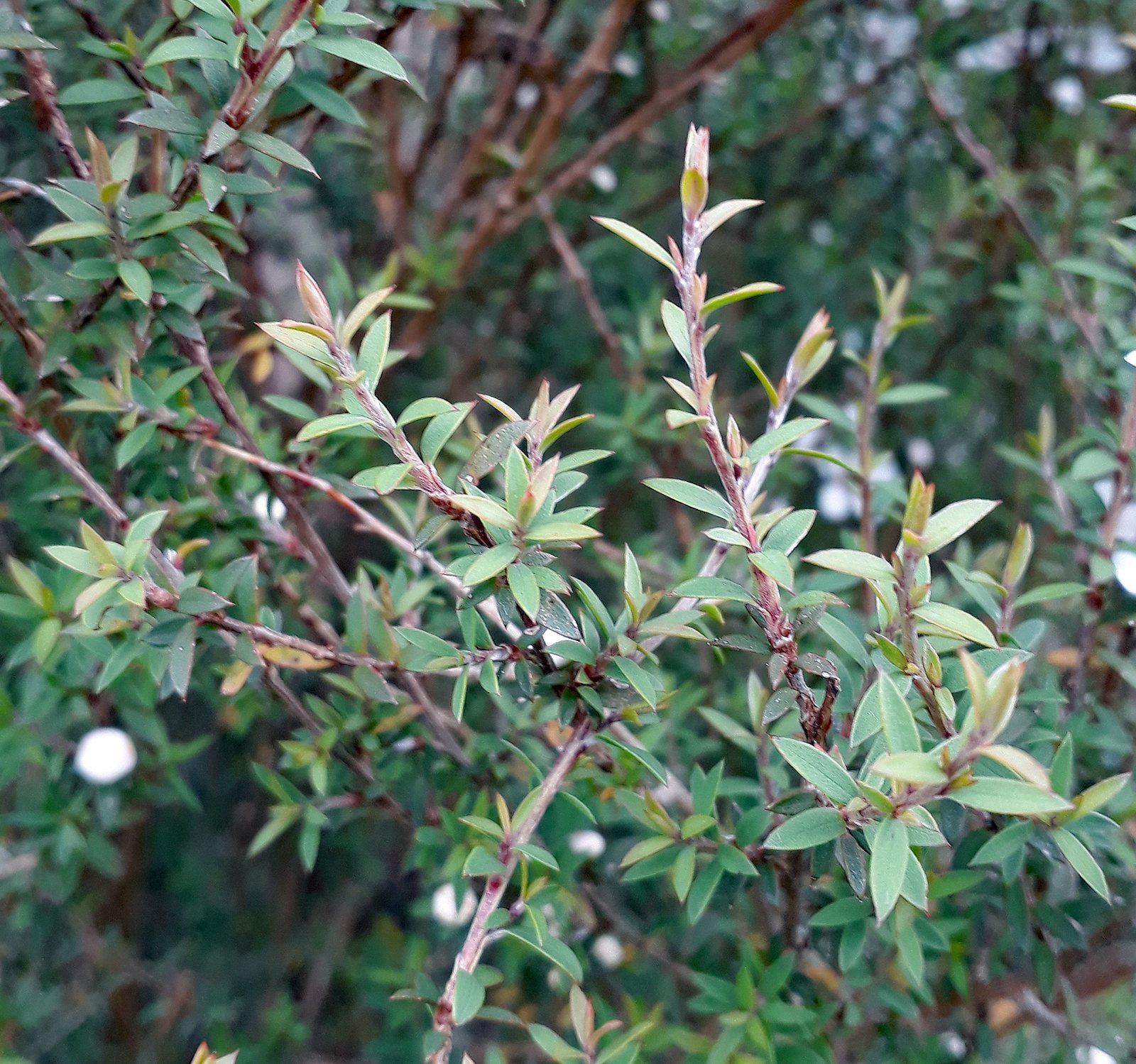
- Evergreen. Small, narrow, pointed leaves, usually dark green and aromatic when crushed; some cultivars have bronze or purple-tinted foliage.
- Growth
- Moderate
- Care needed
- Medium
The year at a glance
- Pollinators
- Heat tolerant
- Wildlife
- Low allergen
| J | F | M | A | M | J | J | A | S | O | N | D | |
|---|---|---|---|---|---|---|---|---|---|---|---|---|
| Flowers | ||||||||||||
| Fruit | ||||||||||||
| Plant |
Northern hemisphere months. In Australia, shift them by six.
- Difficulty
- Hard
- Toughness
- Fairly tough
Will it suit your garden?
Pick your zone, country, light and whether you have pets.
Full sun is 6 or more hours of direct sun a day, part shade 3 to 6 hours, shade under 3.
How it grows
Planting day
1.6 ft (0.5 m)
After 1 year
4 ft (1.1 m)
After 2 years
5 ft (1.7 m)
After 3 years
7 ft (2.2 m)
After 5 years
11 ft (3.4 m)
full size
About 5 years to full size.
From a typical nursery size, at an average rate for this kind of plant. A rule of thumb, not a forecast.
Good to know
- Cats and dogs
- Safe
- Native to
- Australia
- Invasive in
- the US
- In the garden
- Spreads vigorously: plan to contain it.
- Growth rate
- Moderate
Care
Jobs through the year
- WaterApr–May, Sep–Oct, every 14 days
- For established ground plants in mild sites, water if dry; new plants and pots need more frequent checks.
- WaterJun–Aug, every 7 days
- Water established ground plants during dry spells before roots dry completely; avoid standing water.
- WaterJan–Mar, Nov–Dec, every 14 days
- Check frost-free overwintering pots and water only enough to keep the root ball barely moist.
- MulchApr–May
- Refresh a shallow organic mulch, keeping it clear of the trunk.
- FeedApr–May
- Feed lightly only if growth is weak; avoid heavy feeding.
- PruneJun–Jul
- Lightly trim leafy shoots immediately after flowering; do not cut into bare old wood.
- ProtectSep–Oct
- Move pots into bright frost-free shelter before frost; outdoor overwintering is unreliable in zones 6–7.
- ProtectJan–Mar, Nov–Dec
- Keep overwintering plants frost-free, with good light and drainage.
- Plant in spring where winters are cool, choosing a sunny position sheltered from cold, drying winds.
- Water deeply through the first growing season, allowing the surface soil to begin drying between waterings.
- Apply a shallow organic mulch, keeping it clear of the trunk.
- Feed lightly in spring only if growth is weak; avoid heavy feeding.
- Use a free-draining, lime-free potting mix in containers, and protect the root ball from freezing.
Pruning. Lightly trim leafy shoots immediately after flowering to keep the shrub dense. Avoid cutting into bare old wood, which often fails to produce new growth.
Through the year
- Spring
- Plant after severe frost has passed and water new plants thoroughly.
- Spring
- Refresh mulch and check container plants for crowded roots or exhausted compost.
- Late spring
- Check new growth for aphids and scale insects; treat small infestations promptly.
- Summer
- Lightly trim after the main flowering flush and water during prolonged dry weather.
- Late summer
- Take semi-ripe cuttings from healthy, non-flowering shoots.
- Autumn
- Move containers into bright, frost-free shelter before damaging frosts.
- Winter
- Keep sheltered container plants barely moist and ensure outdoor plants are not sitting in waterlogged soil.
In the garden
- Use as an informal flowering screen in a mild, sheltered coastal garden.
- Combine with heathers and hebes in a sunny, acidic-soil border for contrasting foliage textures.
- Grow a compact cultivar in a large courtyard container where its flowers and fine leaves can be seen closely.
- Use single-flowered forms in a pollinator border alongside plants that extend the flowering season.
Garden styles it suits: Coastal, Cottage garden, Wildlife garden, Pollinator garden, Modern courtyard and Australian native.
Plant it with: Hebe, Heather, New Zealand flax, New Zealand sedge and Kangaroo paw.
Wildlife: Single flowers provide nectar and pollen for bees and other insects. Dense established shrubs also offer shelter for small birds; double-flowered cultivars generally provide less accessible forage.
Problems to watch for
- Root rot and sudden decline in wet soil: improve drainage before planting and avoid standing water in container saucers.
- Drought-related browning: water the root zone deeply before the soil or potting mix dries out completely; dead branches may not recover.
- Scale insects and associated sooty mould: inspect stems and leaf undersides, remove small infestations by hand, and use a labelled horticultural oil if needed.
- Frost or cold-wind damage: choose a sheltered site, protect containers before freezing weather, and wait until spring growth starts before removing damaged tips.
Safety
The living plant is not known to be toxic to people, cats, dogs or horses, although species-specific safety information is limited. Leaves and stems are not intended as food, and swallowing plant material may cause stomach upset. Concentrated manuka essential oil should not be treated as safe for pets or swallowed.
Where it spreads. It has naturalised outside its native range and can spread invasively in Hawaii. Check local guidance before planting there, and remove unwanted seedlings before they establish.
Easily confused with
Kanuka (Kunzea robusta)
Kanuka generally has softer foliage and smaller flowers grouped in clusters; manuka leaves feel pricklier and its larger flowers are usually borne singly.
Coast tea tree (Leptospermum laevigatum)
Coast tea tree has broader, blunt-tipped, grey-green leaves rather than manuka's narrow, sharply pointed leaves.
Geraldton wax (Chamelaucium uncinatum)
Geraldton wax has longer, needle-like leaves with hooked tips and conspicuously waxy flowers, rather than manuka's short, flat leaves and papery-looking petals.
The name
Mānuka is its Māori name; Leptospermum means 'slender seed', while scoparium means 'broom-like'.
Propagation. Sow seed in spring, keeping it at the surface of a fine, moist seed mix. Take semi-ripe cuttings in summer to preserve a named cultivar; seedlings may differ from the parent.
Checked against open data
- Accepted botanical name
- Leptospermum scoparium
- In the US and Canada
- Introduced in Hawaii.
- Native range
- Chatham Is., New South Wales, New Zealand North, New Zealand South, Tasmania and Victoria.
- Measured
- Average height 560 cm.
Sources: GBIF (CC BY 4.0), USDA PLANTS and Trefle (CC BY 4.0). The care and design notes are LandscapeGPT's own.
See it in your own yard.
Upload a photo of your yard and see it redesigned with plants that suit your climate, each checked against your zone.