Mexican petunia
Ruellia simplex. Family Acanthaceae. Perennial.
Also called Mexican bluebell, Britton's wild petunia, Ruellia brittoniana.
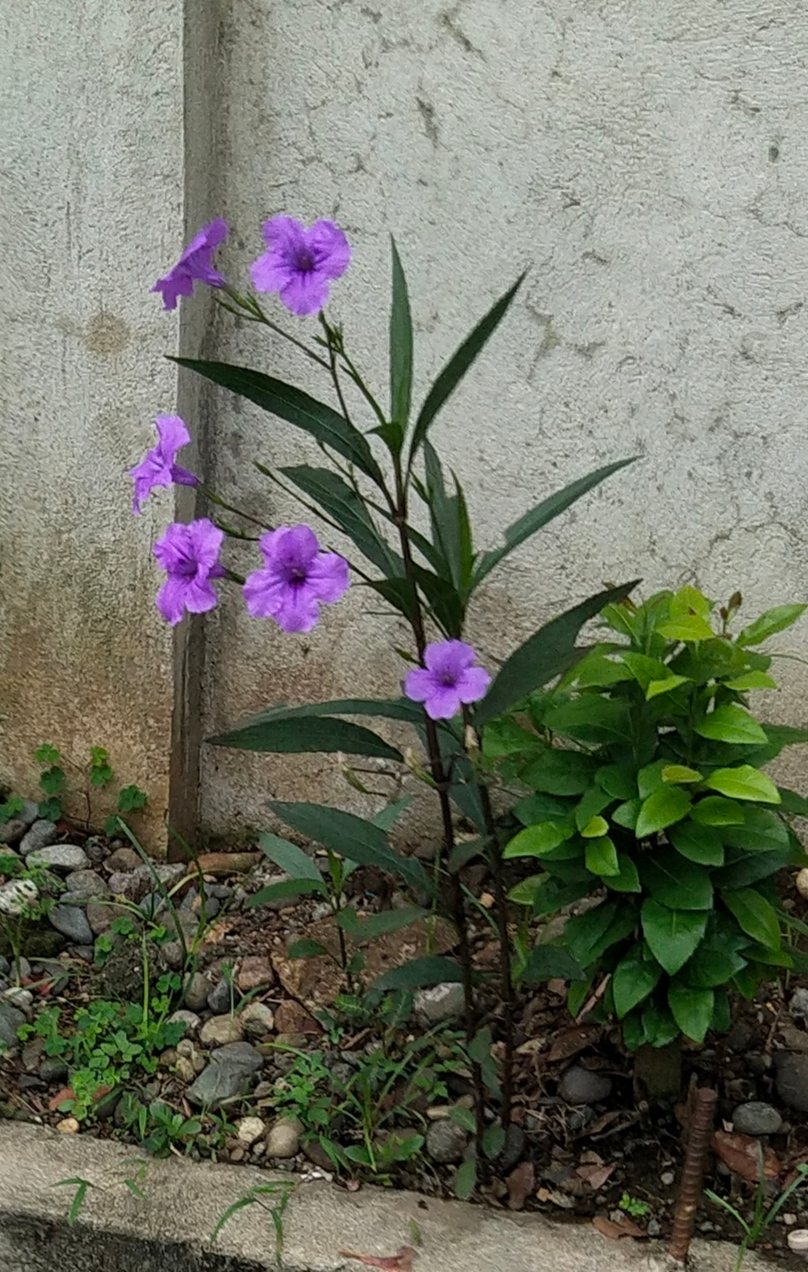
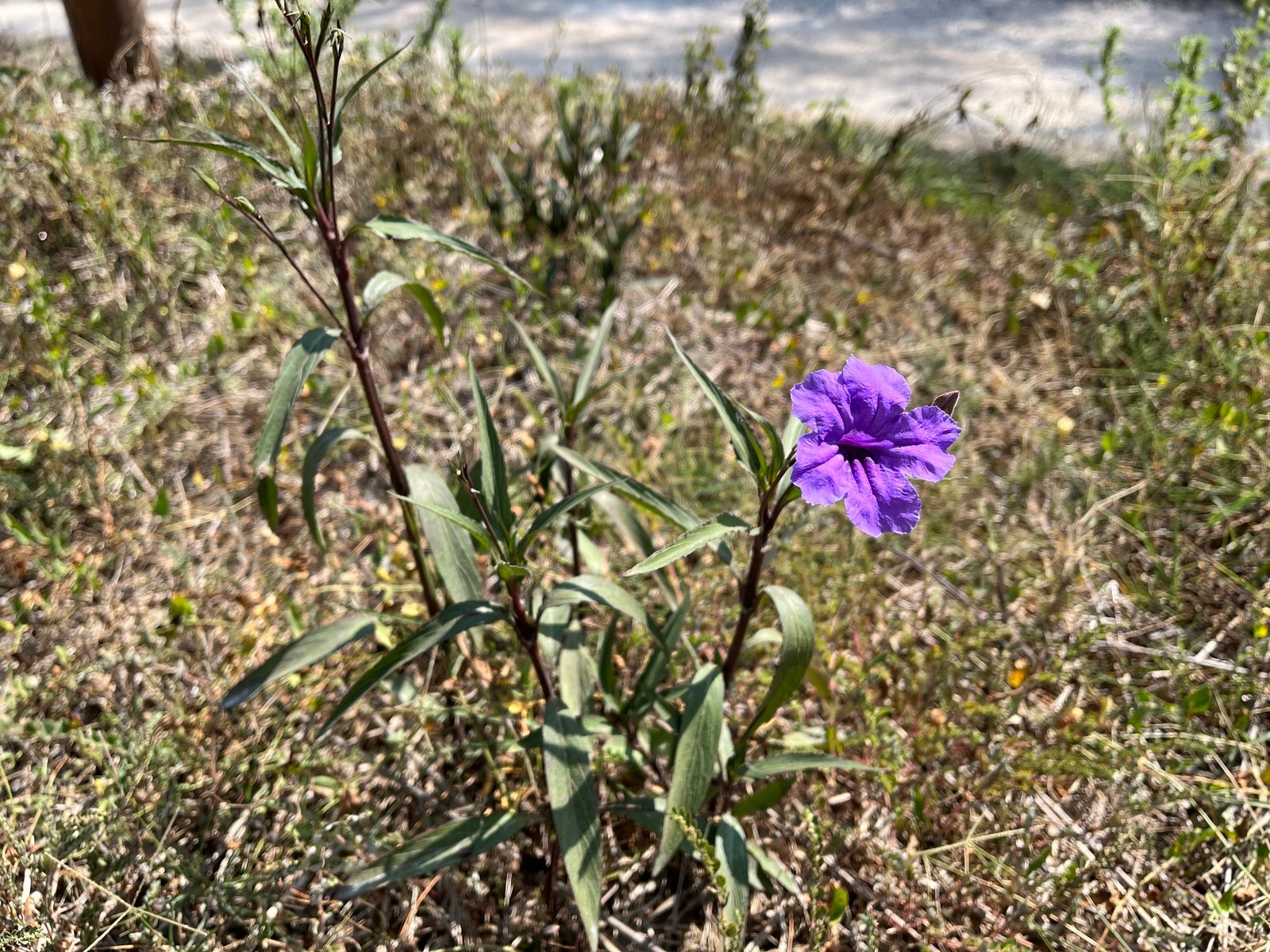
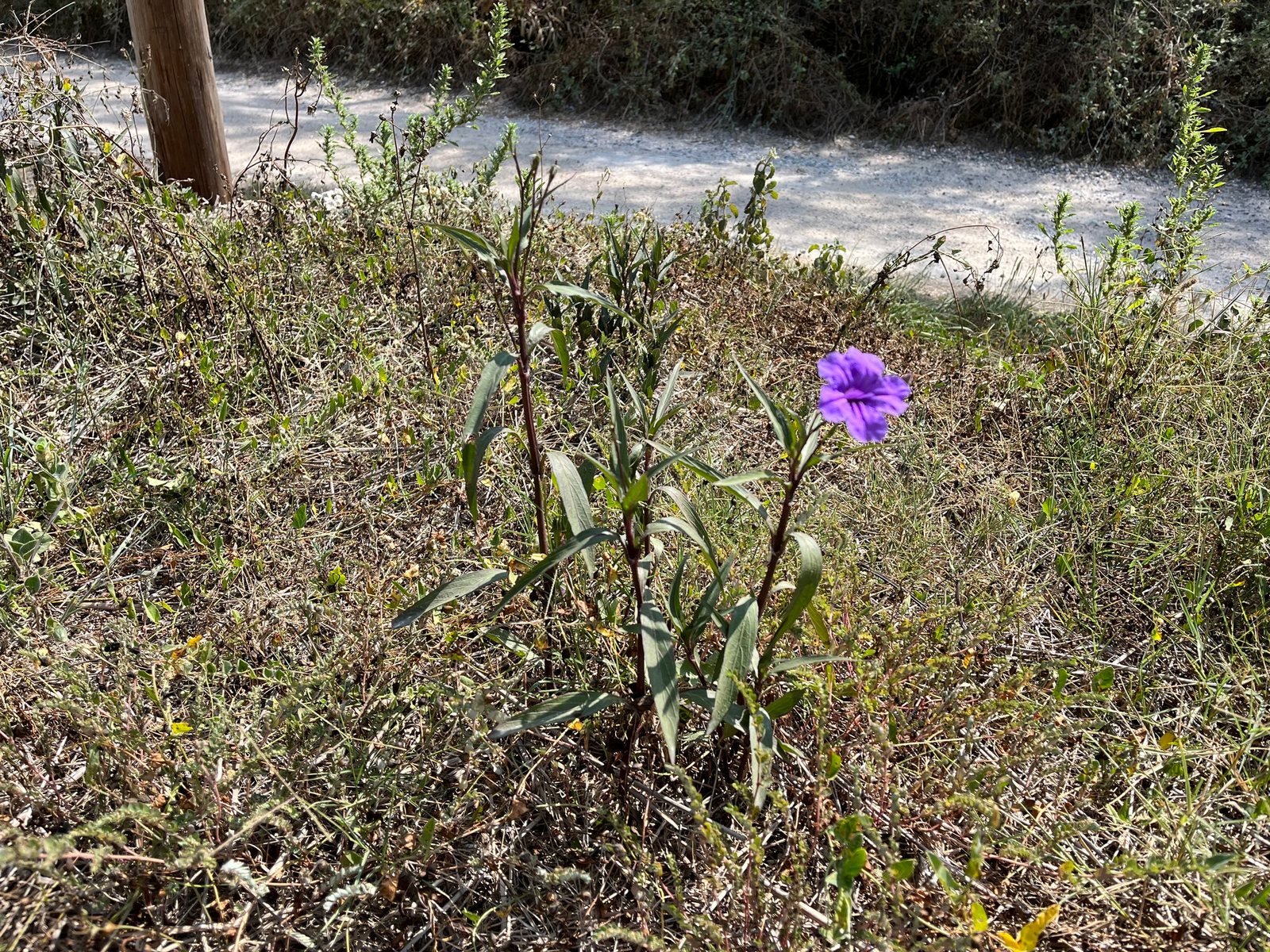
Mexican petunia is an upright, spreading perennial with narrow leaves and purple, trumpet-shaped flowers that open for a day but are replaced over a long season. It is evergreen in frost-free climates and is grown as an annual or overwintered under cover in colder areas. Gardeners grow it for summer colour, but the fertile species is invasive in several warm regions and is unsuitable for unrestricted planting there.
At a glance
- Sun
- Full sun to partial shade; flowering is strongest in full sun.
- Water
- Keep evenly moist while establishing. Established plants tolerate short dry spells as well as wet ground; water containers when the surface begins to dry.
- Soil
- Adaptable to sandy, loamy or clay soils, including periodically waterlogged ground. Use a free-draining potting mix in containers, especially when overwintering indoors.
- Height
- 3-4 ft (0.9-1.2 m)
- Spread
- 2-3 ft (0.6-0.9 m) initially; spreading rhizomes can form much wider colonies
- Flowers
- Purple to violet-blue flowers from late spring into autumn; flowering may continue much longer in frost-free climates. Cultivars also have pink or white flowers.
- Foliage
- Evergreen. Opposite, narrow, lance-shaped dark green leaves on upright green to purplish stems.
- Growth
- Fast in warm weather
- Care needed
- High
The year at a glance
- Pollinators
- Heat tolerant
- Low allergen
| J | F | M | A | M | J | J | A | S | O | N | D | |
|---|---|---|---|---|---|---|---|---|---|---|---|---|
| Flowers | ||||||||||||
| Fruit | ||||||||||||
| Plant |
Northern hemisphere months. In Australia, shift them by six.
- Difficulty
- Hard
- Toughness
- Fairly tough
Will it suit your garden?
Pick your zone, country, light and whether you have pets.
Full sun is 6 or more hours of direct sun a day, part shade 3 to 6 hours, shade under 3.
How it grows
Planting day
1 ft (0.3 m)
After 1 year
2.2 ft (0.68 m)
After 2 years
3 ft (1.1 m)
full size
About 2 years to full size.
From a typical nursery size, at an average rate for this kind of plant. A rule of thumb, not a forecast.
Good to know
- Cats and dogs
- Safe
- Invasive in
- the US and Australia
- In the garden
- Spreads vigorously: plan to contain it.
- Growth rate
- Fast
Care
Jobs through the year
- WaterMay–Jun, every 7 days
- Water established plants if soil is drying; newly planted specimens need more frequent watering.
- WaterJul–Sep, every 10 days
- Water established plants deeply during prolonged dry spells if flowering slows.
- MulchMay–Jun
- Apply a thin organic mulch, keeping it clear of stems.
- PruneMar–Apr
- Remove dead stems and shorten leggy overwintered growth before new shoots develop.
- ProtectMay
- Check local invasive-plant guidance; choose an alternative where invasive and use a retrievable container in cold climates.
- PruneJun–Oct, every 7 days
- Remove unwanted shoots with their rhizomes; contain all roots and debris.
- DeadheadJun–Oct, every 7 days
- Remove developing seed capsules before they mature and burst; sterile cultivars do not need this.
- ProtectSep–Oct
- Move containers into bright, frost-free shelter before frost; reduce winter watering.
- WaterJan–Apr, Nov–Dec, every 21 days
- For frost-free overwintered plants only, water sparingly when the upper compost dries.
- Check local invasive-plant guidance before planting; choose a non-invasive alternative where this species threatens natural areas.
- Water regularly during the first growing season, then water during prolonged dry spells if flowering slows.
- Feed container plants lightly with a balanced fertiliser during active growth; rich garden soil usually needs no extra feeding.
- Use a thin organic mulch around plants, keeping it clear of the stems.
- Remove unwanted shoots promptly, digging out their attached rhizomes rather than simply cutting the tops.
- Keep containers away from drains and natural waterways, and do not dump seed heads, roots or potting mix in garden waste areas outdoors.
Pruning. In late winter or early spring, cut frost-killed stems back to healthy growth or near ground level before new shoots develop. In frost-free areas, shorten leggy stems in early spring; remove seed capsules before they mature if growing a fertile plant.
Through the year
- Late winter
- Check overwintered pots for spider mites and remove dead or damaged stems.
- Spring
- Plant out after frost danger has passed and the soil has warmed.
- Late spring
- Apply mulch and begin regular watering for newly planted specimens.
- Summer
- Inspect for spreading shoots and developing seed capsules; remove both promptly.
- Early autumn
- Take cuttings if you need to keep plants through a cold winter.
- Autumn
- Move container plants under cover before frost where winters are too cold for outdoor survival.
In the garden
- Use in large patio containers for upright foliage and a long display of purple flowers, where local guidance permits.
- Combine with cannas and ornamental grasses for contrasting broad and narrow foliage.
- Plant in repeated groups along sunny borders for a continuous band of summer colour, only where spread can be managed.
- Use a locally recommended sterile selection in warm-climate courtyards; allow space for its continuing rhizome spread.
Garden styles it suits: Modern tropical, Tropical, Modern courtyard, Southern, Mexican hacienda and Luxury resort.
Plant it with: Canna, Daylily, Society garlic, Blue-eyed grass and Gulf muhly grass.
Wildlife: Flowers attract bees and butterflies. In invaded wetlands and waterways, dense colonies can displace native vegetation, so wildlife value does not justify planting it where it is invasive.
Problems to watch for
- Unwanted colonies and seedlings: remove plants with their rhizomes, collect seed capsules before they burst, and monitor repeatedly for regrowth.
- Spider mites, especially under cover: look for stippled leaves and fine webbing; rinse foliage thoroughly and use insecticidal soap labelled for the purpose if needed.
- Sparse flowering and floppy growth in shade: move to a sunnier position and avoid excessive nitrogen feeding.
- Winter losses in cold or persistently wet pots: provide frost-free shelter, good drainage and much less water while growth is slow.
Safety
Not known to be toxic to cats, dogs, horses or people, but species-specific poisoning information is limited. No particular part is established as poisonous; it is not an edible plant, and ingestion should be discouraged.
Where it spreads. Spreads aggressively by rhizomes and explosively dispersed seed. Listed as invasive in Florida and invasive or naturalised elsewhere in the southeastern United States, including parts of the Gulf Coast. It is also an environmental weed in parts of eastern Australia, including Queensland and New South Wales. Avoid planting near wetlands, drains or waterways.
Easily confused with
Carolina wild petunia (Ruellia caroliniensis)
Usually shorter, with broader, often hairy leaves rather than Mexican petunia's long, narrow leaves.
Hairy wild petunia (Ruellia humilis)
A lower-growing plant with noticeably hairy stems and broader leaves; it does not form the same tall, cane-like clumps.
Garden petunia (Petunia × atkinsiana)
Has soft, sticky-hairy foliage, branching or trailing stems and usually larger flowers, rather than smooth, narrow leaves on upright stems.
The name
Ruellia honours the French physician and botanist Jean Ruel, while Mexican petunia refers to its Mexican origin and petunia-like flowers, although it is not a true petunia.
Propagation. Divide rooted clumps in spring or take softwood stem cuttings in warm weather. Fertile plants also grow readily from seed, but deliberately raising or sharing seed is inadvisable where the species is invasive. Cultivars should be propagated vegetatively to retain their characteristics.
Checked against open data
- Accepted botanical name
- Ruellia simplex
- In the US and Canada
- Introduced in Hawaii, the lower 48 states, Pacific Basin, Puerto Rico and US Virgin Islands.
- Native range
- Argentina Northeast, Argentina Northwest, Bolivia, Brazil Northeast, Brazil South, Brazil Southeast, Brazil West-Central, Cayman Is., Costa Rica, Cuba, Dominican Republic and Ecuador.
Sources: GBIF (CC BY 4.0), USDA PLANTS and Trefle (CC BY 4.0). The care and design notes are LandscapeGPT's own.
See it in your own yard.
Upload a photo of your yard and see it redesigned with plants that suit your climate, each checked against your zone.