Old man banksia
Banksia serrata. Family Proteaceae. Tree.
Also called Saw banksia, Saw-tooth banksia, Red honeysuckle.
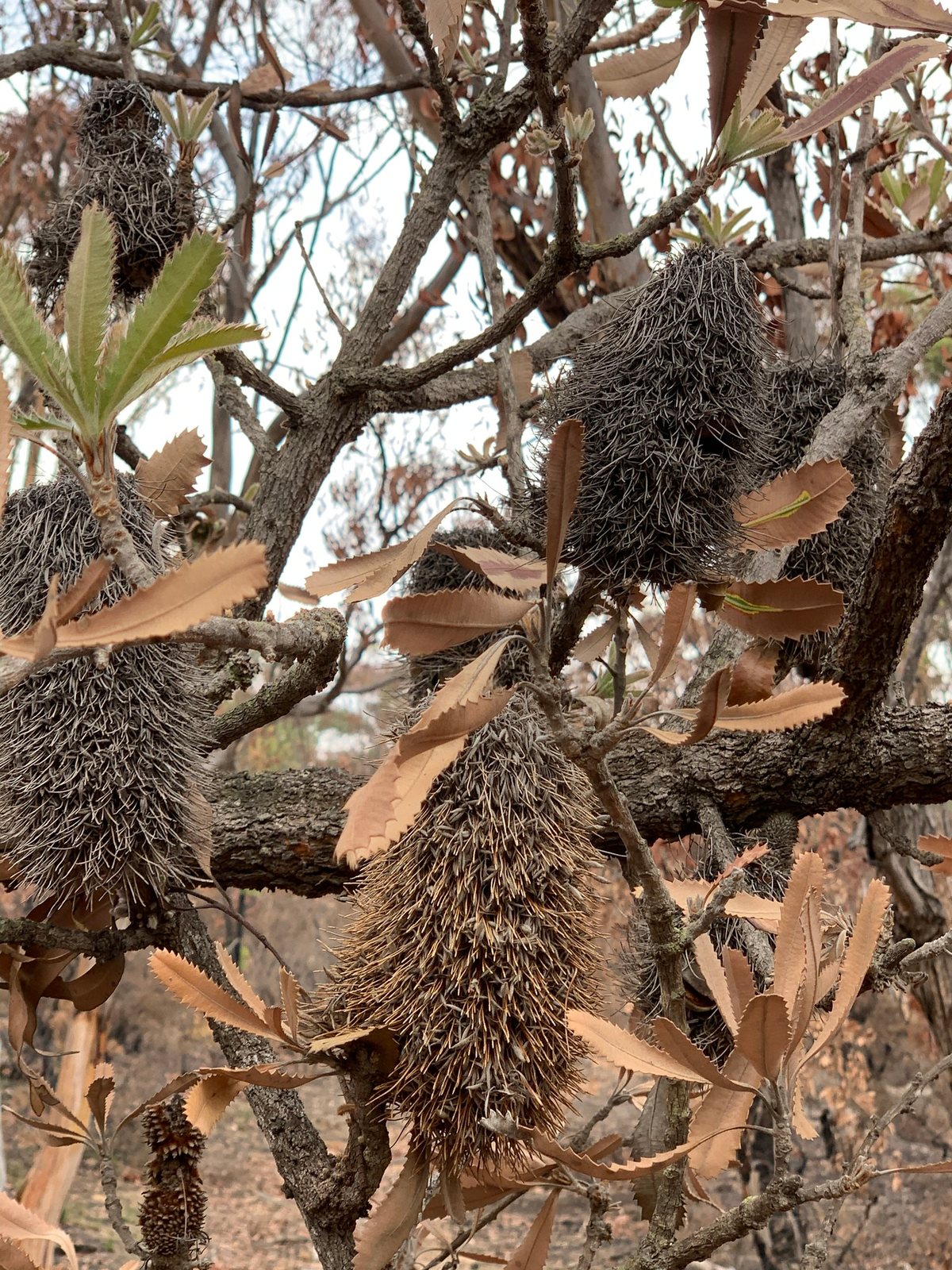
An evergreen tree from eastern Australia, grown for its rugged bark, boldly toothed leaves and large, pale flower spikes. The woody seed cones remain on the branches and develop the weathered appearance behind its common name. It suits mild coastal gardens with freely draining soil, but is not reliably hardy outdoors in most of Canada or colder parts of the UK and United States.
At a glance
- Sun
- Full sun; tolerates light shade, but flowers best in an open position.
- Water
- Water regularly while establishing; drought-tolerant once established, though occasional deep watering helps during prolonged dry weather. Avoid persistently wet roots.
- Soil
- Freely draining, acidic to neutral sand or sandy loam, preferably low in phosphorus. Unsuitable for waterlogged clay or strongly alkaline soil.
- Height
- 20-50 ft (6-15 m)
- Spread
- 15-25 ft (4.5-7.5 m)
- Flowers
- Large cream to pale yellow cylindrical flower spikes, usually in summer and autumn; timing varies with climate.
- Foliage
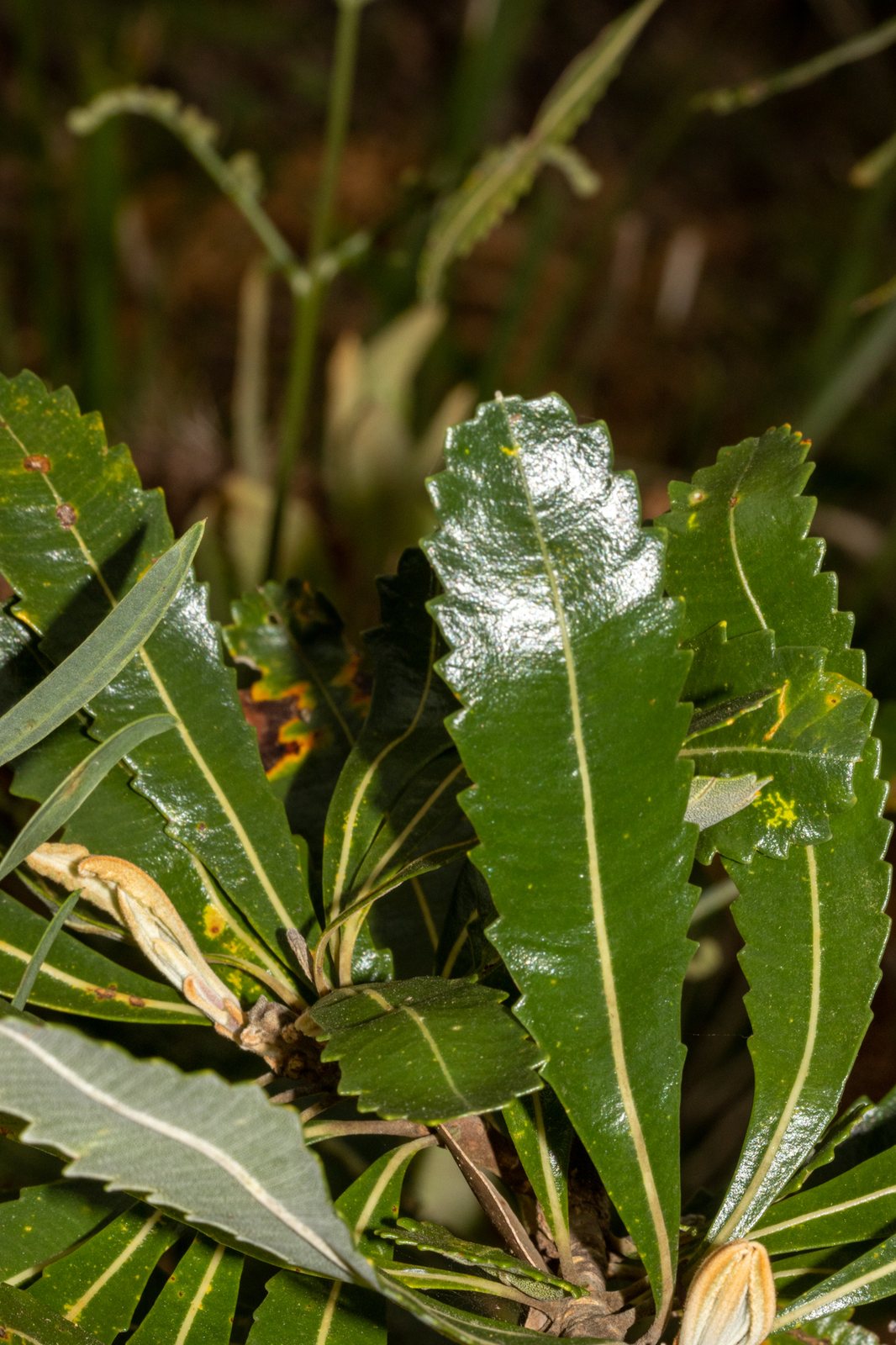
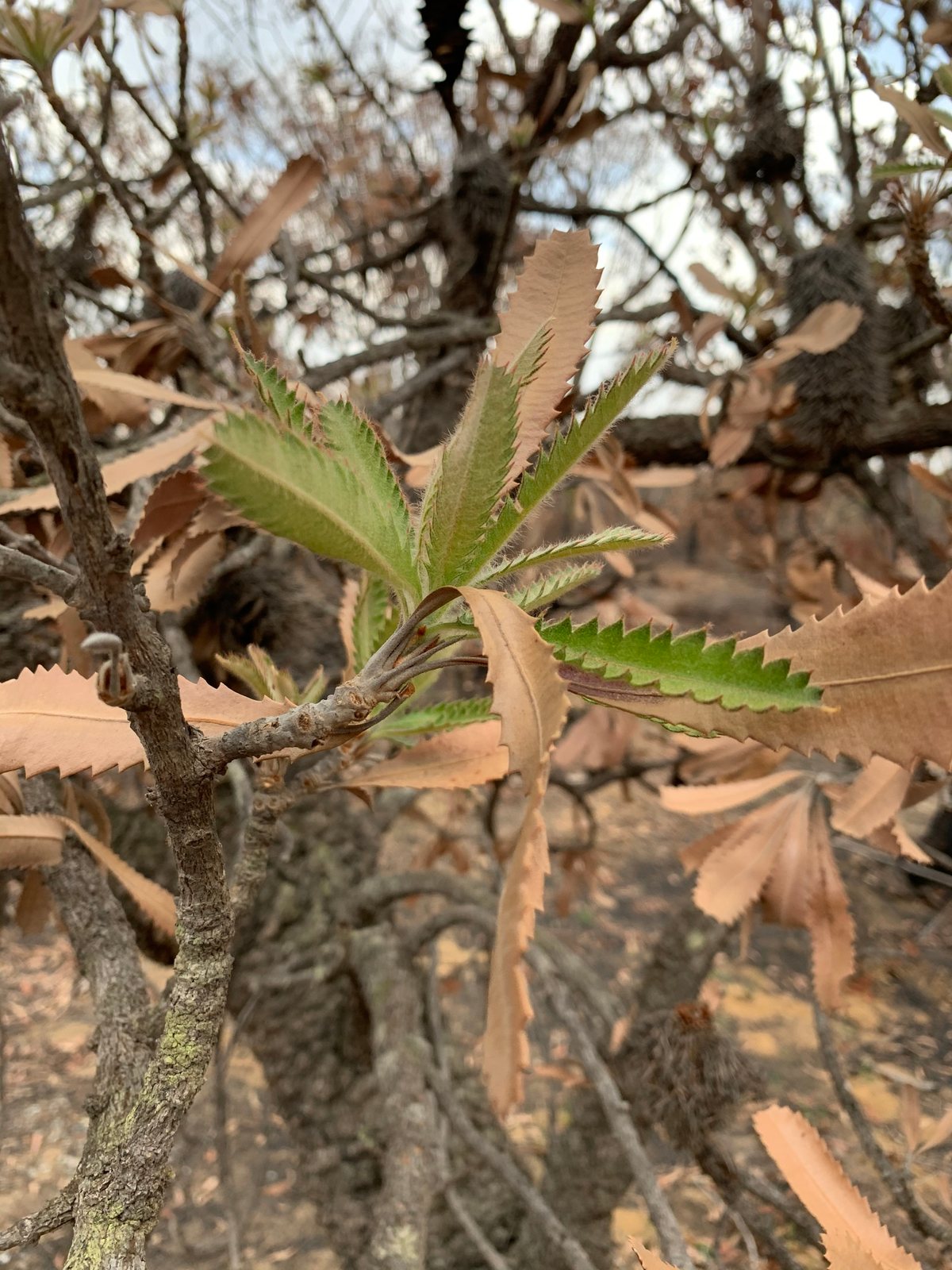
- Evergreen. Leathery, dark green leaves with conspicuous saw-toothed edges and paler undersides; thick, rough bark becomes deeply fissured with age.
- Growth
- Slow to moderate
- Care needed
- Low
The year at a glance
- Pollinators
- Drought tolerant
- Heat tolerant
- Wildlife
- Low allergen
| J | F | M | A | M | J | J | A | S | O | N | D | |
|---|---|---|---|---|---|---|---|---|---|---|---|---|
| Flowers | ||||||||||||
| Fruit | ||||||||||||
| Plant |
Northern hemisphere months. In Australia, shift them by six.
- Difficulty
- Hard
- Toughness
- Fairly tough
Will it suit your garden?
Pick your zone, country, light and whether you have pets.
Full sun is 6 or more hours of direct sun a day, part shade 3 to 6 hours, shade under 3.
How it grows
Planting day
7 ft (2 m)
After 1 year
8 ft (2.3 m)
After 2 years
9 ft (2.7 m)
After 3 years
10 ft (3 m)
After 5 years
12 ft (3.6 m)
About 26 years to full size.
From a typical nursery size, at an average rate for this kind of plant. A rule of thumb, not a forecast.
Good to know
- Cats and dogs
- Safe
- Native to
- Australia
- Growth rate
- Slow
Care
Jobs through the year
- WaterApr–May, Sep–Oct, every 21 days
- Check established ground trees and soak only during prolonged drought; young trees need more.
- WaterJun–Aug, every 14 days
- Deep-water established ground trees during prolonged dry weather; water young trees more often.
- FeedMay
- Feed only if needed after checking drainage and pH; use a banksia-safe low-phosphorus product.
- MulchMay
- Apply coarse bark or leaf litter lightly, keeping the trunk clear.
- PruneSep–Oct
- After flowering, lightly shape young trees if needed; do not top or routinely hard-prune.
- ProtectJan–Apr, Oct–Dec
- Requires frost-free conservatory culture in zones 6–7; a mature outdoor tree cannot be protected adequately.
- Plant with the root collar at soil level and leave enough room for a broad mature crown.
- Water deeply through the first two summers, letting the soil drain between waterings.
- Avoid general-purpose and high-phosphorus fertilisers; use a low-phosphorus native-plant feed only if needed.
- Apply a light mulch of coarse bark or leaf litter, keeping it clear of the trunk.
- Protect young plants from hard frost and avoid disturbing established roots.
Pruning. Prune lightly after flowering to shorten wayward shoots and encourage branching while the tree is young. Remove dead or damaged wood as needed, but avoid routine hard pruning or topping.
Through the year
- Spring
- Plant after hard frosts have passed in cooler climates; water thoroughly and mulch lightly.
- Late spring
- Check new growth for yellowing and review drainage and soil pH before applying any fertiliser.
- Summer
- Water young trees deeply during dry spells; allow the soil to drain between soakings.
- Late summer
- Watch developing flower spikes and check foliage for persistent scale infestations.
- Autumn
- After flowering finishes locally, lightly shape young trees and leave some cones for wildlife and winter structure.
- Winter
- Protect young trees during frost forecasts and check that rainwater is not collecting around the roots.
In the garden
- Use as a specimen tree where its fissured trunk and persistent cones can be seen at close range.
- Combine with grass trees, lomandra and kangaroo paws in a low-phosphorus Australian native planting.
- Plant in a spacious coastal garden for evergreen structure and tolerance of sandy soils and salt-laden wind.
- Include in a wildlife garden to provide nectar, shelter and seed.
Garden styles it suits: Australian native, Coastal, Wildlife garden, Architectural minimal, Dry gravel garden and Low-maintenance.
Plant it with: Coastal rosemary, Spiny-headed mat-rush, Grass tree, Kangaroo paw, Flannel flower and Coastal tea tree.
Wildlife: Nectar attracts honeyeaters and other nectar-feeding birds in Australia, as well as bees and other insects. Cockatoos extract seed from the woody cones, and mature trees provide shelter and perching sites.
Problems to watch for
- Phytophthora root rot: dieback and collapse are more likely in wet soil; improve drainage before planting and avoid moving contaminated soil or plants into the garden.
- Phosphorus toxicity: yellowing, browned leaf tips and poor growth can follow unsuitable feeding; stop phosphorus-rich fertilisers and use only products formulated for sensitive Australian natives.
- Scale insects: inspect stems and leaf undersides; encourage natural predators and treat accessible infestations with horticultural oil according to the label.
- Frost injury: young shoots may blacken after freezing weather; protect young trees and wait until spring growth begins before removing damaged wood.
Safety
Not known to be toxic to people, cats, dogs or horses, although specific safety information is limited. The leaves, flowers and woody cones should not be treated as food; hard cones and seed material can also pose a choking or obstruction risk if swallowed.
Easily confused with
Wallum banksia (Banksia aemula)
Very similar in leaf and flower, but usually has more orange-brown, warty bark rather than the deeply fissured grey bark of an old Banksia serrata. Reliable identification may require examination of the flowers.
Coast banksia (Banksia integrifolia)
Adult leaves usually have smooth margins, distinctly white undersides and a whorled arrangement; Banksia serrata retains strongly saw-toothed adult leaves.
Silver banksia (Banksia marginata)
Has much smaller, narrower leaves, usually with smooth or only lightly toothed edges, and smaller flower spikes.
The name
Banksia honours botanist Joseph Banks, serrata means saw-toothed in reference to the leaves, and old man banksia refers to the weathered, face-like appearance of the persistent woody cones.
Propagation. Usually grown from seed sown in spring in a freely draining, low-phosphorus seed mix. Obtain seed from mature woody cones or a reputable supplier; cuttings are possible but generally more difficult and slower.
Checked against open data
- Accepted botanical name
- Banksia serrata
- Native range
- New South Wales, Queensland, Tasmania and Victoria.
- Measured
- Average height 660 cm.
Sources: GBIF (CC BY 4.0) and Trefle (CC BY 4.0). The care and design notes are LandscapeGPT's own.
See it in your own yard.
Upload a photo of your yard and see it redesigned with plants that suit your climate, each checked against your zone.