Partridgeberry
Mitchella repens. Family Rubiaceae. Groundcover.
Also called Partridge berry, Squaw vine, Twinberry.
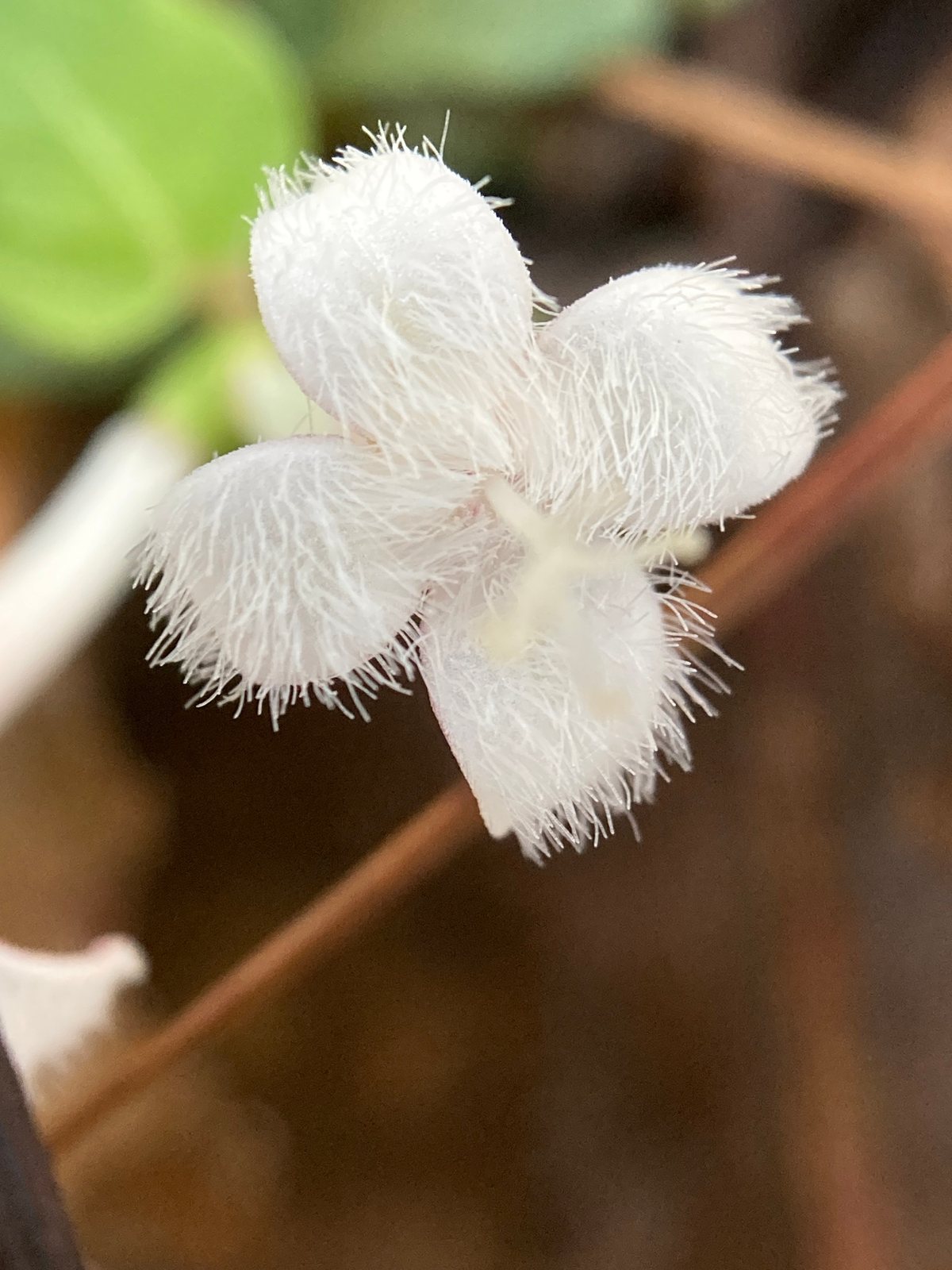
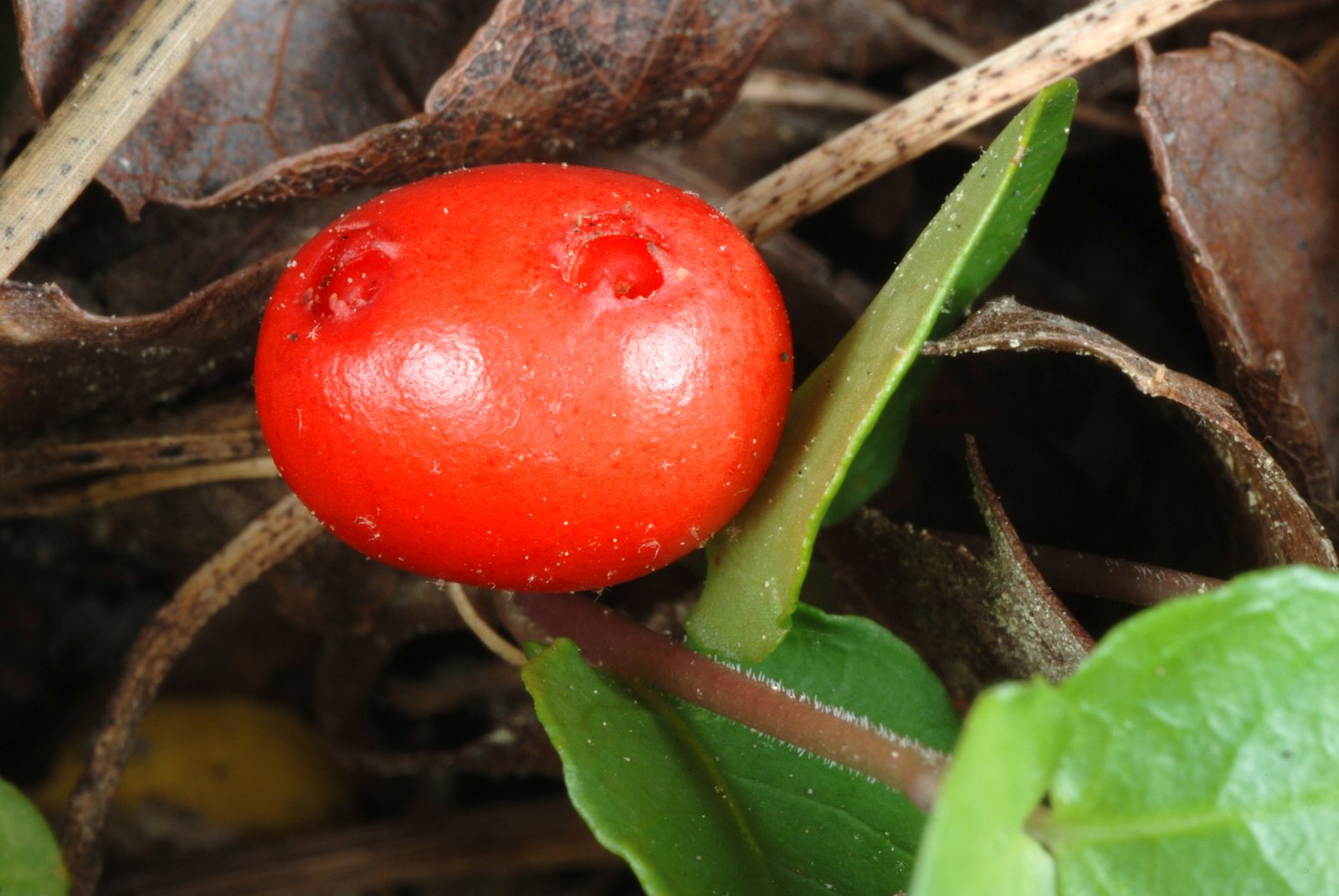
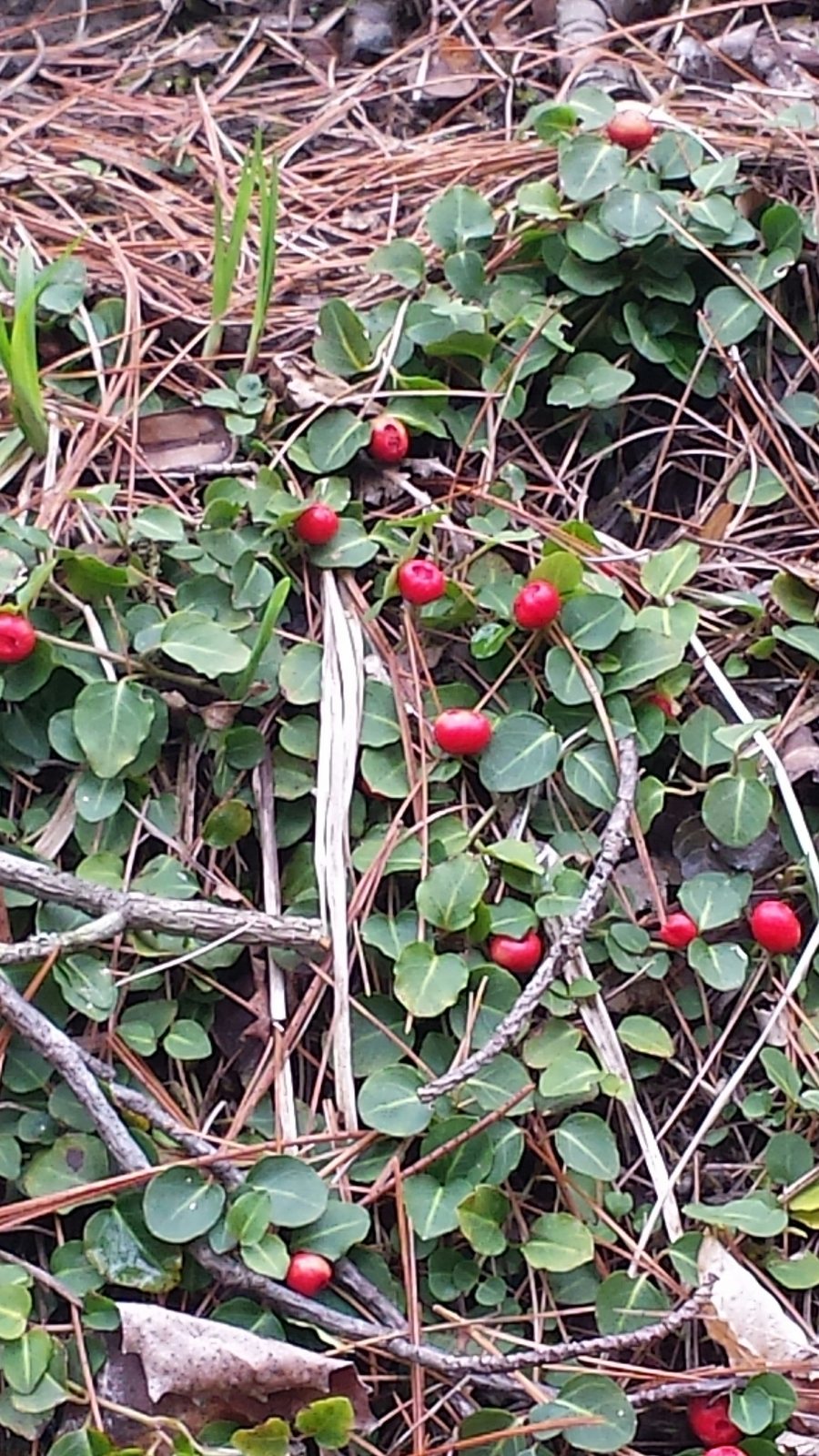
Partridgeberry is a low, creeping evergreen native to eastern North America, grown for its small glossy leaves, paired flowers and red berries that often persist through winter. It makes a slow-spreading carpet in shaded woodland gardens but is too delicate for foot traffic or competition from vigorous groundcovers.
At a glance
- Sun
- Partial to full shade; protect from strong afternoon sun.
- Water
- Keep evenly moist while establishing. Established plants tolerate brief dry spells in shade, but prolonged drought causes thinning.
- Soil
- Acidic, humus-rich soil that holds moisture but drains freely; avoid waterlogged ground and strongly alkaline soil.
- Height
- 0.1-0.25 ft (0.03-0.08 m)
- Spread
- 1-2 ft (0.3-0.6 m), eventually wider as stems root
- Flowers
- Late spring to early summer; small, fragrant white flowers, sometimes flushed pink, borne in pairs.
- Foliage
- Evergreen. Small, rounded, glossy dark green leaves in opposite pairs, often with a pale central vein.
- Growth
- Slow
- Care needed
- Low
The year at a glance
- Pollinators
- Cold hardy
- Wildlife
- Low allergen
- Fragrant
| J | F | M | A | M | J | J | A | S | O | N | D | |
|---|---|---|---|---|---|---|---|---|---|---|---|---|
| Flowers | ||||||||||||
| Fruit | ||||||||||||
| Plant |
Northern hemisphere months. In Australia, shift them by six.
- Difficulty
- Easy
- Toughness
- Fairly tough
Will it suit your garden?
Pick your zone, country, light and whether you have pets.
Full sun is 6 or more hours of direct sun a day, part shade 3 to 6 hours, shade under 3.
How it grows
Planting day
0 ft (0.01 m)
After 1 year
0.1 ft (0.02 m)
After 2 years
0.1 ft (0.03 m)
After 3 years
0.1 ft (0.04 m)
After 5 years
0.2 ft (0.06 m)
full size
About 4 years to full size.
From a typical nursery size, at an average rate for this kind of plant. A rule of thumb, not a forecast.
Good to know
- Cats and dogs
- Safe
- Native to
- the US and Canada
- Growth rate
- Slow
Care
Jobs through the year
- WaterApr–May, Sep–Oct, every 14 days
- Water established ground mats if soil is drying; keep new plants evenly moist.
- WaterJun–Aug, every 7 days
- Water established ground mats during dry spells, especially beneath trees; avoid saturation.
- PruneMar–Apr
- Snip out dead stems and trim unwanted spread back to a rooted section only if needed.
- DivideSep–Oct
- For propagation, separate rooted stem sections and replant promptly into moist acidic soil.
- MulchOct–Nov
- Add a light dressing of leaf mould around plants, keeping stems and foliage uncovered.
- ProtectOct–Dec
- Lift off heavy fallen leaves before they smother the evergreen mat.
- Water during the first growing season whenever the soil surface begins to dry.
- Work leaf mould into poor soil before planting; routine feeding is usually unnecessary.
- Apply a thin layer of leaf mould around plants, keeping creeping stems and leaves uncovered.
- Remove weeds by hand before they become established in the mat.
- Keep heavy fallen leaves from smothering the foliage, and avoid walking on plants.
Pruning. No regular pruning is needed. In spring, snip out dead stems and trim wandering growth back to a rooted section.
Through the year
- Spring
- Plant into moist, prepared soil and water thoroughly.
- Spring
- Remove damaged stems and gently clear accumulated leaves from the mat.
- Early summer
- Hand-weed around plants without disturbing their shallow roots.
- Summer
- Water during prolonged dry weather, especially beneath trees.
- Autumn
- Separate rooted stem sections for propagation and replant promptly.
- Late autumn
- Add a light dressing of leaf mould around plants without burying the foliage.
In the garden
- Carpet small areas beneath deciduous trees and shrubs where soil remains humus-rich.
- Edge a shaded path with evergreen foliage and winter berries, keeping plants outside the walking surface.
- Plant between ferns and other restrained woodland perennials to cover otherwise bare soil.
- Use beside mossy stones or decaying logs for a small-scale woodland planting.
Garden styles it suits: Woodland, Wildlife garden, Moss and fern garden, New England, Winter interest and Secret garden.
Plant it with: Christmas fern, Foamflower, Wild ginger, Rhododendrons and Mountain laurel.
Wildlife: Flowers attract small insect pollinators, including bees. The berries are eaten by some woodland birds and mammals; each berry develops from a pair of flowers and has two small blossom scars.
Problems to watch for
- Yellowing leaves and weak growth in alkaline soil: move to an acidic, leaf-mould-rich site rather than repeatedly applying corrective feeds.
- Root rot in saturated soil: improve drainage or relocate plants; do not keep the root zone waterlogged.
- Scorched or drying foliage: provide deeper shade and water during extended dry spells.
- Plants disappearing beneath weeds or heavy leaf litter: remove competition by hand and lift off thick accumulations of leaves.
Safety
Not known to be toxic to people, cats, dogs or horses. The berries are edible but bland; this does not establish the safety of medicinal preparations made from the leaves or stems.
Easily confused with
American wintergreen (Gaultheria procumbens)
Wintergreen has larger, alternate leaves with fine teeth and upright shoots bearing urn-shaped flowers. Partridgeberry has tiny opposite leaves, creeping stems and paired flowers.
Twinflower (Linnaea borealis)
Twinflower bears paired, nodding pink bells on slender upright stalks and does not produce partridgeberry's conspicuous red berries.
The name
Mitchella honours the botanist John Mitchell, while repens means creeping, describing the plant's trailing stems.
Propagation. Lift and separate naturally rooted stem sections in spring or autumn, keeping roots moist until replanted. Seed propagation is slow and requires patience because dormancy can delay germination.
Checked against open data
- Accepted botanical name
- Mitchella repens
- In the US and Canada
- Native in Canada, the lower 48 states and St. Pierre and Miquelon.
- Native range
- Alabama, Connecticut, Florida, Guatemala, Illinois, Kentucky, Louisiana, Maine, Maryland, Masachusettes, Mexico Northeast and Mexico Southeast.
- Measured
- Average height 6 cm.
Sources: GBIF (CC BY 4.0), USDA PLANTS and Trefle (CC BY 4.0). The care and design notes are LandscapeGPT's own.
See it in your own yard.
Upload a photo of your yard and see it redesigned with plants that suit your climate, each checked against your zone.