Pendulous sedge
Carex pendula. Family Cyperaceae. Ornamental grass.
Also called Hanging sedge, Great pendulous sedge.
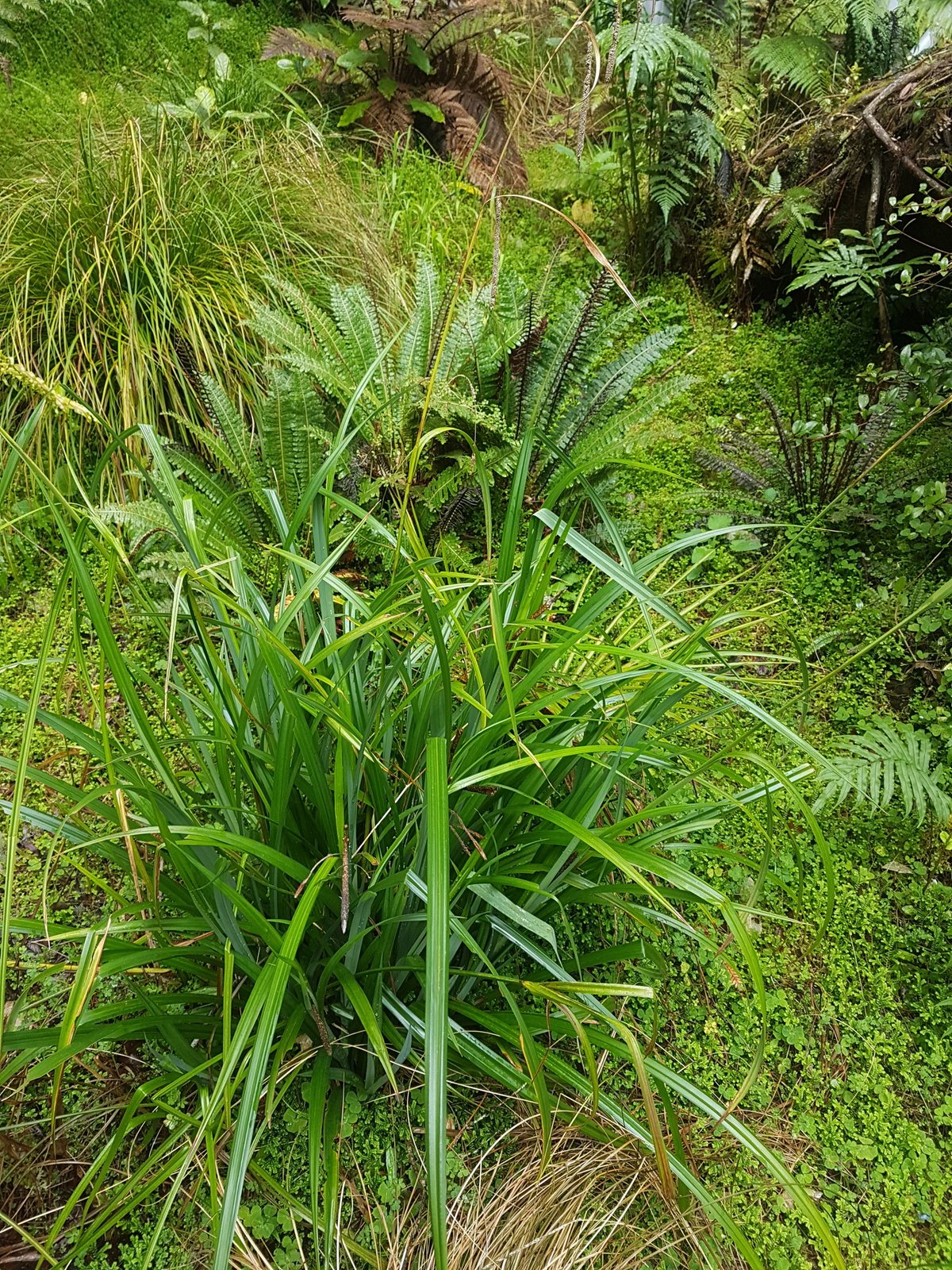
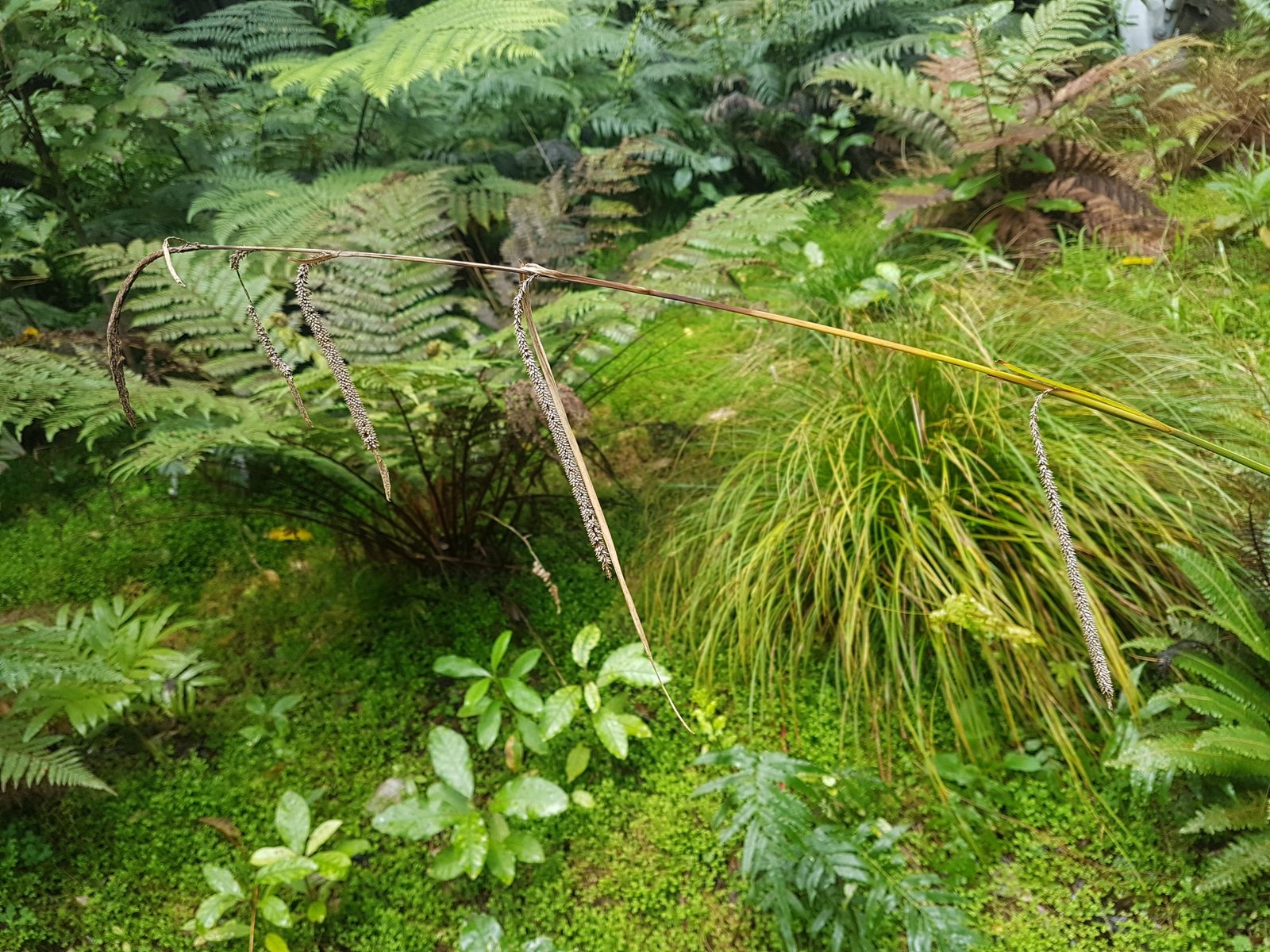
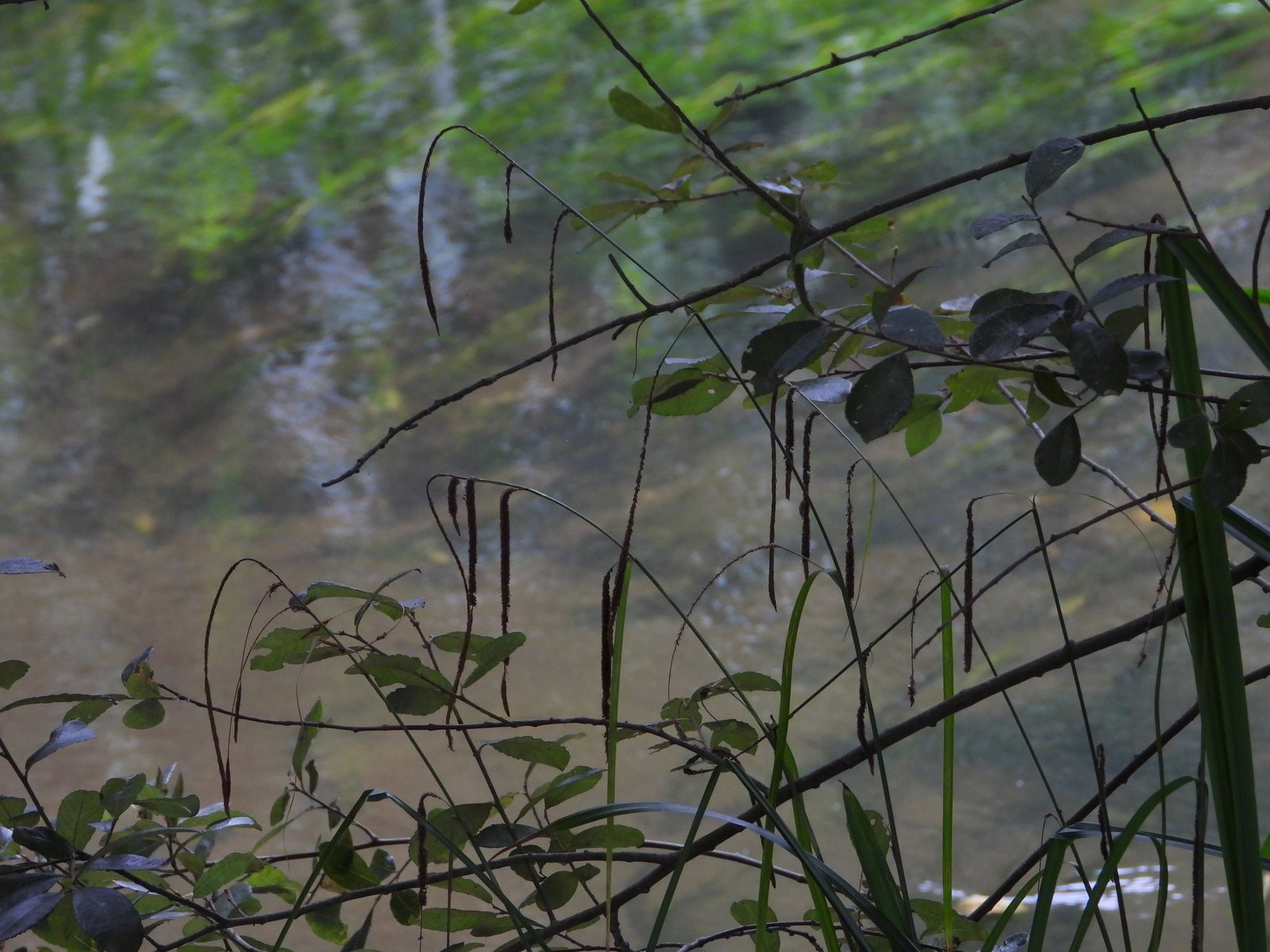
Pendulous sedge is a large, clump-forming sedge with arching evergreen leaves and long, dangling flower spikes. Gardeners grow it for bold texture in damp shade, but it seeds freely and can become difficult to control; avoid planting it where it is invasive.
At a glance
- Sun
- Partial shade is ideal; tolerates full shade and full sun if the soil stays moist.
- Water
- Keep consistently moist, especially during establishment. Established plants tolerate brief dry spells, but prolonged drought scorches the foliage.
- Soil
- Moist to wet, humus-rich soil, including heavy clay; tolerates a broad range of soil pH. Suitable for pond margins above the standing water level.
- Height
- 3-5 ft (0.9-1.5 m), including flower stems
- Spread
- 2-4 ft (0.6-1.2 m)
- Flowers
- Late spring to early summer; long, hanging greenish flower spikes mature to brown.
- Foliage
- Evergreen. Broad, glossy, dark green, strap-shaped leaves arch from a dense basal clump. Foliage may brown or die back in severe winters.
- Growth
- Fast
- Care needed
- Medium
The year at a glance
- Deer resistant
- Heat tolerant
- Wildlife
| J | F | M | A | M | J | J | A | S | O | N | D | |
|---|---|---|---|---|---|---|---|---|---|---|---|---|
| Flowers | ||||||||||||
| Fruit | ||||||||||||
| Plant |
Northern hemisphere months. In Australia, shift them by six.
- Difficulty
- Moderate
- Toughness
- Fairly tough
Will it suit your garden?
Pick your zone, country, light and whether you have pets.
Full sun is 6 or more hours of direct sun a day, part shade 3 to 6 hours, shade under 3.
How it grows
Planting day
1.1 ft (0.35 m)
After 1 year
2.9 ft (0.87 m)
After 2 years
4 ft (1.2 m)
full size
About 2 years to full size.
From a typical nursery size, at an average rate for this kind of plant. A rule of thumb, not a forecast.
Good to know
- Cats and dogs
- Safe
- Native to
- the UK
- Invasive in
- the US and Australia
- In the garden
- Spreads vigorously: plan to contain it.
- Growth rate
- Fast
Care
Jobs through the year
- WaterMar–May, Sep–Oct, every 7 days
- Check established plants and water if the root zone is drying; water young plants more often.
- WaterJun–Aug, every 3 days
- Check soil moisture and water deeply as needed to keep established clumps consistently moist.
- MulchMar–Apr
- Apply a thin compost mulch, keeping the crown clear.
- PruneFeb–Mar
- Remove dead and damaged leaves at the base without cutting healthy new growth.
- DeadheadJun–Jul
- Cut flower stems to ground level before seeds ripen to limit self-seeding.
- DivideMar–Apr
- Divide oversized clumps with a sharp spade and remove unwanted seedlings nearby.
- Water deeply during the first growing season and whenever the root zone begins to dry.
- Apply a thin layer of compost in spring; routine fertiliser is usually unnecessary.
- Mulch around the clump to conserve moisture, keeping mulch clear of the crown.
- Remove flower stems before seeds mature and pull seedlings while they are small.
- Divide oversized clumps in spring, using a sharp spade or saw through the dense root mass.
Pruning. In late winter or early spring, remove dead leaves and damaged foliage at the base without cutting into new growth. Cut spent flower stems to ground level before they shed seed.
Through the year
- Late winter
- Remove dead leaves and check nearby beds for seedlings.
- Spring
- Plant or divide clumps, water thoroughly and mulch the surrounding soil.
- Late spring
- Check moisture as flower stems develop, particularly in sunny sites.
- Early summer
- Cut off flower stems before the seeds ripen if self-seeding is unwanted.
- Summer
- Water during dry spells and remove scorched outer leaves.
- Autumn
- Pull young seedlings before their roots become firmly established.
In the garden
- Use as a bold foliage clump beside a shaded pond, where planting is locally appropriate.
- Combine with ferns and hostas in a moist woodland border for contrasting leaf shapes.
- Place behind lower shade plants to create a tall, arching green backdrop.
- Grow in a large container for architectural foliage, removing seed heads to prevent escape.
Garden styles it suits: Woodland, Bog garden, Architectural minimal, Green on green, English country and Pacific Northwest woodland.
Plant it with: Hostas, Male fern, Astilbes, Rodgersias, Siberian iris and Japanese primroses.
Wildlife: Dense clumps provide shelter for small invertebrates. Flowers are wind-pollinated and offer little value to nectar-feeding insects; outside its native range, dense stands can displace local wetland plants.
Problems to watch for
- Excessive self-seeding: remove flower stems before seed ripens and dig out seedlings promptly.
- Brown leaf tips or scorched foliage: restore even soil moisture and provide afternoon shade in hot sites.
- Winter-damaged leaves: trim damaged foliage in early spring once the worst cold has passed.
- Clumps outgrowing their space: divide in spring or replace with a smaller sedge.
Safety
Not known to be toxic to people, cats, dogs or horses; no poisonous parts are recognised. Leaf edges can cut skin, so wear gloves when handling or dividing it.
Where it spreads. Spreads readily by seed, including in UK gardens within its native range. It is invasive in parts of the Pacific Northwest, including Washington and Oregon, and parts of coastal California; it is also an environmental weed in parts of south-eastern Australia. Check local guidance before planting, and keep it away from natural waterways where it is non-native.
Easily confused with
Wood sedge (Carex sylvatica)
Much smaller and finer-textured, with narrower leaves and slender hanging spikes rather than the thick, long spikes of pendulous sedge.
Cyperus sedge (Carex pseudocyperus)
Has brighter yellow-green foliage and several dangling spikes clustered near the stem tip; pendulous sedge has darker, broader leaves and spikes spaced farther down the stem.
The name
The species name pendula means hanging or drooping, referring to the long flower spikes.
Propagation. Divide established clumps in spring and replant divisions promptly into moist soil. It also grows readily from seed and often produces abundant volunteer seedlings; avoid seed propagation where escape is a concern.
Checked against open data
- Accepted botanical name
- Carex pendula
- In the US and Canada
- Introduced in the lower 48 states.
- Native range
- Algeria, Belgium, Corse, Cyprus, Denmark, East Aegean Is., France, Germany, Great Britain, Greece, Hungary and Ireland.
- Measured
- Average height 105 cm.
Sources: GBIF (CC BY 4.0), USDA PLANTS and Trefle (CC BY 4.0). The care and design notes are LandscapeGPT's own.
See it in your own yard.
Upload a photo of your yard and see it redesigned with plants that suit your climate, each checked against your zone.