Persian shield
Strobilanthes dyerianus. Family Acanthaceae. Shrub.
Also called Royal purple plant.
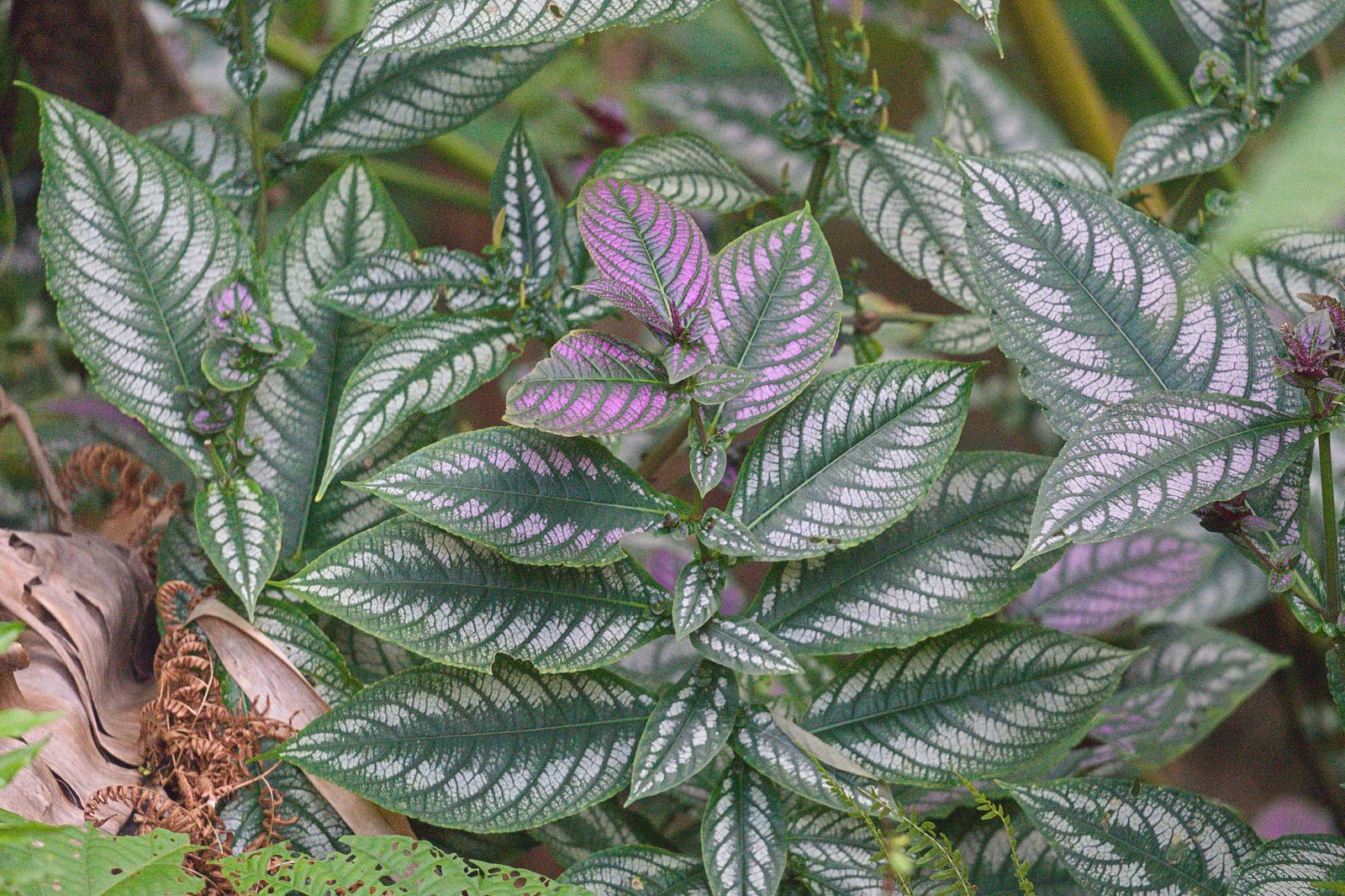
Persian shield is a frost-tender evergreen shrub from Myanmar, grown for its metallic purple leaves with dark green veins. It is grown as an annual in cooler climates, or kept in a container and overwintered indoors; it can remain outdoors year-round in reliably frost-free gardens.
At a glance
- Sun
- Partial shade, ideally morning sun and afternoon shade. Strong afternoon sun can scorch the leaves, while deep shade reduces their purple colour.
- Water
- Keep the root zone evenly moist but not waterlogged. Water when the surface begins to dry; containers may need daily checks in hot weather.
- Soil
- Humus-rich, moisture-retentive soil with good drainage. Use a free-draining potting mix in containers.
- Height
- 3-4 ft (0.9-1.2 m)
- Spread
- 2-3 ft (0.6-0.9 m)
- Foliage
- Evergreen. Large, pointed, slightly puckered leaves with an iridescent purple and silver sheen, dark green veins and purple undersides.
- Growth
- Fast in warm weather
- Care needed
- Medium
The year at a glance
- Heat tolerant
- Low allergen
| J | F | M | A | M | J | J | A | S | O | N | D | |
|---|---|---|---|---|---|---|---|---|---|---|---|---|
| Plant |
Northern hemisphere months. In Australia, shift them by six.
- Difficulty
- Moderate
- Toughness
- Needs looking after
Will it suit your garden?
Pick your zone, country, light and whether you have pets.
Full sun is 6 or more hours of direct sun a day, part shade 3 to 6 hours, shade under 3.
How it grows
Planting day
1.6 ft (0.5 m)
After 1 year
2.2 ft (0.67 m)
After 2 years
2.8 ft (0.84 m)
After 3 years
3 ft (1 m)
After 5 years
3 ft (1.1 m)
full size
About 3 years to full size.
From a typical nursery size, at an average rate for this kind of plant. A rule of thumb, not a forecast.
Good to know
- Cats and dogs
- Safe
- Growth rate
- Fast
Care
Jobs through the year
- WaterMay, Sep, every 7 days
- Keep established ground plants evenly moist; water sooner if drying, especially while young.
- WaterJun–Aug, every 3 days
- Water established ground plants as the surface dries; check containers daily in hot weather.
- WaterJan–Apr, Oct–Dec, every 10 days
- For indoor plants, water when the surface begins drying; never let the root ball dry completely.
- FeedApr–Aug, every 21 days
- Feed actively growing container plants with half-strength balanced liquid fertiliser.
- MulchJun
- Apply a light organic mulch around outdoor plants, keeping stems clear.
- PruneMar–Apr
- Shorten leggy overwintered stems above a leaf pair as strong growth resumes.
- PruneMay–Aug, every 21 days
- Pinch shoot tips as needed to maintain a bushy shape.
- ProtectMay–Jun
- Plant out only after frost and cold nights; acclimatise gradually and provide afternoon shade.
- ProtectJan–Apr, Sep–Dec
- Bring plants indoors before nights fall below 10°C and keep warm in bright, indirect light.
- Plant outdoors only after frost risk has passed and nights are consistently warm.
- Water at soil level before the root ball dries out completely; empty standing water from saucers.
- Feed container plants with a balanced liquid fertiliser at half strength every two to four weeks during active growth.
- Apply a light organic mulch around outdoor plants, keeping it clear of the stems.
- Bring containers indoors before nights regularly fall below 50°F (10°C), and provide bright, indirect light.
- Reduce watering indoors during slow winter growth, without letting the root ball become completely dry.
Pruning. Pinch out shoot tips during spring and summer to encourage branching. Shorten leggy stems in spring as strong growth resumes, cutting just above a pair of leaves.
Through the year
- Spring
- Trim overwintered plants, repot if root-bound and resume feeding when new growth starts.
- Late spring
- Gradually acclimatise indoor plants to outdoor conditions, then plant out once nights are warm and frost risk has passed.
- Early summer
- Pinch shoot tips and take soft stem cuttings for replacement plants.
- Summer
- Check soil moisture frequently and protect foliage from harsh afternoon sun.
- Early autumn
- Bring containers or rooted cuttings indoors before chilly nights damage the foliage.
- Winter
- Keep protected plants warm and bright, water sparingly and inspect for indoor pests.
In the garden
- Use as the central foliage plant in a large shaded patio container, surrounded by smaller trailing plants.
- Repeat groups through a sheltered tropical-style border to carry purple colour between flowering plants.
- Pair with lime-green coleus or golden sweet potato vine for a strong foliage contrast.
- Place beside broad green elephant ears or ferns to contrast its pointed, metallic leaves with softer green foliage.
Garden styles it suits: Tropical, Modern tropical, Modern courtyard, Urban city garden, Victorian and Small-space.
Plant it with: Coleus, Impatiens, Wax begonias, Elephant ears, Sweet potato vine and Boston fern.
Wildlife: Grown mainly for foliage rather than wildlife value. Its small lavender flowers may attract visiting insects where flowering occurs, but it is not a dependable nectar plant in cool-climate gardens.
Problems to watch for
- Spider mites cause stippling and fine webbing, particularly indoors: rinse leaf undersides and use insecticidal soap labelled for the pest, testing a small area first.
- Whiteflies gather beneath leaves: isolate affected containers and treat leaf undersides with an appropriately labelled insecticidal soap.
- Root rot develops in persistently wet soil: improve drainage, empty saucers and allow the surface to begin drying between waterings.
- Scorched, faded or wilted leaves can result from strong sun, dry roots or cold: provide afternoon shade, steady moisture and protection from chilly nights.
Safety
Not known to be toxic to cats, dogs, horses or people, but species-specific safety information is limited. No plant part is established as a serious poisoning hazard; it is ornamental, not edible, and chewing plant material may cause stomach upset.
Easily confused with
Coleus (Coleus scutellarioides)
Purple coleus can have similar colouring, but usually has more obviously scalloped or toothed leaves and square stems; Persian shield has elongated leaves with a distinctive metallic sheen and dark green vein pattern.
Purple waffle plant (Strobilanthes alternata)
Purple waffle plant is low and spreading, with smaller, rounder, deeply puckered leaves. Persian shield grows upright and has much larger, pointed leaves.
The name
The common name refers to the shield-like shape and metallic appearance of the leaves, rather than its origin in Myanmar.
Propagation. Take non-flowering stem cuttings in spring or summer. Remove the lower leaves and root the cuttings in moist propagation mix in warmth and bright, indirect light; small rooted plants are easier to overwinter than large specimens.
Checked against open data
- Accepted botanical name
- Strobilanthes auriculata dyeriana Strobilanthes dyerianus is an older name for Strobilanthes auriculata dyeriana.
Sources: GBIF (CC BY 4.0). The care and design notes are LandscapeGPT's own.
See it in your own yard.
Upload a photo of your yard and see it redesigned with plants that suit your climate, each checked against your zone.