Pineapple guava
Acca sellowiana. Family Myrtaceae. Shrub.
Also called Feijoa, Guavasteen.
Pineapple guava is an evergreen shrub or small tree grown for its silver-backed leaves, edible flower petals and aromatic green fruit. It makes a useful hedge or specimen in mild climates, but reliable fruiting needs a sunny, sheltered position and a sufficiently long, warm growing season.
At a glance
- Sun
- Full sun for flowering and fruiting; tolerates partial shade with fewer flowers and fruit.
- Water
- Water regularly while establishing. Established plants tolerate dry spells, but need consistent moisture during flowering and fruit development for a good crop.
- Soil
- Well-drained soil, preferably slightly acidic to neutral. Tolerates sandy soils and some clay, provided roots do not sit in water.
- Height
- 10-20 ft (3-6 m)
- Spread
- 10-15 ft (3-4.5 m)
- Flowers
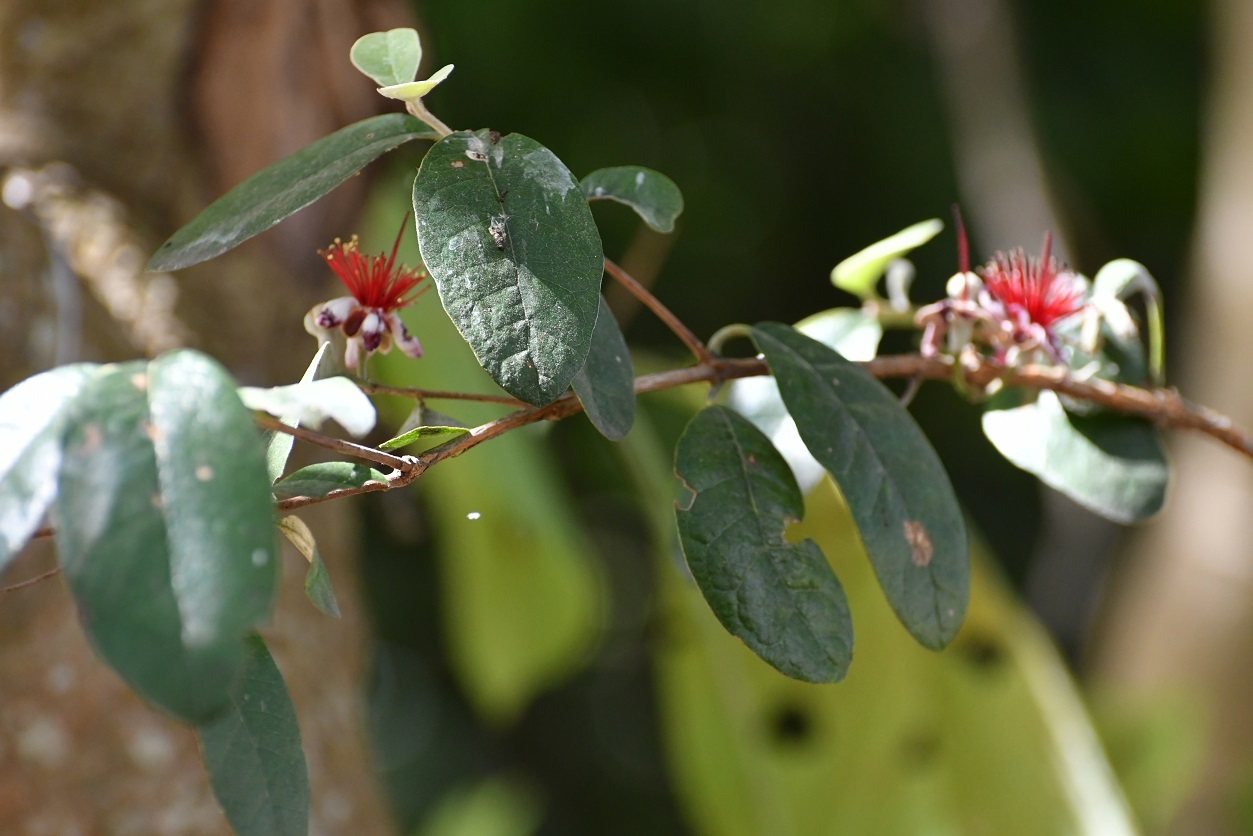
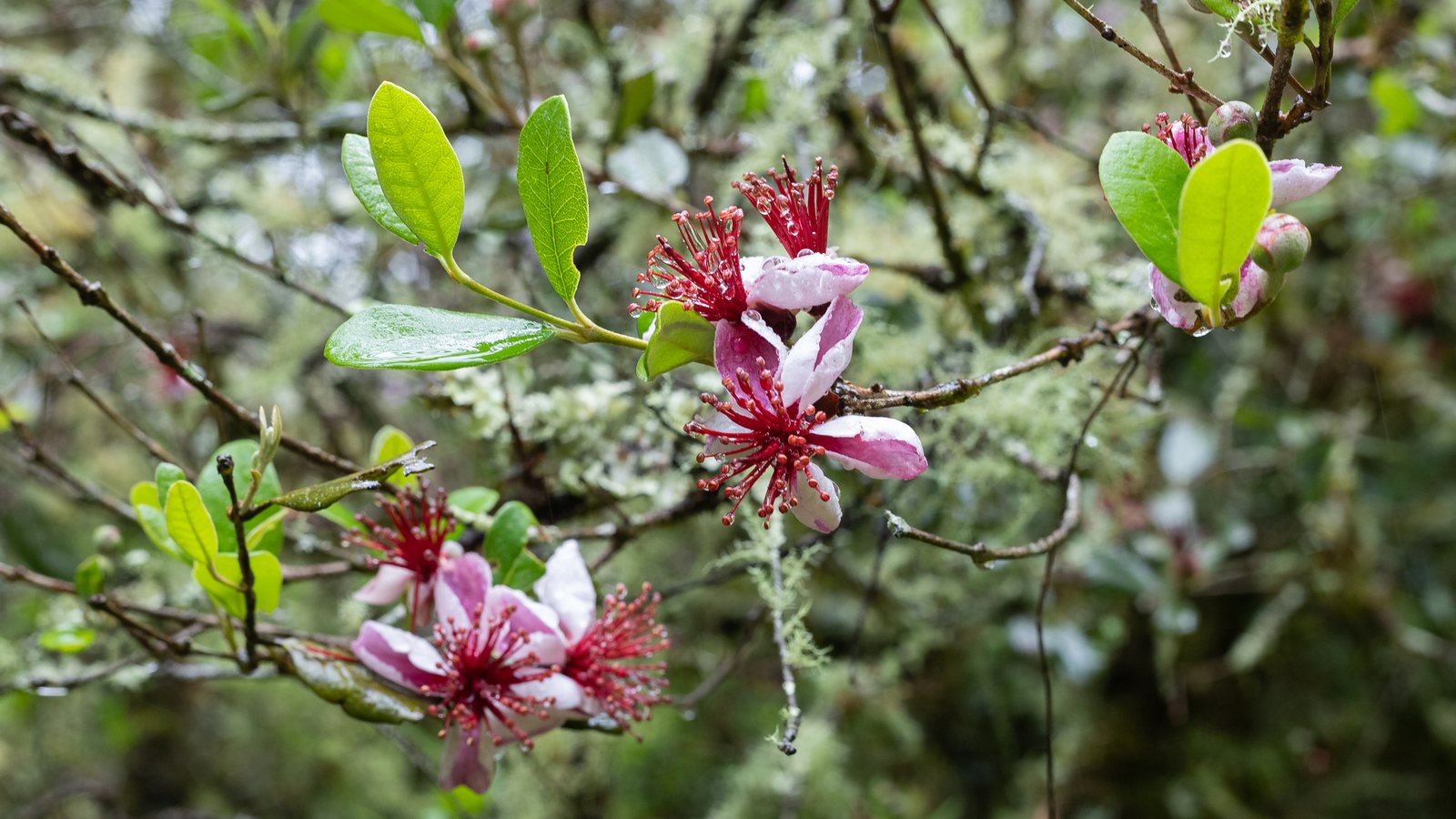
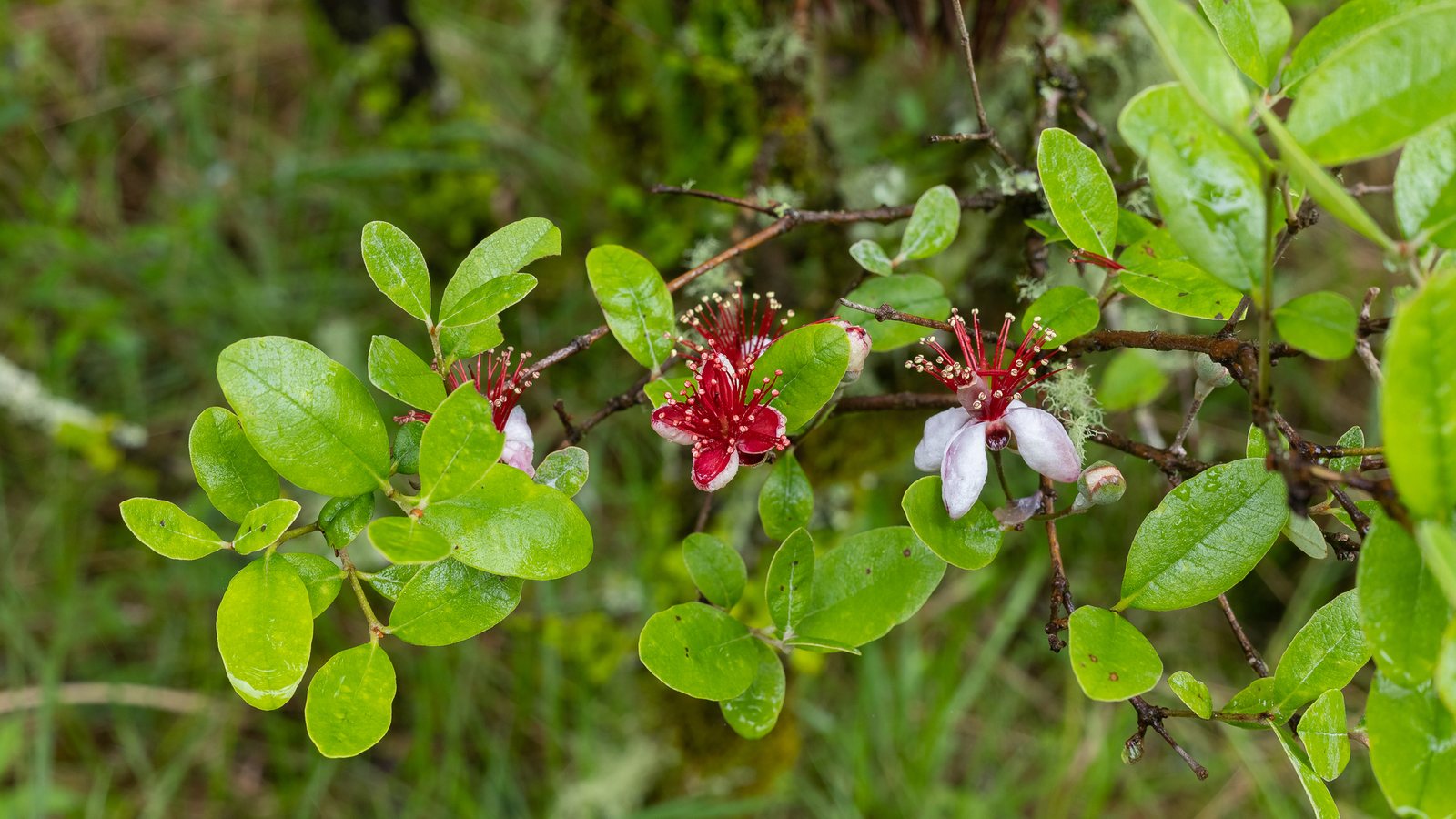
- Late spring to early summer; fleshy white petals, flushed pink inside, surrounding conspicuous red stamens.
- Foliage
- Evergreen. Opposite, oval, leathery leaves with grey-green upper surfaces and silvery, felted undersides.
- Growth
- Slow to moderate.
- Care needed
- Low
The year at a glance
- Pollinators
- Drought tolerant
- Heat tolerant
- Wildlife
- Low allergen
- Fragrant
- Edible
| J | F | M | A | M | J | J | A | S | O | N | D | |
|---|---|---|---|---|---|---|---|---|---|---|---|---|
| Flowers | ||||||||||||
| Fruit | ||||||||||||
| Plant |
Northern hemisphere months. In Australia, shift them by six.
- Difficulty
- Moderate
- Toughness
- Fairly tough
Will it suit your garden?
Pick your zone, country, light and whether you have pets.
Full sun is 6 or more hours of direct sun a day, part shade 3 to 6 hours, shade under 3.
How it grows
Planting day
1.8 ft (0.54 m)
After 1 year
4 ft (1.1 m)
After 2 years
6 ft (1.8 m)
After 3 years
8 ft (2.4 m)
After 5 years
12 ft (3.6 m)
About 7 years to full size.
From a typical nursery size, at an average rate for this kind of plant. A rule of thumb, not a forecast.
Good to know
- Cats and dogs
- Safe
- Growth rate
- Slow
Care
Jobs through the year
- WaterApr–May, Sep–Oct, every 14 days
- Deep-water established ground plants when dry; young plants and containers need more frequent watering.
- WaterJun–Aug, every 7 days
- Maintain moisture during flowering and fruit swelling without waterlogging.
- WaterJan–Mar, Nov–Dec, every 21 days
- For sheltered containers, water sparingly only when compost begins to dry.
- MulchApr–May
- Apply 5–8 cm of organic mulch, leaving the trunk clear.
- PruneMar–Apr
- After severe frost risk, remove dead or crossing branches without routine hedge clipping.
- ProtectMay–Jun, every 7 days
- If fruit set is poor, brush pollen between flowers on genetically different plants.
- ProtectOct–Nov
- In zones 6–7, move container plants into bright frost-protected shelter; outdoor cropping is unreliable.
- HarvestOct–Nov
- Collect freshly fallen ripe fruit daily; cool summers may prevent ripening.
- Plant in a sunny position sheltered from severe frost and cold, drying winds.
- Water deeply during dry weather for the first two growing seasons, then during prolonged drought and fruit development.
- Apply a 2-3 in (5-8 cm) organic mulch, keeping it clear of the trunk.
- Feed lightly in spring if growth is weak; avoid excessive nitrogen, which encourages leaves rather than fruit.
- For better fruit set, plant two genetically different plants that flower together; self-fertility varies between cultivars.
- Protect container roots from freezing and provide winter shelter where outdoor temperatures fall below its reliable range.
Pruning. Prune lightly in late winter or early spring, after the worst frosts, removing dead, crossing or crowded branches. To form a small tree, gradually remove lower branches; repeated hedge clipping reduces flowers and fruit.
Harvest
Harvest the green fruit in autumn, usually September–December in the US, October–November in the UK and mild coastal Canada, and March–June in Australia. Ripe fruit is fragrant, yields slightly to gentle pressure and detaches easily; collect freshly fallen fruit daily rather than pulling off hard, firmly attached fruit.
Through the year
- Late winter
- Remove damaged and crossing branches after severe frost risk has passed.
- Spring
- Plant when the soil is workable, renew mulch and feed lightly if needed.
- Late spring
- During flowering, hand-pollinate with a soft brush if fruit set has been poor, ideally transferring pollen between different plants.
- Summer
- Water during prolonged dry spells, especially while fruit is swelling.
- Autumn
- Collect fallen ripe fruit frequently; use promptly because it bruises and deteriorates quickly.
- Late autumn
- Move container plants into a bright, frost-protected position where winters are too cold.
In the garden
- Grow as an informal evergreen hedge or screen, allowing enough width to avoid constant clipping.
- Train as a small multi-stemmed tree beside a patio, where the flowers and silvery leaf undersides can be seen closely.
- Combine with rosemary, lavender and olive for a dry-climate planting with contrasting leaf textures.
- Use in an edible garden with other mild-climate fruiting shrubs, leaving clear ground beneath for collecting fallen fruit.
Garden styles it suits: Mediterranean, Coastal, Edible landscape, Backyard orchard, Modern courtyard and Low-maintenance.
Plant it with: Rosemary, Lavender, Rockrose, Agapanthus, Olive and Strawberry tree.
Wildlife: Flowers provide pollen for visiting insects, and birds may eat the fleshy petals and help pollinate them. Ripe and fallen fruit can attract birds and mammals.
Problems to watch for
- Few or no fruit: improve sun exposure, maintain moisture during flowering and add a genetically different pollination partner; hand-pollinate if necessary. Cool summers may still prevent ripening.
- Scale insects and sooty mould: inspect stems and leaf undersides, control ants where present and treat scale with a locally approved horticultural oil according to its label.
- Fruit fly in affected regions, including parts of Australia: collect fallen fruit promptly and use locally recommended exclusion bags, netting or baiting programmes.
- Yellowing or declining growth in wet soil: reduce irrigation and improve drainage; plant on a raised mound where drainage is poor.
Safety
Not known to be toxic to people, cats, dogs or horses. Ripe fruit and flower petals are edible for people; information on livestock and pet consumption of leaves and other parts is limited. Large amounts of fruit may cause digestive upset.
Easily confused with
Common guava (Psidium guajava)
Common guava has prominently veined leaves without the dense silvery felt underneath, and white flowers with white rather than bright red stamens.
Strawberry guava (Psidium cattleyanum)
Strawberry guava has glossy leaves without silver-felted undersides, white stamens and smaller, rounded red or yellow fruit.
Olive (Olea europaea)
Olive has much narrower leaves, small cream flowers in clusters and fruit containing a single hard stone.
The name
The common name refers to the fruit's pineapple-like aroma and its resemblance to guava.
Propagation. Sow fresh seed, but expect variable seedlings that may take several years to fruit. Use semi-ripe cuttings in summer or grafting to preserve a named cultivar; cuttings can be slow and unreliable to root.
Checked against open data
- Accepted botanical name
- Feijoa sellowiana Acca sellowiana is an older name for Feijoa sellowiana.
- Native range
- Argentina Northeast, Brazil South, Brazil Southeast and Uruguay.
- Measured
- Average height 450 cm.
Sources: GBIF (CC BY 4.0) and Trefle (CC BY 4.0). The care and design notes are LandscapeGPT's own.
See it in your own yard.
Upload a photo of your yard and see it redesigned with plants that suit your climate, each checked against your zone.