Pistachio
Pistacia vera. Family Anacardiaceae. Tree.
Also called Edible pistachio.
Pistachio is a deciduous tree grown for its edible nuts, rounded crown and grey-green leaves. Reliable crops need long, hot, dry summers, enough winter chill and both male and female trees with overlapping flowering times. It suits dry inland districts of the United States and Australia; outdoor nut production is generally unreliable in the United Kingdom and most of Canada.
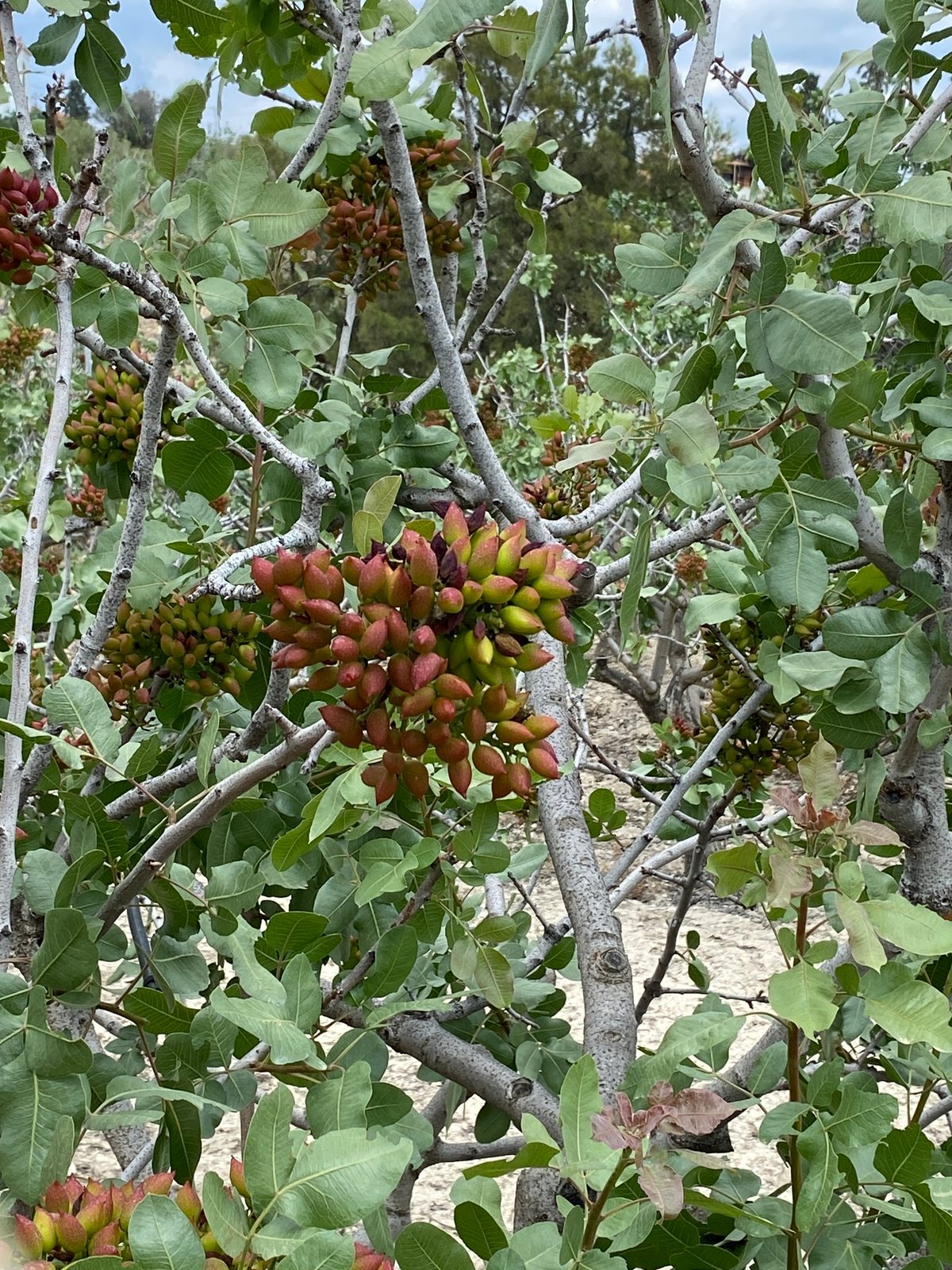
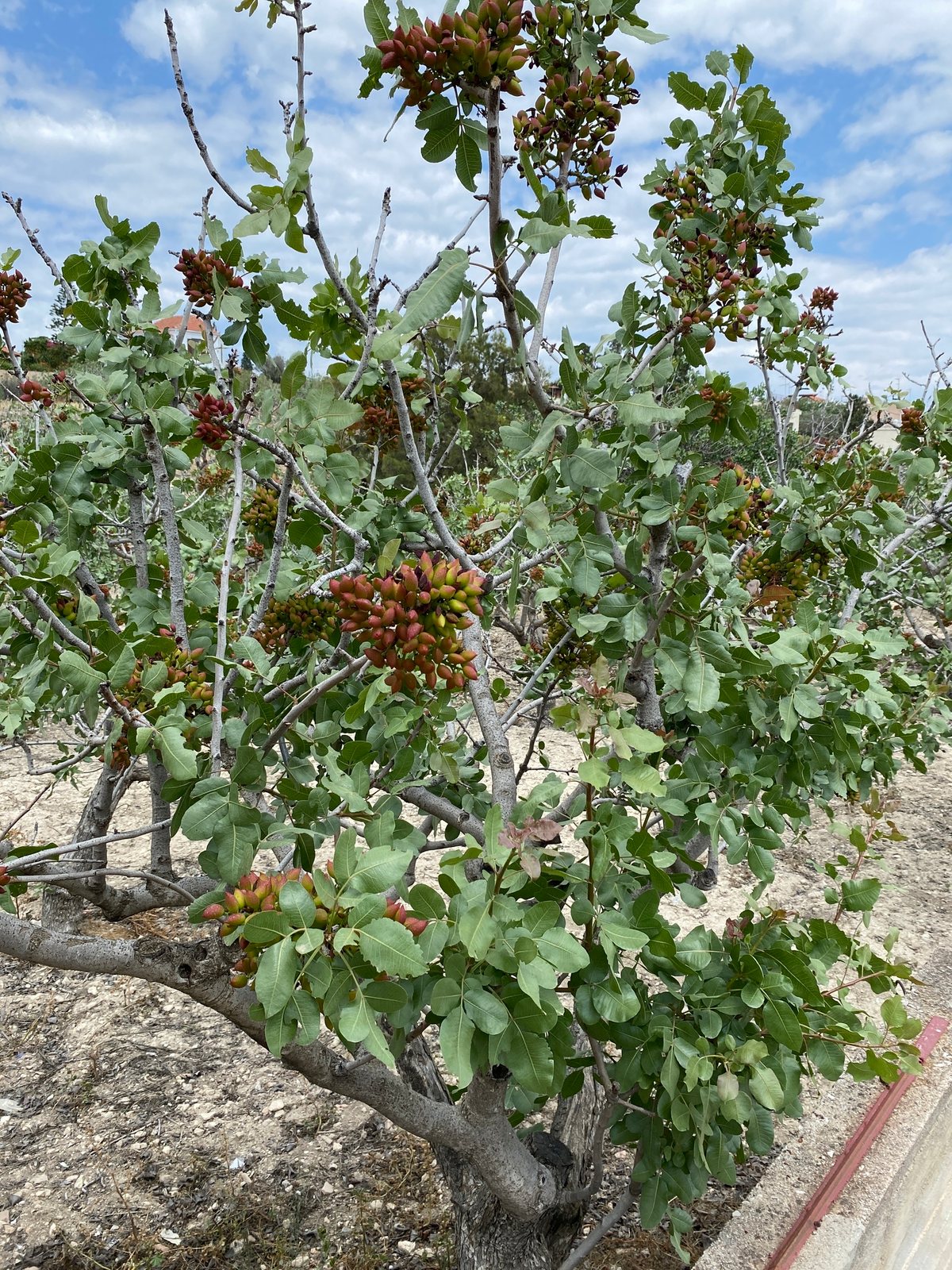
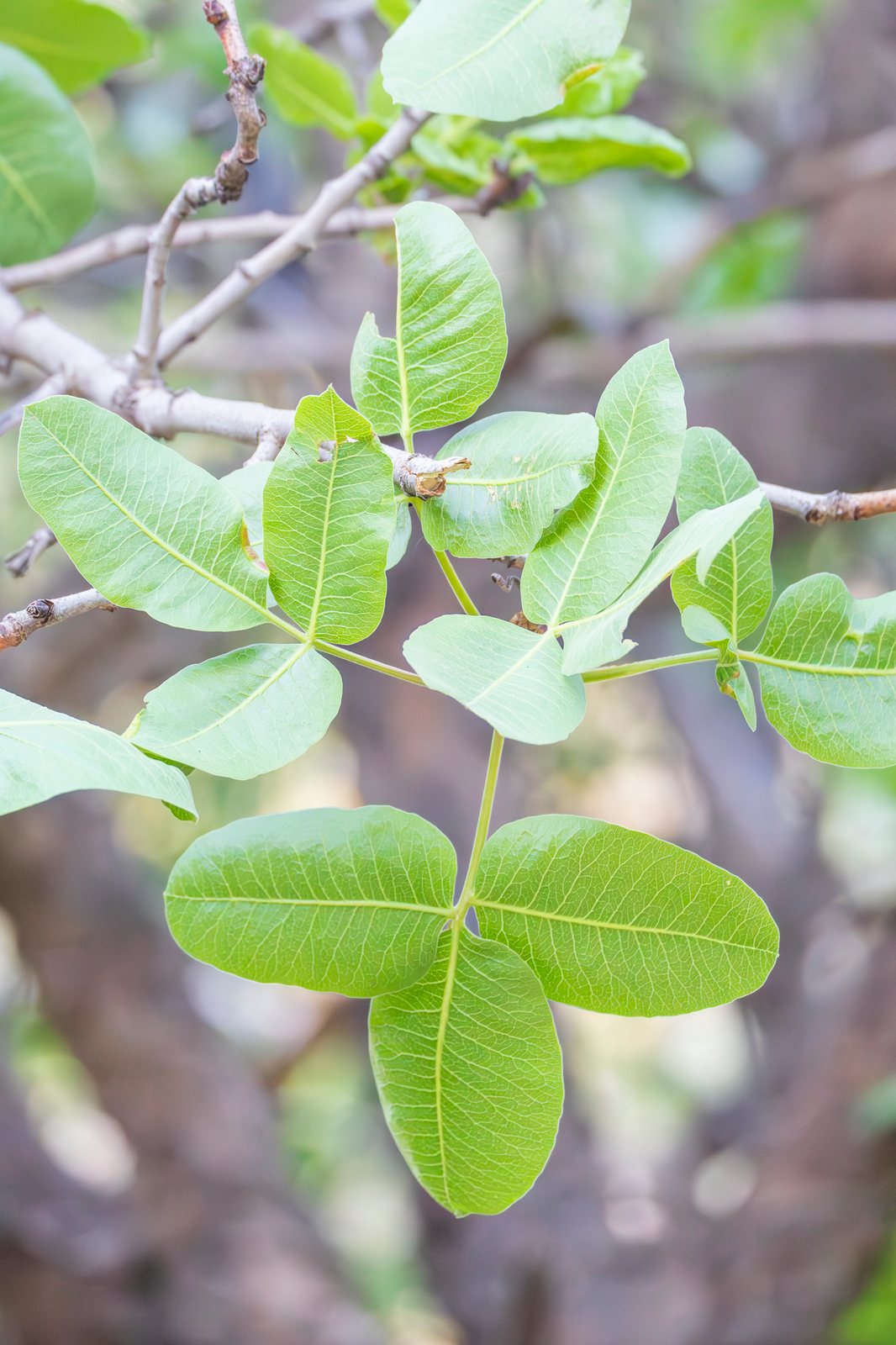
At a glance
- Sun
- Full sun in an open position; avoid frost pockets and humid, poorly ventilated sites.
- Water
- Drought-tolerant once established, but crops better with deep irrigation during dry weather; avoid waterlogged soil.
- Soil
- Deep, well-drained sandy loam or loam; tolerates alkaline soil and some salinity. Drainage matters more than fertility.
- Height
- 20-30 ft (6-9 m)
- Spread
- 20-30 ft (6-9 m)
- Flowers
- Spring; small, inconspicuous greenish to reddish flowers in separate male and female clusters.
- Foliage
- Leathery, grey-green compound leaves, usually with three to five broad leaflets; often yellow or orange in autumn.
- Growth
- Slow to moderate
- Care needed
- Medium
The year at a glance
- Drought tolerant
- Heat tolerant
- Wildlife
- Edible
| J | F | M | A | M | J | J | A | S | O | N | D | |
|---|---|---|---|---|---|---|---|---|---|---|---|---|
| Flowers | ||||||||||||
| Fruit | ||||||||||||
| Plant |
Northern hemisphere months. In Australia, shift them by six.
- Difficulty
- Hard
- Toughness
- Fairly tough
Will it suit your garden?
Pick your zone, country, light and whether you have pets.
Full sun is 6 or more hours of direct sun a day, part shade 3 to 6 hours, shade under 3.
How it grows
Planting day
7 ft (2 m)
After 1 year
7 ft (2.2 m)
After 2 years
8 ft (2.4 m)
After 3 years
9 ft (2.6 m)
After 5 years
10 ft (3.1 m)
About 26 years to full size.
From a typical nursery size, at an average rate for this kind of plant. A rule of thumb, not a forecast.
Good to know
- Cats and dogs
- Safe
- Growth rate
- Slow
Care
Jobs through the year
- WaterApr–May, Oct, every 21 days
- Water established trees only if soil is dry; young trees need more frequent watering.
- WaterJun–Sep, every 14 days
- Irrigate established cropping trees deeply in dry weather; let the soil surface dry between waterings.
- PruneFeb–Mar
- Train young trees to well-spaced branches; prune established trees lightly, preserving fruiting wood.
- MulchApr
- Mulch the grass-free root area lightly, leaving the trunk base uncovered.
- FeedApr
- Feed modestly only for weak growth or confirmed nutrient deficiency.
- ProtectJan–Apr, Nov–Dec
- Protect young trees from severe frost; reliable cropping also requires long, hot summers.
- HarvestAug–Oct
- Pick when hulls colour and separate readily; remove hulls and dry nuts promptly.
- PruneNov
- Remove all leftover nuts from branches and the ground to reduce overwintering pests.
- Plant a grafted female and a compatible male whose flowering overlaps; one male can pollinate several nearby females.
- Choose cultivars suited to your local winter chill and summer heat; hardiness alone does not guarantee nuts.
- Water young trees deeply through dry spells, allowing the soil surface to dry between waterings.
- For established cropping trees, irrigate deeply during nut development without keeping the root zone saturated.
- Keep grass away from the trunk and apply organic mulch, leaving the trunk base clear.
- Feed modestly in spring if growth is weak; use soil or leaf testing before adding extra nutrients.
Pruning. In late winter, train young trees to a strong framework of well-spaced branches. Prune established trees lightly to remove dead, crossing or crowded growth, preserving healthy fruiting wood.
Harvest
Grafted trees commonly take about 5-8 years from planting to give a useful crop, with heavier production later and often alternating heavy and light years. Harvest in late summer or autumn when the outer hull changes colour and separates readily; many ripe shells will have split naturally. Shake or pick nuts onto clean sheets, then remove the hulls and dry the nuts promptly.
Through the year
- Winter
- Plant while dormant where the soil is workable and well drained; confirm that male and female flowering times match.
- Late winter
- Train young trees and remove dead, damaged or crossing branches.
- Spring
- Check that both sexes flower together; maintain even moisture as growth begins.
- Summer
- Irrigate deeply during dry spells and check developing nuts for insect damage.
- Late summer
- Begin checking hull colour and ease of separation; harvest promptly as nuts ripen.
- Autumn
- Remove leftover nuts from the tree and ground to reduce overwintering pests.
In the garden
- Use as a productive small shade tree in a sunny edible landscape, allowing space for a pollinating male.
- Plant in a home orchard with other fruit and nut trees suited to hot, dry summers.
- Set in a broad gravel garden with low, drought-tolerant planting outside its immediate watering basin.
- Use its rounded crown and grey-green foliage as a canopy in a spacious Mediterranean-style garden.
Garden styles it suits: Mediterranean, Backyard orchard, Edible landscape, Homestead, Dry gravel garden and Desert / xeriscape.
Plant it with: Lavender, Rosemary, Thyme, Santolina, Pomegranate and Fig.
Wildlife: Wind-pollinated rather than dependent on bees. Birds and squirrels may take the nuts, and the canopy provides shelter and perching sites.
Problems to watch for
- Few or no nuts: check for a compatible male, overlapping bloom, adequate winter chill and enough summer heat; late frost can also destroy flowers.
- Verticillium wilt: branches wilt or die back, especially on susceptible rootstocks; use locally recommended resistant rootstocks and avoid ground with a history of the disease.
- Root and crown rot: prevent standing water, keep the trunk base uncovered and improve drainage before planting.
- Navel orangeworm in affected parts of the United States: remove all leftover nuts over winter and harvest promptly; seek local guidance if damage persists.
Safety
The edible kernels are not known to be inherently toxic to people, cats or dogs, but pistachios can cause serious allergic reactions in susceptible people. Fatty or salted nuts can make pets ill, shells can cause choking or intestinal blockage, and mouldy nuts can contain dangerous toxins. Toxicity of leaves, bark and hulls to cats, dogs and horses is not well established; do not offer them as feed.
Easily confused with
Chinese pistache (Pistacia chinensis)
Usually has many more, narrower leaflets and clusters of small red fruits that mature blue; it does not produce edible pistachio nuts.
Mastic tree (Pistacia lentiscus)
Usually an evergreen shrub or small tree with smaller leaflets and a winged leaf stalk; its small fruits are not commercial pistachios.
The name
Pistacia and pistachio derive through ancient Mediterranean languages from a Persian name for the nut, while vera is Latin for 'true'.
Propagation. Usually budded or grafted onto selected Pistacia rootstocks. Seedlings vary in nut quality, may be male or female and take longer to crop, so use named grafted trees for predictable results.
Checked against open data
- Accepted botanical name
- Pistacia vera
- Native range
- Afghanistan, Kazakhstan, Kirgizstan, Tadzhikistan, Turkmenistan, Uzbekistan and Iran.
- Measured
- Soil pH 6.5 to 7. Average height 975 cm.
Sources: GBIF (CC BY 4.0) and Trefle (CC BY 4.0). The care and design notes are LandscapeGPT's own.
See it in your own yard.
Upload a photo of your yard and see it redesigned with plants that suit your climate, each checked against your zone.