Pride of Barbados
Caesalpinia pulcherrima. Family Fabaceae. Shrub.
Also called Peacock flower, Red bird of paradise, Dwarf poinciana.
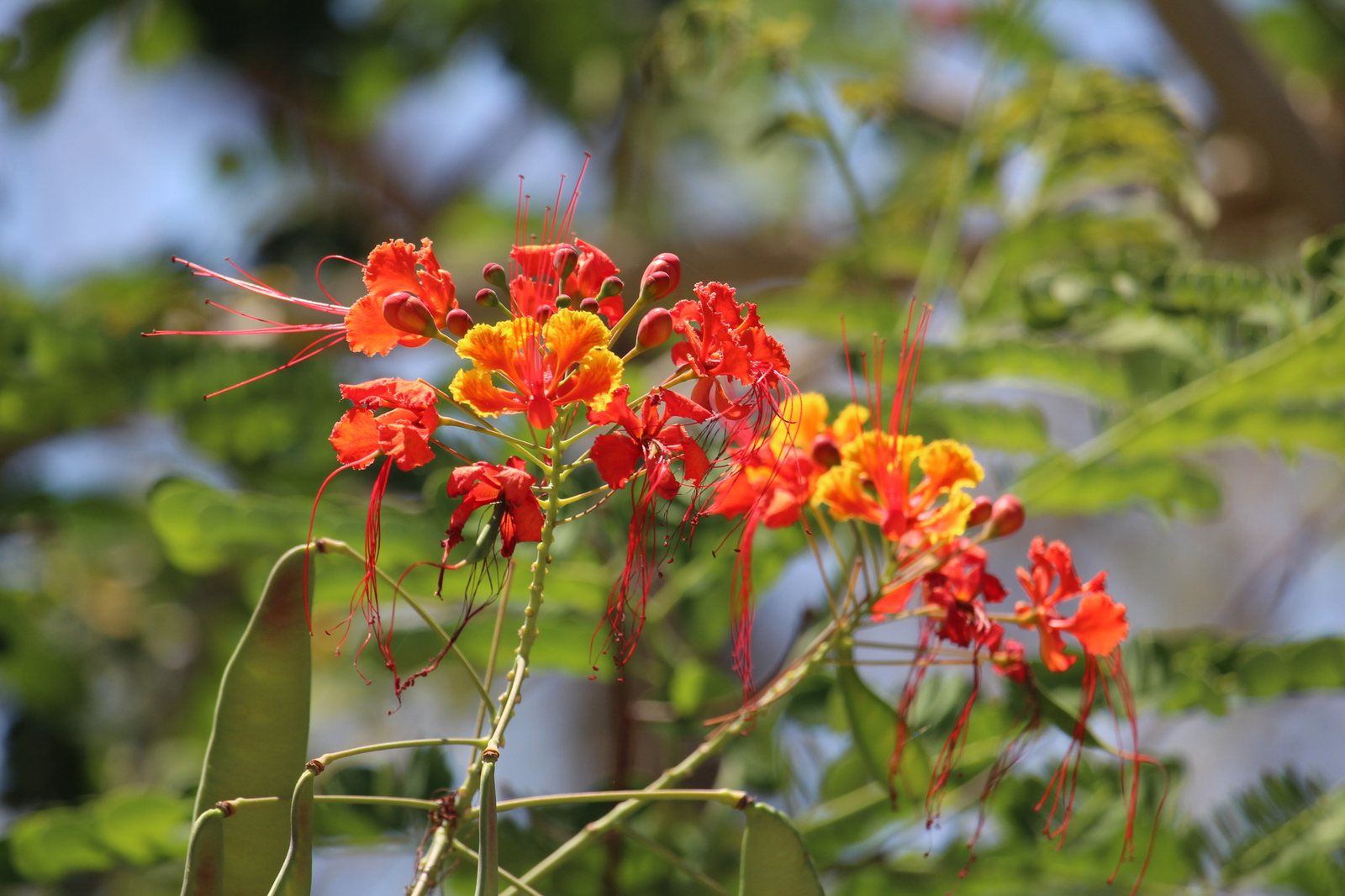
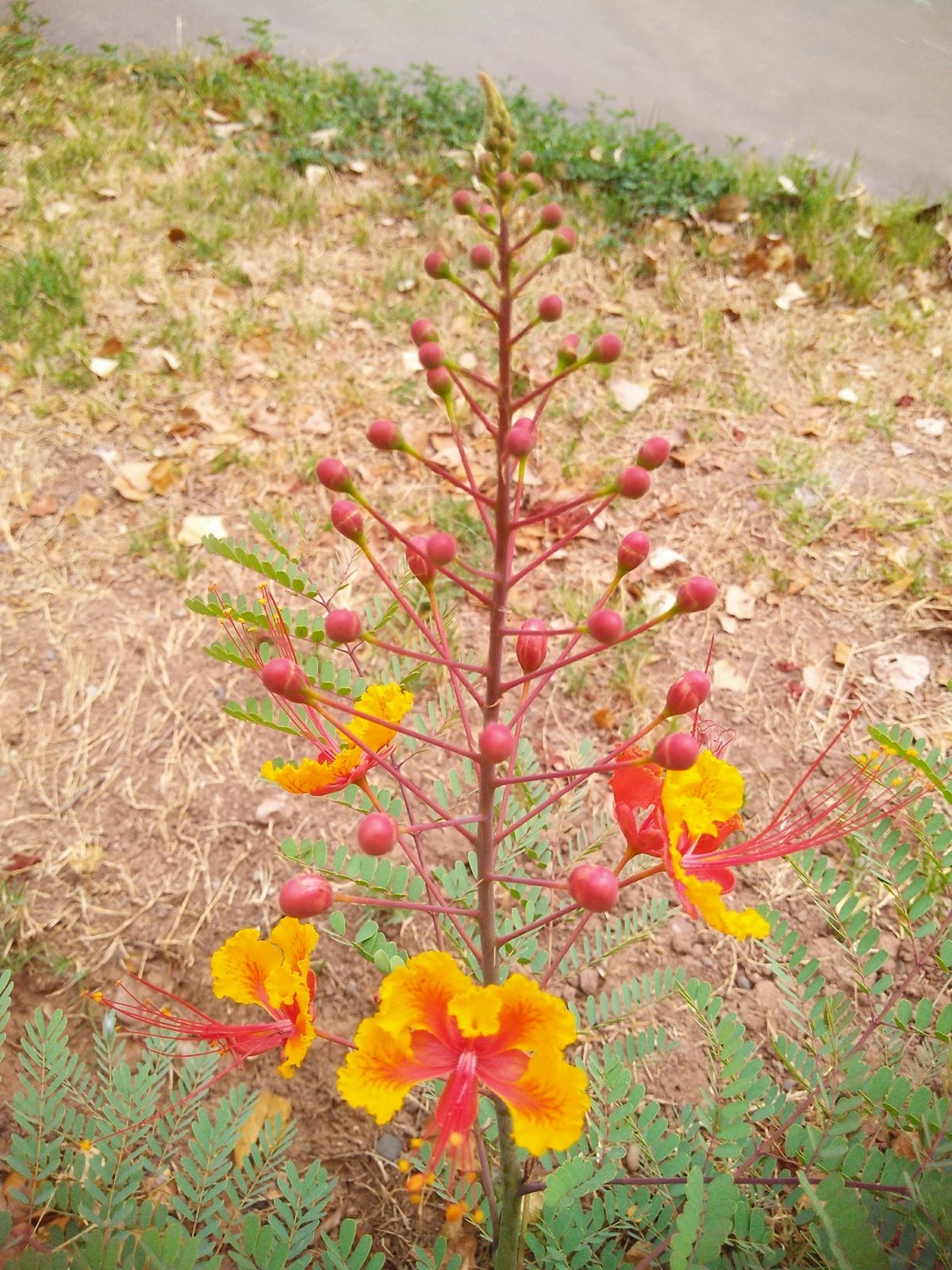
Pride of Barbados is a tropical shrub grown for fernlike foliage and clusters of orange-red flowers with yellow edges and long, projecting stamens. It thrives in hot, sunny gardens, remaining evergreen in frost-free climates but losing leaves or dying back in cooler weather. In most of the UK and Canada, grow it in a container that can spend winter indoors.
At a glance
- Sun
- Full sun; flowering is reduced in partial shade.
- Water
- Water regularly while establishing, then allow the soil to dry between deep waterings. Established plants tolerate drought, but flower better with occasional water during prolonged dry spells.
- Soil
- Well-drained sandy, loamy or gravelly soil; tolerates moderately poor soil but not persistent waterlogging.
- Height
- 6-10 ft (1.8-3 m)
- Spread
- 6-10 ft (1.8-3 m)
- Flowers
- Orange-red flowers with yellow edges from late spring into autumn; flowering may continue intermittently throughout the year in frost-free tropical climates. Yellow-flowered forms also occur.
- Foliage
- Fine-textured, twice-divided green leaves with many small leaflets; evergreen in tropical conditions, partly or fully deciduous with cold or drought.
- Growth
- Fast in warm weather.
- Care needed
- Medium
The year at a glance
- Pollinators
- Drought tolerant
- Heat tolerant
- Wildlife
- Low allergen
| J | F | M | A | M | J | J | A | S | O | N | D | |
|---|---|---|---|---|---|---|---|---|---|---|---|---|
| Flowers | ||||||||||||
| Fruit | ||||||||||||
| Plant |
Northern hemisphere months. In Australia, shift them by six.
- Difficulty
- Moderate
- Toughness
- Fairly tough
Will it suit your garden?
Pick your zone, country, light and whether you have pets.
Full sun is 6 or more hours of direct sun a day, part shade 3 to 6 hours, shade under 3.
How it grows
Planting day
1.6 ft (0.5 m)
After 1 year
4 ft (1.1 m)
After 2 years
5 ft (1.7 m)
After 3 years
7 ft (2.3 m)
After 5 years
8 ft (2.4 m)
full size
About 3 years to full size.
From a typical nursery size, at an average rate for this kind of plant. A rule of thumb, not a forecast.
Good to know
- Cats and dogs
- Toxic
- Invasive in
- Australia
- In the garden
- Spreads vigorously: plan to contain it.
- Growth rate
- Fast
Care
Jobs through the year
- WaterMay, Sep, every 14 days
- Water established ground plants only when dry; young plants and containers need more frequent watering.
- WaterJun–Aug, every 10 days
- Deep-water established ground plants during dry spells, allowing the upper soil to dry between waterings.
- WaterJan–Apr, Oct–Dec, every 21 days
- Water sheltered containers sparingly, only when compost has partly dried.
- MulchMay–Jun
- Mulch the root zone after planting, keeping stems clear.
- PruneApr–May
- Once growth reveals surviving wood, remove dead stems and shorten as needed; wear gloves against prickles.
- ProtectAug–Oct
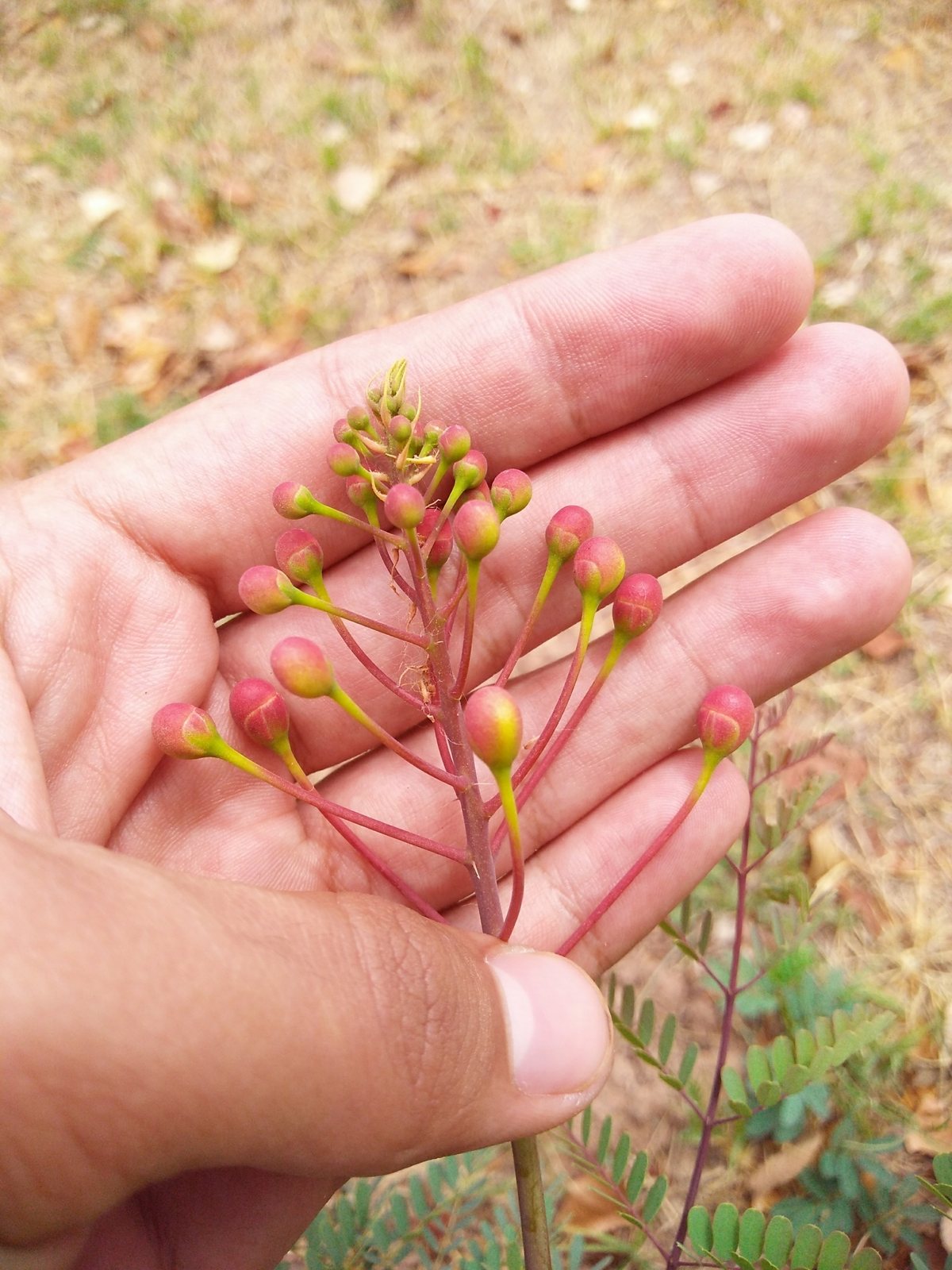
- Remove developing pods before maturity to prevent unwanted seedlings.
- ProtectSep–Oct
- In zones 6–7, move containers into bright frost-free shelter before the first frost.
- Plant after frost danger has passed, in a warm position with excellent drainage.
- Water deeply during establishment, then let the upper soil dry before watering again.
- Apply a light feeding of balanced fertiliser in spring if growth is weak; avoid heavy nitrogen feeding.
- Mulch the root zone, keeping mulch away from the stems.
- Move container plants into a bright, frost-free space before cold weather and reduce winter watering.
- Remove seed pods before they mature where seedlings could escape into nearby vegetation.
Pruning. In late winter or early spring, remove dead or frost-damaged wood once new growth shows which stems have survived, then shorten remaining stems as needed to maintain a bushy shape. Wear gloves and long sleeves because stems can bear prickles.
Through the year
- Late winter
- Check overwintered container plants for pests and keep watering sparingly.
- Spring
- Prune after frost danger passes and new growth begins; remove dead wood and lightly feed if needed.
- Late spring
- Plant outdoors or gradually acclimatise overwintered containers to full sun once nights are reliably warm.
- Summer
- Water during prolonged dry spells and check container soil frequently.
- Late summer
- Remove developing pods to limit self-seeding, or collect mature seed for propagation.
- Autumn
- Bring containers under frost-free cover before the first frost; reduce watering as growth slows.
In the garden
- Use as a flowering focal shrub in a sunny courtyard, set back from paths because of its prickly stems.
- Combine with agaves and ornamental grasses for contrasting textures in a warm-climate gravel garden.
- Place behind salvias and other heat-loving flowers in a red, orange and yellow border.
- Grow in a large container to bring tropical foliage and summer colour to a patio in cooler climates.
Garden styles it suits: Modern tropical, Tropical, Caribbean, Hot border, Southwestern and Pollinator garden.
Plant it with: Agave, Red yucca, Autumn sage, Society garlic, Bougainvillea and Lemongrass.
Wildlife: Flowers attract butterflies and other nectar-feeding insects, and hummingbirds where they occur. Avoid spraying open flowers.
Problems to watch for
- Root rot in wet soil: improve drainage, avoid low spots and let container compost dry partly between waterings.
- Spider mites, especially under glass: inspect leaf undersides, rinse foliage and use insecticidal soap labelled for the plant and pest if needed.
- Whiteflies on sheltered or indoor plants: inspect new growth and leaf undersides, isolate affected pots and treat with a labelled insecticidal soap.
- Poor flowering in shade or after excessive nitrogen feeding: move to full sun and reduce fertiliser.
Safety
Seeds and pods are poisonous if eaten and can cause vomiting, diarrhoea and abdominal pain in people and pets. Keep them away from children, cats and dogs; do not allow horses to browse the plant, as horse-specific toxicity information is limited. Seek medical or veterinary advice after ingestion. Prickly stems can also injure skin.
Where it spreads. Escapes cultivation in tropical climates and is regarded as an environmental weed in parts of Queensland and the Northern Territory, Australia. Remove pods before seed dispersal near bushland and check local planting guidance.
Easily confused with
Yellow bird of paradise (Caesalpinia gilliesii)
Has pale yellow flowers with exceptionally long red stamens, rather than the usual orange-red, yellow-edged flowers of Pride of Barbados.
Royal poinciana (Delonix regia)
Develops into a large, broad-canopied tree with much larger leaves, broad red flowers and long, heavy seed pods.
Mexican bird of paradise (Erythrostemon mexicanus)
Usually has clear yellow flowers and larger individual leaflets; its flower stamens are less conspicuously elongated.
The name
Caesalpinia honours the Italian botanist Andrea Cesalpino, while pulcherrima is Latin for 'most beautiful'.
Propagation. Grow from seed in warm conditions. Lightly nick the hard seed coat away from the seed's attachment scar, soak overnight, then sow in free-draining seed compost. Keep warm and lightly moist; seed-grown plants may differ in flower colour.
Checked against open data
- Accepted botanical name
- Caesalpinia pulcherrima
- In the US and Canada
- Introduced in the lower 48 states, Pacific Basin, Puerto Rico and US Virgin Islands.
- Native range
- Belize, Costa Rica, Guatemala, Mexico Southeast and Nicaragua.
- Measured
- Average height 475 cm.
Sources: GBIF (CC BY 4.0), USDA PLANTS and Trefle (CC BY 4.0). The care and design notes are LandscapeGPT's own.
See it in your own yard.
Upload a photo of your yard and see it redesigned with plants that suit your climate, each checked against your zone.